工业

Search documents
大鹏工业龙虎榜数据(12月18日)
Zheng Quan Shi Bao Wang· 2025-12-18 13:54
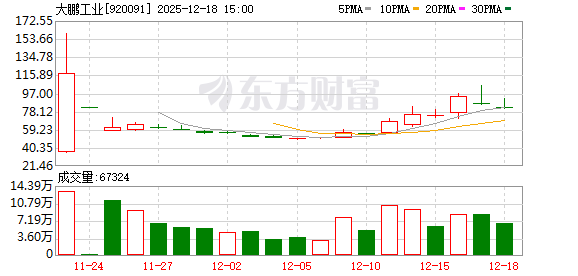
近半年该股累计上榜龙虎榜19次,上榜次日股价平均涨0.61%,上榜后5日平均涨10.16%。(数据宝) 大鹏工业12月18日交易公开信息 | 买/ | 会员营业部名称 | 买入金额(万 | 卖出金额(万 | | --- | --- | --- | --- | | 卖 | | 元) | 元) | | 买一 | 国金证券股份有限公司深圳分公司 | 2446.32 | 1781.39 | | 买二 | 国信证券股份有限公司深圳互联网分公司 | 2076.11 | 1135.46 | | 买三 | 中信建投证券股份有限公司上海营口路证券营业部 | 717.22 | 517.53 | | 买四 | 东方财富证券股份有限公司拉萨金融城南环路证券营业 部 | 700.54 | 433.27 | | 买五 | 机构专用 | 533.71 | 1539.24 | | 卖一 | 国金证券股份有限公司深圳分公司 | 2446.32 | 1781.39 | | 卖二 | 机构专用 | 533.71 | 1539.24 | | 卖三 | 国信证券股份有限公司深圳互联网分公司 | 2076.11 | 1135.46 | | 卖四 | 广 ...

爱仕达:12月18日召开董事会会议
Mei Ri Jing Ji Xin Wen· 2025-12-18 12:42
Group 1 - The company Aishida (SZ 002403) announced that its sixth board meeting will be held on December 18, 2025, to review the proposal for the 2026 comprehensive credit line [1] - For the first half of 2025, Aishida's revenue composition was 96.83% from industrial operations and 3.17% from other businesses [1] - As of the report date, Aishida's market capitalization is 4.2 billion yuan [1]

物产金轮:12月18日召开董事会会议
Mei Ri Jing Ji Xin Wen· 2025-12-18 11:22
每经AI快讯,物产金轮(SZ 002722,收盘价:14.88元)12月18日晚间发布公告称,公司第七届2025年 第六次董事会会议于2025年12月18日在公司会议室召开。会议审议了《关于募投项目延期的议案》等文 件。 (记者 曾健辉) 2025年1至6月份,物产金轮的营业收入构成为:工业占比100.0%。 截至发稿,物产金轮市值为33亿元。 每经头条(nbdtoutiao)——海南封关政策红利全解析:零关税、低个税、投资准入放宽、跨境资金自 由、创业扶持…… ...

三力士:首次回购约114万股
Mei Ri Jing Ji Xin Wen· 2025-12-18 10:20
Group 1 - The company Sanlisi (SZ 002224) announced on December 18 that it repurchased approximately 1.14 million shares through a special securities account, accounting for 0.126% of its total share capital of about 902 million shares, with a total transaction amount of approximately 4.91 million yuan [1] - The highest transaction price during the repurchase was 4.36 yuan per share, while the lowest was 4.27 yuan per share [1] - As of the report date, Sanlisi's market capitalization stands at 4 billion yuan [1] Group 2 - For the first half of 2025, Sanlisi's revenue composition is entirely from the industrial sector, with an industrial revenue share of 100% [1]

苏丹与土耳其探讨工业重建合作
Shang Wu Bu Wang Zhan· 2025-12-18 09:20
12月12日,苏丹通讯社报道,工业和贸易部长马哈欣会见土耳其驻苏丹大使法提赫。她表示,两国计划 近期在杰济拉州举办商业论坛。苏方希望利用土耳其强大的工业实力,帮助苏工业重建,实现"出口导 向型工业"目标。 ...
南非顶尖基金经理预判:本土非资源股被严重低估 2026年至少要涨35%
Zhi Tong Cai Jing· 2025-12-18 07:00
Core Viewpoint - South African non-commodity stocks are currently undervalued, presenting a potential rebound opportunity in 2025 as they lag behind local bonds and overall stock indices [1] Group 1: Market Performance - The South African benchmark stock index has increased over 50% in USD terms this year, driven by soaring precious metal prices, outperforming European, emerging markets, and US indices [1] - Local government bonds, measured by the ALBI index, have returned 38%, with the yield on ten-year rand bonds dropping by a quarter from its April peak to 8.36% [1] Group 2: Investment Opportunities - John Bickard, manager of Ninety One's Value Fund, highlights that local banks, retail, and industrial stocks are significantly lagging, creating investment opportunities [6] - The Value Fund has achieved an average annual return of nearly 17% over the past decade, ranking as the fifth-best fund in South Africa, excluding commodity funds [6] Group 3: Economic Indicators - Signs of improvement in South Africa's economy include a reduction in load-shedding, stabilization of state port and rail operations, and an upgrade in credit outlook by S&P Global Ratings [5][7] - The rand has appreciated by 13% against the USD this year, alongside a slowdown in inflation, supporting a positive economic trajectory [7] Group 4: Fund Strategy - The Value Fund has increased its allocation to local stocks to 50%, significantly above the benchmark index's allocation of approximately 35% [9] - The fund's portfolio includes about 50% in mid-cap companies with a dividend yield close to 6%, and around 20% in large local companies like Bidvest Group Ltd. and Woolworths Holdings Ltd., which have dividend yields of about 4% [9] Group 5: Future Projections - Bickard anticipates that as investors recognize the improving economic growth and declining discount rates, local stocks could see price increases of 35% to 40%, with potential upside of up to 50% [11] - Investing in South African stocks is viewed as a cheaper indirect way to gain exposure to gold and platinum assets, with limited downside risk and considerable upside potential [11]

南向资金持股偏好:聚焦医疗保健、工业与金融,AH股占比过半
Jin Rong Jie· 2025-12-18 02:21
Group 1 - As of December 17, the total shareholding of southbound funds in Hong Kong Stock Connect stocks accounts for 19.33% of the total share capital, with a total market value of HKD 60,627.61 billion [1] - There are 247 stocks where the shareholding ratio of southbound funds exceeds 20% [1] Group 2 - China Telecom has the highest shareholding ratio at 72.27%, followed by Gree Power and China Gas with 70.08% and 69.75% respectively [3] - The stocks with high southbound fund holdings are primarily concentrated in the healthcare, industrial, and financial sectors, with 56, 36, and 34 stocks respectively [3] - Over half of the stocks with high southbound fund holdings are AH concept stocks, with 128 out of the 247 stocks also listed in mainland China and Hong Kong, representing 51.82% [3]



247只港股获南向资金大比例持有
Sou Hu Cai Jing· 2025-12-18 01:44
Core Insights - The overall shareholding ratio of southbound funds in Hong Kong Stock Connect stocks is 19.33%, with 247 stocks having a shareholding ratio exceeding 20% [1] - Southbound funds hold a total of 4,915.49 million shares, accounting for 19.33% of the total share capital of the stocks, with a market value of 60,627.61 billion HKD, representing 14.57% of the total market value [1] Group 1: Shareholding Distribution - 247 stocks have a shareholding ratio of over 20%, 130 stocks between 10% and 20%, 94 stocks between 5% and 10%, 84 stocks between 1% and 5%, and 26 stocks below 1% [1] - The stock with the highest shareholding ratio by southbound funds is China Telecom, holding 1,003.09 million shares, which is 72.27% of the issued shares [2] - Other notable stocks with high shareholding ratios include Green Power Environmental (70.08%) and China Resources Power (69.75%) [2] Group 2: Industry Concentration - Southbound funds with a shareholding ratio exceeding 20% are primarily concentrated in the healthcare, industrial, and financial sectors, with 56, 36, and 34 stocks respectively [2] - The healthcare sector shows significant representation among high-shareholding stocks, with several companies like WuXi AppTec (57.49%) and Fosun Pharma (57.43%) [3] - The industrial sector also features prominently, with companies such as China Shenhua (66.44%) and COSCO Shipping Energy (63.69%) [2][3]
科技方向再次走强,成长ETF(159259)标的指数涨超5%
Sou Hu Cai Jing· 2025-12-17 11:28
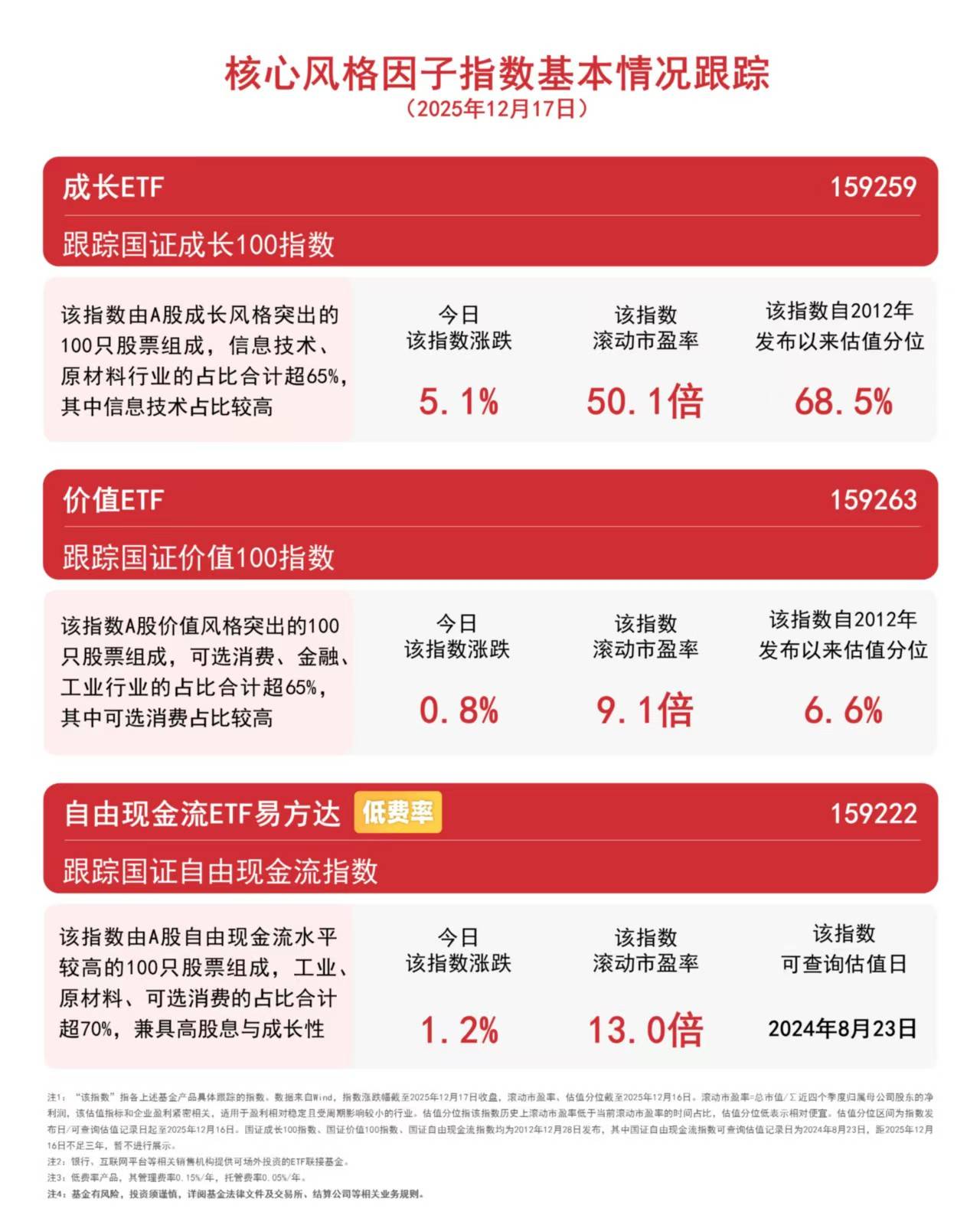
Core Viewpoint - The market showed strong performance in the afternoon, particularly in the technology sector, with the Guozheng Growth 100 Index rising by 5.1%, indicating a robust interest in growth-style investments [1]. Group 1: Market Performance - The Guozheng Growth 100 Index increased by 5.1%, while the Guozheng Free Cash Flow Index rose by 1.2%, and the Guozheng Value 100 Index went up by 0.8% [1]. - The trading volume for the Growth ETF (159259) reached approximately 130 million yuan, significantly higher than previous days, reflecting active market participation [1]. Group 2: Index Composition - The Guozheng Growth 100 Index focuses on A-share stocks with a strong growth style, with over 70% of its weight concentrated in the electronics, communications, and computer sectors, aligning with the core areas of AI computing power [1]. - The Growth ETF (159259) is the only product tracking this index, providing investors with opportunities to capitalize on growth-style investments [1]. Group 3: Sector Analysis - The Guozheng Growth 100 Index consists of 100 stocks, with the information technology and materials sectors accounting for over 65% of the index, highlighting a significant emphasis on technology [3]. - The Guozheng Value 100 Index, which tracks 100 value-style stocks, has over 65% of its weight in consumer discretionary, financial, and industrial sectors, with consumer discretionary having a high proportion [3]. - The Guozheng Free Cash Flow Index includes 100 stocks with high free cash flow levels, with industrial, materials, and consumer discretionary sectors making up over 70%, combining high dividends and growth potential [3].
巴西政府批准新版国家气候计划
中国能源报· 2025-12-17 11:04
Core Viewpoint - The Brazilian government has approved a new national climate plan to implement the goals of the Paris Agreement and promote a low-carbon transition, providing a clear roadmap for action [1]. Group 1: Emission Reduction Targets - The new plan sets specific emission reduction targets across eight sectors, aiming to reduce greenhouse gas emissions from 2.04 billion tons of CO2 equivalent in 2022 to 1.2 billion tons by 2030, and further down to between 850 million and 1.05 billion tons by 2035 [2]. - The overall goal is to achieve net-zero emissions by 2050, while also emphasizing the need to enhance resilience to climate change [2]. Group 2: Adaptation and Action Plans - The plan includes 16 sectors and thematic action plans for adapting to climate change, covering areas such as public health, tourism, energy, transportation, disaster risk reduction, water resources, food security, and biodiversity, with over 800 specific actions proposed [2]. - The Brazilian government will continuously improve the national climate plan through biennial assessments and systematic revisions every four years to ensure alignment with climate science advancements and international commitments [2].