
软件服务

Search documents
广发策略:从不买就跑输到买了就跑输——再看南下定价权
智通财经网· 2026-01-25 23:38
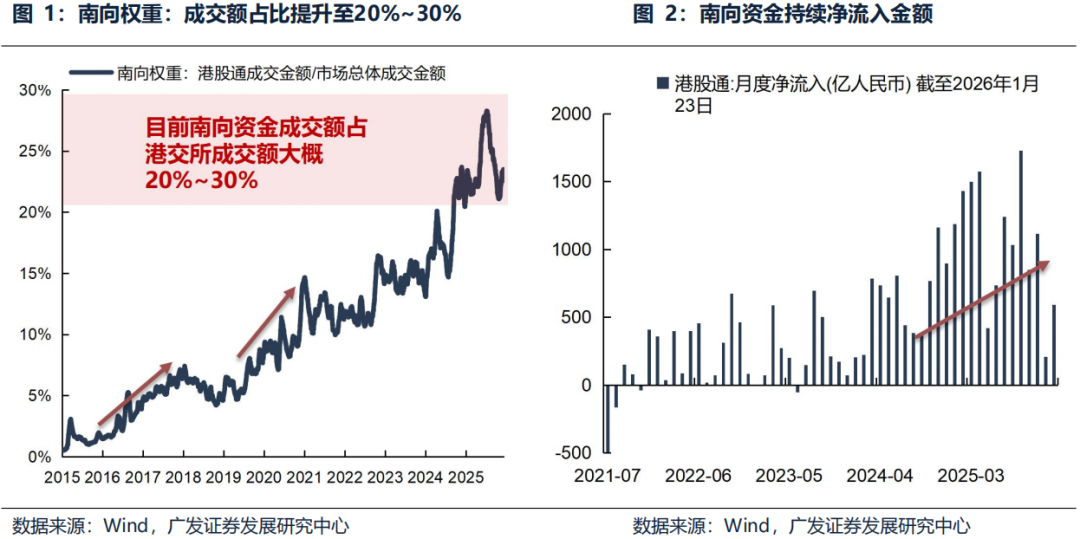
Group 1 - Since September 2024, the proportion of southbound capital transactions has rapidly increased to 20%-30%, nearly doubling compared to before 2024 [2][5] - In 2025, both active and passive foreign capital have become synchronous indicators of the Hong Kong stock market, showing no leading characteristics [2][5] - During sharp declines or corrections in the Hong Kong stock market, southbound capital tends to buy against the trend [2][5] Group 2 - Each round of pricing power competition typically begins with the optimization of the Stock Connect policy or the influx of incremental capital, which usually flows into dividend and scarce assets [5] - Net outflows of southbound capital often occur in response to adverse industry policies or external macroeconomic environments, particularly in sectors where foreign capital pricing power is increasing, such as software services, hardware equipment, consumer services, and discretionary retail [5][12] - Industries less likely to experience significant net outflows include those favored by long-term capital, such as banking, telecommunications, and public utilities, unless there are clear adverse policies affecting the sector [5][12] Group 3 - The proportion of medium to long-term capital in the current round of southbound capital inflow into Hong Kong stocks has increased, with insurance capital making 41 stakes, 35 of which are in H-shares, marking the highest record in the past decade [8] - Key industries for increased holdings include discretionary retail, finance (banking, insurance), innovative pharmaceuticals, software services, and hardware equipment [8] Group 4 - Current industries with pricing power for southbound capital and Chinese capital include semiconductors and dividend stocks, while industries lacking pricing power include internet, hardware equipment, software services, home appliances, and media [11][12] - Active management public funds have low pricing power in the Hong Kong stock market, focusing heavily on AI-related CSP giants, electronics, and innovative pharmaceuticals [16]

港股市场策略展望:从不买就跑输到买了就跑输:再看南下定价权?
GF SECURITIES· 2026-01-25 09:19
Group 1 - Since September 2024, the proportion of southbound capital in transaction volume has rapidly increased to 20%-30%, nearly doubling compared to before 2024, indicating a significant shift in market dynamics [3][8] - Historical reviews of two rounds of competition for pricing power in the Hong Kong stock market occurred in 2016-2017 and 2020-2021, typically initiated by policy optimizations and inflows of incremental capital [15][28] - The current southbound capital inflow is characterized by a higher proportion of medium to long-term funds, with insurance capital making 41 stakes in 2025, 35 of which were in H-shares, marking a record high in the past decade [3][31] Group 2 - The industries where southbound capital and Chinese capital have pricing power include semiconductors and dividend-paying sectors, while industries lacking pricing power include internet, hardware, software services, home appliances, and media [3][36] - The top five industries by southbound capital holdings include coal (41.8%), semiconductors (32.7%), environmental protection (24.5%), oil and petrochemicals (24.1%), and pharmaceutical biology (20.5%) [37] - The active management public funds have a low preference for Hong Kong stocks, with significant holdings concentrated in AI-related CSP giants, electronics, and innovative pharmaceuticals [46] Group 3 - The current sentiment in the Hong Kong stock market has fully reflected negative factors such as US-China trade friction and the high unlock peak at the end of last year, suggesting potential upward investment opportunities if liquidity pressure eases [53][54] - The spring rally in the Hong Kong stock market has a high probability of success, with southbound capital and foreign capital expected to net inflow at the beginning of the year, driven by the demand for core Chinese assets [53][54] - The pricing power of southbound capital is rapidly increasing, with expectations of a potential upward beta in the Hong Kong stock market at the beginning of the year [3][53]
暂停降息?!美联储,重磅来袭!
Sou Hu Cai Jing· 2026-01-25 07:48
Group 1: Federal Reserve Meeting - The Federal Reserve is expected to pause interest rate cuts during its upcoming meeting on January 27-28, with a 95.6% probability of maintaining rates unchanged [1][2] - Economists predict the Fed will keep the benchmark rate in the range of 3.50%-3.75%, with 58% forecasting no rate changes in the first quarter [2][3] - Political factors and internal disagreements within the Fed may influence future rate decisions, with potential challenges in selecting the next chairperson [3] Group 2: Earnings Reports - Approximately one-fifth of S&P 500 companies will report earnings next week, including major tech firms like Apple, Microsoft, Meta, and Tesla [4][5] - The key theme for this earnings season is whether tech giants will start benefiting from AI-related investments, with concerns about capital expenditures in data centers and infrastructure [5] - Goldman Sachs forecasts Apple's Q1 FY2026 revenue to reach $137.4 billion, driven primarily by iPhone sales, with an expected EPS of $2.66 [5][6] Group 3: Tesla's Focus - Investors are shifting their focus from traditional financial metrics to advancements in Tesla's AI technologies, including Robotaxi and AI5 chip developments [5][6] - Morgan Stanley predicts Tesla's 2026 delivery volume will be 1.6 million units, which is 9% lower than market expectations and a 2.5% year-over-year decline [5]




苹果进入双寡头时代
虎嗅APP· 2026-01-24 09:43
Core Viewpoint - The article discusses the transition of leadership at Apple as Tim Cook approaches retirement, highlighting the potential successors John Ternus and Craig Federighi, marking the end of the post-Jobs era and the beginning of a new "duopoly" leadership structure at Apple [4][24]. Group 1: Leadership Transition - Tim Cook, aged 65, is facing questions about succession as Apple undergoes significant management restructuring following the departures and retirements of several executives [4]. - John Ternus and Craig Federighi are identified as key figures in Cook's succession plan, with Ternus being positioned as a potential CEO due to his youth and extensive experience in hardware engineering [12][25]. Group 2: Design Department Changes - The design department at Apple has undergone significant changes since the departure of former Chief Design Officer Jony Ive in 2019, leading to a fragmented structure with responsibilities split between Evans Hankey and Alan Dye [6][9]. - Ternus was appointed as the "Executive Sponsor" for design, allowing him to bridge the gap between designers and executives, although he does not directly oversee design [10][11]. Group 3: Federighi's Role in AI - Craig Federighi, now overseeing Apple's AI department, has shifted from being an AI skeptic to actively integrating AI technologies into Apple's products, particularly following the emergence of ChatGPT [17][19]. - Under Federighi's leadership, Apple has faced challenges in AI development, leading to the decision to collaborate with Google for AI capabilities, indicating a pragmatic approach to technology integration [20][26]. Group 4: Philosophical Differences in Management - Ternus represents a shift towards a product-driven, engineering-first approach at Apple, moving away from the design-centric philosophy of the past [13][26]. - Federighi's management style emphasizes cost control and practicality, which may lead to a more stable financial performance for Apple, albeit with less revolutionary innovation [22][26]. Group 5: Future Outlook - The combination of Ternus and Federighi as co-leaders may signify a new era for Apple, focusing on operational efficiency and practical product development rather than groundbreaking design [26][27]. - The transition is seen as a response to the evolving tech landscape, with Apple aiming to maintain relevance without overextending financially [22][26].

博思软件:公司业务与人工智能深度结合
Zheng Quan Ri Bao Wang· 2026-01-24 03:48
Core Viewpoint - The company, Bosi Software, is integrating artificial intelligence deeply into its business operations across various sectors, including healthcare, finance, procurement, and intelligent tax management, with a focus on driving digital transformation in these industries [1] Group 1: Business Integration - Bosi Software has successfully implemented AI solutions in multiple business lines and scenarios, particularly in healthcare, where its financial platform connects hospital financial systems and intelligently analyzes non-structured documents [1] - The company has established nearly 200 application cases in leading hospitals, such as Sichuan University West China Hospital and Shanghai Ruijin Hospital, across more than 20 regions [1] Group 2: AI Solutions Development - The company is advancing its "AI + Finance" digital solutions through the development of various intelligent applications, including smart regulatory Q&A, intelligent document processing, and electronic voucher recognition [1] - Future plans include accelerating AI research and application, focusing on a strategy that combines industry-specific large models with intelligent agents to create a closed loop of data, models, and scenarios [1]

印度或罚苹果380亿美元
Guan Cha Zhe Wang· 2026-01-23 09:37
Core Viewpoint - India's antitrust agency has issued an ultimatum to Apple, threatening to proceed with an investigation that could result in fines up to $38 billion if the company continues to delay its response [1][2]. Group 1: Antitrust Investigation - The case against Apple dates back to 2022 when Match Group and several Indian startups accused the company of abusing its dominant market position by imposing unfair commissions on app developers, known as the "Apple tax" [1]. - The Indian Competition Commission (CCI) has preliminarily found that Apple has abused its market dominance, affecting developers' returns and growth [1]. - In 2024, India revised its antitrust laws to increase penalties for violations, allowing fines to be based on a company's global revenue, with a cap of 10% of the average global turnover over the past three years [1]. Group 2: Legal Proceedings - Following the CCI's findings, Apple filed a lawsuit in the Delhi High Court, claiming that the penalty regulations are unconstitutional and disproportionate [2]. - The CCI has pressured Apple to submit objections to the investigation results and provide global financial data for penalty assessment, but Apple has repeatedly requested extensions [2]. - The CCI issued a final ultimatum to Apple, stating that if no response is received within a week, it will unilaterally advance the case [2]. Group 3: Global Context - The legal challenges Apple faces in India are part of a broader trend, as regulatory bodies in regions like the EU and the US have also taken action against the "Apple tax" [3]. - In 2020, the EU initiated an antitrust investigation against Apple, resulting in a €1.84 billion fine in 2024 and new regulations requiring Apple to allow software downloads from outside its app store [3]. - In the US, Epic Games has successfully pushed for a court ruling requiring Apple to allow external payment links, leading to changes in Apple's App Store guidelines [4]. Group 4: Compliance Measures - In response to regulatory pressures, Apple has relaxed its App Store policies in Japan, reducing the commission rates for the "Apple tax" to between 10% and 21% [5].

中移软件取得负载均衡方法专利提升应用隔离性
Sou Hu Cai Jing· 2026-01-23 02:40
Company Overview - China Mobile Communication Group Co., Ltd. was established in 1999 and is based in Beijing, primarily engaged in telecommunications, broadcasting, and satellite transmission services. The company has a registered capital of 30 billion RMB [1] - China Mobile (Suzhou) Software Technology Co., Ltd. was founded in 2014 and is located in Suzhou, focusing on software and information technology services. The company has a registered capital of 3.172 billion RMB [1] Patent Acquisition - China Mobile (Suzhou) Software Technology Co., Ltd. and China Mobile Communication Group Co., Ltd. have obtained a patent titled "A Load Balancing Method, Device, Equipment, and Computer Readable Storage Medium," with the authorization announcement number CN116781625B, applied for on September 2022 [1] Business Activities - China Mobile (Suzhou) Software Technology Co., Ltd. has participated in 5,000 bidding projects and holds 2,682 patents, along with 112 trademark registrations and 28 administrative licenses [1] - China Mobile Communication Group Co., Ltd. has also participated in 5,000 bidding projects, holds 5,000 patents, has 2,218 trademark registrations, and possesses 50 administrative licenses [1]

兴业证券分析师微信群不当言论引争议
Xin Lang Cai Jing· 2026-01-23 02:29
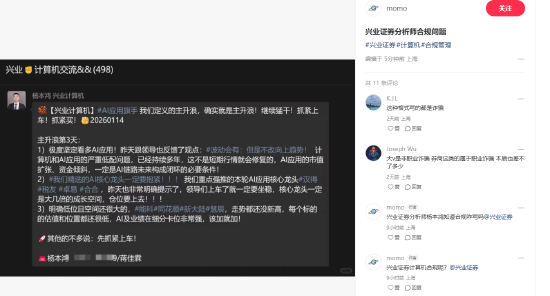
Group 1 - Analysts from Industrial Securities' computer division actively promoted AI stocks in a WeChat group, urging members to invest heavily in selected core AI leaders, including HanDe, ShuiYou, ZhuoYi, and HeHe, claiming significant growth potential [1][2] - The analysts emphasized that the current market conditions present low valuations and strong performance potential for stocks like NengKe, TongHuaShun, XinDaLu, and HuiChen, suggesting that these stocks are still below their recent highs and should be added to portfolios [1][2] - The comments from analysts have sparked controversy, with some netizens criticizing the approach as overly promotional and lacking substance, suggesting that such behavior from TMT sell-side analysts should be scrutinized [1][2]

捡剩饭、傍大款,甲骨文拿命搏生存?
3 6 Ke· 2026-01-23 01:51
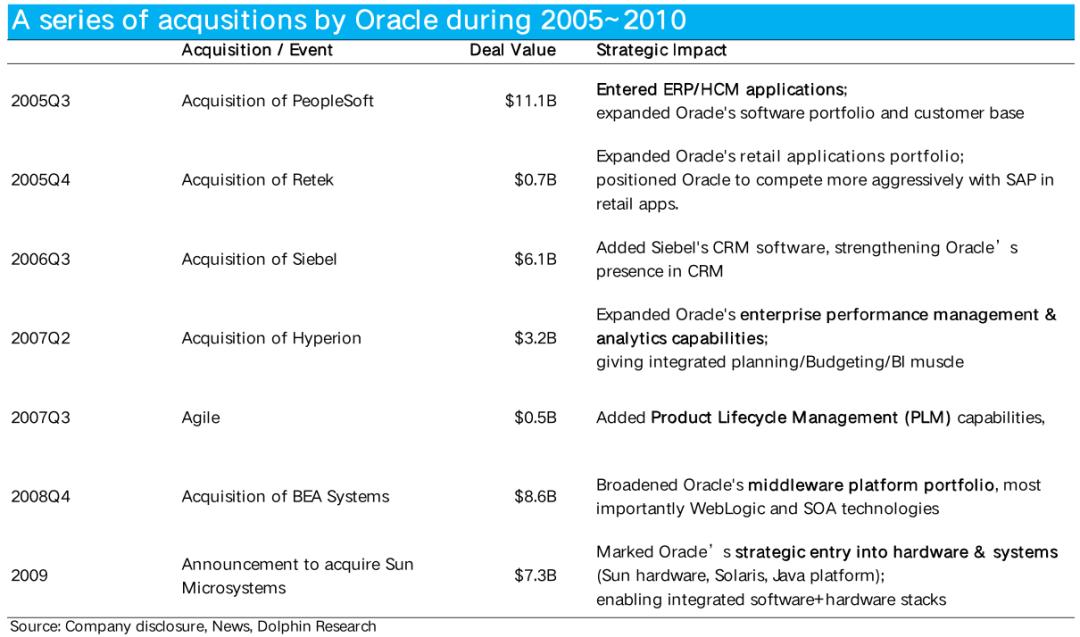
Company History - Oracle has evolved from a traditional database management company established over 50 years ago to a significant player in the cloud services industry, particularly in AI cloud services [1][5]. - The company initially focused on relational database management systems and gradually diversified into enterprise management software, including ERP, CRM, and HCM solutions through both internal development and strategic acquisitions [2][4]. - After acquiring Sun Microsystems, Oracle expanded into hardware and operating systems, integrating its software and hardware offerings into comprehensive solutions [3][5]. Business Structure and Revenue Composition - Oracle's business segments are now classified into four main categories: Cloud, Software, Hardware, and Services, with the cloud segment being the most critical for revenue growth [10][11]. - The cloud business is further divided into IaaS (Oracle Cloud Infrastructure - OCI) and SaaS (Oracle Cloud Applications - OCA), with OCI rapidly gaining importance and surpassing OCA in revenue contribution [12][13]. - Traditional software and hardware segments have seen stagnant or declining growth, with software revenue dropping from over 60% to less than 40% of total revenue [14][15]. Key Trigger Point - $300 Billion Order - Oracle announced a staggering $300 billion in new demand contracts, equivalent to 5.8 times its total revenue for the fiscal year 2025, indicating a significant growth trajectory [25][26]. - The revenue guidance for fiscal years 2026 to 2030 suggests a compound annual growth rate of 31%, with OCI expected to grow from approximately $10 billion in 2025 to $166 billion by 2030 [25][26]. - The majority of this new order is believed to come from OpenAI, with a substantial annual contract value of around $60 billion starting from fiscal year 2027 [31][32]. Partnership with OpenAI - Oracle has replaced Microsoft as OpenAI's primary cloud service partner, which has led to significant revenue opportunities but also comes with risks associated with customer concentration [34][36]. - The partnership allows Oracle to leverage OpenAI's technology while providing substantial cloud computing resources, although it raises concerns about the quality and sustainability of the business [36][39]. - Oracle's reliance on a single client for a large portion of its revenue could pose risks, similar to those faced by other cloud service providers with concentrated customer bases [37][39]. Summary of Opportunities and Risks - Oracle's future growth heavily depends on the success of its OCI business, which is critical for the company's survival as traditional business segments decline [45]. - The company faces challenges related to high capital expenditures and debt levels, which could strain its financial health if not managed properly [39][40]. - While the partnership with OpenAI presents significant revenue potential, it also carries risks of over-reliance on a single client and the possibility of unfulfilled contracts [46].

A股公司退市将呈现多元化、精准化、快节奏
Zheng Quan Ri Bao· 2026-01-22 16:36
Group 1 - The core viewpoint of the articles highlights the increasing trend of delistings in the A-share market, with *ST Aowei potentially becoming the first company this year to meet the market cap delisting criteria due to its continuous low market value [1][2] - The A-share market is undergoing a transformation from speculative trading to a focus on value, as evidenced by the market's response to companies with poor fundamentals, leading to a more efficient pricing mechanism [2][3] - Major illegal delistings have become a prominent type of delisting this year, with companies like Dongfang Tong and Guangdao Digital Technology being forced to delist due to significant violations [3][4] Group 2 - The trend of voluntary delistings is increasing, with companies like Debon Logistics opting for this route to better align with industry developments and avoid competition [4][5] - Financial delistings are also on the rise, with companies like Shanghai Guijiu and Wanfang Town Investment warning of potential financial delisting due to expected low revenues and negative profits [5][6] - The delisting landscape is expected to remain diverse, with a focus on expediting the removal of low-quality companies and enhancing the transparency and rigidity of the delisting mechanisms [5][6]


