
乙烯

Search documents
券商晨会精华 | 建材行业将进一步深化产业改革 在四个方向进一步突破
智通财经网· 2025-09-17 00:54
Group 1: Market Overview - The market experienced fluctuations, with the ChiNext index initially dropping over 1% but recovering in the afternoon, leading to a positive close. The Shanghai Composite Index rose by 0.04%, the Shenzhen Component increased by 0.45%, and the ChiNext index gained 0.68% [1] - The total trading volume in the Shanghai and Shenzhen markets reached 2.34 trillion yuan, an increase of 64 billion yuan compared to the previous trading day [1] - Strong performances were noted in sectors such as robotics, internet e-commerce, and logistics, while sectors like pork, non-ferrous metals, and film and television saw declines [1] Group 2: Industry Insights - CITIC Securities indicated that the price of waterproof products in China is stabilizing under the "anti-involution" trend, with a positive outlook for the waterproof sector due to its correlation with construction activity and increased industry concentration [1] - China International Capital Corporation (CICC) projected that the ethylene industry may reach a turning point after 2027, driven by the exit of overseas capacities and potential domestic policy controls on new ethylene production [2] - Galaxy Securities highlighted that the building materials industry will deepen its reforms, focusing on structural optimization, green transformation, digital upgrades, and international expansion, with cement industry capacity reduction expected to accelerate [3] - The demand for high-end fiberglass products is anticipated to grow due to the rapid development of emerging industries, benefiting companies with R&D capabilities and production scale [3] - Leading consumer building materials companies are leveraging both domestic and international markets to enhance profitability and expand overseas production capacity, which is expected to contribute significantly to future performance growth [3]
九月补涨行情:九大核心赛道(附名单)
Sou Hu Cai Jing· 2025-09-03 01:30
Group 1: Macro Economic Environment - The A-share market is showing a fluctuating upward trend driven by policy support and capital inflow as the global macroeconomic environment stabilizes [1] Group 2: Petrochemical Industry - The petrochemical industry is expected to see strong profit recovery due to the ongoing "anti-involution" policies, which include capacity elimination, technological upgrades, and collaborative innovation across the industry chain [3] - In August, the China Chemical Product Price Index (CCPI) decreased by 7.48% month-on-month, but the elimination of inefficient capacity is accelerating, leading to significant improvements in supply-demand structures in refining, ethylene, and fluorochemical sectors [3] Group 3: Related Companies in Petrochemical - Key companies in the petrochemical sector include Lingpai Technology, Xiangtan Electric, Putailai, Lushan New Materials, Xiamen Tungsten New Energy, New Agricultural Shares, Jinniu Chemical, Taihe Technology, China Baoan, Xiangfenghua, Tianci Materials, and Dinglong Technology [4] Group 4: Banking Sector - Large commercial banks are enhancing their intermediate income through wealth management in a low-interest-rate environment, while regional banks are flexibly adjusting asset structures based on local advantages [5] - In the first half of 2025, the total profit of the banking industry is expected to grow by 57.9% year-on-year, with an ongoing trend of asset expansion [5] Group 5: Insurance Market - The Hong Kong insurance market's premium income increased by 6.2% year-on-year, driven by strong demand for long-term savings and health insurance products [5] - Domestic insurance companies are expanding service boundaries through models like "insurance + health management" and "insurance + green energy," maintaining a stable dividend realization rate above 100% [5] Group 6: Related Companies in Insurance - Key players in the insurance sector include China Pacific Insurance, Ping An Insurance, China Life Insurance, China People’s Insurance, COFCO Capital, and New China Life Insurance [6] Group 7: Securities Industry - The concentration of leading securities firms is increasing, with new public fund regulations promoting a return to long-term investment strategies and heightened activity in mergers and acquisitions [7] - The industry is expected to see a 9% year-on-year increase in net profit by 2025, with a high probability of the securities index breaking upward [8] Group 8: Tourism and Hospitality Sector - The tourism consumption data from Sichuan shows impressive results, with visitor spending exceeding 912.5 billion yuan, indicating a release of consumption potential through the "tourism + various industries" model [9] - Online booking via mobile devices accounts for over 70%, with young users aged 20-30 becoming the main consumer force [9] Group 9: Renewable Energy Sector - The global energy transition is driving continuous growth in installed capacity for photovoltaics and wind power, with urgent demand for energy storage solutions [11] - The expansion of the green electricity trading market is supported by breakthroughs in ultra-high voltage transmission technology [11] Group 10: Related Companies in Renewable Energy - Key companies in the renewable energy sector include Yangtze Power, Luxin Technology, Jidian Co., Jingyun Tong, Shanghai Electric, Zhaoxin Shares, Huaguang Huaneng, Meiyan Jixiang, and Guotou Power [11] Group 11: Consumer Goods and High-End Products - The government is increasing support for sectors like food and beverage, home appliances, and pharmaceuticals, with a rising penetration of high-end and differentiated products [12] - Leading brands like Moutai and Wuliangye have strong pricing power, while smart home appliance companies like Ecovacs benefit from consumption upgrades [12] Group 12: Infrastructure Development - The "14th Five-Year Plan" emphasizes continued investment in traditional infrastructure such as transportation, energy, and water conservancy, alongside an increased focus on new infrastructure like 5G base stations and data centers [12] - Companies involved in engineering contracting and design consulting are expected to benefit from policies supporting regional development initiatives [12]


全球炼化及烯烃行业格局展望
2025-08-25 14:36
Summary of Key Points from Conference Call Records Industry Overview - The global refining and olefins industry is expected to see a decline in refining margins after reaching a peak around 2030, influenced by geopolitical factors, carbon taxes, and the transition to renewable energy. Approximately 1.5 million tons per day of refining capacity has been announced for closure or conversion, with China accounting for 50% of this capacity [1][5][34]. - By 2035, about 22% of global refining capacity (18.4 million barrels per day) is at risk of closure, primarily concentrated in Europe and the Middle East. National Oil Companies (NOCs) are less inclined to close facilities due to government support, while International Oil Companies (IOCs) are more likely to close or sell unprofitable refineries [1][7][8]. Olefins Market Dynamics - Since 2020, global ethylene investment has been predominantly led by China, with private companies like Longsheng and Hengli entering the market significantly. From 2025 to 2028, major state-owned companies like PetroChina and Sinopec are expected to lead investments, shifting focus towards increasing petrochemical production [1][11][12]. - Approximately 40%-50% of global ethylene assets are currently at a loss or breakeven, indicating that the industry is at a cyclical low. China has seen a surge in new refining projects since 2017, leading to global oversupply, while Europe faces significant pressure due to high energy prices and carbon tax issues [1][14][15]. Regional Insights - In the U.S., a refinery in the PAD3 region with a capacity of 290,000 barrels per day has announced closure and will transition to hydrogen production by 2025. Other refineries are also shifting towards renewable fuel production [6][25]. - In Europe, the refining landscape is undergoing structural adjustments, with several companies announcing closures or asset sales to adapt to economic and environmental challenges. By 2028, European ethylene capacity is expected to decrease by 12% compared to 2024 [23][24]. Future Projections - The global refining industry is projected to peak in demand for crude oil and chemical products around 2030 or 2031, after which refining profits and utilization rates will gradually decline. This trend is expected to lead to more local refineries exiting the market, particularly in China and Europe [34][36]. - The ethylene market's future will largely depend on investment levels and the rate of capacity elimination. While the pace of new projects may slow, it does not imply cancellations, especially for large enterprises. Economic recovery in China is expected to significantly impact demand for petrochemical products [36][28]. Risk Assessment - Approximately 63 million tons of global ethylene capacity is at risk of closure, representing 27% of the total capacity by 2025. High and medium-risk capacities are primarily concentrated in Asia and Europe, with North America and Russia having lower closure rates [18][19]. - In China, around 11 million tons of ethylene capacity is at risk of closure in the next five years, with significant portions being high-risk. The government is tightening approvals for new ethylene projects, which is expected to alleviate pressure on domestic refining companies [21][19]. Conclusion - The refining and olefins industries are facing significant transformations driven by market dynamics, regulatory changes, and geopolitical factors. The future landscape will be shaped by capacity adjustments, investment trends, and the ongoing transition towards more sustainable energy sources.


股市热度下反内卷板块的机会展望
2025-08-24 14:47
Summary of Key Points from Conference Call Records Industry Overview - The petrochemical industry is facing a new round of policy adjustments, with refineries under 2 million tons potentially being eliminated and older facilities over 20 years old undergoing adjustments, which will constrain domestic capacity utilization [1][2][3] - The petrochemical sector has entered a downward cycle since the second half of 2022, with significant declines in safety investments and capital expenditures [1][4] - The China Chemical Industry Index PB percentile is at historical lows, and leading companies like Wanhua, Hualu, and Yangnong are expected to see significant gains in the next year and a half due to favorable policies [1][6] Policy Impacts - The recent policies targeting the petrochemical industry began in July 2023, focusing on assessing and potentially shutting down or upgrading older capacities [2][3] - The actual capacity ceiling is between 950 million to 1 billion tons, with small refineries (under 2 million tons) accounting for approximately 35 to 40 million tons, which may be eliminated [3] - The coal sector is also affected by stricter production limits, with coal prices expected to fluctuate between 650-750 RMB depending on policy enforcement [1][8] Market Dynamics - The aluminum and copper sectors are experiencing accelerated industrial upgrades due to the cancellation of export tax rebates, with demand from AI driving up processing fees for certain copper products [1][16][17] - The express delivery industry has seen significant price increases, particularly in Guangdong, where average prices rose by about 0.5 RMB, which is expected to enhance profitability for major express companies [1][19] Economic Indicators - The dovish stance of the Federal Reserve has raised expectations for interest rate cuts, which is likely to lead to price increases for upstream resources like copper, aluminum, and gold [1][18] - Recent macroeconomic indicators such as M1 and M2 growth rates have rebounded, driven by increased demand for currency exchange and a high trade surplus [1][24] Investment Outlook - The petrochemical sector is expected to enter an upward trend, with leading companies likely to benefit from upcoming policy support [1][6] - The coal sector's profitability will depend on the strictness of policy enforcement regarding production limits [1][8] - The express delivery sector's price increases are anticipated to provide substantial earnings elasticity for listed companies [1][19] Additional Insights - The complexity of the current capacity reduction differs from previous supply-side reforms, as many capacities are relatively new and require more coordination among local governments and ministries [1][7] - The overall market liquidity is expected to increase, benefiting various asset classes, although the stock market may experience some marginal outflows to the bond market [1][27]
规模最大的化工ETF(159870)涨超1%,盘中净申购近3亿份,冲刺连续9天净流入
Xin Lang Cai Jing· 2025-08-22 03:43
Group 1 - Jiangsu Province has revised its chemical industry adjustment directory, targeting pesticide production, which may benefit leading companies like Yangnong Chemical, Jiangshan Chemical, and Limin Chemical [1] - Titanium dioxide companies have announced price increases, with Longbai Group raising prices by 500 RMB/ton for domestic customers and 70 USD/ton for international customers starting August 18, 2025 [1] - Over 20 titanium dioxide manufacturers have followed suit with price hikes, marking the first industry-wide increase in five months [1] Group 2 - The "anti-involution" policy is showing initial effects, as indicated by July's PMI, PPI, and CPI data, suggesting a positive macroeconomic environment for the chemical sector [2] - The macroeconomic outlook is improving, with expectations of a recovery in chemical cycles supported by reduced tariffs and better external conditions [2] Group 3 - Key investment themes include: 1. Macro expectations and earnings recovery for resilient companies like Wanhua, Hualu, Huafeng, and Luxi [3] 2. Industries with favorable supply-demand dynamics, such as polyester filament and caustic soda, with companies like Tongkun and Xinfonming [3] 3. Domestic anti-involution and the exit of overseas capacity in refining and ethylene, focusing on Hengli, Rongsheng, and Sinopec [3] 4. Domestic sectors facing severe losses, particularly state-owned enterprises in soda ash and PVC, with attention on Zhongtai Chemical and Sanyou Chemical [3] Group 4 - The chemical sector has seen significant capital inflow, with the chemical ETF experiencing a net inflow of 21.54 billion RMB over eight days, averaging 2.69 billion RMB daily [4] - As of July 31, 2025, the top ten weighted stocks in the CSI Chemical Industry Index accounted for 43.54% of the index, including Wanhua Chemical and Yanhai [4]
石化行业 国内“反内卷”及海外产能清退专家电话会
2025-08-20 14:49
Summary of Petrochemical Industry Conference Call Industry Overview - The conference call focused on the **petrochemical industry** in China, discussing the impact of domestic "anti-involution" policies and overseas capacity reductions [1][2][3]. Key Points and Arguments - **Policy Impact**: The anti-involution policy is expected to last for 3-4 years, accelerating the elimination of outdated capacities, particularly small and old private refining units, such as those with capacities below 2 million tons and over 20 years old [1][2][9]. - **Capacity Management**: China's refining capacity is nearing the 1.1 billion tons threshold, with future measures focusing on capacity reduction rather than maintaining total levels. Ethylene capacity has increased significantly, but coal-based ethylene glycol projects face economic and energy consumption challenges [1][6]. - **Market Dynamics**: The concentration of propane dehydrogenation units has led to an oversupply of propylene, primarily due to decisions made during the dual control period in 2022 [7]. - **Development Trends**: The industry is shifting towards fine chemicals and high-end materials, as merely producing ethylene is no longer sufficient to meet market demands. Outdated units, typically with a lifecycle of 20 years, are prioritized for elimination [1][11]. - **Overseas Capacity Reductions**: Frequent capacity reductions in overseas ethylene production are attributed to economic inefficiencies and aging facilities, particularly in Europe, Japan, South Korea, and Southeast Asia [1][29]. Additional Important Insights - **Government Initiatives**: The Ministry of Industry and Information Technology (MIIT) is expected to release a detailed list of policies for the petrochemical and chemical industries by September 2025, including specific requirements for capacity elimination and transformation [2]. - **Supply Chain Challenges**: European ethylene production faces upstream raw material supply shortages, leading to reliance on imports, which increases transportation costs and disrupts supply-demand balance [4][22]. - **Investment Needs**: Significant investments are required for energy-saving and carbon reduction initiatives, with costs for upgrading old facilities potentially reaching billions of RMB [18][28]. - **Regional Variations**: Different responses to environmental pressures are observed between state-owned enterprises and private firms, with state-owned enterprises more proactive in adopting technological upgrades [9][14]. - **Future Outlook**: The petrochemical industry is expected to undergo a rebalancing, with small outdated units being phased out and larger units requiring upgrades. This transition will benefit companies with lower costs and diverse product offerings [26][27]. Conclusion The conference highlighted the ongoing transformation within the petrochemical industry, driven by stringent government policies aimed at reducing outdated capacities and promoting high-quality development. The focus on fine chemicals and high-end materials indicates a significant shift in production strategies, while overseas market dynamics continue to influence domestic supply and demand.
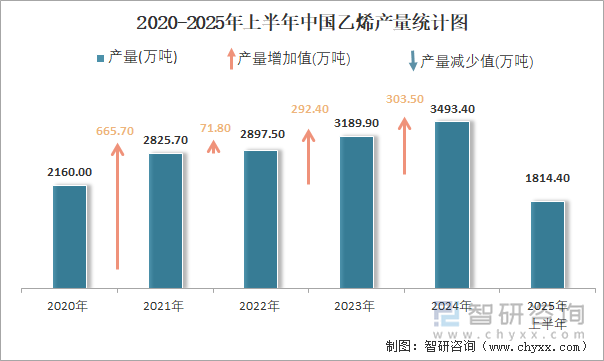
2025年上半年中国乙烯产量为1814.4万吨 累计增长10.9%
Chan Ye Xin Xi Wang· 2025-08-16 03:36
Group 1 - The core viewpoint of the news highlights the growth forecast for China's ethylene industry, with a projected production of 2.85 million tons by June 2025, representing a year-on-year increase of 5.8% [1] - In the first half of 2025, China's cumulative ethylene production is expected to reach 18.144 million tons, reflecting a cumulative growth of 10.9% [1] - The report is based on data from the National Bureau of Statistics and is compiled by Zhiyan Consulting, a leading industry research institution in China [3]
多重不稳定因素影响 乙烯产业发展在欧洲或将停滞
Zhong Guo Chan Ye Jing Ji Xin Xi Wang· 2025-08-05 22:58
Group 1 - The European chemical industry has experienced a wave of steam cracker shutdowns and downstream capacity consolidation over the past 18 months due to rising raw material costs, low naphtha cracking margins, low-priced imports, structural market oversupply, and weak demand [1] - Six steam crackers in Europe have been shut down or are planned to be shut down, with the potential for this number to increase in the future [1] - Major companies like Saudi Basic Industries Corporation and Dow Chemical have announced closures of their steam cracker facilities in the UK and Germany, respectively, indicating a necessary reduction in ethylene capacity to alleviate oversupply [1] Group 2 - Global demand for feedstock for steam crackers is projected to increase from 432 million tons in 2024 to 610 million tons by 2034, with ethylene production from ethane and naphtha expected to reach 74 million tons each in 2024 [2] - The report emphasizes that unless Europe consolidates its ethylene market to address years of oversupply, it will face a prolonged downturn [2] - As of the end of 2024, the operating rate of European steam crackers is expected to be around 75%, necessitating a reduction of approximately 2 million tons per year of ethylene capacity to rebalance the market [2] Group 3 - European ethylene production profits and prices are expected to remain under pressure for the remainder of the year, with spot prices fluctuating around €790 per ton since the end of 2022 and dropping to €563 per ton in July 2023 [3] - European ethylene producers have gradually lost global competitiveness due to consistently lower spot prices compared to other regions since Q2 2022, forcing them to reduce operating rates or shut down facilities [3] - High costs and geopolitical, tariff, and macroeconomic instability are severely restricting the development of the European ethylene industry, with a potential stagnation in growth if there are no relevant policy subsidies [3]
(投资中国)多家跨国企业持续加码中国市场
Zhong Guo Xin Wen Wang· 2025-08-02 09:33
Group 1: Investment and Expansion - Henkel's President for Greater China emphasized the company's commitment to increasing investment in China, leveraging the China International Import Expo to connect resources along the supply chain and accelerate local innovation [1] - The acquisition of Suzhou Bock factory and the initiation of the Henkel Kunpeng factory in Yantai, with a total investment of approximately 900 million RMB, highlight Henkel's strategic expansion in the industrial sector [1] - The German company Voith announced an additional investment of 500 million RMB to expand its production base for chassis suspension components in Suzhou, marking its fourth investment in China [1] Group 2: Green Economy and Sustainability - Schneider Electric's executive highlighted the global trend towards digitalization and green low-carbon initiatives, with the company operating 21 "zero-carbon factories" out of 30 in China, showcasing its commitment to sustainability [2] - The Wuxi factory of Schneider Electric has achieved a 90% reduction in Scope 1 and 2 carbon emissions and a 65% reduction in Scope 3 emissions, earning the title of "Sustainable Lighthouse Factory" from the World Economic Forum [2] - ExxonMobil's Huizhou ethylene project, with a total investment of 10 billion USD, officially commenced production, utilizing green technology to reduce nitrogen oxide emissions by 50% and greenhouse gas emissions by 35% [2] Group 3: Industry Innovation and Standards - Lubrizol's Asia Pacific Vice President noted that China is not only a source of technological innovation but also a key player in global standard-setting, particularly with the advancement of the "National 7" emission standards [3] - Danfoss's China President stated that the ongoing industrial transformation in China is creating new development opportunities for various industries focused on green solutions, with strong growth expected in data centers, semiconductors, shipping, and energy storage in 2024 [3]
国联民生证券:关注“反内卷”八大细分领域龙头公司
Zhi Tong Cai Jing· 2025-07-31 02:53
Group 1 - The core viewpoint of the reports indicates that the recent "anti-involution" policies are beneficial in curbing low-level repetitive construction in the chemical industry and are actively promoting a shift from homogeneous price wars to high-quality development [1][3] - The chemical industry is expected to see a recovery in its prosperity, with a focus on the revival of terminal product demand, increasing industry concentration, and investment opportunities in segments with industrial moats and potential cyclical rebounds, such as refining, ethylene, polyester filament, PVC, organic silicon, battery materials, glyphosate, and soda ash [1][2] Group 2 - The chemical industry has faced significant pressure since 2022 due to demand contraction and supply shocks, with the CCPI continuing to decline by 5.57% from early 2025 to July 24, 2025 [2] - From January to May 2025, the revenue of the chemical raw materials and chemical products manufacturing industry grew by 2.10% year-on-year, while total profits decreased by 4.70% [2] - The industry's capacity utilization rate was 71.90% in the second quarter of 2025, down by 1.60 percentage points from the first quarter [2] - The capital expenditure in the large chemical sector has significantly declined, with the capital expenditure growth rate for the oil and petrochemical/basic chemical sectors turning negative at -6.6% and -15.0%, respectively [2] Group 3 - The "anti-involution" policies are expected to reshape the petrochemical industry landscape, addressing the pressures of overcapacity and homogeneous competition [3] - Refining is experiencing a decline in operating rates due to demand downturn and electrification, with potential policy measures to reduce inefficient capacity and encourage integrated development [3] - The ethylene sector faces oversupply and competition, but controlling production and improving quality could alleviate supply-demand imbalances [3] Group 4 - In the battery materials sector, rapid capacity expansion amid growing demand has led to significant supply pressure, but "anti-involution" policies may guide healthier industry development [4] - The organic silicon industry is nearing the end of its capacity expansion phase, with recent supply disruptions and sustained demand growth expected to ease short-term supply pressures [4] - The "anti-involution" policies are anticipated to improve the supply landscape in the soda ash sector by accelerating the exit of outdated processes and capacities [4]
