
企业软件

Search documents
金蝶与云天励飞发布深度融合计划
3 6 Ke· 2025-11-04 03:19
Core Insights - Shenzhen Yuntian Lifei Technology Co., Ltd. announced a deep integration plan with Kingdee Group, marking the first domestic project combining "independent reasoning chip computing power engine + enterprise-level software ecosystem" [1] - The initiative aims to connect the entire "computing power-software-scenario" chain, facilitating seamless integration of AI reasoning capabilities into enterprise digital processes [1] Summary by Categories - **Partnership Details** - The collaboration includes the launch of the "Kingdee + Yuntian Lifei reasoning acceleration card" integrated suite [1] - Establishment of a "Smart Computing Native Technology Laboratory" [1] - Development of "AI+" integrated solutions [1]

Strategy Inc(原 MicroStrategy)第三季度重返盈利,净利润 28 亿美元
Xin Lang Cai Jing· 2025-10-30 22:42
Core Viewpoint - Strategy Inc (formerly MicroStrategy) returned to profitability in Q3, reporting a net profit of $2.8 billion ($8.42 per share), driven primarily by unrealized gains from its Bitcoin holdings valued at approximately $69 billion [1] Financial Performance - The company's traditional enterprise software business revenue increased by 11% to $128.7 million [1] - The net profit marked a significant turnaround from a loss in the previous year, indicating a strong recovery [1] Market Reaction - Despite the positive financial results, Strategy's stock price has declined by about 45% since its peak in November of the previous year, raising concerns about its financing structure and Bitcoin acquisition pace [1] - There is weak demand for the company's preferred stock issuance, and the pace of Bitcoin purchases has also slowed [1] Strategic Initiatives - Strategy Inc is advancing plans to issue credit securities overseas, indicating a potential shift in its financing strategy [1]
“PE巨头”黑石总裁:华尔街低估了AI的颠覆性,现在投项目首先评估“颠覆风险"
美股IPO· 2025-10-19 22:59
Core Viewpoint - The article emphasizes that Blackstone has elevated AI risk assessment to the highest priority in investment decisions, warning that traditional industries may face significant disruption from AI technologies [2][3][5]. Group 1: AI Disruption Risks - Blackstone's President Jonathan Gray warns that Wall Street investors are underestimating the potential of AI to render entire industries obsolete [2][5]. - The company has mandated that all investment teams must outline the impact of AI on their investment memorandums, focusing on how AI affects business models in sectors like accounting, legal, and data processing [3][4]. - Gray compares the disruption caused by AI to the fate of New York taxi medallions, which lost 80% of their value due to the rise of ride-sharing apps, highlighting the rapid changes AI can bring to traditional business models [3][5]. Group 2: Investment Strategy Adjustments - Blackstone is actively reassessing both new transactions and existing portfolio companies in light of AI risks, particularly in sectors vulnerable to AI-driven competition [3][6]. - Despite recognizing the risks, Blackstone is also positioning itself to capitalize on AI opportunities, investing heavily in utility companies that power data centers and repositioning industrial portfolio companies to sell products to AI infrastructure providers [6]. - Gray notes that while AI may cause economic disruption, it could also lead to significant productivity gains and the creation of trillions of dollars in new enterprise wealth, urging teams not to overlook AI-related opportunities [6].



资本市场加持!MSTR囤的比特币规模已逼近亚马逊、谷歌和微软的账面现金
Hua Er Jie Jian Wen· 2025-10-08 07:15
Core Insights - MicroStrategy's significant investment in Bitcoin is elevating its asset value to levels comparable to major tech companies like Amazon, Google, and Microsoft, highlighting the growing acceptance of Bitcoin as a corporate treasury asset [1][3] - The number of publicly traded companies incorporating Bitcoin into their balance sheets has surged from under 100 at the beginning of the year to over 200, indicating a potential paradigm shift in corporate financial strategies [1][7] Group 1: MicroStrategy's Bitcoin Holdings - MicroStrategy's Bitcoin holdings, amounting to 640,031 BTC, reached a value exceeding $80 billion, closely rivaling the cash reserves of major tech firms [1] - The company purchased its Bitcoin at an average cost of $73,981, resulting in a substantial paper profit of approximately $30.4 billion, reflecting a 65% return on investment [3] - Despite its impressive Bitcoin reserves, MicroStrategy's holdings still fall short of Berkshire Hathaway's cash reserves, which stand at about $344 billion [3] Group 2: Bitcoin as a Hedge Against Inflation - Bitcoin is increasingly recognized as a hedge against currency devaluation, with prominent financial figures advocating for its role in corporate treasury management [2][4] - Analysts from JPMorgan and BlackRock have positioned Bitcoin alongside gold as a viable option for mitigating inflation risks, suggesting a transformative shift in corporate financial strategies [2][4] - Concerns over cash devaluation and low bond yields have prompted discussions on Bitcoin's potential to protect corporate profits from inflationary pressures [4] Group 3: Corporate Adoption Trends - The year 2025 is projected to be a breakthrough year for corporate adoption of Bitcoin, with a significant increase in companies integrating it into their financial strategies [6][7] - The successful case of MicroStrategy serves as a model for other companies, signaling a growing trend towards Bitcoin as an alternative reserve asset in the current macroeconomic environment [7] - Major tech companies like Microsoft and Meta have faced criticism for their reluctance to adopt Bitcoin, missing out on substantial gains as Bitcoin prices surged [5][7]

AI盈利隐忧,美股终结连涨势头
Wind万得· 2025-10-07 22:46
Market Overview - The U.S. stock market faced downward pressure, with major indices ending a multi-day rally. Oracle's disappointing profit margins in its AI business led the decline, while investors remained cautious about the ongoing government shutdown [1][6][8] - The S&P 500 index fell by 0.38% to 6,714.59, ending a seven-day upward trend. The Nasdaq composite index dropped 0.67% to 22,788.36, while the Dow Jones Industrial Average decreased by 0.2% to 46,602.98 [1][2] Gold Market Dynamics - COMEX gold prices surpassed $4,000 per ounce, closing at a record $4,007.90, driven by investor concerns over dollar credit, geopolitical issues, and asset safety [2][5] - Gold prices have surged approximately 50% this year, with a 10% decline in the dollar index making gold cheaper for holders of other currencies, thus stimulating demand [5][6] - The Federal Reserve's recent interest rate cuts have diminished the appeal of short-term debt instruments, further enhancing gold's attractiveness as a zero-yield asset [5][6] Investment Sentiment - Ray Dalio, founder of Bridgewater Associates, suggested that investors allocate about 15% of their portfolios to gold, emphasizing its role as a reliable asset during poor performance of typical investments [6] - The market is reflecting on the substantial investments in AI and questioning the expected returns, with concerns that current expectations may be overly optimistic [7] Political and Economic Risks - The ongoing U.S. government shutdown, now in its seventh day, poses increasing risks to the economy, delaying key economic data and affecting federal employees' salaries [8] - The political deadlock in Washington has created uncertainty, with the Senate failing to pass funding legislation, which could lead to greater pressure on Congress to reach an agreement [8] Future Projections for Gold - Goldman Sachs raised its gold price forecast for December 2026 from $4,300 to $4,900 per ounce, citing expected continued purchases by central banks and individual investors [16] - UBS projected gold prices could reach $3,900 per ounce by mid-2026, indicating further upside potential amid a backdrop of expected Fed policy easing and persistent inflation [16]

安联投资:人工智能投资主题仍具吸引力 甚至可能被市场低估
Zhi Tong Cai Jing· 2025-10-02 08:49
Group 1 - Global growth momentum is slightly declining due to decreased confidence among businesses and consumers, despite resilience in the services sector and a gradual retraction in manufacturing from short-term boosts caused by tariffs [1] - The U.S. is facing stagflation risks with tariffs and labor market constraints potentially increasing inflationary pressures, while Europe is more stable with controlled inflation and expected expansionary fiscal policies in Germany [1] - Asia presents a mixed scenario, with China implementing stimulus measures and Japan awaiting clearer economic recovery signals before adjusting interest rate policies [1] Group 2 - In the technology sector, there is increasing market attention on humanoid robots and smart devices driven by breakthroughs in artificial intelligence and leading companies [2] - The investment theme in artificial intelligence remains attractive and may be undervalued, with its potential not fully recognized by the market [2] - The enterprise software sector shows resilience due to stable recurring revenues and high profit margins, with expectations that artificial intelligence will help simplify repetitive tasks and effectively enhance human productivity [2]
Palantir的危险游戏
美股研究社· 2025-08-12 11:20
Core Viewpoint - Palantir's performance remains strong as U.S. businesses increasingly invest in AI software to enhance operational efficiency, but the company's current stock valuation is difficult to justify, reminiscent of post-2000 internet bubble stocks, leading analysts to adopt a bearish outlook on the stock [1][18]. Group 1: Company Performance - Palantir is a leading player in the enterprise AI software sector, reporting a 64% increase in U.S. commercial accounts, reaching 485 accounts [3]. - Revenue surged by 48% in Q2 2025, surpassing $1 billion for the first time, with U.S. commercial revenue growing an impressive 93%, although quarterly sales in June only reached $306 million [3][5]. - The total contract value for Palantir this quarter reached $2.3 billion, with an annual contract value of $684 million and an average contract duration of three years, indicating strong future demand [7]. Group 2: Growth and Valuation Concerns - Palantir's high growth rate is attributed to its early-stage position in the AI business, with expectations of revenue growth slowing as it scales to $5-10 billion in revenue over the next few years [5]. - The company's stock valuation is considered excessive, with stock-based compensation leading to a market cap increase of nearly $28 billion, while projected revenue is only expected to reach $4.15 billion [8][11]. - Analysts project that Palantir's stock price is currently 12 times its revenue target for 2033, and even considering high profit margins, the stock price reflects a 30 times multiple on projected earnings per share [12]. Group 3: Market Dynamics and Risks - The market has not accurately reflected the risks associated with Palantir, with a price-to-sales ratio exceeding 100, which could diminish the value of future stock-based compensation [15]. - Over the past five years, Palantir's stock price has increased by 1870%, while its business revenue has only grown by 244%, highlighting a disconnect between stock performance and business fundamentals [16]. - Despite high risks, there is potential for the stock price to rise further, with recent momentum suggesting a possible increase to $200, but this also amplifies the downside risk [18].


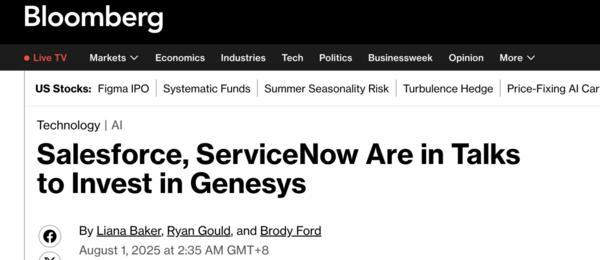
Salesforce与ServiceNow罕见联手:拟各投7.5亿美元押注Genesys
Huan Qiu Wang· 2025-08-01 03:27
Core Insights - Salesforce and ServiceNow are in advanced talks to invest approximately $750 million each in Genesys Cloud Services, potentially valuing the company at $15 billion if the deal is finalized [1][3] - This collaboration marks a significant shift in the cloud services industry from a "zero-sum game" to an "ecosystem co-building" approach, as it is rare for major competitors to jointly invest in a single company [1][3] Company Overview - Genesys is recognized as the largest independent provider of customer experience and contact center solutions globally, integrating multiple communication channels such as voice, chat, and email, along with generative AI tools for service script generation and customer sentiment analysis [3] - The company is projected to exceed $3 billion in revenue in 2024, with an annual growth rate of 25%, serving over 10,000 clients including major corporations like Amazon and Vodafone [3] Strategic Implications - The investment by Salesforce and ServiceNow is seen as a strategic bet on Genesys' core position in the AI-driven customer experience sector [3] - If the deal is successfully completed, Genesys will have sufficient funding to accelerate its AI research and development, with plans to launch a "multimodal customer service agent" by 2025 that can handle voice, text, and video interactions simultaneously [3] - Salesforce and ServiceNow will benefit from Genesys' channels to reach more mid-sized enterprise customers, creating a "investment-empowerment-feedback" loop [3]


数据迁移成本骤降 AI砸了企业软件的“铁饭碗”?
Hua Er Jie Jian Wen· 2025-07-29 13:24
Core Insights - Artificial intelligence (AI) technology is breaking down traditional barriers in the enterprise software market, significantly reducing data migration costs and providing unprecedented bargaining power to enterprise customers [1] - Major tech companies like Amazon, Microsoft, Salesforce, and Palantir are competing to launch AI code generation tools that facilitate the easy transfer of large volumes of data or the reprogramming of legacy applications [1] - Federal agencies, including the Department of Defense, are testing AI models from Microsoft and OpenAI to extract data from various analytical applications operated by contractors like Palantir and Lockheed Martin, aiming to gain leverage in negotiations with existing suppliers [1] - CIOs report that as software switching costs decrease, they are beginning to save on expenses, particularly traditional enterprises that can leverage AI to move away from proprietary software from companies like Microsoft or Salesforce to open-source alternatives or competing applications [1][3] - This shift poses challenges to the entire enterprise software ecosystem, as business models that have long relied on customer stickiness face a potential reshuffling, prompting investors to reassess the moat value of related companies [1] AI Tools Reshaping Data Migration Landscape - AI is fundamentally changing the competitive landscape of enterprise software, making it cheaper and easier for companies to switch software suppliers [1] - Previously, enterprises were often forced to continue using existing software due to the difficulties in extracting large amounts of data from legacy applications [2] - New AI tools are being sold or offered for free by tech suppliers, enabling businesses to write code for migrating data from one application to another or reprogramming old applications into updated formats [2] Enterprises Accelerating Adoption of Open Source and Competing Solutions - Traditional enterprises are leveraging AI technology to reduce dependence on large software vendors [3] - Companies like C1 are using tools such as ChatGPT to write code for migrating data from Microsoft Dynamics to new sales applications that can automate more tasks [3] - CIOs are considering switching to AI agent platforms from Salesforce and similar tools offered by competing startups, indicating a shift in the competitive landscape [3] - The trend of decreasing software switching costs is particularly beneficial for legacy enterprises looking to transition from proprietary software to open-source alternatives [3]

数据迁移成本骤降,AI砸了企业软件的"铁饭碗"?
Hua Er Jie Jian Wen· 2025-07-29 12:35
Core Insights - Artificial intelligence (AI) technology is breaking down traditional barriers in the enterprise software market, significantly reducing data migration costs and providing unprecedented bargaining power to enterprise clients [1][2] - Major tech companies like Amazon, Microsoft, Salesforce, and Palantir are competing to launch AI code generation tools that facilitate the easy transfer of large volumes of data or the reprogramming of legacy applications [1][2] - Federal agencies, including the Department of Defense, are testing AI models from Microsoft and OpenAI to extract data from various analytical applications operated by contractors like Palantir and Lockheed Martin, aiming to leverage these tools for better negotiation positions with existing suppliers [1][2] Group 1: AI Tools Reshaping Data Migration - AI technology is fundamentally changing the competitive landscape of enterprise software, making it cheaper and easier for companies to switch software vendors [2][3] - Previously, companies were often forced to continue using existing software due to the difficulties in extracting large amounts of data from legacy applications [2] - New AI tools are being sold or offered for free by tech suppliers, enabling businesses to migrate data from one application to another or reprogram old applications into updated formats [2] Group 2: Accelerated Adoption of Open Source and Competitive Solutions - Traditional enterprises are leveraging AI technology to reduce dependence on major software vendors [3] - Companies are using tools like ChatGPT to write code for migrating data from Microsoft Dynamics to new sales applications that can automate more tasks [3] - CIOs are considering switching to AI-enabled platforms from Salesforce and similar tools offered by competing startups, indicating a shift in the market dynamics [3]