
消费品行业

Search documents
1月PMI为49.3%!传统淡季下企业生产仍继续扩张|快讯
Hua Xia Shi Bao· 2026-01-31 05:31
文/张智 从企业规模来看,大型企业PMI继续高于临界点。大型企业PMI为50.3%,仍位于扩张区间,大型企业 支撑作用持续显现;中、小型企业PMI分别为48.7%和47.4%,比上月下降1.1个和1.2个百分点,景气水 平有所回落。 一个亮点是,高技术制造业持续领跑。高技术制造业PMI为52.0%,连续两个月位于52.0%及以上较高水 平,相关行业发展态势持续向好。装备制造业PMI为50.1%,保持在扩张区间。消费品行业和高耗能行 业PMI分别为48.3%和47.9%,景气水平有所回落。 企业预期保持乐观。生产经营活动预期指数为52.6%,继续高于临界点。从行业看,农副食品加工、食 品及酒饮料精制茶等行业生产经营活动预期指数连续两个月位于56.0%以上较高景气区间,相关企业对 近期行业发展信心较强。 编辑:徐芸茜 1月份,制造业采购经理指数(PMI)为49.3%,比上月下降0.8个百分点,但传统淡季下企业生产仍继 续扩张。 具体来看,生产指数为50.6%,高于临界点,制造业生产保持扩张;新订单指数为49.2%,市场需求有 所回落。从行业看,农副食品加工、铁路船舶航空航天设备等行业生产指数和新订单指数均高于 5 ...


资本市场服务等行业市场活跃度较高!国家统计局最新发布
Xin Lang Cai Jing· 2026-01-31 05:00
国家统计局1月31日发布数据显示,1月份,制造业采购经理指数(PMI)、非制造业商务活动指数和综合PMI产出指数分别为49.3%、49.4%和49.8%,比 上月下降0.8个、0.8个和0.9个百分点,经济景气水平有所回落。 从行业看,货币金融服务、资本市场服务、保险等行业商务活动指数均高于65.0%,市场活跃度较高。 出厂价格指数近20个月来首次升至临界点以上 "1月份,部分制造业行业进入传统淡季,加之市场有效需求仍显不足,制造业PMI为49.3%,景气水平较上月下降。"国家统计局服务业调查中心首席统计 师霍丽慧表示。 高技术制造业持续领跑。1月份,高技术制造业PMI为52.0%,连续两个月位于52.0%及以上较高水平,相关行业发展态势持续向好。装备制造业PMI为 50.1%,保持在扩张区间。消费品行业和高耗能行业PMI分别为48.3%和47.9%,景气水平有所回落。 企业预期保持乐观。1月份,生产经营活动预期指数为52.6%,继续高于临界点。从行业看,农副食品加工、食品及酒饮料精制茶等行业生产经营活动预 期指数连续两个月位于56.0%以上较高景气区间,相关企业对近期行业发展信心较强。 "1月份,受季节性因 ...
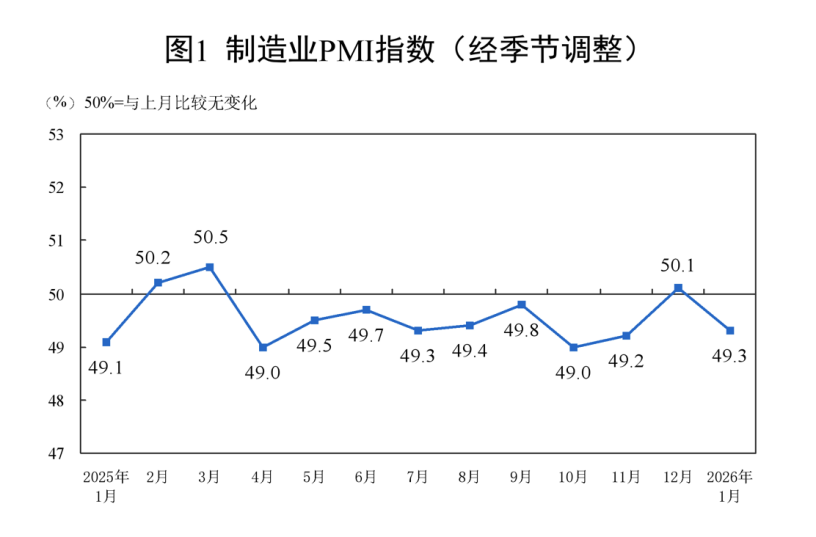
国家统计局:1月制造业PMI为49.3% 景气水平较上月下降 生产继续保持扩张
Guo Jia Tong Ji Ju· 2026-01-31 01:42
Group 1: Manufacturing PMI Overview - In January 2026, the Manufacturing Purchasing Managers' Index (PMI) was reported at 49.3%, a decrease of 0.8 percentage points from the previous month, indicating a tightening in market demand while production continues to expand [1][5] - The production index stood at 50.6%, remaining above the critical point, suggesting ongoing expansion in manufacturing production despite a decline in new orders index to 49.2% [5][6] - High-tech manufacturing PMI was recorded at 52.0%, indicating a sustained positive trend, while equipment manufacturing PMI was at 50.1%, also in the expansion zone [7] Group 2: Non-Manufacturing PMI Overview - The Non-Manufacturing Business Activity Index was reported at 49.4%, down 0.8 percentage points from the previous month, reflecting a general decline in non-manufacturing sector activity [3][8] - The service sector's business activity index was at 49.5%, with financial services and capital market services showing high activity levels above 65.0%, while the real estate sector dropped below 40.0% [8] - The construction sector's business activity index fell to 48.8%, a significant decrease of 4.0 percentage points, indicating a notable decline in construction activity [8] Group 3: Comprehensive PMI Insights - The Comprehensive PMI Output Index was at 49.8%, down 0.9 percentage points from the previous month, suggesting a slowdown in overall business activities [3][9] - The manufacturing production index and non-manufacturing business activity index contributed to the comprehensive PMI, recorded at 50.6% and 49.4% respectively [9]
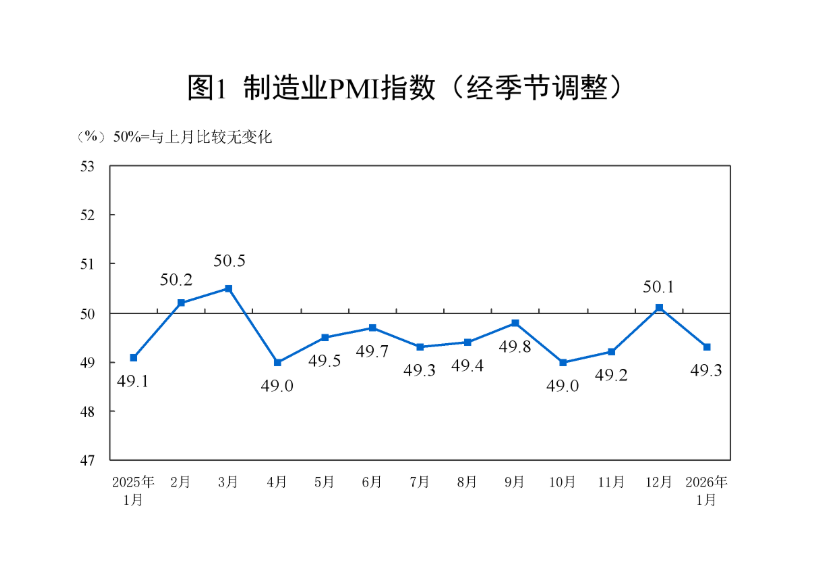
国家统计局服务业调查中心首席统计师霍丽慧解读2026年1月中国采购经理指数
Guo Jia Tong Ji Ju· 2026-01-31 01:35
——国家统计局服务业调查中心首席统计师霍丽慧解读2026年1月中国采购经理指数 2026年1月31日国家统计局服务业调查中心和中国物流与采购联合会发布了中国采购经理指数。对此, 国家统计局服务业调查中心首席统计师霍丽慧进行了解读。 1月份,制造业采购经理指数、非制造业商务活动指数和综合PMI产出指数分别为49.3%、49.4%和 49.8%,比上月下降0.8个、0.8个和0.9个百分点,经济景气水平有所回落。 一、制造业采购经理指数有所下降,生产继续保持扩张 1月份,部分制造业行业进入传统淡季,加之市场有效需求仍显不足,制造业PMI为49.3%,景气水平较 上月下降。 (一)企业生产继续扩张。生产指数为50.6%,高于临界点,制造业生产保持扩张;新订单指数为49.2%, 市场需求有所回落。从行业看,农副食品加工、铁路船舶航空航天设备等行业生产指数和新订单指数均 高于56.0%,产需释放较快;石油煤炭及其他燃料加工、汽车等行业两个指数均低于临界点,相关行业 市场需求放缓,企业生产有所回落。 1月份中国采购经理指数有所回落 (四)高技术制造业持续领跑。高技术制造业PMI为52.0%,连续两个月位于52.0%及以上 ...
将更多财力用于促消费和惠民生
2 1 Shi Ji Jing Ji Bao Dao· 2026-01-30 22:16
Group 1 - The core viewpoint of the news is that China's fiscal revenue is expected to maintain stable growth in 2025, with strong support for key expenditures, reflecting an improving economic situation [1] - Fiscal revenue showed a trend of slight decline in Q1, turning to growth in Q2, and stabilizing in Q3 and Q4, indicating a gradual recovery in economic operations [1] - The proactive fiscal policy has increased counter-cyclical adjustments, with the deficit rate raised by 1 percentage point to 4%, and the issuance of special bonds to support state-owned banks [1] Group 2 - The fiscal policy aims to boost market consumption confidence by allocating 300 billion yuan for special long-term bonds to support consumer upgrades, promoting green and intelligent products [2] - Measures include personal consumption loan subsidies and support for new consumption models, enhancing both supply and demand sides to stimulate consumption potential [2] - Continuous strengthening of social welfare is emphasized, with increased funding for healthcare, pensions, and childcare subsidies, effectively enhancing residents' consumption capacity [2] Group 3 - In 2026, a more proactive fiscal policy will be implemented, maintaining necessary deficit levels and expanding total fiscal expenditure to support key areas like national strategy and basic livelihoods [3] - The focus will shift towards enhancing local financial autonomy and optimizing transfer payment structures to stimulate local economic vitality [3] - More funds will be directed towards consumption and social welfare, aiming to increase disposable income and consumption propensity, thus expanding domestic demand [3] Group 4 - Fiscal support will concentrate on high-level technological self-reliance, with increased investment in key laboratories and research institutions to strengthen foundational research [4] - The government will leverage investment funds to support leading enterprises in pioneering technological advancements in cutting-edge fields [4] - Collaboration between fiscal and financial sectors will be enhanced through special funds and risk compensation tools to support industries like AI, quantum information, and biomanufacturing [4]
Dow Jones Faces Big Week As Four Heavyweights Report Earnings
Benzinga· 2026-01-20 20:30
Core Viewpoint - The earnings season is gaining momentum as major publicly traded companies report quarterly financial results, with a focus on four Dow Jones Industrial Average companies this week and their potential impact on the SPDR Dow Jones Industrial Average ETF (DIA) [1] Group 1: Earnings Reports - 3M Company reported earnings, missing revenue expectations but beating earnings per share (EPS) estimates, marking its first revenue miss after seven consecutive beats [3][4] - Johnson & Johnson is expected to report EPS of $2.48 and revenue of $24.15 billion, both showing year-over-year growth, continuing its trend of beating EPS estimates for over 10 quarters [5][6] - Travelers is anticipated to report EPS of $8.60 and revenue of $11.65 billion, both lower than the previous year's figures, while maintaining a strong track record of beating analyst estimates [9][10] - Procter & Gamble is projected to report EPS of $1.87 and revenue of $22.27 billion, with a focus on consumer shopping trends and health, despite a slight decline in EPS expectations [11][12] Group 2: Company Performance and Stock Movements - 3M's stock fell 7.8% to $155.84, with a 52-week range of $121.98 to $174.69, while being up 5.4% over the last year [4] - Johnson & Johnson's stock trades near all-time highs at $217.89, reflecting a 47.1% increase over the past 52 weeks [8] - Travelers shares are priced at $270.57, up 13.1% over the last year, with a 52-week range of $230.42 to $296.85 [10] - Procter & Gamble's shares are down 9.3% over the last 52 weeks, trading at $146.72 with a range of $137.62 to $179.99 [13] Group 3: ETF Impact - The earnings from the four companies are expected to create volatility in ETFs like DIA, which is currently trading at $484.45, up 10.8% over the past year [14][15]

全年全省居民人均可支配收入36120元
Xin Lang Cai Jing· 2026-01-19 18:12
Core Insights - The 2025 annual survey data for Sichuan's livelihood indicates steady economic progress, with a focus on agricultural production and consumer spending growth [1][2] Group 1: Economic Performance - Sichuan's total grain production reached 732.5 billion jin, marking a 0.8% increase from the previous year, ranking 7th in growth among 13 major grain-producing provinces and maintaining 9th in total production [1] - The total output of pork, beef, mutton, and poultry in Sichuan was 666.9 million tons, an increase of 21.1 million tons or 3.3% year-on-year, ensuring a solid foundation for livestock product supply [1] Group 2: Income and Consumption - The per capita disposable income for residents in Sichuan was 36,120 yuan, reflecting a real growth of 5.5% compared to the previous year [1] - Per capita consumption expenditure was 26,073 yuan, with a real growth of 5.1% year-on-year, indicating a steady increase in residents' income and consumption willingness [1] - The per capita service consumption expenditure was 11,766 yuan, up 6.0% from the previous year, accounting for 45.1% of total consumption expenditure, which is an increase of 0.5 percentage points, suggesting an upgrade in consumer quality [2]
华泰资产资深副总经理姜光明:科技和先进制造是2026年市场投资主线
Shang Hai Zheng Quan Bao· 2026-01-18 18:15
Core Viewpoint - The A-share market in 2026 is experiencing significant activity, with insurance funds acting as a stabilizing force and booster in the rising equity market [2][3] Investment Strategy - The company plans to focus on sectors such as AI, semiconductor autonomy, robotics, and new energy, while also considering financial, cyclical, and consumer sectors for investment [3] - The use of ETFs and other investment tools will be leveraged to enhance asset allocation [3] Market Dynamics - The strong performance of the equity market in early 2026 is attributed to three main factors: macroeconomic recovery, policy expectations, and the influx of new capital [3][4] - The macroeconomic environment is improving, with a positive outlook for policies supporting technological innovation and new productive forces [4] Economic Indicators - The manufacturing PMI returned to the expansion zone at 50.1% in December 2025, indicating a recovery in manufacturing activity [4] - High-tech manufacturing PMI reached 52.5%, with production and new order indices also showing positive trends, supporting the stock market's upward movement [4] Liquidity and Capital Inflow - Reasonable liquidity and expected inflow of new capital are contributing to market growth, with potential new capital exceeding 70 billion yuan due to regulatory adjustments [4] - The strengthening of the RMB is enhancing the attractiveness of Chinese assets, with increased participation from ordinary residents through various investment channels [4] Market Outlook - The equity market is expected to experience a steady increase in overall index levels compared to 2025, reflecting a process of core function optimization and market value reassessment [5] - The improvement in corporate earnings, ongoing policy support, and the recognition of Chinese asset value are identified as the three core drivers of market strength [5][6] Corporate Earnings and Policy Support - A turning point in corporate earnings is anticipated, transitioning from valuation recovery to fundamental improvement, supported by favorable policies and the global AI technology cycle [5] - The "14th Five-Year Plan" is expected to drive significant investments in sectors like AI and commercial aerospace, with long-term capital entering the market [5][6] International Perspective - China's manufacturing industry has developed a robust competitive edge, with global recognition of high-quality Chinese assets increasing [6]

杨德龙:不忘初心 坚定价值投资理念
Xin Lang Cai Jing· 2026-01-14 08:34
Market Overview - The market has experienced continuous growth at the beginning of 2026, with trading volume reaching a historical record of 3.6 trillion yuan [1][6] - Margin trading balances have surpassed 2.6 trillion yuan, indicating increased market activity [1][6] - January is typically the month with the highest credit issuance, estimated between 3 trillion to 4 trillion yuan, which may contribute to capital market growth [1][6] Monetary and Fiscal Policy - China's monetary policy is expected to remain moderately accommodative, with measures such as interest rate cuts and reserve requirement ratio reductions to support low interest rates and liquidity [2][7] - The fiscal policy will be more proactive, with initiatives to boost investment and consumption, including a new subsidy policy for replacing old consumer goods [2][7] - A 12 trillion yuan local government debt relief plan is set to be implemented, easing interest payment pressures and allowing more funds for public welfare and growth [2][7] International Economic Context - The U.S. Federal Reserve is likely to continue its rate-cutting cycle in 2026, with expectations of at least two 25 basis point cuts due to weak economic data [2][8] - The U.S. inflation rate has fallen below 3%, indicating a shift in focus towards stabilizing employment rather than solely controlling inflation [2][8] Currency and Investment Trends - The dollar index has shown a downward trend, raising concerns about U.S. dollar credit, especially with the national debt exceeding 38 trillion dollars and annual interest payments over 1 trillion dollars [9] - China's central bank is reducing U.S. Treasury holdings while increasing gold reserves as a strategy to mitigate dollar credit risks [4][9] - The international influence of the dollar is expected to decline, while the internationalization of the renminbi is anticipated to progress, potentially leading to a renminbi appreciation against the dollar [10] Stock Market Dynamics - The U.S. stock market is experiencing high valuations, with major indices near historical peaks, but the AI technology revolution is supporting genuine business models [11] - Volatility in the U.S. stock market is expected to increase in 2026, with potential short-term corrections in tech stocks, but significant downturns similar to the 2001 internet bubble are unlikely [11] - A-shares and Hong Kong stocks are viewed as attractive investment opportunities due to their valuation advantages, independent of U.S. market fluctuations [11]
2025年12月制造业市场需求回升,原材料供应端交货时间持续缩短 | 高频看宏观
Sou Hu Cai Jing· 2026-01-08 15:14
Economic Activity Index - The China High-Frequency Economic Activity Index (YHEI) as of January 6, 2026, is 1.13, an increase of 0.05 from December 30, 2025, driven by a rise in the coastal coal freight index [1][3] - The "import dry bulk freight index" remained stable at 1.15, indicating consistent shipping costs [1][3] Manufacturing Sector - The manufacturing PMI for December 2025 is 50.1%, up 0.9 percentage points from the previous month, marking a return to expansion for the first time since April 2025 [17] - High-tech manufacturing, equipment manufacturing, and consumer goods sectors saw PMIs of 52.5%, 50.4%, and 50.4%, respectively, all above the neutral line [17] - New orders index rose from 49.2% to 50.8%, and the production index increased by 1.7 percentage points to 51.7% [2][17] - The procurement volume index also returned to expansion at 51.1%, indicating increased demand for raw materials [2][17] Non-Manufacturing Sector - The non-manufacturing business activity index for December 2025 is 50.2%, up 0.7 percentage points, indicating a return to expansion [18] - The construction and service sectors reported indices of 52.8% and 49.7%, respectively, with construction rebounding after four months of contraction [18] Price Trends - The producer price index increased by 0.7 percentage points to 48.9%, while the main raw material purchase price index remains high at 53.1% [2][17] Financial Market Indicators - The central bank's net cash withdrawal through open market operations was 695.9 billion yuan, with a reverse repurchase rate of 1.4% [5] - The overnight interbank rate decreased by 1 basis point to 1.33%, while the seven-day repo rate fell by 66 basis points to 1.49% [8] Real Estate Market - In the week ending January 6, 2026, new and second-hand home transaction areas in first-tier cities fell by 48.57% and 38.95%, respectively [30] - Second-tier cities saw a decline of 59.67% and 23.04% in transaction areas for new and second-hand homes [30] Consumer Behavior - The average daily box office for movies reached 154 million yuan, an increase of 78.64 million yuan from the previous week [32]
