
电力热力燃气及水生产和供应业

Search documents
工业企业利润延续增长态势
Ren Min Ri Bao Hai Wai Ban· 2025-12-29 01:53
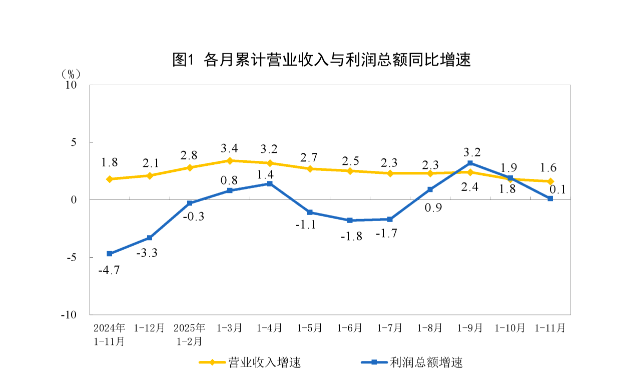
Core Viewpoint - The profits of industrial enterprises in China have continued to grow, with a total profit of 66,268.6 billion yuan from January to November, indicating a sustained upward trend supported by new industrial momentum [2][3]. Profit Growth - From January to November, the profit of industrial enterprises above designated size increased by 0.1% year-on-year, marking four consecutive months of growth since August [3]. - The manufacturing sector achieved a total profit of 50,317.9 billion yuan, growing by 5.0%, while the electricity, heat, gas, and water production and supply sector saw profits of 8,054.4 billion yuan, up by 8.4%. In contrast, the mining sector experienced a profit decline of 27.2% [3]. Revenue and Assets - The total operating revenue for industrial enterprises above designated size reached 125.34 trillion yuan, reflecting a year-on-year increase of 1.6%. By the end of November, total assets amounted to 189.28 trillion yuan, up by 4.8%, and total equity was 79.32 trillion yuan, growing by 4.5% [4]. New Momentum Industries - New momentum industries, particularly equipment manufacturing and high-tech manufacturing, have shown rapid growth. The profit of the equipment manufacturing sector increased by 7.7%, contributing 2.8 percentage points to the overall profit growth of industrial enterprises [5]. - In the high-tech manufacturing sector, profits grew by 10.0%, surpassing the average growth rate of all industrial enterprises by 9.9 percentage points [5]. Specific Industry Performance - The "Artificial Intelligence+" initiative has positively impacted related equipment manufacturing sectors, with profits in the electronic industrial specialized equipment manufacturing sector rising by 57.4%. Notably, profits in semiconductor device manufacturing and electronic components manufacturing surged by 97.2% and 46.0%, respectively [6]. - The aerospace industry also experienced significant profit growth, with profits in aerospace and related equipment manufacturing increasing by 13.3%, including a remarkable 192.9% growth in aerospace-related equipment manufacturing [6]. Industrial Economic Development - The growth in profits reflects a steady advancement in the industrial economy, with a focus on achieving qualitative improvements and reasonable quantitative growth by 2025 [7]. - The high-tech manufacturing and equipment manufacturing sectors have shown substantial value-added growth, with increases of 9.2% and 9.3%, respectively, from January to November [8].
1—11月,全国规上工业企业实现利润总额66268.6亿元——工业企业利润延续增长态势
Xin Hua Wang· 2025-12-28 23:50
Core Viewpoint - The profits of industrial enterprises above designated size in China continued to grow, reaching a total of 66,268.6 billion yuan from January to November, indicating a sustained upward trend supported by new industrial momentum [1] Group 1: Profit Growth - From January to November, the profits of industrial enterprises above designated size increased by 0.1% year-on-year, marking four consecutive months of growth since August [2] - The manufacturing sector achieved a profit total of 50,317.9 billion yuan, growing by 5.0%, while the electricity, heat, gas, and water production and supply sector saw profits of 8,054.4 billion yuan, up by 8.4% [2] - The mining sector reported a profit total of 7,896.3 billion yuan, experiencing a year-on-year decline of 27.2%, although the decline was narrowed by 0.6 percentage points compared to the previous month [2] Group 2: Sector Performance - The steel industry showed significant improvement in profitability, with a substantial year-on-year increase due to low base factors, while the non-ferrous metals sector maintained double-digit profit growth driven by increased market demand [2] - The profits of raw material manufacturing industries grew rapidly, with a year-on-year growth rate of 16.6%, contributing 2.0 percentage points to the overall profit growth of industrial enterprises [2] Group 3: Revenue and Assets - From January to November, the total operating revenue of industrial enterprises above designated size reached 125.34 trillion yuan, reflecting a year-on-year growth of 1.6% [3] - By the end of November, the total assets of these enterprises amounted to 189.28 trillion yuan, up by 4.8%, while total equity reached 79.32 trillion yuan, growing by 4.5% [3] - The operating revenue per 100 yuan of assets for these enterprises was 74.4 yuan [3] Group 4: New Momentum Industries - New momentum industries, represented by equipment manufacturing and high-tech manufacturing, exhibited rapid growth, with equipment manufacturing profits increasing by 7.7%, contributing 2.8 percentage points to overall profit growth [4] - In the equipment manufacturing sector, seven out of eight major categories reported year-on-year profit growth, with the railway, shipbuilding, aerospace, and electronics industries achieving double-digit growth rates of 27.8% and 15.0% respectively [4] - High-tech manufacturing profits grew by 10.0% year-on-year, surpassing the average growth rate of all industrial enterprises by 9.9 percentage points [4] Group 5: Impact of Technological Advancements - The implementation of the "Artificial Intelligence +" initiative positively influenced the profits of related equipment manufacturing sectors, with profits in the electronic industrial specialized equipment manufacturing sector soaring by 57.4% [5] - The aerospace industry also experienced rapid profit growth, with profits in aerospace and related equipment manufacturing increasing by 13.3%, including a remarkable 192.9% growth in space-related equipment manufacturing [5] - The smart consumer device manufacturing sector saw profits rise by 54.0%, with specific categories like smart vehicle-mounted devices and intelligent drones achieving growth rates of 105.7% and 76.6% respectively [5] Group 6: Industrial Economic Development - The growth in profits reflects a steady advancement in the industrial economy, with a national conference highlighting goals for 2025 aimed at achieving qualitative improvements and reasonable quantitative growth [6] - The added value of high-tech manufacturing and equipment manufacturing industries increased by 9.2% and 9.3% year-on-year respectively [6] - The establishment of over 7,000 advanced and 500 excellent smart factories, along with significant advancements in green manufacturing, underscores the ongoing transformation and upgrading of traditional industries [7]
工业利润累计增速连续4个月增长,装备制造业带动明显
Di Yi Cai Jing· 2025-12-27 02:34
Core Insights - In November, profits of industrial enterprises above designated size decreased by 13.1% year-on-year, with the decline expanding by 7.6 percentage points compared to the previous month [1] - From January to November, profits of industrial enterprises above designated size grew by 0.1%, maintaining a growth trend for four consecutive months since August [1] Group 1: Profit Trends - In the manufacturing sector, profits increased by 5.0% from January to November, while the electricity, heat, gas, and water production and supply sector saw an 8.4% profit growth [3] - The mining industry experienced a profit decline of 27.2%, although the decline was narrowed by 0.6 percentage points compared to the first ten months of the year [3] Group 2: Sector Performance - The equipment manufacturing sector significantly contributed to profit growth, with a 7.7% increase in profits from January to November, accounting for a 2.8 percentage point increase in overall industrial profits [3] - High-tech manufacturing profits accelerated, with a 10.0% year-on-year increase, surpassing the average growth rate of all industrial enterprises by 9.9 percentage points [3] - The raw materials manufacturing sector also saw a robust profit growth of 16.6%, contributing 2.0 percentage points to the overall industrial profit growth [4] Group 3: Future Outlook - The overall profit growth of industrial enterprises indicates a continued upward trend, supported by new industrial dynamics, although challenges remain due to international uncertainties and structural adjustments [5] - The Ministry of Industry and Information Technology has set goals for 2026, prioritizing the stabilization of the industrial economy, with an expected 5.9% year-on-year growth in industrial added value for the year [5] - Analysts predict that industrial profits may recover from low levels, potentially achieving around 10% growth by the end of 2026, indicating a shift from policy-driven to profit-driven market dynamics [5]

2024年上市公司内部控制质量进一步提高
Shang Hai Zheng Quan Bao· 2025-12-25 19:11
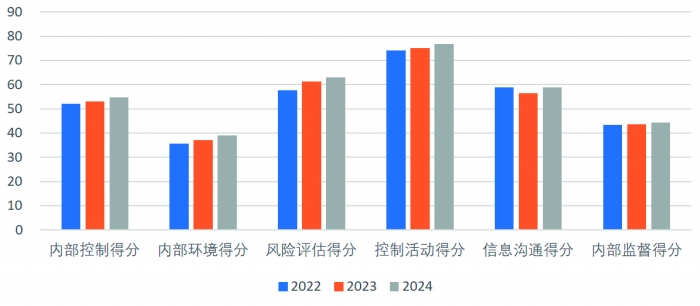
Core Insights - The internal control quality of listed companies in 2024 has improved compared to 2023, with internal environment remaining the weakest aspect that requires further enhancement [4][19] - Companies with financial shared centers, high digital transformation levels, and high-quality new productivity show better internal control levels, while those facing penalties, restatements, or receiving non-standard audit opinions exhibit lower internal control levels [20] Group 1: Overall Internal Control Status - The overall internal control level of listed companies has shown a steady increase from 52.47 in 2022 to 54.75 in 2024 [7] - The distribution of listed companies is concentrated in economically developed regions, with Guangdong, Zhejiang, and Jiangsu having the highest number of listed companies [8] Group 2: Regional Analysis - Internal control index averages vary by region, with Yunnan (58.49), Beijing (56.25), and Hebei (56.60) showing higher scores, while Qinghai (50.42), Hainan (50.33), and Heilongjiang (51.64) are lower [8] - The internal control quality is more balanced in economically developed areas like Beijing, Shanghai, and Guangdong, indicating a mature governance structure [8] Group 3: Industry Analysis - The financial industry maintains a significantly higher internal control quality compared to other sectors, attributed to stringent government regulations [9] - Some service and public sectors have shown notable improvements in internal control levels from 2022 to 2024, while education, construction, and comprehensive industries remain at lower levels [9] Group 4: Financial Shared Services and Digital Transformation - Companies utilizing financial shared services have an internal control index average of 57.76, compared to 54.36 for non-financial shared companies, indicating a clear advantage [10] - Companies with high digital transformation levels have an internal control index average of 55.54, outperforming those with lower levels at 53.98, highlighting the positive impact of digital transformation on internal control quality [11] Group 5: ESG and New Productivity - Companies with high ESG levels have an internal control index that is 4.51 points higher than those with lower ESG levels, particularly in the internal environment dimension [13] - Companies with high new productivity levels demonstrate superior internal control quality across various dimensions compared to those with lower levels [14] Group 6: Penalties and Audit Opinions - Companies that have faced penalties have an internal control index average of 44.45, significantly lower than the 55.06 average of non-penalized companies, with the internal environment being the most affected area [15] - Companies receiving non-standard audit opinions have a notably lower internal control index, with a score of 34.76 in 2024, indicating serious deficiencies in internal control execution [18]
1-11月内蒙古经济稳中有进
Xin Lang Cai Jing· 2025-12-20 20:03
Economic Overview - Inner Mongolia's economy shows steady growth in 2023, with industrial production, agricultural output, and fixed asset investment all increasing [1][2][3] Agriculture - The grain planting area in Inner Mongolia increased to 10,567,000 acres, up by 493,000 acres or 0.5% year-on-year [1] - Grain yield reached 397.8 kg per acre, an increase of 7.9 kg or 2.0% from the previous year [1] - Total grain production amounted to 84.07 billion jin, an increase of 2.5% or 2.06 billion jin compared to last year, marking the 22nd consecutive year of increased production [1] Industrial Production - The added value of industrial enterprises above designated size grew by 6.5% year-on-year [2] - The mining industry saw an increase of 4.5%, while the manufacturing sector grew by 8.8% [2] - The electricity, heat, gas, and water production and supply industries increased by 7.8%, and strategic emerging industries grew by 10.2% [2] Investment - Fixed asset investment (excluding rural households) rose by 3.5% year-on-year [2] - Infrastructure investment increased by 8.4%, and private investment saw a significant rise of 11.8% [2] Consumption - The total retail sales of consumer goods reached 488.06 billion yuan, reflecting a year-on-year growth of 5.3% [3] - Urban retail sales grew by 5.3%, while rural retail sales increased by 5.7% [3] - The government is focusing on boosting consumption through various initiatives, including promoting equipment upgrades and consumption exchanges [3]
2025年11月宏观数据点评:生产偏稳,需求回落
Shanghai Securities· 2025-12-17 10:58
Economic Performance - In November, the industrial production growth rate was 4.8%, a slight decrease of 0.1 percentage points from the previous month[11] - Fixed asset investment (excluding rural households) fell by 2.6% year-on-year from January to November, with a deeper decline compared to the previous period[11] - The total retail sales of consumer goods in November reached 43,898 billion yuan, growing by 1.3%, which is a decrease of approximately 1.6 percentage points from the previous month[11] Investment Trends - Manufacturing investment grew by 1.9%, with a decline of 0.8 percentage points in growth rate[18] - Infrastructure investment decreased by 1.1% year-on-year, with the decline expanding by 1 percentage point[18] - Real estate development investment from January to November was 78,591 billion yuan, down 15.9%, with the decline widening by 1.2 percentage points[19] Consumer Behavior - Retail sales excluding automobiles grew by 2.5%, indicating that the decline in automobile consumption negatively impacted overall consumer performance[25] - The growth rate of retail sales in urban areas was 1.0%, while rural areas saw a growth of 2.8%[21] - Consumption of furniture, building materials, and jewelry saw significant declines, with automobile consumption experiencing a deepening drop[22] Policy Outlook - The government aims to maintain stable economic growth while enhancing quality and efficiency, with a focus on expanding domestic demand and optimizing supply[28] - Policies will include increasing central budget investment and implementing measures to stabilize investment and consumption[28] Risk Factors - Potential risks include worsening geopolitical events, changes in international financial conditions, and unexpected shifts in China-U.S. policies[29]
前十一月,全国规上工业增加值增长百分之六——工业经济转型升级持续推进
Xin Hua Wang· 2025-12-17 00:27
Core Insights - The Central Economic Work Conference emphasizes the implementation of a new round of high-quality development actions for key industrial chains and the deep integration of technological and industrial innovation [1] Industrial Performance - From January to November, the industrial added value of large-scale enterprises in China grew by 6.0% year-on-year, surpassing the previous year's growth by 0.2 percentage points [2] - In November, the industrial added value increased by 4.8% year-on-year, maintaining stable growth, with a month-on-month increase of 0.44%, accelerating by 0.27 percentage points from the previous month [2] - The mining, manufacturing, and electricity, heat, gas, and water production and supply industries saw year-on-year growth of 6.3%, 4.6%, and 4.3% respectively, with 30 out of 41 industrial categories experiencing growth [2] Equipment Manufacturing Sector - The equipment manufacturing sector is highlighted as a key growth area, with a year-on-year increase of 7.7% in November, accounting for 36.4% of the total industrial added value, an increase of 1.8 percentage points from the previous year [2][3] - All eight industries within the equipment manufacturing sector reported growth, with the electronics and automotive industries growing by 9.2% and 11.9% respectively, contributing 20.2% and 17.9% to overall industrial growth [3] High-tech Manufacturing - High-tech manufacturing added value grew by 8.4% year-on-year in November, contributing 29.8% to the overall industrial growth [4] - Key sectors such as integrated circuit manufacturing and biopharmaceuticals saw significant growth rates of 32.4% and 17.3% respectively [4] Digital Product Manufacturing - The digital product manufacturing sector experienced a year-on-year growth of 7.6% in November, with notable increases in smart vehicle equipment and industrial control systems [5] - Production of smart consumer devices like smart wristbands and 5G smartphones grew by 27.6% and 11.5% respectively, while 3D printing equipment saw a remarkable increase of 100.5% [5] Future Industrial Strategy - The Ministry of Industry and Information Technology aims to stabilize industrial production and promote new industrialization, focusing on growth, innovation, and integration [6][7] - Plans include enhancing supply-demand adaptability, implementing key industry growth strategies, and promoting deep integration of technological and industrial innovation [7]
【宏观经济】一周要闻回顾(2025年12月10日-12月16日)
乘联分会· 2025-12-16 08:39
Consumer Price Index (CPI) Overview - In November 2025, the national consumer price index (CPI) increased by 0.7% year-on-year, with urban areas rising by 0.7% and rural areas by 0.4% [3] - Food prices rose by 0.2%, while non-food prices increased by 0.8% [3] - The average CPI from January to November remained flat compared to the previous year [3] Price Changes in November - Year-on-year, food, tobacco, and alcohol prices increased by 0.3%, contributing approximately 0.09 percentage points to the CPI [4] - Fresh vegetable prices surged by 14.5%, impacting the CPI by about 0.31 percentage points [4] - Pork prices fell by 15.0%, leading to a decrease in CPI by approximately 0.21 percentage points [4] Month-on-Month Price Changes - In November, the CPI decreased by 0.1% month-on-month, with urban areas also declining by 0.1% [3] - Food prices increased by 0.5% month-on-month, while non-food prices decreased by 0.2% [3] - Among various categories, other goods and services prices rose by 14.2%, while transportation and communication prices fell by 2.3% [4][5] Industrial Production - In November 2025, the industrial added value for large-scale enterprises grew by 4.8% year-on-year, with a month-on-month increase of 0.44% [7] - The mining sector saw a 6.3% increase, while manufacturing and electricity, heat, gas, and water production and supply grew by 4.6% and 4.3%, respectively [7] - Among 41 major industries, 30 reported year-on-year growth in added value [7] Retail Sales Performance - The total retail sales of consumer goods reached 43,898 billion yuan in November, marking a 1.3% year-on-year increase [10] - Retail sales excluding automobiles grew by 2.5% [10] - Online retail sales from January to November amounted to 144,582 billion yuan, reflecting a 9.1% year-on-year increase [12] Fixed Asset Investment Trends - From January to November 2025, fixed asset investment (excluding rural households) totaled 444,035 billion yuan, a decrease of 2.6% year-on-year [15] - The investment in the primary industry rose by 2.7%, while the secondary industry saw a 3.9% increase [15] - Infrastructure investment in the tertiary sector declined by 1.1% [15]

11月消费投资低于预期
Ge Lin Qi Huo· 2025-12-15 08:25
1. Report Industry Investment Rating - Not provided in the content 2. Core Viewpoints of the Report - In November, the growth rates of fixed - asset investment and social consumer goods retail总额 were lower than market expectations, while the export growth rate exceeded expectations [4][23]. - The year - on - year decline of real estate sales volume and price continued in November, and the data in early December also showed the same trend [4][23]. - As of the end of October, 5000 billion yuan of new policy - based financial instruments had been fully invested, but the investment data in October and November did not show obvious improvement [4][23]. - The relatively stable international environment after the China - US summit at the end of October is beneficial to China's exports, and stable export confidence is conducive to the growth of private investment [4][23]. - The Central Economic Work Conference in December proposed to implement a more proactive fiscal policy and a moderately loose monetary policy next year to promote investment to stop falling and rebound and boost consumption [23]. 3. Summary by Relevant Catalogs 3.1 Fixed - Asset Investment - From January to November, the national fixed - asset investment decreased by 2.6% year - on - year, worse than the market expectation of a 2.2% decline [1][5]. - From January to November, the broad infrastructure investment (including electricity) increased by 0.1% year - on - year, lower than the market expectation of 1.5% [1][5]. - From January to November, the manufacturing investment increased by 1.9% year - on - year, higher than the market expectation of 0.6% [1][5]. - From January to November, the national real estate development investment decreased by 15.9% year - on - year, worse than the market expectation of a 15.4% decline [1][5]. - From January to November, private fixed - asset investment decreased by 5.3% year - on - year [5]. - In November, manufacturing investment decreased by 4.5% year - on - year, and narrow - sense infrastructure investment (excluding electricity) decreased by 9.7% year - on - year [5]. - In November, the national fixed - asset investment decreased by 1.03% month - on - month, showing a continuous decline for ten consecutive months [5]. 3.2 Real Estate - From January to November, the sales area of new commercial housing decreased by 7.8% year - on - year, and the sales volume decreased by 11.1% year - on - year [2][9]. - In the fourth quarter, the daily average transaction area of commercial housing in 30 large and medium - sized cities decreased significantly year - on - year, and the national real estate sales were still at the bottom [10]. - In November, the second - hand housing prices in first - tier cities decreased by 1.1% month - on - month, with the decline expanding [2][10]. - In November, the real estate development enterprise's available funds decreased by 32.6% year - on - year [11]. - In November, the new housing start - up area decreased by 28% year - on - year, and the housing completion area decreased by 25% year - on - year [11]. 3.3 Industrial Added Value - In November, the value - added of industrial enterprises above designated size increased by 4.8% year - on - year, lower than the market expectation of 5.0% [2][12]. - In November, the value - added of high - tech manufacturing increased by 8.4% year - on - year, maintaining rapid growth [2][12]. 3.4 Foreign Trade - In November, China's exports denominated in US dollars increased by 5.9% year - on - year, exceeding expectations, and imports increased by 1.9% year - on - year [2][14]. - From January to November, China's cumulative export amount increased by 5.4% year - on - year, and the cumulative import amount decreased by 0.6% year - on - year [14]. 3.5 Consumption - In November, the total retail sales of social consumer goods increased by 1.3% year - on - year, lower than the market expectation of 2.9% [3][18]. - In November, among the retail sales of consumer goods by units above the quota, categories with relatively fast year - on - year growth included communication equipment, cultural and office supplies, etc. Categories with relatively fast year - on - year decline included household appliances and audio - visual equipment, building and decoration materials, etc. [19]. 3.6 Service Industry and Employment - In November, the national service industry production index increased by 4.2% year - on - year, hitting a new low for the year [3][21]. - In November, the national urban surveyed unemployment rate was 5.1%, remaining the same as the previous month and 0.1 percentage point higher than the same month of the previous year [3][21].
11月中国经济“成绩单”出炉!支持价格合理回升的积极因素继续累积
Qi Huo Ri Bao· 2025-12-15 06:40
Economic Overview - In November, the national economy continued to show a stable and progressive development trend, with a focus on implementing proactive macro policies and promoting high-quality development [2][6] - The total grain production for the year is expected to exceed 1.4 trillion jin, with a year-on-year increase of 1.2% [2] Industrial Production - The industrial added value above designated size increased by 4.8% year-on-year in November, with a month-on-month increase of 0.44% [3] - The equipment manufacturing industry and high-tech manufacturing industry saw significant growth, with increases of 7.7% and 8.4% respectively [3] - The production of 3D printing equipment, industrial robots, and new energy vehicles grew by 100.5%, 20.6%, and 17.0% year-on-year respectively [3] Retail Sales - The total retail sales of consumer goods reached 43,898 billion yuan in November, a year-on-year increase of 1.3% [4] - Online retail sales amounted to 144,582 billion yuan, with a year-on-year growth of 9.1%, and physical goods online retail sales accounted for 25.9% of total retail sales [4] - Service retail sales grew by 5.4% year-on-year, with significant growth in cultural, sports, and travel services [4] Fixed Asset Investment - Fixed asset investment (excluding rural households) decreased by 2.6% year-on-year from January to November, while manufacturing investment increased by 1.9% [5] - Infrastructure investment fell by 1.1%, and real estate development investment dropped by 15.9% [5] - Investment in high-tech industries, such as information services and aerospace manufacturing, saw significant increases of 29.6% and 19.7% respectively [5] Policy Impact - A series of proactive macro policies have effectively supported stable economic operations, leading to expanded consumer demand and increased key investments [7][8] - The implementation of consumption upgrade policies has resulted in significant sales growth in home appliances and communication equipment [8] - The industrial production growth was supported by policies promoting market demand and industrial upgrades [8] Price Trends - The Consumer Price Index (CPI) rose by 0.7% year-on-year in November, marking a continuous recovery trend [9] - The Producer Price Index (PPI) showed a month-on-month increase of 0.1%, indicating a narrowing decline trend since August [10][11] Long-term Economic Outlook - The resilience of the economy remains strong, with macro policies providing robust support and new growth drivers emerging [12][13] - The expansion of market demand and the continuous growth of new economic drivers are expected to positively impact economic development [12][14] - The upcoming economic policies aim to enhance domestic demand and optimize supply, ensuring a solid foundation for future growth [14]