
石油炼化

Search documents
两巨无霸“联姻”,两千亿航油市场变局开启
Huan Qiu Wang· 2026-01-09 07:41
Core Viewpoint - The restructuring of China Petroleum & Chemical Corporation (Sinopec) and China Aviation Oil Group (CAOG) marks a significant event in the central enterprise's professional integration, potentially reshaping the 200 billion yuan aviation fuel market and impacting the trillion-level energy and chemical market [1] Group 1: Market Context - China's refined oil consumption is facing a historic turning point, with a projected decline due to the rapid growth of the electric vehicle industry and energy electrification [3] - Sinopec's net profit for 2024 is expected to decline by over 16% year-on-year, with further declines anticipated in the first three quarters of 2025 [3] - In contrast, aviation kerosene is one of the few refined oil categories with a certain growth outlook, with an estimated consumption of around 40 million tons in 2024, leading to a market size exceeding 200 billion yuan [3] Group 2: Strategic Integration - The merger aims to create an integrated supply chain from refinery to wing, leveraging Sinopec's refining capacity and CAOG's distribution network as Asia's largest aviation fuel service provider [3][4] - The vertical integration allows Sinopec to access CAOG's channels for aviation fuel sales, enhancing resource supply stability and bargaining power in international markets [4] Group 3: Industry Dynamics - The merger raises concerns about the bargaining power of downstream airlines, as aviation fuel typically accounts for about 30% of their total operating costs [5] - The consolidation may lead to a shift in market dynamics, potentially disadvantaging smaller domestic airlines against the newly formed "giant" in the upstream market [5] - Analysts suggest that to balance the power dynamics in the aviation fuel supply chain, the civil aviation industry may initiate a new round of consolidation, potentially forming large airline groups based on existing major carriers [5]


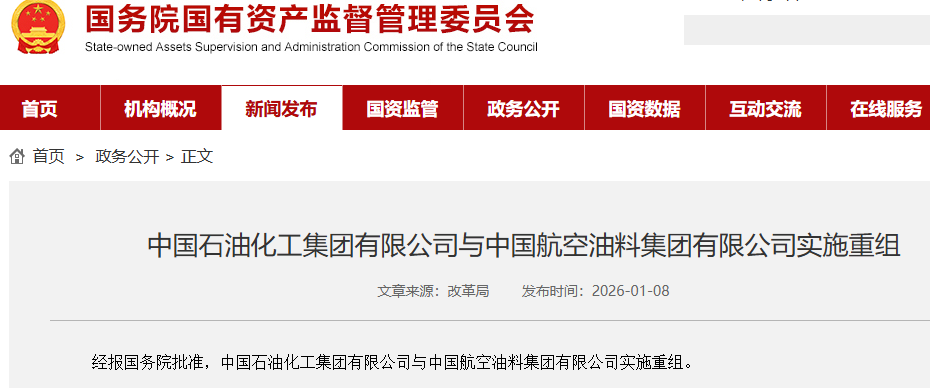
央企“巨无霸”重组启幕!超2000亿元航空燃油市场或将重构
Zheng Quan Shi Bao· 2026-01-08 22:53
Group 1 - The core viewpoint of the news is the restructuring of Sinopec and China Aviation Oil, which is expected to reshape the trillion-level energy and chemical market and enhance the competitiveness of state-owned enterprises [1][4][5] - The restructuring is seen as a response to the historical turning point in China's refined oil consumption, driven by the rapid development of the new energy vehicle industry and the electrification of end-use energy [2][3] - Sinopec's integration with China Aviation Oil aims to create a vertically integrated supply chain from refinery to wing, enhancing operational resilience and market competitiveness [4][6][7] Group 2 - The aviation fuel market is projected to grow, with China expected to consume approximately 40 million tons of aviation fuel in 2024, reflecting a 13% year-on-year increase [3] - The restructuring may lead to a redistribution of market share among major energy state-owned enterprises in the aviation fuel segment, providing Sinopec with new growth opportunities [3][6] - The integration is anticipated to improve the stability of aviation fuel supply for airlines, potentially reducing transaction costs and maximizing efficiency [6][9] Group 3 - The restructuring is part of a broader trend of state-owned enterprise consolidation aimed at optimizing the layout of state-owned economies and enhancing operational efficiency [5][8] - There are concerns among airlines regarding the potential impact on their bargaining power and cost control due to the consolidation of aviation fuel supply [9][10] - The restructuring may prompt a reevaluation of market strategies among airlines, especially if it leads to a dominant player in the aviation fuel market [9][10]
财经聚焦丨中国石化“牵手”中国航油,影响几何?
Xin Hua Wang· 2026-01-08 13:47
Group 1 - The restructuring of China Petroleum & Chemical Corporation (Sinopec) and China Aviation Oil Group has been approved by the State-owned Assets Supervision and Administration Commission (SASAC), marking a significant move in the central enterprise restructuring landscape [1][5] - Sinopec is the world's largest refining company and the largest aviation fuel producer in China, while China Aviation Oil is the largest integrated aviation fuel supply chain service provider in Asia, serving hundreds of airports [1][3] - The merger aims to create a seamless supply chain from crude oil refining to aircraft refueling, enhancing energy security for China's aviation industry and improving international competitiveness [3][5] Group 2 - The restructuring aligns with China's "dual carbon" goals, promoting the use of Sustainable Aviation Fuel (SAF) as a key measure for carbon reduction in the aviation sector [3][6] - Sinopec has been a pioneer in SAF production, and the collaboration is expected to break commercial barriers for SAF, facilitating its large-scale application at domestic airports [3][6] - The restructuring reflects a broader trend of central enterprises optimizing their structure and enhancing core competitiveness, with multiple strategic mergers occurring across various sectors [5][6]

美国嫌弃印度货,莫迪转头全销中国,顺手把俄罗斯也坑了!
Sou Hu Cai Jing· 2026-01-08 13:39
Core Viewpoint - The imposition of a 50% tariff by the U.S. on India represents a significant economic blow, marking a shift from verbal threats to concrete actions, impacting India's trade dynamics and geopolitical positioning [1][3]. Group 1: Economic Impact - The U.S. previously imposed a 25% tariff on India in July, which was perceived as a bargaining tactic, but the subsequent 50% tariff on August 27 led to a collapse of India's export market, affecting goods worth $60.2 billion [3]. - India's oil imports from Russia are expected to decrease by 20% to 30% starting in October, as state-owned refineries received directives to comply with the new tariff regime [5]. Group 2: Political Dynamics - Modi's government is under pressure to respond to the tariffs, with public assurances of resilience, yet the political maneuvering indicates a deeper struggle for balance between U.S. and Russian relations [3][5]. - The reduction in Russian oil imports sends a concerning political signal to Moscow, suggesting that India may not be a reliable partner in critical times, which could impact India's military supply chains [9]. Group 3: Strategic Shifts - India is attempting to pivot towards China by promoting a "de-Americanization" strategy, encouraging exports of products not needed in the U.S. to the Chinese market, despite the challenges of entering this competitive landscape [11][12]. - The reliance on the Chinese market as a fallback option is viewed as naive, given India's manufacturing shortcomings and the high costs compared to competitors like Vietnam and Bangladesh [12][16]. Group 4: Long-term Consequences - The U.S. tariff strategy reflects a broader assessment of India's economic capabilities, revealing vulnerabilities in sectors like textiles, jewelry, and seafood, which can be easily replaced by other countries [14][16]. - The overall situation illustrates India's precarious position in global trade, with the inability to effectively counteract U.S. pressures leading to a loss of diplomatic autonomy and economic stability [14][16].

中国石化与中国航油重组落地 打通原油炼化到飞机加油全链条
Xin Lang Cai Jing· 2026-01-08 11:31
Core Viewpoint - The restructuring of China Petroleum & Chemical Corporation (Sinopec) and China Aviation Oil Group is aimed at enhancing core competitiveness and streamlining operations within the state-owned enterprise sector [1][4]. Group 1: Company Overview - China Aviation Oil Group was established in 1990 and became a central enterprise directly managed by the State-owned Assets Supervision and Administration Commission (SASAC) in 2003 [1][3]. - The company is recognized as Asia's largest integrated aviation fuel supply service provider, covering procurement, transportation, storage, testing, sales, and refueling [1][3]. Group 2: Financial Performance - China Aviation Oil's subsidiary, China Aviation Oil (Singapore) Corporation Ltd. (referred to as "China Aviation Oil"), previously submitted an application for listing in 2020 but withdrew it in January 2024 [1][3]. - The company's revenue primarily comes from refined oil sales, storage services, and urban gas business, with annual refined oil trading volume exceeding 10 billion yuan, ranking fifth among central enterprises in the industry [1][3]. Group 3: Strategic Implications - The merger is expected to create a seamless integration from crude oil refining to aircraft refueling, potentially reshaping the competitive landscape of the refining market [2][3]. - The restructuring aligns with recent state-owned enterprise reforms that focus on core responsibilities and enhancing competitiveness through consolidation [4].
抚顺石化石油三厂:精益管理理念融入“毛细血管”
Zhong Guo Hua Gong Bao· 2026-01-07 03:22
Core Viewpoint - The company is implementing lean management principles across its production processes to enhance efficiency and value creation, focusing on optimizing production and resource utilization. Group 1: Production Efficiency - The company has achieved a historic daily production of liquid wax exceeding 860 tons, with a yield increase to over 36%, maintaining growth for two consecutive months [2] - A specialized task force was established to enhance production efficiency through targeted measures in raw material optimization, process control, and equipment maintenance [2] - The company has addressed bottlenecks in raw material supply by purchasing molecular sieve materials, effectively increasing the production capacity of high-efficiency products like aviation kerosene and liquid wax [2] Group 2: Equipment Optimization - The company has implemented refined management for five major production units, establishing a comprehensive control system to ensure optimal operational status [3] - Upgrades to the heating furnace have improved thermal efficiency to 93%, while also reducing nitrogen oxide emissions, achieving a balance between energy saving and emission reduction [3] - Operators have adopted a meticulous approach to operations, ensuring precise control of parameters to maintain optimal equipment performance [3] Group 3: Resource Utilization - The company has initiated a project to enhance the extraction of high-value carbon nine components from by-products, significantly improving resource utilization and economic benefits [4] - A specialized operational management mechanism has been established to monitor equipment performance and ensure stable recovery efficiency of carbon nine components [4] - The company has implemented multiple energy-saving and water-saving measures, achieving significant reductions in water consumption and improving resource utilization efficiency [5]
恒逸石化,1200万吨/年化工项目官宣
DT新材料· 2026-01-06 16:04
Core Viewpoint - Hengyi Petrochemical has announced the full launch of the second phase of the PMB petrochemical project in Brunei, aiming for completion by the end of 2028, with a designed capacity of 12 million tons per year [2]. Group 1: Project Overview - The second phase of the Brunei refining project includes refining, aromatics, ethylene, and polyester, with a focus on producing high-value products such as diesel, PX, benzene, and polypropylene [2]. - Upon completion, the total capacity of the Brunei refinery will reach 20 million tons per year, with initial site preparation and sand filling already completed [2]. Group 2: Competitive Advantages - The project benefits from geographical advantages, including convenient crude oil procurement without import quotas and proximity to the Malacca Strait, which reduces logistics costs [3]. - The Brunei project is located in the ASEAN Free Trade Area, offering tax advantages such as an 11-year corporate income tax exemption, extendable to 24 years under certain conditions [4]. Group 3: Strategic Alignment - The advancement of the Brunei phase two project complements Hengyi Petrochemical's domestic strategy, which includes a comprehensive PTA production base along the coast of China with a capacity of 19 million tons per year, ranking first globally [4]. - The integration of products from Brunei and the Guangxi Qinzhou project is expected to enhance logistics efficiency through direct shipping routes, further reducing costs [4]. Group 4: Market Demand - The Southeast Asian market for refined oil products is experiencing tight supply and demand dynamics, with local GDP growth significantly outpacing the global average, leading to sustained demand for refining products [4]. - According to IEA forecasts, the supply-demand gap for refined oil in Southeast Asia is expected to widen to 68 million tons by 2026, presenting significant market opportunities for the Brunei refining project [4].

恒逸石化文莱炼化二期项目全面启动
Zhong Zheng Wang· 2026-01-06 08:41
Group 1 - Company Hengyi Petrochemical has announced the full launch of the PMB petrochemical project phase II (Brunei Refinery Phase II), aiming for completion by the end of 2028, in response to local policy and market conditions [1] - The design capacity of the Brunei Refinery Phase II has been optimized to 12 million tons per year, focusing on producing diesel, PX, benzene, polypropylene, and other high-value-added products, which will increase the total capacity of the Brunei refinery to 20 million tons per year upon completion [1] - The project is expected to enhance the company's overseas market share, strengthen integrated industrial chain advantages, reduce production costs, ensure stable raw material supply, and improve product structure to meet diverse market demands [1] Group 2 - The Southeast Asian refined oil supply-demand situation remains tight, with demand driven by GDP growth significantly above the global average and old capacities being phased out, leading to limited new capacity additions [2] - According to IEA forecasts, the supply-demand gap for refined oil in Southeast Asia is expected to expand to 68 million tons by 2026, providing significant market opportunities for the Brunei refining project [2] - Hengyi Group and its affiliates have adjusted their share buyback price range from a maximum of 10 yuan per share to 15 yuan per share, reflecting confidence in the company's future development and long-term investment value [2]
恒逸石化(000703):公告点评:全面启动文莱炼化二期项目,看好公司未来成长性
EBSCN· 2026-01-06 06:53
Investment Rating - The report maintains a "Buy" rating for the company, indicating a positive outlook for future investment returns [4][6]. Core Views - The company has fully launched the Brunei Refinery Phase II project, aiming for completion by the end of 2028, which is expected to enhance its growth potential [2]. - The design capacity of the Brunei Refinery Phase II project has been optimized to 12 million tons per year, producing high-value products such as diesel, PX, benzene, and polypropylene [2]. - The Southeast Asian refined oil market is experiencing a growing supply-demand gap, which the Brunei Refinery project is poised to benefit from [3]. Summary by Sections Project Development - The company has signed the Phase II Implementation Agreement and received necessary tax incentives and financing commitments from local banks and shareholders [2]. - Upon completion, the total capacity of the Brunei refinery will reach 20 million tons per year, enhancing the company's market share and integrated supply chain advantages [2]. Market Outlook - The ASEAN region's GDP is projected to grow at 4.5% in 2025, with Indonesia, the Philippines, and Vietnam expected to see even higher growth rates, driving demand for refined products [3]. - The Southeast Asian market has seen over 30 million tons of refining capacity exit from 2020 to 2023, leading to an anticipated supply-demand gap of 68 million tons by 2026 [3]. Financial Forecasts - The company has adjusted its profit forecasts for 2025-2027, with expected net profits of 449 million, 683 million, and 836 million yuan respectively, reflecting a downward adjustment of 23%, 11%, and 13% [4]. - The report projects earnings per share (EPS) of 0.12, 0.19, and 0.23 yuan for the years 2025, 2026, and 2027 [4]. Valuation Metrics - The company’s price-to-earnings (P/E) ratio is projected to decrease from 83 in 2025 to 45 by 2027, indicating an improving valuation as earnings grow [4][14]. - The report highlights the company's strategy to accelerate the development of high-value differentiated products, which is expected to enhance its profitability [4].
恒逸石化文莱炼化二期项目全面启动 增持价格上限上调彰显发展信心
Zheng Quan Shi Bao Wang· 2026-01-05 14:21
Group 1: Company Developments - Hengyi Petrochemical announced the full launch of the PMB petrochemical project phase II in Brunei, aiming for completion by the end of 2028, in response to the Brunei government's policy direction and cooperation willingness [1] - The project has an optimized design capacity of 12 million tons per year, producing diesel, PX, benzene, polypropylene, and other high-value-added chemical products, which will increase the total capacity of the Brunei refinery to 20 million tons per year upon completion [1] - The project is expected to enhance the company's overseas market share, strengthen integrated industrial chain advantages, reduce production costs, ensure stable raw material supply, and improve product structure to meet diverse customer demands [1] Group 2: Industry Insights - The supply-demand balance for refined oil in Southeast Asia remains tight, with local GDP growth significantly exceeding the global average, leading to strong demand for refining products [2] - The International Energy Agency (IEA) predicts that the supply-demand gap for refined oil in Southeast Asia will expand to 68 million tons by 2026, providing significant market opportunities for the Brunei refining project [2] Group 3: Shareholder Actions - Hengyi Group and Hengyi Investment adjusted their share buyback price range from no more than 10 CNY per share to no more than 15 CNY per share to boost investor confidence and support the company's sustainable development [2] - As of January 5, 2026, Hengyi Group has cumulatively increased its shareholding by 140 million shares, with an investment amount of 1.159 billion CNY (excluding fees), while Hengyi Investment has increased its shareholding by 126 million shares, with an investment amount of 1.085 billion CNY (excluding fees) [2]