锂离子电池制造业

Search documents
解读:2025年12月份CPI同比涨幅继续扩大 PPI同比降幅收窄
Guo Jia Tong Ji Ju· 2026-01-09 03:00
Group 1: CPI Analysis - The Consumer Price Index (CPI) increased by 0.2% month-on-month and 0.8% year-on-year, with the core CPI rising by 1.2% year-on-year, indicating a recovery in consumer demand as New Year's approaches [1][2][3] - The month-on-month increase in CPI was primarily driven by rising prices of industrial consumer goods, excluding energy, which rose by 0.6%, contributing approximately 0.16 percentage points to the CPI increase [2] - Food prices rose by 1.1% year-on-year, with significant increases in fresh vegetables (18.2%) and fresh fruits (4.4%), contributing approximately 0.17 percentage points to the year-on-year CPI increase [3] Group 2: PPI Analysis - The Producer Price Index (PPI) rose by 0.2% month-on-month, marking the third consecutive month of increase, with the growth rate expanding by 0.1 percentage points compared to the previous month [4] - The month-on-month PPI increase was supported by improved supply-demand dynamics, with notable price increases in coal mining (1.3%) and lithium-ion battery manufacturing (1.0%) [4] - Year-on-year, the PPI decreased by 1.9%, but the decline rate narrowed by 0.3 percentage points, reflecting positive changes in certain industries due to ongoing macroeconomic policies [4]
国家统计局:PPI环比涨幅扩大 同比降幅收窄
Sou Hu Cai Jing· 2026-01-09 02:36
Group 1 - The Producer Price Index (PPI) for industrial producers increased by 0.2% month-on-month in December 2025, marking the third consecutive month of growth, with the year-on-year decline narrowing to 1.9% [1] - Key industries such as coal mining and lithium-ion battery manufacturing saw price increases, with coal mining prices rising by 1.3% and lithium-ion battery prices by 1.0%, both continuing their upward trend for three months [1][2] - Seasonal demand increases contributed to price rises in gas production and supply, as well as electricity and heat production, with respective increases of 1.2% and 1.0% [1] Group 2 - Domestic prices in the non-ferrous metals and petroleum sectors showed divergence due to external factors, with non-ferrous metal mining and smelting prices rising by 3.7% and 2.8% respectively, while oil extraction and refining prices fell by 2.3% and 0.9% [2] - The narrowing year-on-year decline in PPI reflects the effectiveness of macroeconomic policies, with certain industries experiencing positive price changes [2] - The construction of a unified national market is progressing, leading to a continuous reduction in year-on-year price declines across various industries [2] Group 3 - Consumer potential is being effectively released, driving price increases in related industries, with prices for arts and crafts manufacturing rising by 23.3% and sports ball manufacturing by 4.0% [3] - The implementation of special actions to boost consumption has led to rapid growth in cultural and quality-related consumption [3]
国家统计局:12月份CPI同比上涨0.8% PPI降幅收窄
Sou Hu Cai Jing· 2026-01-09 02:25
Group 1: Consumer Price Index (CPI) Insights - In December, the CPI increased by 0.2% month-on-month and 0.8% year-on-year, with the core CPI rising by 1.2% year-on-year, indicating a recovery in consumer demand driven by policies to boost consumption and the upcoming New Year holiday [1][2] - The rise in CPI was primarily influenced by a 1.1% increase in food prices, with fresh vegetables and fruits seeing significant price hikes of 18.2% and 4.4% respectively, contributing to a greater upward impact on the CPI [2] - Energy prices decreased by 3.8%, with gasoline prices dropping by 8.4%, while the core CPI has maintained a growth rate above 1% for four consecutive months [2] Group 2: Producer Price Index (PPI) Insights - The PPI rose by 0.2% month-on-month, marking the third consecutive month of increases, with a narrowing year-on-year decline of 1.9%, indicating improvements in supply-demand dynamics in certain industries [3][4] - Key industries such as coal mining and lithium-ion battery manufacturing experienced price increases, with coal mining prices rising for five consecutive months [3] - Input factors led to a mixed price trend in the domestic non-ferrous metals and petroleum sectors, with domestic prices for non-ferrous metals rising due to international price increases, while oil extraction and refining prices fell due to declining international crude oil prices [3][4]
2025年CPI数据发布
Di Yi Cai Jing Zi Xun· 2026-01-09 02:08
Core Viewpoint - In December 2025, the Consumer Price Index (CPI) increased by 0.8% year-on-year, with urban areas rising by 0.9% and rural areas by 0.6%, indicating a steady increase in consumer prices driven by food and non-food price changes [1][4][6]. CPI Summary - The CPI rose by 0.2% month-on-month in December, reversing a previous decline of 0.1% [5]. - Core CPI, excluding food and energy, increased by 1.2% year-on-year, maintaining a growth rate above 1% for four consecutive months [6]. - Food prices rose by 1.1% year-on-year, with significant increases in fresh vegetables (18.2%) and fresh fruits (4.4%), contributing to the overall CPI increase [6][8]. - Energy prices decreased by 3.8% year-on-year, with gasoline prices dropping by 8.4% [6]. PPI Summary - The Producer Price Index (PPI) increased by 0.2% month-on-month, marking three consecutive months of growth [8]. - Year-on-year, the PPI decreased by 1.9%, but the decline was less severe than in previous months, indicating some stabilization in industrial prices [9]. - Key industries such as coal mining and lithium-ion battery manufacturing saw price increases, reflecting improved supply-demand dynamics [8][9]. - Input factors like international commodity prices influenced the price trends in domestic industries, with non-ferrous metal prices rising due to global market conditions [8][9].

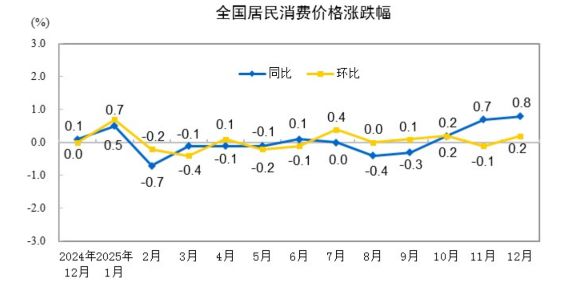
中国12月CPI环比由降转涨,同比涨幅继续扩大,核心CPI上涨1.2%
Hua Er Jie Jian Wen· 2026-01-09 01:35
Group 1: CPI Analysis - In December, the Consumer Price Index (CPI) increased by 0.8% year-on-year, up from 0.7% in the previous month, marking the highest level since March 2023 [1][4] - The core CPI, excluding food and energy, rose by 1.2% year-on-year, maintaining above 1% for four consecutive months [4] - The increase in CPI was primarily driven by a rise in food prices, which increased by 1.1%, with fresh vegetables and fruits seeing significant price hikes of 18.2% and 4.4% respectively [4][3] Group 2: PPI Analysis - The Producer Price Index (PPI) rose by 0.2% month-on-month, marking the third consecutive month of increase, with the growth rate expanding by 0.1 percentage points from the previous month [5][7] - Year-on-year, the PPI decreased by 1.9%, but the decline was narrower by 0.3 percentage points compared to the previous month, indicating some positive changes in certain industries [7] - Key industries such as coal mining and lithium-ion battery manufacturing saw price increases, reflecting improvements in supply-demand dynamics and ongoing policy effects [5][6]
国家统计局解读2025年11月份CPI和PPI数据
Guo Jia Tong Ji Ju· 2025-12-10 01:43
Group 1: CPI Analysis - The Consumer Price Index (CPI) increased by 0.7% year-on-year, marking the highest growth since March 2024, with a rise of 0.5 percentage points from the previous month [2] - Food prices shifted from a decline of 2.9% to an increase of 0.2%, contributing positively to the CPI, with fresh vegetable prices rising by 14.5% after nine months of decline [2] - Core CPI, excluding food and energy, rose by 1.2%, maintaining above 1% for three consecutive months, driven by increases in service prices and industrial consumer goods [2][3] Group 2: PPI Analysis - The Producer Price Index (PPI) increased by 0.1% month-on-month, marking two consecutive months of growth, influenced by seasonal demand increases in certain domestic industries [4] - Year-on-year, the PPI decreased by 2.2%, with the decline slightly widening by 0.1 percentage points compared to the previous month, primarily due to high comparison bases from the previous year [6] - The prices in key industries such as coal mining and photovoltaic equipment manufacturing showed a narrowing decline, indicating improvements in market competition and policy effectiveness [6]
中国10月PPI环比由平转涨,为年内首次上涨
Ge Long Hui A P P· 2025-11-09 02:11
Core Viewpoint - The Producer Price Index (PPI) has increased by 0.1% month-on-month for the first time in 2023, indicating an improvement in supply-demand relationships across various industries [1] Group 1: PPI Trends - The month-on-month PPI has shifted from flat to an increase of 0.1%, marking the first rise this year [1] - Key industries experiencing price increases include coal mining and washing (up 1.6%), coal processing (up 0.8%), and photovoltaic equipment manufacturing (up 0.6), all of which have seen continuous price rises for over two months [1] - Other sectors such as cement manufacturing, computer assembly, lithium-ion battery manufacturing, and integrated circuit manufacturing have also transitioned from price declines to increases, with respective rises of 1.6%, 0.5%, 0.2%, and 0.2% [1] Group 2: Impact of External Factors - Domestic prices in the non-ferrous metals and petroleum-related industries have shown a divergence due to external factors [1] - The rise in international non-ferrous metal prices has led to a 5.3% increase in domestic non-ferrous metal mining prices and a 2.4% increase in non-ferrous metal smelting and rolling prices, with gold and copper smelting prices rising by 8.7% and 4.3%, respectively [1] - Conversely, the decline in international oil prices has resulted in a 2.3% decrease in domestic oil and natural gas extraction prices and a 0.8% decrease in refined petroleum product manufacturing prices [1]
重要数据发布→
新华网财经· 2025-06-09 08:28
Group 1 - The core viewpoint of the article highlights the decline in the Consumer Price Index (CPI) and the increase in the core CPI, indicating a mixed economic environment with ongoing adjustments in consumer prices [2][4]. - In May, the CPI decreased by 0.2% month-on-month and 0.1% year-on-year, while the core CPI, excluding food and energy, rose by 0.6% year-on-year, an increase of 0.1 percentage points from the previous month [1][4]. - The Producer Price Index (PPI) also saw a month-on-month decline of 0.4% and a year-on-year decrease of 3.3%, with the decline in PPI year-on-year widening by 0.6 percentage points compared to the previous month [1][5]. Group 2 - The decrease in CPI was primarily influenced by a 1.7% drop in energy prices, which accounted for approximately 70% of the total decline in CPI [3][4]. - Food prices saw a slight decrease of 0.2%, with seasonal factors affecting the prices of fresh vegetables, eggs, and meat, while some fruits and fish experienced price increases due to supply constraints [3][4]. - The increase in consumer demand, driven by holiday activities and entertainment, led to a rise in hotel accommodation and tourism prices, with hotel prices reaching a near ten-year high [3][4]. Group 3 - The PPI's decline was significantly impacted by international factors, particularly the decrease in global oil prices, which affected domestic oil-related industries [6]. - Domestic energy and raw material prices also saw a seasonal decline, with coal prices dropping due to sufficient supply and low demand [6]. - Despite the overall decline in PPI, some sectors showed signs of improvement, with macroeconomic policies enhancing supply-demand relationships in certain industries [5][6]. Group 4 - The article notes that new consumption drivers are emerging, leading to a recovery in prices for daily necessities, with life goods prices stabilizing after a previous decline [7]. - High-end manufacturing and technological advancements are contributing to price increases in related industries, with significant growth in sectors like integrated circuits and aerospace manufacturing [7][8]. - The renewable energy sector, including solar and lithium battery industries, is experiencing improved supply-demand dynamics, resulting in a narrowing of price declines [8].

中创新航拟11.8亿入主苏奥传感,5.1亿买了控股权!
梧桐树下V· 2025-05-16 03:09
Core Viewpoint - The control of Su Ao Sensor is set to change hands from its current major shareholder, Li Hongqing, to Zhong Chuang Xin Hang Technology Group, which will acquire a controlling stake through a share transfer agreement and a voting rights waiver agreement [1][2]. Group 1: Share Transfer and Control Change - Li Hongqing will transfer 87,620,380 shares (11% of total shares) to Zhong Chuang Xin Hang at a price of 5.83 CNY per share, totaling approximately 510.83 million CNY [1]. - After the transfer, Li Hongqing will hold 203,500,324 shares (25.55% of total shares), while Zhong Chuang Xin Hang will hold 87,620,380 shares (11% of total shares) with voting rights [2]. - Zhong Chuang Xin Hang will become the controlling shareholder of Su Ao Sensor after the completion of the share transfer and voting rights waiver [2][3]. Group 2: Fundraising and Project Investment - Zhong Chuang Xin Hang plans to issue up to 119,482,337 A-shares at a price of 5.63 CNY per share, raising a maximum of approximately 672.69 million CNY, which will be used for the AMB copper-clad laminate construction project [2][3]. - The total investment for the AMB project is estimated at 862.06 million CNY, with the raised funds covering the majority of this cost [2]. Group 3: Financial Performance of Zhong Chuang Xin Hang - As of March 31, 2025, Zhong Chuang Xin Hang reported total assets of 12.25 billion CNY and net assets of 4.81 billion CNY, with a revenue of 2.78 billion CNY and a net profit of 84.36 million CNY for the year 2024 [5][7]. - The company has shown a consistent increase in total assets and net profit over the past three years, indicating a strong financial position [7]. Group 4: Su Ao Sensor's Business Overview - Su Ao Sensor specializes in manufacturing sensors and automotive components, with a focus on the automotive core electronics sector [9]. - The company reported a revenue of 1.67 billion CNY in 2024, a year-on-year increase of 48.87%, primarily driven by growth in new energy component sales [10][11]. - The net profit for 2024 was approximately 138 million CNY, reflecting an 11.31% increase compared to the previous year [10][11]. Group 5: Future Commitments and Performance Guarantees - The share transfer agreement includes a performance commitment where Su Ao Sensor is expected to achieve a net profit of at least 178 million CNY in 2025 and 195 million CNY in 2026 [13][14]. - If the actual net profit falls below these targets, Li Hongqing will be required to compensate Zhong Chuang Xin Hang, with a maximum compensation cap of 80 million CNY [14].