
TMT

Search documents
策略周报:“春躁”调整期,静待AI催化-20260208
Bank of China Securities· 2026-02-08 15:21
Core Insights - The report indicates that the "Spring Fever" market is entering a phase of adjustment, with expectations for technology growth to regain prominence post-holiday, particularly in AI applications which may see a rebound [2][12] - The report emphasizes that while there are short-term fluctuations in the non-ferrous metals sector, the long-term re-evaluation logic remains intact, driven by financial attributes and industrial trends [13] - AI applications are anticipated to experience a bottoming rebound, with significant updates expected from leading domestic firms around the Spring Festival, suggesting potential investment opportunities in the AI industry chain [30][31] Market Overview - The market is currently characterized by a shrinking volume and oscillating patterns, with structural opportunities still present despite a lack of systemic rebound momentum [12] - The report notes that the recent volatility in overseas commodity prices has contributed to a weakening market, with a rotation among sectors and active individual stocks [12][23] - The report highlights that the consumer sector is beginning to recover, while previously overvalued technology and non-ferrous sectors are undergoing adjustments [12] Industry and Economic Data - The report provides insights into key economic indicators, such as the ISM manufacturing PMI in the US, which rose to 52.6, and China's foreign exchange reserves, which increased to $33,990.8 million [17] - It also notes that the non-ferrous metals sector is facing increased short-term volatility, but the long-term demand-supply dynamics remain favorable due to tightening global copper supply and emerging demand [13] AI Sector Insights - The report discusses the recent downturn in the AI industry, driven by uncertainties surrounding business models and real demand, particularly following Microsoft's financial disclosures and Nvidia's investment stance on OpenAI [27][28] - It argues that traditional SaaS companies are well-positioned to leverage their industry knowledge and data advantages to build new barriers in the AI era, despite market concerns about self-built AI systems being inefficient and costly [29] - The report anticipates that the upcoming updates from major AI models around the Spring Festival could catalyze a rebound in AI applications, suggesting a focus on investment opportunities in AI applications, cloud services, and storage [30][31]
A股分析师前瞻:兼具胜率与赔率,策略分析师普遍看好持股过节
Xuan Gu Bao· 2026-02-08 13:49
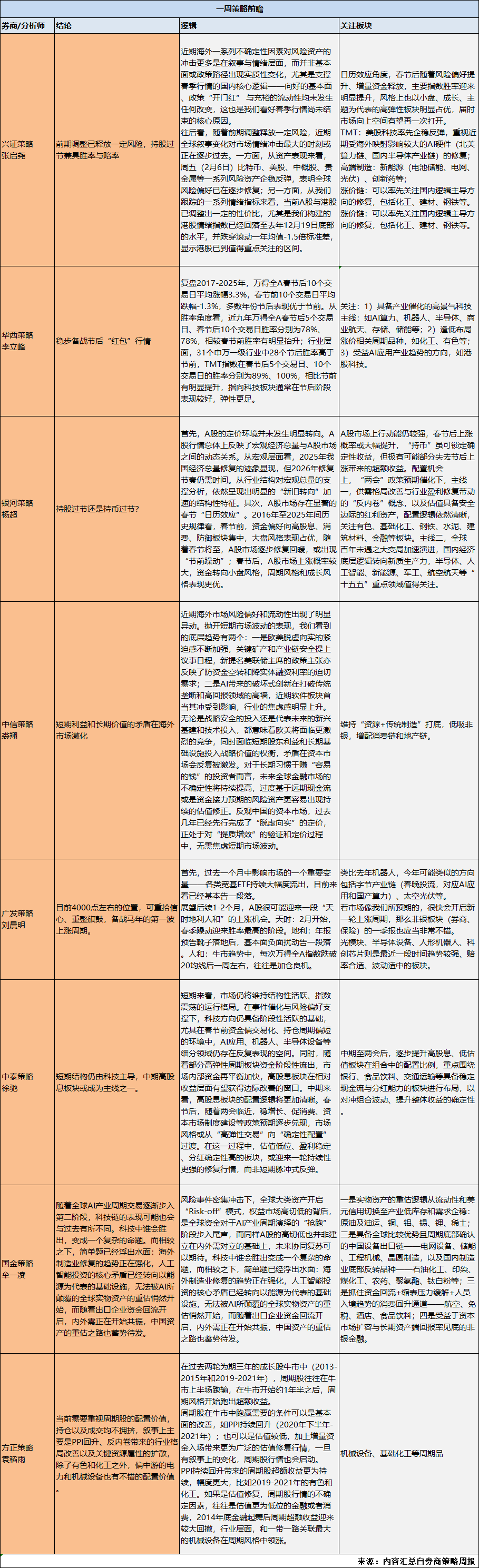
本周各家券商策略分析师讨论的焦点在于是否持股过节,整体偏向乐观。 华西策略李立峰团队也指出,可稳步备战节后"红包"行情。 其复盘2017-2025年,万得全A春节后10个交易日平均涨幅3.3%,春节前10个交易日平均跌幅-1.3%,多数年份节后表现优于节 前。从胜率角度看,近九年万得全A春节后5个交易日、春节后10个交易日胜率分别为78%、78%,相较春节前胜率有明显抬升; 行业层面,31个申万一级行业中28个节后胜率高于节前,TMT指数在春节后5个交易日、10个交易日的胜率分别为89%、100%, 相比节前有明显提升,指向科技板块通常在节后阶段表现较好,弹性更足。 银河策略杨超团队称,A股市场上行动能仍较强,春节后上涨概率或大幅提升,"持币"虽可锁定确定性收益,但极有可能部分失 去节后上涨带来的超额收益。以2016年至2025年间历 史规律看,春节前,资金偏好向高股息、消费、防御板块集中,大盘风格表现占优,随着春节将至,A股市场逐步修复回暖,或 出现"节前躁动";春节后,A股市场上涨概率较大,资金转向小盘风格,周期风格和成长风格表现更优。 广发策略刘晨明团队指出,目前4000点左右的位置,占据天时地利人和。 ...

兴证策略:前期调整释放一定风险 持股过节兼具胜率与赔率
Xin Lang Cai Jing· 2026-02-08 10:18
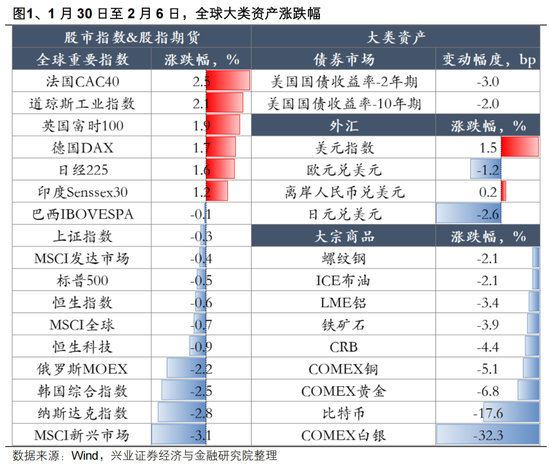
由此来看,近期海外一系列不确定性因素对风险资产的冲击更多是在叙事与情绪层面,而并非基本面或 政策路径出现实质性变化,尤其是支撑春季行情的国内核心逻辑——向好的基本面、政策"开门红" 与 充裕的流动性均未发生任何改变,这也是我们看好春季行情尚未结束的核心原因。 往后看,随着前期调整释放一定风险,近期全球叙事变化对市场情绪冲击最大的时刻或正在逐步过去。 一方面,从资产表现来看,周五(2月6日)比特币、美股、中概股、贵金属等一系列风险资产企稳反 弹,表明全球风险偏好已在逐步修复;另一方面,从我们跟踪的一系列情绪指标来看,当前A股与港股 已调整出一定的性价比,尤其是我们构建的港股情绪指数已经回落至去年12月19日底部的水平,并跌穿 滚动一年均值-1.5倍标准差,显示港股已到值得重点关注的区间。 从事件催化和日历效应的角度来看,后续也将逐步进入一个有利于权益资产演绎的良好环境。事件催化 角度,下周即将进入中美宏观数据的披露窗口,国内物价、社融等数据对于基本面改善的验证值得期 待,美国非农和CPI数据也有望对货币政策预期形成校准。此外,国内外AI应用等产业层面的密集催化 也有望在春节前后集中演绎。经历近期轮动加快、主线降 ...
兴证策略张启尧团队:持股过节吗?
Xin Lang Cai Jing· 2026-02-08 09:07
Group 1 - The recent global risk asset adjustment is primarily driven by narrative and sentiment rather than fundamental or policy changes, indicating a rebalancing of global assets and internal styles [10][25][32] - The core logic supporting the spring market remains unchanged, with positive fundamentals, favorable policies, and ample liquidity still in place [3][25][28] - The upcoming macro data releases from China and the US are expected to validate improvements in fundamentals, which could enhance market sentiment [7][28] Group 2 - The post-Spring Festival market is anticipated to favor technology manufacturing, resource products, and infrastructure chains, driven by an increase in risk appetite [11][32] - Key sectors to focus on include TMT (Technology, Media, and Telecommunications), high-end manufacturing (such as renewable energy and innovative pharmaceuticals), and price recovery chains (including chemicals, building materials, and steel) [14][35][38] - The AI application sector is expected to see concentrated catalysts, with its current crowding level being reasonable, making it a focal point for investment [17][38]
新股上市时间在哪看?散户必知的4种查询方法
Sou Hu Cai Jing· 2026-02-06 23:13
Core Viewpoint - The implementation of a comprehensive registration system has led to both new stock price drops and surges, making it essential for retail investors to accurately grasp listing times and scientifically analyze subsequent trends to avoid pitfalls in new stock participation [1] Group 1: Information Sources - The official websites of the Shanghai and Shenzhen Stock Exchanges are the primary platforms for new stock information, providing accurate and timely updates without risks of delays or misleading information [3] - Securities company apps, such as those from Dongfang Caifu and Tonghuashun, offer convenient access to new stock information, including listings and subscription details, and allow for one-stop operations [4] - The China Securities Regulatory Commission (CSRC) website provides a source for compliance information, allowing investors to track the approval and registration progress of new stocks [5] - Authoritative financial platforms like Securities Times and Eastmoney aggregate new stock information, offering comprehensive data including listing times and price-earnings ratios [6] Group 2: Investment Strategy - The first step in investment strategy is to assess industry heat, as new stocks in popular sectors are more likely to attract capital and have a lower probability of price drops [7] - Preferred sectors include those supported by policies and high-growth areas such as semiconductors and TMT, which tend to receive strong capital interest [8] - An example is the stock of JN Robotics, which saw a 227.27% increase on its first day due to the favorable conditions in its sector [9] - Conversely, traditional industries with overcapacity and weak growth, such as low-end manufacturing, are more likely to experience price drops [10] Group 3: Valuation Assessment - The core reason for new stock price drops under the registration system is high valuations, necessitating a comparison of valuations before participating in new stock offerings [11] - A key indicator is the issuance price-earnings ratio; if it exceeds the industry average by more than 30%, the stock is likely overvalued, increasing the risk of price drops [12] - Practical tips include comparing the company's valuation metrics with industry leaders and avoiding participation if the valuation is significantly high [13] Group 4: Monitoring Capital Trends - The short-term performance of newly listed stocks is primarily influenced by capital sentiment, requiring close attention to trading volume and institutional movements [14] - Strong signals include significant price increases on the first day with high institutional net buying, indicating strong capital support [15] - Conversely, signals of risk include price drops on the first day with substantial institutional net selling, suggesting significant capital divergence [16] - It is important to note that under the registration system, new stocks have no price fluctuation limits in the first five days, leading to high volatility [17] Group 5: Conclusion - Retail investors should rely on authoritative channels to confirm listing times and use a three-dimensional approach of industry, valuation, and capital trends to assess value, while strictly adhering to risk management practices [18] - The new stock market is increasingly polarized under the registration system, and blind participation can lead to losses; rational inquiry and scientific analysis are crucial for retail investors [19]
安永2025年中国海外投资概览
EY· 2026-02-06 04:10
Investment Rating - The report indicates a positive investment outlook for Chinese overseas investments, with a focus on high-quality growth and strategic cooperation in global markets [5][12]. Core Insights - Chinese enterprises' overseas direct investment (ODI) reached USD 174.4 billion in 2025, marking a year-on-year increase of 7.1%. Non-financial ODI was USD 145.7 billion, up 1.3% [12][25]. - Investment in countries participating in the Belt and Road Initiative (BRI) saw a significant increase, with non-financial ODI amounting to USD 39.7 billion, a growth of 17.6% [25]. - The report highlights a notable recovery in overseas mergers and acquisitions (M&A), with announced transaction amounts reaching USD 43.6 billion, a nearly 40% increase year-on-year [36][39]. - The global economic landscape is characterized by resilience despite challenges, with a projected growth rate of 3.1% for 2026 [5][59]. Summary by Sections 1. Overview of Chinese Overseas Investment in 2025 - The report outlines that China's GDP grew by 5% in 2025, surpassing 140 trillion RMB for the first time [5]. - The overall ODI growth reflects a robust performance amid global economic uncertainties [5][12]. 2. Key Highlights of Chinese Enterprises Going Abroad - Direct investment in BRI countries accounted for 27% of total ODI, an increase of 4 percentage points from the previous year [25]. - New contracts signed in overseas projects reached USD 289.2 billion, up 8.2%, with completed turnover at USD 178.8 billion, a 7.7% increase [51]. 3. Analysis of Overseas M&A - The number of M&A transactions was 429, a slight decrease of 1%, but the value of large transactions (over USD 1 billion) increased significantly [36][39]. - The most active sectors for M&A included consumer goods, TMT (Technology, Media, and Telecommunications), and mining and metals [39][42]. 4. Factors Influencing Overseas Investment in 2026 - The report anticipates continued high-quality outbound investment, driven by China's strategic focus on expanding domestic demand and optimizing investment structures [5][59]. - Geopolitical dynamics and trade relations, particularly with the U.S. and European countries, are expected to shape investment strategies [5][66]. 5. Policy Support for Overseas Investment - The report emphasizes the Chinese government's commitment to enhancing support for enterprises going abroad, including the establishment of a comprehensive service system for overseas operations [17][20].
景顺长城科技军团郭琳:看好科技、互联网、周期资源品、制造业出海等
Xin Lang Cai Jing· 2026-02-04 09:15
Core Viewpoint - The A-share market has entered a phase of fluctuation and adjustment after a continuous rise at the beginning of the year, with popular sectors like commercial aerospace, gold, and silver also experiencing corrections. A balanced investment strategy across different industries is recommended to capture opportunities and mitigate risks associated with concentrated investments [1][7]. Investment Strategy - The newly issued fund, Invesco Great Wall Smart Mixed Fund (code: 026709), is managed by Guo Lin, a member of the Invesco Great Wall Technology Legion, who emphasizes a growth-oriented investment style with balanced allocations across various sectors [1][3]. - Guo Lin's investment philosophy focuses on "trends, timing, and cost," seeking to identify sub-industries with mid-term growth potential by analyzing industry policies, technological innovations, and supply-demand changes [3][9]. Portfolio Composition - In Guo Lin's managed funds, over 50% of the holdings are in growth-style stocks, primarily concentrated in TMT (Technology, Media, and Telecommunications), with additional allocations in non-ferrous metals, pharmaceuticals, military, and new consumption sectors [4][10]. - The fund has shown strong performance, with returns of 54.77% and 98.12% over the past 1 and 2 years, respectively, significantly outperforming the benchmark [10]. Market Outlook - The A-share market is currently fluctuating around the 4000-point mark, with expectations of increased trading volume and active performance in growth sectors due to a favorable liquidity environment [5][11]. - Guo Lin suggests that the first quarter is an opportune time for stock selection, as many companies will provide clearer guidance for the new year, and the market is expected to undergo differentiation after an active investment phase [12]. Fee Structure - The Invesco Great Wall Smart Mixed Fund employs a floating fee structure linked to excess returns, aligning the interests of the fund manager with those of investors and promoting a focus on sustainable long-term performance [6][12].

IREN: Why The AI Transition Still Isn't Fully Priced In
Seeking Alpha· 2026-02-03 15:23
Core Viewpoint - IREN is expected to report its 2Q26 results, and the stock is maintained as a buy ahead of the earnings announcement [1] Company Analysis - The analyst has a background as a retired Wall Street portfolio manager specializing in Technology, Media, and Telecommunications (TMT) [1] - The analyst has over two decades of experience in the market, focusing on risk mitigation during significant market events such as the dot-com bubble, the credit default crisis of 2008, and the recent AI boom [1] - The investment strategy revolves around momentum, indicating a focus on stocks that are trending positively [1]


节前债稳,节后股暖?
Hua Er Jie Jian Wen· 2026-02-03 13:27
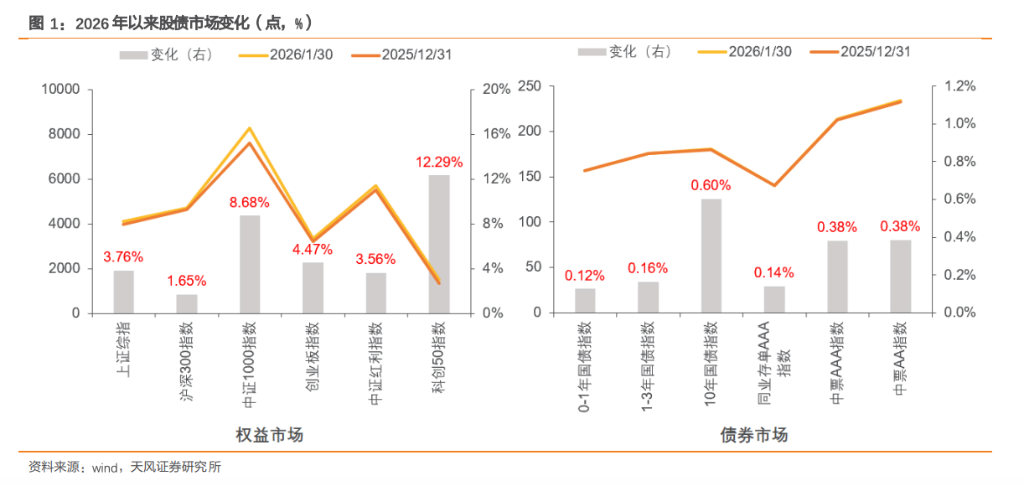
Core Viewpoint - The market performance at the beginning of 2026 is breaking traditional historical patterns, with significant divergence between stocks and bonds observed in the Chinese capital market [1]. Market Environment - The A-share market is expected to experience a "spring rally" after the Spring Festival, with a shift from a defensive large-cap style to a growth-oriented small-cap style [1][5]. - The bond market has shown a "V-shaped" recovery after initial pressure, with a structural interest rate cut of 0.25% by the central bank in January, leading to a stabilization in market sentiment [3][12]. Historical Patterns - Historical data from 2015 to 2025 indicates a clear seasonal pattern in the A-share market, with a 63.64% probability of the CSI 300 index rising in the 30 days before the Spring Festival, while the probability for the CSI 1000 index is only 27.27% [5][6]. - Post-Spring Festival, the CSI 300 index has a 72.73% probability of rising, with an average increase of 3.15%, while the CSI 1000 index shows an 81.82% probability and an average increase of 8.71% [5][6]. Bond Market Dynamics - The bond market typically shows strength in the 30 days before the Spring Festival due to increased liquidity and strong demand from institutional investors, with a historical average decline of 5.73 basis points in the 1-year bond yield [7][11]. - After the Spring Festival, the bond market may face upward pressure on yields due to changes in policy expectations and increased supply, with an average increase of 1.03 basis points in the 10-year bond yield [7][11]. 2026 Outlook - The foundation for the "spring rally" is expected to be stronger this year due to favorable policy expectations, global liquidity conditions, and a trend of residents allocating more assets to equity markets [12]. - Consumer demand is anticipated to be released earlier than in previous years due to an extended holiday, with expectations for increased spending on travel and consumption [12]. - The bond market is likely to experience a range-bound trading pattern, with reduced necessity for further rate cuts following the January reduction [12]. Potential Changes in Patterns - The traditional "strong bonds, weak stocks" model before the Spring Festival may be disrupted this year, with both markets potentially showing support and increased competition [13]. - The typical post-Spring Festival shift to small-cap growth may be weakened, as large-cap growth could perform well alongside high-dividend assets, leading to a mixed market style rather than a clear transition [13][14].
——量化资产配置月报202602:低波因子表现回归、形成共振-20260202
Shenwan Hongyuan Securities· 2026-02-02 06:26
Group 1 - The report indicates a return of low volatility factors, forming a resonance in the current market environment, with economic indicators showing a weakening trend, liquidity slightly easing, and credit indicators remaining weak [2][8][11] - The report emphasizes the selection of factors that are insensitive to economic changes but sensitive to liquidity and credit, highlighting the low volatility factor in the CSI 300 as a key resonant factor [5][9][11] - The macroeconomic outlook suggests a continued downtrend in economic indicators, with the economic forecast model indicating that February 2026 is at the beginning of a decline that started in December 2025 [11][12][13] Group 2 - The liquidity environment is assessed as slightly easing, with short-term interest rates declining and monetary supply showing a neutral signal, while excess reserves are decreasing [18][21][23] - Credit indicators are showing a weakening trend, with credit spreads widening and overall credit metrics declining, indicating a contraction in credit availability [24][25] - The asset allocation strategy suggests a slight allocation to US stocks, with a neutral stance on A-shares and a positive outlook on gold based on momentum [26][28] Group 3 - The report identifies PPI as the most closely monitored variable, with inflation concerns rising and liquidity becoming a significant focus for the market [28] - The industry selection is biased towards TMT (Technology, Media, and Telecommunications) and consumer sectors, based on macroeconomic indicators and their sensitivity to economic changes [29]