
工业

Search documents
指数的新质生产力属性增强
Qi Huo Ri Bao· 2025-12-17 02:40
Group 1 - The A-share market regularly adjusts index constituents in June and December to maintain representativeness and investability [1] - The CSI 300 index replaced 11 constituents, adding companies like Huadian New Energy and Dongshan Precision, with increases in the information technology and communication services sectors [1] - The average P/E ratio of removed constituents from the CSI 300 was approximately 25.95 times, while the average P/E ratio of added constituents was about 35.23 times [1] Group 2 - The CSI 500 index replaced 50 constituents, adding companies such as Zhongtung High-tech and Huahong Semiconductor, with an increase in the industrial sector [2] - The average P/E ratio of removed constituents from the CSI 500 was around 27.17 times, while the average P/E ratio of added constituents was approximately 34.30 times [2] - The CSI 1000 index replaced 100 constituents, adding companies like Shijia Photon and Yongding Co., with increases in the communication services and industrial sectors [2] Group 3 - The adjustments across indices generally increased the sample size and weight of sectors like information technology, communication services, and industrial, enhancing the indices' productivity attributes [3] - The overall market capitalization coverage of the CSI 300, CSI 500, and CSI 1000 indices remains significant, indicating strong market representation and influence on market sentiment [3] - The adjustments will lead to corresponding changes in ETFs and other funds tracking these indices, significantly impacting the prices of related stocks [3] Group 4 - Newly included stocks typically experience price increases and higher trading volumes, while excluded stocks often see price declines and reduced trading volumes [4] - Historical data suggests that index adjustments lead to short-term positive performance due to increased attention and capital influx, but the long-term impact on index trends is limited [4]
田中精机:12月16日召开董事会会议
Mei Ri Jing Ji Xin Wen· 2025-12-16 13:32
Group 1 - The core point of the article is that Tianzhong Precision Machinery (SZ 300461) announced a board meeting to discuss increasing equity in an associated company and related transactions [1] - The company's revenue composition for the year 2024 is 100% from the industrial sector [1] - As of the report, Tianzhong Precision Machinery has a market capitalization of 3 billion yuan [1]

ST复华:本次上科科技被轮候冻结股份总计6920万股
Mei Ri Jing Ji Xin Wen· 2025-12-16 12:33
每经头条(nbdtoutiao)——中标企业频频弃标 大型医疗设备采购有何难言之隐? 每经AI快讯,ST复华(SH 600624,收盘价:5.66元)12月16日晚间发布公告称,上海上科科技投资有 限公司(以下简称"上科科技")为上海复旦复华科技股份有限公司(以下简称"公司")持股5%以上非 控股股东。截至公告披露日,上科科技持有公司股份共计69,206,536股,占公司总股本的10.1872%,其 中质押的公司股份数量为69,202,880股,占其所持公司股份总数的99.9947%,占公司总股本的 10.1867%。本次上科科技被轮候冻结股份总计69,206,536股,占其所持公司股份的100%。 (记者 曾健辉) 2024年1至12月份,ST复华的营业收入构成为:工业占比48.28%,软件开发占比42.88%,房地产业占比 6.57%,其他业务占比2.27%。 截至发稿,ST复华市值为38亿元。 ...

科技方向集体回调,资金逆势加仓,成长ETF(159259)全天获3000万份净申购
Sou Hu Cai Jing· 2025-12-16 10:22
Core Viewpoint - The technology sector experienced a pullback today, with popular concepts such as CPO, optical chips, and optical communication collectively declining over 3%. Despite this, there was a counter trend in funding, with the Growth ETF (159259) seeing a net subscription of 30 million shares throughout the day [1]. Group 1: Index Performance - The National Securities Value 100 Index fell by 0.9% [1]. - The National Securities Free Cash Flow Index decreased by 1.2% [1]. - The National Securities Growth 100 Index dropped by 2.1% [1]. Group 2: Growth ETF Details - The Growth ETF (159259) tracks the National Securities Growth 100 Index, which focuses on A-share stocks with prominent growth styles [3]. - Over 70% of the index's weight is concentrated in the electronics, communication, and computer sectors, aligning with the core aspects of AI computing power [1][3]. - The Growth ETF is the only product that tracks this index, providing investors with opportunities to capitalize on growth-style investments [1].


ST复华:12月16日召开董事会会议
Mei Ri Jing Ji Xin Wen· 2025-12-16 09:01
每经AI快讯,ST复华(SH 600624,收盘价:5.66元)12月16日晚间发布公告称,公司第十一届第十九 次董事会会议于2025年12月16日以通讯方式召开。会议审议了《关于聘任公司副总经理的议案》等文 件。 2024年1至12月份,ST复华的营业收入构成为:工业占比48.28%,软件开发占比42.88%,房地产业占比 6.57%,其他业务占比2.27%。 截至发稿,ST复华市值为38亿元。 每经头条(nbdtoutiao)——中标企业频频弃标 大型医疗设备采购有何难言之隐? (记者 王晓波) ...
服务消费稳固,智能经济消费展现高成长性
China Post Securities· 2025-12-16 08:54
Group 1 - The core viewpoint of the report indicates that China's economy continues to develop steadily, characterized by "demand decline and stable production" as of November [2] - Retail sales growth has shown a declining trend, with a year-on-year growth rate of 1.3% in November, down 1.6 percentage points from the previous value, marking six consecutive months of marginal slowdown [8] - Service consumption remains robust, while smart economy consumption, such as smart wearables and digital consumption, exhibits high growth potential [2][8] Group 2 - Fixed asset investment has seen a cumulative year-on-year decline of 2.6% from January to November, with the real estate market undergoing deep adjustments and construction investment growth in negative territory [15] - The average price of commercial housing in November was 9096.64 yuan per square meter, a year-on-year decrease of 9.94%, indicating a bottoming process in housing prices [16] - Industrial value-added growth remained relatively stable at 4.8% year-on-year in November, with mining and high-tech industries showing significant growth [28]
劲拓股份:12月15日召开董事会会议
Mei Ri Jing Ji Xin Wen· 2025-12-16 08:22
Group 1 - The company, Jintuo Co., Ltd. (SZ 300400), announced that its sixth board meeting will be held on December 15, 2025, in Shenzhen, where it will discuss the appointment of a new vice president and board secretary [1] - For the year 2024, the company's revenue composition is reported to be 100% from the industrial sector [1] - The current market capitalization of Jintuo Co., Ltd. is 4.4 billion yuan [2]

超频三:12月16日召开董事会会议
Mei Ri Jing Ji Xin Wen· 2025-12-16 08:17
截至发稿,超频三市值为31亿元。 每经头条(nbdtoutiao)——中标企业频频弃标 大型医疗设备采购有何难言之隐? (记者 王晓波) 每经AI快讯,超频三(SZ 300647,收盘价:6.67元)12月16日晚间发布公告称,公司第四届第十三次 董事会会议于2025年12月16日在公司会议室召开。会议审议了《关于控股股东、实际控制人向公司提供 借款展期暨关联交易的议案》等文件。 2025年1至6月份,超频三的营业收入构成为:工业占比96.54%,其他行业占比3.46%。 ...
中省媒体摄影名家走进巴中通江 见证发展感受巨变
Zhong Guo Xin Wen Wang· 2025-12-16 06:56
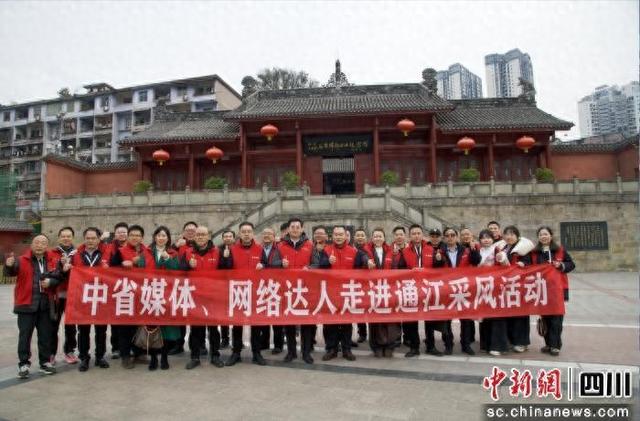
Core Viewpoint - The event "Retracing the Red Army Route" highlights the historical significance and cultural richness of Tongjiang County, while promoting its economic development through media engagement and tourism [2]. Group 1: Historical and Cultural Significance - Tongjiang County is the capital of the Sichuan-Shanxi Revolutionary Base, rich in red history, where the Fourth Front Army of the Chinese Workers' and Peasants' Red Army established a revolutionary base lasting 2 years and 5 months starting from December 1932 [2]. - The photography team visited significant historical sites such as the former headquarters of the Fourth Front Army and various memorials to honor the sacrifices made during the revolutionary period [2][3]. Group 2: Economic and Developmental Aspects - The photography team explored various sectors including agriculture, industry, and cultural tourism, documenting the rapid changes and achievements in these areas [2]. - Tongjiang County is recognized for its rich natural resources, including 580.3 billion cubic meters of natural gas geological resources and 8 million tons of limestone resources, indicating a promising development outlook [7]. - The county has implemented policies to optimize the business environment, including the establishment of a "Happiness Center" for enterprise communication and support for patent acquisition, with 47 companies obtaining 464 patents [7]. Group 3: Tourism and Promotion - The event aimed to enhance the visibility and influence of Tongjiang County, contributing to high-quality economic and social development through the promotion of its red culture and natural beauty [2][5]. - The photography tour included four thematic routes: red historical exploration, green ecological experience, characteristic industry observation, and historical culture exploration, showcasing the integration of various aspects of Tongjiang's development [5].
港股市场估值周报:2025.12.08-2025.12.14-20251216
Zhe Shang Guo Ji Jin Rong Kong Gu· 2025-12-16 05:59
Valuation of Hong Kong Stock Market - The Hang Seng Composite Index (HSCI) and Hang Seng Index (HSI) are key indicators of market valuation[8][12] - The Hang Seng Technology Index (HSTECH) reflects the valuation trends in the tech sector[16][18] Industry Valuation Levels - The PE (TTM) valuation shows that the utilities sector is undervalued, with a percentile below 20%[23] - Consumer discretionary, consumer staples, healthcare, information technology, and utilities are below the 50th percentile in PE valuation[23] - High valuation sectors (above 50%) include energy, materials, industrials, financials, and telecommunications[23] - No sectors are currently undervalued based on PB (LF) valuation, with consumer staples, information technology, utilities, and real estate below the 50th percentile[27] - Energy, materials, industrials, consumer discretionary, healthcare, financials, and telecommunications are above the 50th percentile in PB valuation[27] AH Share Premium/Discount Levels - The Hang Seng AH Share Premium Index shows fluctuations in premium levels over time, with historical averages and standard deviations noted[33]