数码

Search documents
最新发布!重大利好!
天天基金网· 2025-12-31 01:17
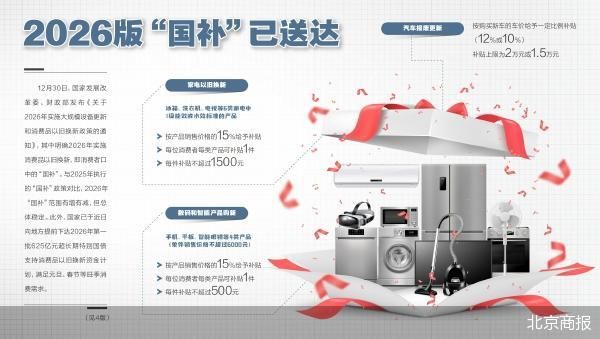
上天天基金APP搜索777注册即可领500元券包,优选基金10元起投!限量发放!先到先得! 2026年"国补"政策来了! 12月30日晚间消息,国家发改委、财政部印发《关于2026年实施大规模设备更新和消费品以旧换新政策 的通知》,明确2026年"两新"政策的支持范围、补贴标准和工作要求。 2026年,将继续实施汽车报废更新和汽车置换更新补贴;继续实施家电以旧换新补贴,支持范围聚焦冰 箱、洗衣机、电视、空调、电脑、热水器等6类产品;同时,将数码产品购新补贴拓展为数码和智能产品 购新补贴,支持范围包括手机、平板、智能手表(手环)、智能眼镜和智能家居产品。 另据新华社报道,近日,国家发改委会同财政部,已向地方提前下达2026年第一批625亿元超长期特别 国债支持消费品以旧换新资金计划。 两部门重磅发布 12月30日,国家发展改革委、财政部印发的《关于2026年实施大规模设备更新和消费品以旧换新政策的 通知》(以下简称"通知")对外发布。据悉,2026年"两新"政策主要做了3个方面优化: 一是优化支持范围。设备更新方面,总体延续2025年支持范围,在民生领域增加老旧小区加装电梯、养 老机构设备更新,在安全领域增加消 ...

12月31日证券之星早间消息汇总:2026年“国补”政策来了
Sou Hu Cai Jing· 2025-12-31 00:48
Macro News - The National Development and Reform Commission and the Ministry of Finance issued a notice on the implementation of large-scale equipment updates and consumer goods replacement policies in 2026, outlining support scope, subsidy standards, and work requirements [1] - The policy includes subsidies for replacing old home appliances, with consumers receiving 15% of the sales price as a subsidy for purchasing energy-efficient appliances, capped at 1,500 yuan per item [1] - The policy also supports the purchase of digital and smart products, offering a similar subsidy structure, with a cap of 500 yuan per item for products priced under 6,000 yuan [1] - Additionally, the policy provides subsidies for scrapping old cars, with 12% of the purchase price for new energy vehicles (up to 20,000 yuan) and 10% for fuel vehicles with an engine size of 2.0 liters or less (up to 15,000 yuan) [1] Industry News - The Ministry of Industry and Information Technology and other departments released the "Automobile Industry Digital Transformation Implementation Plan," aiming for significant improvements in smart manufacturing capabilities and digital levels by 2027 [2] - By 2030, the plan envisions a high level of digital and intelligent development in the industry, with deep integration of digitalization and business, and a well-established digital public service system [2] - The National Defense Science and Technology Industry Bureau emphasized the need to promote commercial aerospace development and accelerate the construction of a strong aerospace nation [2] - The Ministry of Education plans to advance artificial intelligence in education, with policies expected next year to enhance AI education and applications [2] Overseas News - U.S. stock indices closed lower on December 30, with the Dow Jones down 94.87 points, S&P 500 down 9.5 points, and Nasdaq down 55.27 points, marking three consecutive days of decline [3] - The Federal Reserve's December meeting minutes revealed significant internal disagreements, with a 25 basis point rate cut approved, lowering the target range to 3.50% to 3.75% [3] - The decision had the highest number of dissenting votes since 2019, indicating a divided stance among Fed members regarding the rate cut [3]
积极识变应变求变,牢牢把握战略主动(人民观点)
Ren Min Ri Bao· 2025-12-31 00:37
善于识变应变求变,于变局中稳大局、开新局,是我们党领导人民战胜一切风险挑战、牢牢把握战略主 动的重要方法。 2026年我们将迎来"十五五"开局之年。党的二十届四中全会深刻把握世界大势和时代潮流,就"十五 五"时期我国发展面临的环境作出重大判断,对事关全局的战略任务进行顶层设计和战略擘画。全会审 议通过的"十五五"规划建议,事关我国未来5年发展的新蓝图,是以习近平同志为核心的党中央发扬历 史主动精神的重要体现,是我们党准确识变、科学应变、主动求变的实践成果,为我们掌握主动、赢得 未来提供了重要遵循。 确保"十五五"开好局、起好步,一个重要方面就是增强识变应变求变的自觉和本领,以历史主动精神克 难关、战风险、迎挑战,奋力开创中国式现代化建设新局面。 (一) 正确判断形势是科学决策的重要前提。 保持战略清醒,面对前进道路上必然会遇到的风险挑战、矛盾问题,始终做到胸中有数,正是我们掌握 历史主动的重要基础。 习近平总书记指出,"正确认识党和人民事业所处的历史方位和发展阶段,是我们党明确阶段性中心任 务、制定路线方针政策的根本依据"。 从直面"三期叠加"的复杂局面,作出我国经济发展进入新常态的判断,到把握结构失衡、环境 ...
2026“国补”继续!“两新”政策部署来了,将优化支持范围
Xin Hua She· 2025-12-30 23:21
Core Viewpoint - The 2026 "National Subsidy" policy has been announced, focusing on large-scale equipment updates and the replacement of consumer goods, with specific support for electric vehicles and smart products like smart glasses [1][6]. Group 1: Support Scope Optimization - The support scope for equipment updates will continue from 2025, adding new categories such as the installation of elevators in old residential areas and equipment updates in elderly care institutions [2][7]. - In the consumer goods replacement program, the focus will be on key consumer products with strong market impact, including continued subsidies for vehicle scrappage and replacement, as well as for six categories of home appliances [2][7]. - The subsidy for digital products will now include smart products, covering smartphones, tablets, smartwatches, smart glasses, and smart home products [2][7]. Group 2: Subsidy Standard Optimization - The subsidy for updating old residential elevators will shift from a fixed amount to a tiered system based on the number of floors [3][8]. - For scrapping old commercial vehicles, there will be a priority for replacing them with electric vehicles [3][8]. - The consumer goods replacement subsidy will maintain the upper limit for vehicle subsidies while adjusting the fixed subsidy to a percentage of the vehicle price; home appliance subsidies will be set at 15% of the price for energy-efficient products, with a maximum of 1,500 yuan per item [3][8]. Group 3: Implementation Mechanism Optimization - The project application and review processes will be streamlined to lower the investment threshold for applications, enhancing support for small and medium-sized enterprises [4][9]. - The funding distribution method will be optimized, and strict measures will be taken against fraudulent claims and price inflation before subsidies [4][9]. - A unified subsidy standard will be implemented nationwide for vehicle scrappage, replacement, and six categories of home appliances, with coordination among various government departments to ensure effective policy execution [4][9].
“两新”政策三大方面优化升级 首批625亿超长期特别国债已下达
Chang Jiang Shang Bao· 2025-12-30 23:19
Core Viewpoint - The 2026 policy for large-scale equipment updates and consumer goods trade-in aims to stimulate economic recovery through targeted subsidies and support measures [2][3][7]. Group 1: Policy Overview - The National Development and Reform Commission (NDRC) and the Ministry of Finance released a notification detailing the 2026 "Two New" policy, which includes 23 specific measures across five sections [2][6]. - The policy focuses on optimizing support scope, subsidy standards, and implementation mechanisms to enhance its effectiveness [2][7]. Group 2: Economic Impact - In 2025, the "Two New" policy significantly boosted consumption and investment, with equipment investment growing by 14% year-on-year, contributing 2 percentage points to overall investment growth [3]. - The trade-in program for consumer goods generated over 2.5 trillion yuan in sales, with over 1.12 million vehicles and 128 million home appliances traded in [3]. Group 3: Sectoral Growth - The manufacturing value added in general and smart consumer equipment sectors increased by 9.4% and 11.4% respectively, with over 80% of funding for equipment updates benefiting private enterprises [4]. - The recycling of waste electrical and electronic products saw a 70% year-on-year increase, indicating progress in resource recycling systems [4]. Group 4: Policy Adjustments - The 2026 policy expands support to include the installation of elevators in old residential areas and updates for equipment in elderly care institutions [7]. - New subsidy standards were introduced, including differentiated subsidies for old elevators based on the number of floors and prioritizing electric vehicles in trade-in programs [8]. Group 5: Implementation Mechanisms - The policy aims to simplify project application processes and enhance support for small and medium-sized enterprises, while also ensuring strict oversight to prevent fraud [9]. - A unified subsidy standard will be enforced nationwide for various categories of consumer goods, ensuring consistency in implementation [9].
二〇二六年“两新”政策优化实施(政策速递)
Sou Hu Cai Jing· 2025-12-30 22:23
Core Viewpoint - The Chinese government has announced a significant policy initiative for 2026, allocating 62.5 billion yuan in special long-term bonds to support a consumption upgrade program, particularly focusing on the replacement of old consumer goods and equipment [1][2]. Group 1: Policy Support and Funding - A total of 62.5 billion yuan in special long-term bonds has been allocated to support the consumption upgrade program for 2026, with funds being distributed ahead of schedule to meet seasonal demand [1]. - The policy aims to enhance support for various sectors, including the installation of elevators in old residential areas and the upgrading of equipment in elderly care institutions [2]. Group 2: Optimizations in Policy - The 2026 policy includes three main optimizations: expanding the support scope, adjusting subsidy standards, and improving implementation mechanisms [2][3]. - The support scope now includes updates for safety equipment in the fire rescue sector and consumer infrastructure in commercial complexes and supermarkets [2]. - The subsidy for old residential elevators will now be differentiated based on the number of floors, and there will be a priority for electric vehicle replacements in the old freight truck subsidy program [3]. Group 3: Subsidy Standards and Implementation - The subsidy for household appliances will focus on energy-efficient products, with a 15% subsidy on the selling price, capped at 1,500 yuan per item [3]. - The implementation mechanism has been optimized to lower the investment threshold for project applications, particularly benefiting small and medium-sized enterprises [3]. - A unified subsidy standard will be enforced nationwide for various categories, including automotive and household appliances, to ensure consistency and prevent fraudulent claims [3].
汽车报废和置换更新等执行全国统一补贴标准
Xin Lang Cai Jing· 2025-12-30 20:11
据新华社北京12月30日电(记者 魏玉坤 魏弘毅) 一是优化支持范围。在民生领域增加老旧小区加装电梯、养老机构设备更新,在安全领域增加消防救 援、检验检测设备更新,在消费基础设施领域增加商业综合体、购物中心、百货店、大型超市等线下消 费商业设施的设备更新。继续实施汽车报废更新和汽车置换更新补贴;继续实施家电以旧换新补贴,支 持范围聚焦冰箱、洗衣机、电视、空调、电脑、热水器6类产品;同时,将数码产品购新补贴拓展为数 码和智能产品购新补贴,支持范围包括手机、平板、智能手表(手环)、智能眼镜和智能家居产品(含 适老化家居产品)。 二是优化补贴标准。设备更新方面,将住宅老旧电梯更新由定额补贴调整为按电梯层(站)数分档差异 化补贴;在老旧营运货车报废更新补贴中,优先支持更新为电动货车。消费品以旧换新方面,在保持汽 车补贴上限不变的基础上,将定额补贴调整为按车价比例进行补贴。 三是优化实施机制。设备更新方面,优化项目申报机制和审核流程,进一步降低申报项目的投资额门 槛,加大对中小企业的支持力度,扩大政策惠及面。消费品以旧换新方面,优化资金分配方式,完善全 链条实施细则,严厉打击骗补套补和"先涨后补"等违法违规行为。同时, ...
2026年“两新”政策出炉 支持范围、补贴标准优化 已提前下达首批625亿元超长期特别国债支持消费品以旧换新资金计划
Shang Hai Zheng Quan Bao· 2025-12-30 19:20
2026年"两新"政策出炉支持范围、补贴标准优化 同时,将数码产品购新补贴拓展为数码和智能产品购新补贴,支持范围包括手机、平板、智能手表(手 环)、智能眼镜和智能家居产品(含适老化家居产品)。 "与2025年政策相比,2026年将智能眼镜纳入了支持范围,这是明显的增量部分。"中泰证券研究所政策 团队首席分析师杨畅向上海证券报记者表示,可以预期这将对相关产业产品形成利好。 将汽车定额补贴调为按车价比例补贴 2026年"两新"政策,还进一步优化了补贴标准。其中,消费品以旧换新方面,继续实施汽车报废更新和 汽车置换更新补贴,在保持汽车补贴上限不变的基础上,将定额补贴调整为按车价比例进行补贴。 已提前下达首批625亿元超长期特别国债支持消费品以旧换新资金计划 国家发展改革委、财政部印发的《关于2026年实施大规模设备更新和消费品以旧换新政策的通知》12月 30日对外发布,明确2026年"两新"政策的支持范围、补贴标准和工作要求。据悉,为优化实施"两新"政 策,做好政策平稳有序衔接,满足元旦、春节等旺季消费需求,近日,国家发展改革委会同财政部,已 向地方提前下达2026年第一批625亿元超长期特别国债支持消费品以旧换新 ...
汽车以旧换新调整为按车价比例补贴
Xin Lang Cai Jing· 2025-12-30 18:07
三是优化实施机制。设备更新方面,优化项目申报机制和审核流程,进一步降低申报项目的投资额门 槛,加大对中小企业的支持力度,扩大政策惠及面。消费品以旧换新方面,优化资金分配方式,完善全 链条实施细则,严厉打击骗补套补和"先涨后补"等违法违规行为。同时,落实全国统一大市场建设要 求,对汽车报废更新、汽车置换更新、6类家电以旧换新、4类数码和智能产品购新,明确在全国范围内 执行统一的补贴标准。 相关报道详见P09 一是优化支持范围。设备更新方面,总体延续2025年支持范围,在民生领域增加老旧小区加装电梯、养 老机构设备更新,在安全领域增加消防救援、检验检测设备更新,在消费基础设施领域增加商业综合 体、购物中心、百货店、大型超市等线下消费商业设施的设备更新。消费品以旧换新方面,进一步集中 资源,着力提升覆盖人群广、带动效应强的重点消费品"得补率"。继续实施汽车报废更新和汽车置换更 新补贴;继续实施家电以旧换新补贴,支持范围聚焦冰箱、洗衣机、电视、空调、电脑、热水器等6类 产品;同时,将数码产品购新补贴拓展为数码和智能产品购新补贴,支持范围包括手机、平板、智能手 表(手环)、智能眼镜和智能家居产品(含适老化家居产品)。 ...
汽车补贴按价浮动 明年“两新”政策继续
Bei Jing Shang Bao· 2025-12-30 16:04
Group 1 - The core policy for 2026 includes large-scale equipment updates and a trade-in program for consumer goods, with support for home appliances and digital products [1][3] - Consumers purchasing energy-efficient home appliances will receive a subsidy of 15% of the product price, capped at 1500 yuan per item, with a limit of one item per category per consumer [1] - New digital products eligible for subsidies include smartphones, tablets, smartwatches, and smart glasses, with a similar subsidy structure as home appliances [3] Group 2 - The automotive subsidy policy for 2026 will adjust from fixed amounts to a percentage of the vehicle price, linking subsidies directly to the purchase price [3][4] - For vehicle trade-ins, consumers can receive an 8% subsidy on the price of new energy vehicles, capped at 15,000 yuan, and a 6% subsidy for fuel vehicles with an engine size of 2.0 liters or less, capped at 13,000 yuan [3][4] - The scrapping and replacement subsidy offers higher rates, with 12% for new energy vehicles (up to 20,000 yuan) and 10% for smaller fuel vehicles (up to 15,000 yuan) [4] Group 3 - Funding for the "national subsidy" program will primarily come from the issuance of long-term special bonds, with the issuance amount increasing from 150 billion yuan last year to 300 billion yuan this year [4][5] - The central government will support local governments with a 9:1 funding ratio for the consumer goods trade-in program, with varying central government contributions based on regional classifications [4][5] - Unused subsidy funds by the end of 2026 will be reclaimed by the central government, and regions with significant unfulfilled subsidy claims will face increased oversight [5]