航空业

Search documents
深夜,关税大消息!
天天基金网· 2025-07-28 05:12
Core Viewpoint - The U.S. Secretary of Commerce, Wilbur Ross, confirmed that the deadline for imposing tariffs on trade partners is set for August 1, with no extensions or grace periods [2] Group 1: Tariff Implementation - The tariffs will officially take effect on August 1, and customs will begin collecting them [2] - A few countries have reached agreements with the Trump administration, resulting in tariff levels higher than the new 10% baseline but lower than the threatened higher rates [2] Group 2: U.S.-EU Trade Negotiations - Ursula von der Leyen, President of the European Commission, is scheduled to meet with President Trump to negotiate a trade agreement before the August 1 deadline, or face tariffs up to 30% on EU exports to the U.S. [6][7] - The outcome of the negotiations largely depends on Trump's decisions, as he has previously altered terms at the last minute [7] - The EU is proposing a 15% tariff cap on most trade with the U.S., with certain exemptions for specific products [7][8] Group 3: Business Delegation to China - A high-level U.S. business delegation is set to visit China, organized by the U.S.-China Business Council, to potentially restart commercial negotiations [4][5] - The delegation will include executives from Boeing and the U.S.-China Business Council, indicating a significant engagement in trade discussions [3][4]


比美日协议更复杂!美欧领导人苏格兰会晤,贸易谈判将进入“冲刺时刻”
Di Yi Cai Jing· 2025-07-27 09:35
Core Points - The EU faces a "collective action problem," which hinders trade negotiations with the US [1][6] - The US-EU trade talks are in the final stages, with leaders set to meet for crucial discussions [1][3] - A potential framework trade agreement is estimated to have a 50% chance of being reached, with the EU eager to finalize it [1][3] Group 1: Trade Negotiation Dynamics - The US and EU are engaged in "intensive negotiations" on technical and political levels, aiming for a balanced outcome that provides stability for businesses and consumers on both sides of the Atlantic [3] - The potential agreement may include a 15% general tariff on EU goods entering the US, similar to recent agreements with Japan [3][4] - Trump's administration maintains a firm stance on a 50% tariff on steel and aluminum imports, indicating limited flexibility in this area [3][4] Group 2: Differences Between US-EU and US-Japan Agreements - The economic relationship between the US and EU is characterized by lower complementarity and higher competition compared to the US-Japan relationship [4] - Japan's political and military dependency on the US contrasts with the EU's higher degree of autonomy, particularly for France and Germany [4] - The EU's current capital shortage complicates its ability to negotiate large-scale direct investments as Japan did [4] Group 3: Challenges in Specific Sectors - The EU's stringent food standards make negotiations in agricultural imports more challenging compared to Japan's concessions on agricultural products [5] - The EU may allow limited imports of genetically modified agricultural products, but this is expected to only address a fraction of the trade volume [5] - The aerospace sector could be a potential breakthrough area, although Airbus's strong position in Europe complicates US Boeing's procurement efforts [5] Group 4: Political Considerations and Internal EU Dynamics - The EU's collective decision-making process complicates negotiations, as the European Commission must represent all member states [6] - Recent meetings between German and French leaders indicate a shift towards a unified stance on trade negotiations with the US [7] - Germany's reevaluation of its economic model in light of geopolitical tensions may lead to a more assertive position in trade discussions [7]

欧盟930亿欧元关税反击美国,中欧合作新空间能否打开?
Sou Hu Cai Jing· 2025-07-27 07:53
Group 1 - The European Union has approved a significant retaliatory tariff decision against the United States, amounting to €93 billion, targeting key economic sectors such as Boeing aircraft, automobiles, and agricultural products [1] - The tariff measures specifically focus on symbolic American products, including bourbon whiskey and soybeans, which are closely tied to the voter base of former President Trump [1] - The decision comes in response to the U.S. imposing tariffs on EU steel and aluminum products starting in 2025, which has severely impacted the European automotive and aerospace industries, particularly in Germany and France [1] Group 2 - Ursula von der Leyen's recent visit to China played a crucial role in the EU's decision-making process, emphasizing the need to rebalance trade relations between China and the EU [3] - During the visit, significant agreements were reached on climate change, energy transition, and green technology, indicating a potential for enhanced cooperation despite existing economic disagreements [3] - China's response to the EU's concerns about "overcapacity" and "industrial subsidies" highlighted its stance against perceived protectionist measures, warning that cooperation could stagnate if the EU continues to apply double standards [5]

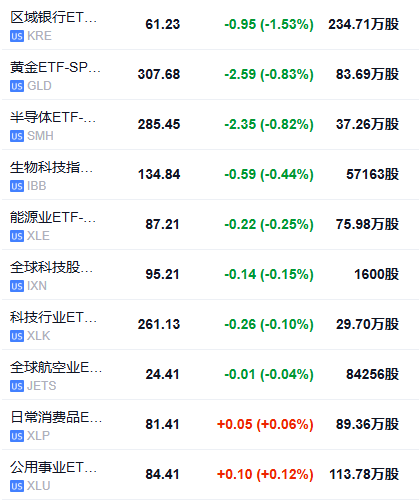
美股盘初,主要行业ETF涨跌不一,区域银行ETF跌超1.5%,黄金ETF跌幅居前。
news flash· 2025-07-25 13:50
Core Viewpoint - The major industry ETFs in the US stock market showed mixed performance, with regional bank ETFs declining over 1.5% and gold ETFs experiencing notable losses [1]. Group 1: ETF Performance - Regional bank ETF (KRE) fell to 61.23, down by 0.95 (-1.53%) with a trading volume of 2.3471 million shares [2]. - Gold ETF (GLD) decreased to 307.68, down by 2.59 (-0.83%) with a trading volume of 836,900 shares [2]. - Semiconductor ETF (SMH) dropped to 285.45, down by 2.35 (-0.82%) with a trading volume of 372,600 shares [2]. - Biotechnology ETF (IBB) declined to 134.84, down by 0.59 (-0.44%) with a trading volume of 57,163 shares [2]. - Energy ETF (XLE) decreased to 87.21, down by 0.22 (-0.25%) with a trading volume of 759,800 shares [2]. - Global technology ETF (IXN) fell to 95.21, down by 0.14 (-0.15%) with a trading volume of 1,600 shares [2]. - Technology sector ETF (XLK) decreased to 261.13, down by 0.26 (-0.10%) with a trading volume of 297,000 shares [2]. - Global airline ETF (JETS) fell to 24.41, down by 0.01 (-0.04%) with a trading volume of 84,256 shares [2]. - Consumer staples ETF (XLP) increased slightly to 81.41, up by 0.05 (+0.06%) with a trading volume of 893,600 shares [2]. - Utility ETF (XLU) rose to 84.41, up by 0.10 (+0.12%) with a trading volume of 1.1378 million shares [2].
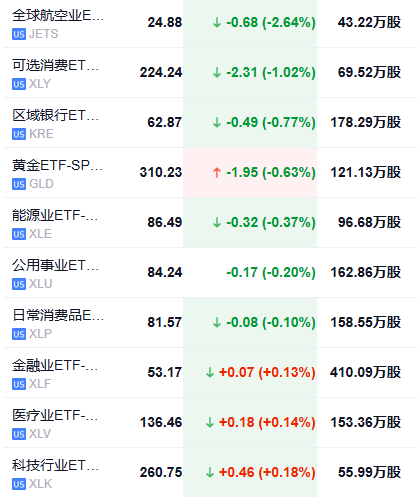
美股盘初,主要行业ETF涨跌不一,全球航空业ETF跌超2%,可选消费ETF、区域银行ETF跌幅居前。
news flash· 2025-07-24 14:00
Group 1 - Major industry ETFs showed mixed performance in early trading, with the global airline industry ETF declining over 2% [1] - The consumer discretionary ETF and regional bank ETF experienced the largest declines, with the consumer discretionary ETF down 1.02% and the regional bank ETF down 0.77% [1][2] - The gold ETF saw a slight increase of 0.63%, while the energy sector ETF and utility ETF both experienced minor declines [2] Group 2 - The global airline ETF (US JETS) closed at 24.88, down 2.64% with a trading volume of 432,200 shares [2] - The consumer discretionary ETF (US XLY) closed at 224.24, down 1.02% with a trading volume of 695,200 shares [2] - The regional bank ETF (US KRE) closed at 62.87, down 0.77% with a trading volume of 1,782,900 shares [2]
7月24日电,美国航空盘前股价下跌超5%,因公司预测第三季度亏损超出预期。
news flash· 2025-07-24 11:14
智通财经7月24日电,美国航空盘前股价下跌超5%,因公司预测第三季度亏损超出预期。 ...

策略对话交运:交运反内卷行情展望
2025-07-23 14:35
Summary of Conference Call Notes Industry Overview - **Aviation Industry**: The aviation sector has experienced significant losses since 2020, totaling nearly 500 billion. This has led to a drastic decline in supply, with the compound annual growth rate dropping from 12% to less than 3% [1][4]. - **Express Delivery Industry**: The express delivery sector has seen an escalation in price wars since 2024, with both single ticket prices and profitability entering a downward trend [3][8]. Key Insights and Arguments Aviation Industry - **Price Dynamics**: Airline ticket prices are increasingly reflecting supply and demand realities rather than expectations. As of May 2024, ticket prices have shown signs of recovery, primarily driven by supply-demand relationships [1][2]. - **Demand Recovery**: Although demand has rebounded quickly, business travel remains weak, with a 10% month-on-month decline in June due to factors like the alcohol ban [1][4]. - **Profitability Outlook**: The aviation sector is expected to return to profitability in 2024 after five years of significant losses. Current expectations for profitability are low, indicating limited risk in buying airline stocks with a high probability of upside [1][5][6]. - **Recommended Stocks**: High-elasticity airline stocks are recommended, including major Hong Kong carriers (Air China, China Eastern, China Southern) and A-share companies (HNA, Spring Airlines, and Juneyao Airlines) [1][5]. Express Delivery Industry - **Regulatory Environment**: The National Postal Administration has initiated anti-involution measures, with expectations for specific details to be implemented soon. Key production areas like Yiwu and Guangdong are already taking steps to stabilize prices [1][7]. - **Market Dynamics**: The express delivery market is currently facing intense competition, with a significant impact on franchise operations. The first quarter of 2024 showed mixed results, and the second quarter is expected to see a decline across the board [3][8]. - **Recommended Companies**: Leading express delivery companies such as YTO and ZTO are recommended due to their ability to regain market share amid price wars. Companies like Jitu and Shentong are also highlighted for their potential to improve governance and performance [3][10]. Additional Important Points - **Historical Context**: The aviation industry has never faced large-scale supply issues before, with the current situation being unprecedented. The historical context suggests that supply-side reforms can lead to improved stock performance [4]. - **Previous Anti-Involution Success**: The express delivery sector previously experienced a successful anti-involution campaign in 2021, which stabilized prices and improved profitability. The current environment shows similarities, but the competitive landscape has shifted [9][10]. - **Future Projections**: The express delivery sector may see a repeat of past recovery patterns if regulatory measures are effectively implemented and if companies can enhance their core capabilities [9][10].
俄罗斯赴朝鲜旅游需求激增
证券时报· 2025-07-22 15:36
Core Viewpoint - The demand for Russian tourists to visit North Korea has surged two to four times in the past year and a half, indicating a significant growth potential in this tourism sector [2][3]. Group 1: Demand Growth - The demand for North Korean tourism from Russia has increased fourfold from the Moscow office of the "Orient International Travel Agency," while overall demand has doubled in the past year and a half [2][3]. - The potential for tourism development in North Korea, particularly in the Wonsan area, is considered substantial, with a possibility that 70% of visitors could come from central Russia if direct flights from Moscow are established [3]. Group 2: Transportation Developments - Currently, Russian tourists can only enter North Korea through a weekly flight operated by Air Koryo from Vladivostok to Pyongyang, with a new Moscow-Pyongyang flight set to launch on July 27, although the monthly frequency is expected to have limited impact on tourist flow [3]. - The restoration of international railway passenger services between Russia and North Korea began on June 17, with two monthly trains from Pyongyang to Moscow and one train from Pyongyang to Khabarovsk starting June 19 [3]. - The Russian Foreign Ministry has indicated that the resumption of direct rail services will strengthen friendly relations and reflects the positive development of mutually beneficial cooperation between Russia and North Korea [3].