跨境电商

Search documents
内斗导致三季报“姗姗来迟”,有棵树拟改名行云科技
Shen Zhen Shang Bao· 2026-01-27 00:39
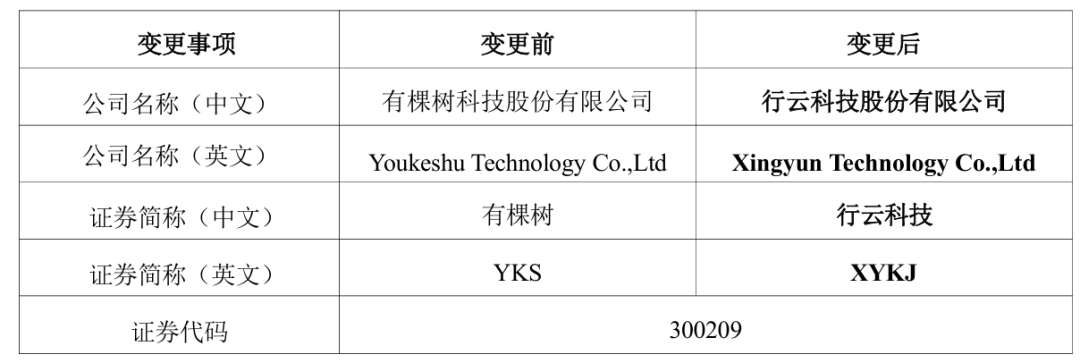
1月26日晚间,有棵树(300209)发布公告称,公司拟对现有名称及证券简称进行变更,变更后公司名称为行云科技股份有限公司,变更后公司简称为行 云科技,证券代码保持不变。 | 变更事项 | 変更前 | 変更后 | | --- | --- | --- | | 公司名称(中文) | 有棵树科技股份有限公司 | 行云科技股份有限公司 | | 公司名称(英文) | Youkeshu Technology Co.,Ltd | Xingyun Technology Co.,Ltd | | 证券简称(中文) | 有棵树 | 行云科技 | | 证券简称(英文) | yks | XYKJ | | 证券代码 | 300209 | | 有棵树表示,本次变更旨在更加全面地体现公司的产业布局和运营情况,准确反映公司未来战略发展方向,产业投资人能够积极履行《重整计划》中相关 承诺,突出核心产业投资人深圳市天行云供应链有限公司的企业品牌。 追溯到2024年12月,法院裁定确认公司重整计划执行完毕并终结公司重整程序。公司第一大股东王维直接持有9.89%公司股份。同时,王维及其一致行动 人深圳市天行云供应链有限公司、长沙云蜀信息科技有限公司及 ...


商务部:今年将出台扩大入境消费政策措施
Zhong Guo Zheng Quan Bao· 2026-01-26 23:25
Group 1: Foreign Investment and Trade Policies - The Ministry of Commerce aims to expand high-level foreign investment and enhance the "Invest in China" brand by reforming the foreign investment promotion system by 2026 [1][3] - The Ministry will implement a "combination punch" of foreign trade policies, including new measures to support enterprises in overseas exhibitions and trade promotion activities [2] - A national-level overseas comprehensive service platform will be launched to provide a one-stop service for enterprises regarding policy consultation, business handling, and risk prevention [3][4] Group 2: Service Trade Development - The Ministry plans to improve the negative list management system for cross-border service trade and promote the opening of service markets [3][4] - There will be a focus on expanding the export of productive services and enhancing the international competitiveness of traditional services such as Chinese medicine and cuisine [3] - The Ministry will support foreign-funded enterprises in extending their value chains and achieving specialized, integrated, and intelligent development [4] Group 3: Consumer Market and Domestic Demand - The retail sales of consumer goods are projected to exceed 50 trillion yuan in 2025, with a growth rate of 3.7% and a contribution rate of 52% to economic growth [5] - In 2026, the Ministry will focus on expanding domestic demand, optimizing the implementation of old-for-new consumption policies, and promoting consumption in durable goods [5][6] - The Ministry will also work on improving the consumption environment by fostering international consumption centers and creating new consumption scenarios [5][6]
阿根廷变天!米莱给中国抛橄榄枝:关税归零,50万美元拿黄金护照
Sou Hu Cai Jing· 2026-01-26 19:03
Group 1 - A Chinese cargo ship carrying 5,800 BYD electric vehicles has broken Argentina's 22-year trade barrier, with the vehicles arriving at Buenos Aires' Sarandí port on January 23, 2026, after the elimination of a 35% import tax that previously added significant costs [1] - The new Argentine president, Javier Milei, has drastically reduced tariffs on electric vehicles to zero, attracting Chinese automakers like BYD and Tesla to the market [3] - Argentina's immigration policy has introduced a $500,000 golden passport program, allowing foreign investors, particularly from China, to obtain residency and access to international opportunities, leading to a surge in applications [3][4] Group 2 - In 2025, China's exports to Argentina surged by 75%, with Chinese products becoming increasingly available in local markets, including a rise in Chinese supermarkets [4] - The electric vehicle market in Argentina is experiencing rapid growth, with sales expected to triple in 2025, 70% of which are anticipated to be Chinese brands [6] - The influx of Chinese technology, including solar panels and wind turbine components, is transforming Argentina's energy landscape, with local resources being utilized for lithium mining to support battery production [8][11] Group 3 - The sudden policy changes have led to unexpected winners, such as second-hand car dealers, who are struggling as consumers shift towards new electric vehicles from brands like BYD [9] - The demand for Chinese electric vehicles has increased significantly, with local consumers now preferring them over traditional domestic options [9] - The vibrant market for Chinese goods and services is reshaping Buenos Aires, with a notable increase in the presence of Chinese businesses and products [11]

2026年如何提振消费、稳定外贸、拓展双向投资?
Xin Lang Cai Jing· 2026-01-26 16:55
Group 1: Consumer Promotion and Service Sector Growth - In 2026, the Ministry of Commerce will optimize the implementation of the old-for-new consumption policy to boost sales of durable goods such as automobiles and home appliances [2] - The service sector is identified as a key driver for domestic demand expansion and transformation, with initiatives to enhance the supply levels in cultural, entertainment, tourism, and healthcare sectors [2] - The Ministry will continue to promote service consumption quality improvement actions and remove unreasonable restrictions in service consumption areas [2] Group 2: Foreign Trade Stability and Innovation - The Ministry of Commerce aims to stabilize the foreign trade base through a combination of policies and support for cross-border e-commerce development [4] - Service trade and digital trade are highlighted as important areas for innovation, with plans to establish national service trade innovation development demonstration zones [4] - The Ministry will promote the "Export China" brand and leverage major trade exhibitions to expand imports from countries involved in the Belt and Road Initiative [4][5] Group 3: Attracting Foreign Investment - In 2026, efforts will be made to enhance the attractiveness of foreign investment by expanding access in sectors like telecommunications, healthcare, and education [7] - The Ministry will implement policies to support foreign enterprises in participating in consumption stimulation and government procurement activities [7] - A national-level overseas comprehensive service platform will be established to provide a one-stop service for companies going abroad, integrating various service resources [8]
有棵树:2025年第三季度净亏损1572.98万元
Mei Ri Jing Ji Xin Wen· 2026-01-26 13:25
每经AI快讯,1月26日,有棵树(300209)公告,2025年第三季度营业收入为1638.33万元,同比下降 83.59%;归属于上市公司股东的净利润为-1572.98万元。 ...
跨境电商+资金合力 有棵树(300209)单日大涨15.50%:异动背后的消息共振
Jin Rong Jie· 2026-01-26 13:16
有棵树科技股份有限公司的主营业务是跨境电商业务、软件开发、硬件终端及配件销售等。公司着力研 发并迭代企业级物联网大数据处理平台,提供完整的IOT大数据闭环方案;不断整合并创新使用诸多算 法,设计了多种数据挖掘模型。新技术、新产品的研究与运用扩充和完善了产品线,提高了公司相关产 品的竞争力,今日的大涨或与经营预期改善有关。 2026年1月26日,有棵树(300209)迎来显著股价异动,当日涨幅高达15.50%,每股上涨约0.97元,收 盘价来到7.23元,创下近3月股价单日最大涨幅,交易活跃度显著提升。 责任编辑:安东 股市有风险,投资需谨慎!本文所有信息均为公开信息整理与客观分析,不构成任何投资建议,投资者 需结合自身风险承受能力理性判断,切勿盲目跟风操作,自行承担投资风险。 股票频道更多独家策划、专家专栏,免费查阅>> 资金层面,前一交易日主力资金净流入2615万元,股价同步上涨2.29%,为今日提前积累了一定的资金 热度;从今日盘面表现来看,成交额达6.24亿,换手率18.63%,多方资金合力助推股价,吸引市场关注 度聚焦,形成短期资金炒作热潮。 ...
低价之后,中国电商出海靠什么?
2 1 Shi Ji Jing Ji Bao Dao· 2026-01-26 12:08
Core Insights - The cross-border e-commerce landscape for Chinese platforms is shifting from a price war to a focus on sustainability and compliance by 2025 [1][4] - The "Four Little Dragons" (AliExpress, Temu, TikTok Shop, and Shein) are transitioning from low-cost strategies to brand enhancement and local market integration due to increasing global trade regulations and geopolitical challenges [1][9] Group 1: Market Dynamics - The initial price advantage of the "Four Little Dragons" is being challenged by rising global trade protectionism and changes in major market policies, particularly in the U.S. [2][3] - The cancellation of the $800 de minimis exemption in the U.S. has significantly impacted the competitiveness of Chinese cross-border e-commerce platforms, leading to a decline in daily active users for Shein and Temu [3][9] - The revenue growth for Pinduoduo's Temu has been severely affected, with transaction service revenue growth dropping to 5.8% and 0.7% in the first two quarters of 2025 [3] Group 2: Strategic Shifts - Platforms are focusing on brand building, localization, and high-quality growth as part of a systemic transformation to adapt to the new market environment [5][6] - AliExpress has launched a "Super Brand Going Global" initiative, aiming to compete directly with Amazon and has seen a significant increase in brand presence during major sales events [6] - Temu is also shifting its operational model to enhance brand value and is targeting high-quality development through its supply chain [7] Group 3: Compliance Challenges - The regulatory environment is becoming increasingly stringent, with compliance in data security, product safety, and environmental standards becoming critical for long-term success [9][10] - Temu is under investigation by the EU Commission, highlighting the growing scrutiny of Chinese platforms regarding compliance with international regulations [9] - The focus on compliance is expected to become a core competitive advantage for Chinese cross-border platforms, shifting the emphasis from rapid growth to sustainable and compliant operations [10]
广东外贸规模连续40年居全国首位 “十四五”年均增长6%
Xin Lang Cai Jing· 2026-01-26 11:44
Core Viewpoint - Guangdong's foreign trade is expected to grow at an average annual rate of 6% during the 14th Five-Year Plan, significantly higher than the 2.2% growth rate during the 13th Five-Year Plan, demonstrating resilience and competitiveness in the face of external challenges [1] Group 1: Foreign Trade Growth - Guangdong's foreign trade volume is projected to reach 9.49 trillion yuan by 2025, with a year-on-year growth of 4.4%, maintaining its position as the largest in the country for 40 consecutive years [1] - In the previous year, Guangdong organized over 300 "Yue Trade Global" overseas exhibitions, assisting more than 26,000 enterprises in expanding into international markets [1] Group 2: Export Industry Development - Guangdong is actively cultivating advantageous export industry clusters, including two trillion-yuan clusters in electronic information and modern light industry, one 500 billion yuan cluster in artificial intelligence, and several clusters at the billion and hundred billion yuan levels [2] - AI chip equipment exports exceeded 800 billion yuan last year, marking a year-on-year growth of 19.9%, while exports of "new three samples" surpassed 200 billion yuan, with a growth rate of 30.6% [1] Group 3: Import Growth and Strategy - In the previous year, Guangdong's imports reached 3.46 trillion yuan, with a year-on-year growth of 7.8%, leading the nation for 24 consecutive months [2] - The province plans to strengthen the construction of three national import demonstration zones in Nansha, Huangpu, and Qianhai, focusing on major commodities and electronic components [2] Group 4: E-commerce and New Industries - Guangdong aims to further enhance traditional industries while developing emerging industries, including the establishment of new foreign trade transformation and upgrading bases for robotics and low-altitude economy [2] - The province will deepen the construction of cross-border e-commerce comprehensive pilot zones, strengthening development in Guangzhou, Shenzhen, and eastern Guangdong [2]
今天刚刚∶中国经济第一大省,定了
Sou Hu Cai Jing· 2026-01-26 11:16
国民经略 2026-01-26 11:03发布于广东 文|凯风 经济第一大省,继续领跑。 刚刚,广东省人代会透露,2025年广东省GDP达14.58万亿,连续37年蝉联全国第一。 不只是经济第一,广东更拿下财政、人口、生育、工业、外贸、科创、财政转移支付及养老金调剂净贡献等诸多"第一"。 "永争第一,不为人后",经济第一大省何以更进一步? GDP站稳14万亿,意味着什么? 14万亿的GDP,相当于2万亿美元,与巴西、俄罗斯相当,超过韩国、澳大利亚等国,放在全球可排在12位。 过去5年,广东连续迈过3个万亿级大关,GDP全面赶超"亚洲四小龙",跻身全球第一梯队。 与经济同步突破的是人口。广东常住人口已达1.27亿,实时人口超1.5亿,双双赶超日本。 对于广东来说,14万亿只是新的开始,远远谈不上天花板。 根据"十五五"规划建议,广东2035年经济总量实现倍增,人均GDP达到中等发达国家水平。 按照2022年13万亿左右GDP测算,到2035年广东经济总量要达到26万亿左右。 考虑到人民币升值大势,届时广东GDP将达4万亿美元以上,直追全球第一大"省"——美国加州。 30多年前,广东曾以"亚洲四小龙"为追赶目标, ...

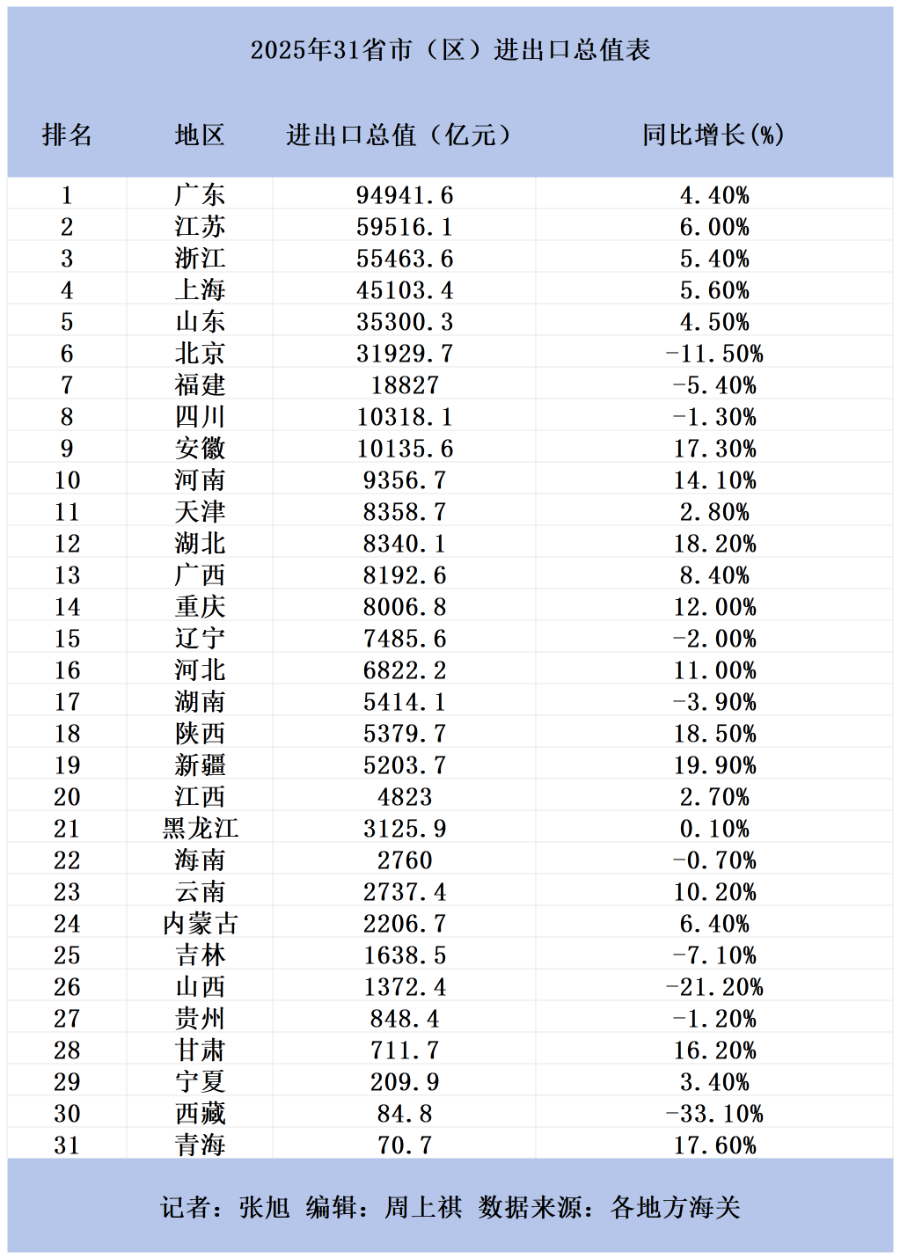
广东9万亿压舱,安徽逆袭河南,下个万亿省份是谁?中国外贸暗涌
2 1 Shi Ji Jing Ji Bao Dao· 2026-01-26 09:18
21世纪经济报道 记者张旭 北京报道 近日,31个省份2025年外贸数据陆续公布。2025年,全国进出口总值达45.47万亿元,增长3.8%,外贸总值突破万亿元的省份增 至9个。 从总值来看,广东凭借9万亿元的成绩继续领跑全部省份。江苏、浙江、上海、山东、北京分列第二至第六位,外贸总值在3万 亿元至6万亿元之间。安徽以10135.57亿元的成绩,成为中部首个、全国第九个外贸总值破万亿元省份。 从同比增速来看,共有17个省份跑赢3.8%的"全国线",21个省份实现同比正增长,新疆增长19.9%排名全国第一。而在外贸大 省中,安徽以17.3%增速领跑。曾经的"中部外贸第一省"河南,则以14.1%的增速,位居十大外贸省份第二。2025年,河南进出 口总值达9356.73亿元,有望在2026年突破万亿元大关。 对于广东外贸成绩单,广东外语外贸大学广东国际战略研究院执行院长、教授韩永辉向21世纪经济报道记者表示,广东拥有全 国最完备的制造业体系和产业链配套能力,这是其外贸长期领跑的根本支撑。民营经济活跃且外贸主体持续扩容,形成强大的 市场韧性。 此外,广东在跨境电商、海外仓、保税物流等新型贸易方式上领先全国,同时依托粤 ...