
保险业

Search documents
50万亿定存到期,理财保险基金谁能接住“泼天流量”
Bei Jing Shang Bao· 2026-01-20 14:11
Core Viewpoint - A significant wave of "high-interest fixed deposit maturities" is expected in 2026, with approximately 50 trillion yuan of funds set to be released, reshaping the asset allocation landscape for residents [1][6][7]. Group 1: Background and Causes - The upcoming maturity wave is a result of two overlapping funding cycles: high-interest fixed deposits from 2020-2021 and passive savings due to market pressures in 2022-2023 [1][5]. - In 2020-2021, banks initiated a high-interest deposit campaign, with five-year fixed deposit rates reaching as high as 5%, leading to a significant accumulation of funds maturing in 2026 [4][6]. - The passive savings trend emerged in 2022-2023 due to market volatility, prompting many investors to redeem their investments and seek safety in fixed deposits [5][7]. Group 2: Current Market Conditions - Current fixed deposit rates have significantly decreased, with major banks offering rates around 1.2% for three-year deposits, down from previous highs [8][9]. - Despite the decline in interest rates, many conservative investors are likely to continue renewing their fixed deposits due to a low tolerance for risk and a preference for capital preservation [9][10]. Group 3: Investment Alternatives - The market is witnessing a competition among various financial products, including fixed deposits, wealth management products, insurance, and funds, to attract the migrating capital [1][11]. - "Stable" wealth management products have gained popularity as they offer better returns than current fixed deposit rates, with some achieving annual yields above 3% [11][12]. - Insurance products are also becoming a favored option, with long-term stable returns appealing to investors seeking safety and growth [14][16]. Group 4: Fund Management and Future Outlook - Fund management companies are expected to enhance their asset management capabilities to effectively attract and manage the incoming funds from maturing deposits [20]. - The shift in investor sentiment towards diversified financial products indicates a potential for sustained growth in the insurance and fund sectors, particularly for products that offer a balance of safety and returns [17][18].


锦泰保险注册资本增至31.9亿元
Zheng Quan Ri Bao Wang· 2026-01-20 13:47
(编辑 张昕) 本报讯 (记者袁传玺)天眼查工商信息显示,近日,锦泰财产保险股份有限公司发生工商变更,注册资本由约23.8亿元增 至约31.9亿元。 ...
专访大摩徐然:全面降息弊大于利,2026年中国金融体系将逐步回归正循环
第一财经· 2026-01-20 13:16
Core Viewpoint - The article emphasizes that comprehensive interest rate cuts are more harmful than beneficial and should not be seen as a panacea for stimulating the economy [2][4]. Monetary Policy and Structural Adjustments - On January 15, the People's Bank of China announced a policy package with eight measures focused on structural monetary policy tools, including interest rate cuts and increased quotas to support key areas like private small and micro enterprises and technological innovation [2][3]. - Xu Ran believes that the implementation of structural interest rate cuts indicates that broad monetary policy will not arrive soon, as financial products rely on layered interest rate risks, and lowering rates will not stimulate consumption and credit [2][4]. Credit Market Dynamics - By the end of 2025, the total social financing stock is projected to reach 442.12 trillion yuan, with a year-on-year growth of 8.3%, and over 50% of new financing will come from non-loan sources like bonds [7]. - Xu Ran points out that the key to driving credit demand lies in addressing existing stock issues rather than merely pursuing incremental growth, indicating a shift towards higher quality credit [7]. Deposit Trends - In 2025, non-bank financial institutions' RMB deposits increased by 6.41 trillion yuan, a significant rise of 147% year-on-year, while household deposits grew by 14.64 trillion yuan, only 3% more than the previous year [8]. - Xu Ran argues that the notion of "deposit migration" is inaccurate, as the overall deposit growth rate remains high at 8.7%, reflecting a diversification in residents' financial asset allocation rather than a reduction in deposits [8]. Future Outlook for Financial Sector - Xu Ran anticipates that by 2026, the financial system will gradually return to a positive cycle, supported by multiple favorable factors, including adjustments in interest rate pricing mechanisms and a rebound in net interest margins [9][10]. - The banking sector's net interest margin is expected to stabilize and begin to rebound in the second half of 2026, contributing to a substantial increase in bank revenues [11].

中保协:当前普通型人身保险产品预定利率研究值为1.89%
Sou Hu Cai Jing· 2026-01-20 12:42
Core Viewpoint - The meeting organized by the China Insurance Industry Association focused on the development of the life insurance sector, emphasizing the importance of adapting to economic conditions and regulatory frameworks to promote high-quality industry growth [1] Group 1: Economic Outlook - Experts noted that China's economy is resilient and vibrant, progressing towards new and improved development despite facing pressures in 2025 [1] - The development of new productive forces and enhanced social security levels were highlighted as key factors in supporting the life insurance industry [1] Group 2: Interest Rate Research - The current predetermined interest rate for ordinary life insurance products is set at 1.89% [1] - The committee has successfully implemented a mechanism for linking predetermined rates to market rates, allowing for dynamic adjustments [1] Group 3: Industry Transformation and Innovation - The life insurance sector is focusing on transformation and innovation, particularly in health and pension areas, while optimizing structural adjustments [1] - The use of technology to enhance service quality and efficiency is a priority for the industry [1] Group 4: Research and Recommendations - The committee has conducted in-depth research on the impacts of new accounting standards, changes in international trade patterns, and insurance asset allocation [1] - Constructive suggestions for industry development have been provided, contributing positively to the sector's growth [1]
净资产比率排行丨增速大幅减缓!46%险企下降,数量翻倍,形势严峻
Xin Lang Cai Jing· 2026-01-20 08:47
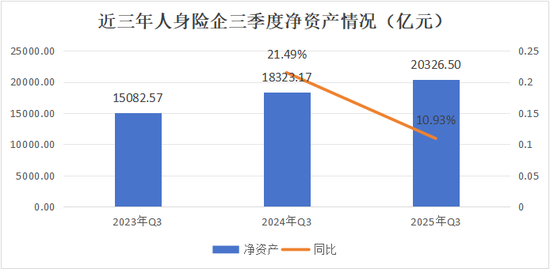
Core Insights - The net asset scale of the life insurance industry reached 2.03 trillion yuan in Q3 2025, an increase of approximately 200 billion yuan compared to the same period in 2024, reflecting a year-on-year growth of 10.93%, but the growth rate has significantly slowed down [1][36] - The increase in net assets is primarily driven by the stable growth of large and medium-sized insurance companies and the capital raising activities of smaller firms [2][36] - Among the 72 life insurance companies that reported their Q3 2025 net assets, 54% achieved positive growth, while 46% experienced a year-on-year decline, indicating a challenging industry environment [4][38] Net Asset Growth - The top 10 companies in terms of net asset growth are dominated by large and medium-sized insurers, with the top seven including China Life, Ping An, New China, Taiping, AIA, PICC Health, and China Post Life, collectively increasing their net assets by 206.17 billion yuan [1][36] - The number of companies experiencing a decline in net assets has doubled compared to the previous year, with 33 companies reporting a decrease in Q3 2025, up from 14 in Q3 2024 [4][40] - The proportion of companies with a net asset ratio exceeding 10% is only 28%, while 72% of companies fall below this threshold, indicating a significant disparity in financial health across the industry [23][36] Capital Raising Activities - A total of 12 life insurance companies have been approved for capital increases from October 1, 2024, to September 30, 2025, with several smaller firms showing significant growth due to capital injections [8][36] - The issuance of bonds for capital supplementation has also been a key strategy for many smaller insurers, with 16 companies issuing bonds during the same period [9][36] Net Asset Ratio Trends - The number of companies with an increasing net asset ratio has dropped sharply from 38 in Q3 2024 to only 20 in Q3 2025, while 72% of companies have seen their ratios decline [24][36] - The net asset ratio of the top 10 companies is predominantly above 20%, but five of these companies have experienced a decline in their ratios compared to the previous year [27][36] Performance of Major Insurers - The "big four" insurers (China Life, Ping An, Taiping, and Taikang) collectively hold 1.33 trillion yuan in net assets, accounting for 65.37% of the industry's total net assets [7][41] - Notable changes in rankings have occurred, with China Post Life entering the top 10 due to significant capital increases [40][41] Challenges and Future Outlook - The industry faces significant challenges, with many companies struggling to maintain positive growth amid changing accounting standards and market conditions [20][41] - The future landscape of the industry will likely be shaped by the resilience and internal capital generation capabilities of insurers as the effects of recent capital-raising activities and accounting changes stabilize [33][41]



花旗展望2026中国保险业:寿险迈入黄金时代,财险CoR持续改善
Hua Er Jie Jian Wen· 2026-01-20 08:15
Core Viewpoint - Citi believes that the Chinese life insurance industry is facing a significant turning point in 2026, with historical growth opportunities expected due to the maturation of over 70 trillion RMB in bank deposits and a shift in retail investor preferences towards higher-yielding insurance products [1][2]. Life Insurance Industry - The life insurance sector is projected to experience historic growth opportunities as retail investors seek higher returns in a low-interest environment, particularly through insurance products linked to the stock market [2]. - The proportion of insurance in Chinese household financial asset allocation is significantly lower than in mature markets like Japan, Singapore, and the UK, indicating substantial growth potential [2]. - Major life insurance companies, including China Life, Pacific Insurance, and Ping An Life, have reported strong new business value (NBV) growth in 2024 and the first half of 2025, with double-digit growth on a comparable basis [2]. - The shift towards participating insurance products is evident, with Pacific Life's participating insurance accounting for 42.5% of first-year premiums, Ping An Life at 40%, and China Life exceeding 50% in its agency channel [2][3]. - Life insurance profit margins are expected to remain stable, with the pricing rate adjustment in September 2025 offsetting potential margin erosion from the shift towards participating insurance [3]. Property and Casualty Insurance Industry - The property and casualty (P&C) insurance sector is anticipated to achieve a steady 4% growth in premiums in 2026, driven primarily by auto and personal insurance businesses [4]. - There is significant room for improvement in the combined ratio (CoR), especially after excluding natural disaster losses, supported by regulatory benefits [4]. - Regulatory measures, such as extending compliance management to non-auto insurance and enhancing auto insurance fee management, are expected to support CoR improvements [4][5]. - The relaxation of the pricing coefficient cap for new energy vehicle insurance from 1.35 to 1.5 will provide insurers with greater pricing flexibility [4]. - The top three P&C insurers have shown CoR improvements, with PICC, holding approximately 32% market share, expected to benefit the most from regulatory support [4]. Regulatory Environment - Since 2025, Chinese insurance regulators have introduced a series of supportive policies aimed at enhancing industry growth and profit margins [5][6]. - New regulations emphasize compliance and profitability over mere premium growth, requiring insurers to optimize key performance indicators and manage expenses effectively [6]. - Policies encouraging the development of commercial health insurance and long-term care insurance are also in place, promoting the growth of participating long-term health insurance products [6]. - A directive mandates that large state-owned insurers invest 30% of new premiums in the A-share market starting in 2025, which is expected to enhance investment returns, particularly during bullish market conditions [6].
2025年前11月大连市原保费收入489.3亿元,同比增长9.1%
Jin Rong Jie· 2026-01-20 04:47
Core Insights - Dalian's insurance industry achieved a total premium income of 48.93 billion yuan from January to November, reflecting a year-on-year growth of 9.1%, although the growth rate decreased by 0.3 percentage points compared to the first ten months of the year [1] - Claims and benefit payments increased by 0.2% year-on-year, with the growth rate improving by 0.6 percentage points compared to the previous ten months [1] - By the end of November, the total assets of the industry reached 534.2 billion yuan, marking a year-on-year increase of 22.7% [1] Premium Income Breakdown - Property insurance premium income was 9.52 billion yuan, showing a year-on-year growth of 5.5% [1] - Life insurance premium income amounted to 39.41 billion yuan, with a year-on-year increase of 10.0% [1] - Within life insurance, premium income from life insurance, health insurance, and accident insurance grew by 11.1%, 4.9%, and 3.0% respectively [1]
资讯早班车-2026-01-20-20260120
Bao Cheng Qi Huo· 2026-01-20 02:36
1. Report Industry Investment Rating No relevant content provided. 2. Core Viewpoints of the Report - The IMF has raised the global economic growth forecast for 2026 by 0.2 percentage points to 3.3%, and also increased the growth forecasts for China, the US, the Eurozone, and Japan. AI - driven IT investment growth is becoming an important driver for the global economy [2][16]. - The Chinese economy's 2025 "report card" shows that GDP grew by 5% year - on - year, reaching 140.19 trillion yuan, with the service industry's share in GDP rising to 57.7%, and final consumption contributing 52% to economic growth, while fixed - asset investment declined by 3.8% [2][13]. - In the stock market, on Monday, A - shares had a shrinking - volume oscillation with major indices showing different trends. A - share listed companies' 2025 annual report performance pre - announcements are accelerating, and AI is a strong driver for corporate performance growth [32]. 3. Summary by Relevant Catalogs 3.1 Macro Data - In December 2025, GDP at constant prices had a quarterly - on - quarterly growth of 4.5%, down from 4.8% in the previous period and 5.4% in the same period last year. The manufacturing PMI was 50.1%, slightly up from 49.8% in the previous period, and the non - manufacturing PMI for business activities was 50.2%, up from 50.0% in the previous period [1]. - Social financing scale in December 2025 was 2207.5 billion yuan, down from 3529.9 billion yuan in the previous month and 2853.7 billion yuan in the same period last year. M0, M1, and M2 growth rates showed different trends compared to the previous period and the same period last year [1]. - In December 2025, CPI increased by 0.8% year - on - year, up from - 0.3% in the previous period, and PPI decreased by 1.9% year - on - year, an improvement from - 2.3% in the previous period and the same period last year [1]. 3.2 Commodity Investment Reference 3.2.1 Comprehensive - China's 2025 economic data shows overall growth in multiple sectors, with a decline in fixed - asset investment, especially in real - estate development investment [2]. - The EU will hold an emergency summit on January 22 to discuss Trump's tariff threat and consider counter - measures, and is preparing to impose retaliatory tariffs on $93 billion worth of US goods [2]. - The Guangzhou Futures Exchange will adjust the daily price limit and margin standards for lithium carbonate futures contracts starting from January 21 [3]. 3.2.2 Metals - COMEX gold futures' February contract reached a record high of $4698 per ounce on January 19, approaching the $4700 mark, driven by geopolitical risks and expectations of a decline in the US dollar's credit. Gold ETFs and futures are more suitable for short - term investment [4]. - Japan will use 39 billion yen in reserve funds to ensure rare - earth supply [5]. - The Shanghai Futures Exchange has approved an increase in tin futures delivery warehouses and their approved storage capacities in Guangdong [6]. 3.2.3 Coal, Coke, Steel, and Minerals - In early January, key steel enterprises' daily crude - steel output was 1.997 million tons, a 10.51% increase from the previous period but a 3.29% decrease year - on - year. Pig - iron and steel production also showed different trends compared to the previous period and the same period last year [7]. - The first shipment of nearly 200,000 tons of Simandou iron ore arrived in China on January 17, which will enhance the global iron - ore supply [7]. - Shanxi produced over 13 billion tons of coal in 2025, and 65 billion tons during the 14th Five - Year Plan period, an increase of 19 billion tons compared to the 13th Five - Year Plan [7]. - Coking coal options were listed on the Dalian Commodity Exchange, enriching the risk - management tools for the coal - coke - steel industry chain [8]. 3.2.4 Energy and Chemicals - Goldman Sachs has raised its 2026 price forecast for TTF natural gas to 36 euros [9]. - Venezuela has officially launched the export of liquefied petroleum gas [9]. - After Maduro's downfall, many trade and oil companies are competing for the deal to export Venezuelan crude oil to the US [9][10]. - China National Coal Group will promote the clean and efficient use of coal, transforming it from a fuel to "raw material + material" [10]. 3.2.5 Agricultural Products - The average price of live pigs rebounded this week. On January 16, the average wholesale price of pork was 18.07 yuan per kilogram, up 0.6% from January 9, and the average price this week was 18 yuan per kilogram, up 0.3% from last week [11]. 3.3 Financial News Compilation 3.3.1 Open Market - On January 19, the central bank conducted 158.3 billion yuan of 7 - day reverse - repurchase operations at a fixed interest rate of 1.40%, with a net injection of 72.2 billion yuan after 86.1 billion yuan of reverse - repurchases matured [12]. 3.3.2 Important News - China's 2025 economic data, including population changes, shows a decrease in the population by 339,000 [13][14]. - In December 2025, housing prices in major Chinese cities showed different trends, with some cities' price declines narrowing and Shanghai's new - home prices rising [14]. - The NDRC and the Ministry of Finance will hold press conferences to introduce relevant economic policies [14]. - Premier Li Qiang emphasized high - quality development, calling for more active fiscal policies and moderately loose monetary policies [15]. - The central bank will announce the January LPR on January 20 [15]. - The Supreme People's Procuratorate has made arrangements to use legal power to serve high - quality development, including cracking down on economic crimes and safeguarding the capital market [17]. - The CSRC's 2026 system work meeting has outlined a clear path for capital - market reform [18]. - In 2025, the number and scale of registered insurance asset - management products decreased [18]. - There is a heated discussion about the "2026 time - deposit maturity wave", with different views on the scale, but most banks are not worried [19]. - There are several bond - related events, such as bond rating changes and early redemptions [20]. 3.3.3 Bond Market Review - The bond market showed an overall weak and oscillating trend, with most Treasury - bond futures closing down, and the yields of major interest - rate bonds in the inter - bank market mostly rising slightly. Some bonds like Vanke and AVIC Industry Finance bonds rose [21]. - The money - market interest rates showed different trends, with some rising and some falling [22][23]. - The yields of some financial bonds were determined in the bidding process, and European bond yields mostly increased [24]. 3.3.4 Foreign Exchange Market - The on - shore RMB against the US dollar closed at 6.9636 on January 20, up 54 basis points from the previous trading day, and the central parity rate was 7.0051, up 27 basis points [25]. - The US dollar index fell by 0.32% in New York's late trading, and most non - US currencies rose [25]. 3.3.5 Research Report Highlights - Shenwan Fixed - Income states that the issuance of new special bonds this year is faster than in previous years but has not significantly accelerated. The planned issuance of local bonds in Q1 2026 is 2.1179 trillion yuan, similar to the same period in 2025 [27]. - CICC Fixed - Income suggests that in the current fluctuating interest - rate bond yield environment, credit - bond yields may follow the fluctuations, especially for Tier 2 and perpetual bonds. It also recommends paying attention to short - term trading opportunities and non - financial credit bonds with a remaining term of about 5 years. The future spread of science - and - technology innovation bonds depends on the change in the scale of science - and - technology innovation bond ETFs [27]. - CITIC Securities believes that Trump's tariff threat is a means to test the EU's attitude, and the change of Greenland's territory is difficult to achieve. If the US takes real actions, gold may benefit, the US dollar's credit may be damaged, and European assets may be under pressure [28]. 3.4 Stock Market - On Monday, A - shares had a shrinking - volume oscillation. The Shanghai Composite Index rose 0.29% to 4114 points, the Shenzhen Component Index rose 0.09%, the ChiNext Index fell 0.7%, and the total market turnover was 2.73 trillion yuan, down from 3.06 trillion yuan the previous day. Power - infrastructure, AVIC - related, and Hainan Free - Trade - Port concepts led the gains, while semiconductors and consumer electronics led the losses [32]. - The Hong Kong Hang Seng Index fell 1.05% to 26563.9 points, with pharmaceutical stocks leading the decline and aviation stocks rising. South - bound funds had a net purchase of nearly HK$2.3 billion [32]. - A - share listed companies' 2025 annual report performance pre - announcements are accelerating, with 156 out of 451 companies reporting positive pre - announcements, and 42 companies expecting a net - profit increase of over 100% year - on - year [32].
Bofa_Hartnett_“特朗普热潮”引发了新的全球牛市,但如果发生这种情况,牛市就会结束。
2026-01-20 01:50
Summary of Key Points from Conference Call Industry or Company Involved - The discussion primarily revolves around global financial markets, with a focus on the implications of U.S. fiscal policies, Japanese economic conditions, and the performance of various currencies, particularly the Japanese yen and its impact on global liquidity and investment strategies. Core Insights and Arguments - **Global Bull Market Triggered by U.S. Policies**: The "Trump Boom" is seen as a catalyst for a new global bull market, but there are concerns that this could end if certain economic conditions change [1] - **Japanese Economic Context**: The ongoing devaluation of the Japanese yen is viewed as inevitable, despite periodic interventions by the Bank of Japan and the Ministry of Finance. The yen is currently trading near historical lows against the dollar, which is affecting its value against other currencies like the Chinese yuan [8][13] - **Risks of Currency Appreciation**: A rapid appreciation of currencies such as the yen, won, and New Taiwan dollar poses a significant risk to the consensus of a bull market, potentially leading to a tightening of global liquidity [13] - **Investment Strategy Recommendations**: The strategy suggested includes holding international stocks to capitalize on the new bull market, while also being cautious of potential currency fluctuations [17] - **Geopolitical Factors**: Geopolitical tensions are acknowledged as having a potential impact on stock markets, although their current influence is deemed limited [25] - **Gold and Other Assets**: The discussion highlights a new bull market for gold, driven by factors such as fiscal expansion and debt devaluation. Gold is noted as one of the best-performing assets of the 21st century [31][36] - **Economic Indicators**: The U.S. unemployment rate is a critical indicator, with expectations that it will rise to 5% due to corporate cost-cutting and other economic pressures. This could affect the performance of cyclical stocks [41] - **Impact of U.S. Elections**: The upcoming midterm elections are seen as a significant factor influencing market dynamics and investor sentiment, particularly regarding the sustainability of the "Trump Boom" [48] Other Important but Possibly Overlooked Content - **Historical Context of Economic Policies**: The call references historical instances, such as Nixon's price controls, to draw parallels with current economic strategies and their potential effectiveness [46][47] - **Market Sentiment and Support Rates**: Current support rates for Trump are low, which could impact investor confidence and the holding of cyclical stocks if not improved by the end of the first quarter [46][47] - **Sector-Specific Insights**: There is a focus on sectors that may benefit from the current economic climate, including energy, healthcare, and technology, particularly in relation to AI-driven price increases [45][46] This summary encapsulates the key points discussed in the conference call, providing insights into the current state of the financial markets and the potential implications of U.S. fiscal policies and global economic conditions.
阳光保险1亿股被拍卖 首程控股子公司4.41亿元承接
Zhong Guo Jing Ying Bao· 2026-01-20 00:25
Group 1 - The auction of 100 million shares of Sunshine Insurance Group (06963.HK) held by Guangxi Yuancheng Investment Group has concluded, with Beijing Shouyuan Xinrong Investment Co., a wholly-owned subsidiary of Shoucheng Holdings (00697.HK), winning the bid at a price of 441.07 million yuan [1] - The shares auctioned are not ordinary H-shares but "unlisted domestic shares" held by domestic shareholders before the overseas listing, which cannot be traded on the Hong Kong stock market [1] - Since 2018, Shoucheng Holdings has been continuously introducing strategic investors, and in 2023, Sunshine Insurance Group was brought in as an investor [1] Group 2 - The major shareholders of Shoucheng Holdings include Shougang Group, Orix Group, Beijing State-owned Capital Operation Management Center, and Sunshine Insurance Group [1] - Shoucheng Holdings has established a close partnership with Sunshine Insurance Group, including the joint establishment of the Beijing Shoucheng Urban Development Infrastructure Investment Fund, with a total scale of 10 billion yuan [1] - The issuance price of Sunshine Insurance Group was 5.83 HKD per share, and as of January 19, 2026, its closing price was 4.19 HKD per share [1]