
服装制造

Search documents
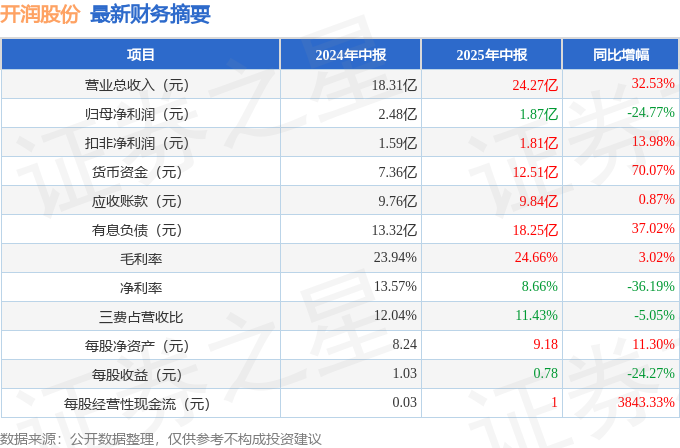
开润股份2025年中报简析:增收不增利,公司应收账款体量较大
Zheng Quan Zhi Xing· 2025-08-28 22:59
Core Viewpoint - The company reported a mixed performance in its 2025 mid-year financial results, with significant revenue growth but a decline in net profit, raising concerns about cash flow and debt levels. Financial Performance - The company achieved total revenue of 2.427 billion yuan, a year-on-year increase of 32.53% [1] - The net profit attributable to shareholders was 187 million yuan, a decrease of 24.77% compared to the previous year [1] - The gross profit margin was 24.66%, up 3.02% year-on-year, while the net profit margin fell to 8.66%, down 36.19% [1] - Operating cash flow per share increased significantly to 1.0 yuan, a rise of 3843.33% year-on-year [1] Business Segments - The company's OEM manufacturing business generated revenue of 2.098 billion yuan, a growth of 37.22% year-on-year, with the apparel segment seeing a remarkable increase of 148.25% [5] - The total production capacity for bags was 22.073 million units, with a utilization rate of 93.39%, while the apparel segment had a capacity of 30.014 million units and a utilization rate of 50.73% [6] Debt and Cash Flow - The company has a significant amount of receivables, with accounts receivable accounting for 258.37% of net profit [1][2] - The interest-bearing debt reached 1.825 billion yuan, an increase of 37.02% year-on-year, leading to a debt-to-asset ratio of 31.94% [2] Governance Changes - The company is restructuring its governance by abolishing the supervisory board, transferring its powers to the audit committee of the board of directors, in line with new regulations [8]

到智能工厂感受新质生产力(探访)
Ren Min Wang· 2025-08-28 22:40
Core Insights - Industrial tourism, particularly factory tours, is gaining popularity as a way to engage the public with modern manufacturing processes and cultural heritage [2][3] - The Ministry of Industry and Information Technology has initiated a survey to support the protection and development of industrial cultural resources [2] Group 1: Factory Tours - NIO's factory in Hefei has opened to the public, receiving nearly 50,000 visitors last year, with slots quickly filling up during holidays [3] - Visitors can experience the production process firsthand, including a unique "cyber journey" through the factory [3][6] - The factory features advanced technology, such as a large vehicle storage platform that can hold up to 753 car bodies [4] Group 2: Food Industry Tours - The Luoyang-based "Luo Wang" industrial park has become a representative of industrial tourism, attracting visitors to learn about the production of instant river snail rice noodles [7][8] - Since its opening in March 2021, the park has welcomed approximately 300,000 visitors, showcasing the integration of culture and industry [8] Group 3: Clothing Industry Tours - The Seven Wolves Industrial Park in Fujian has transformed old factory buildings into a museum, attracting around 300,000 visitors annually [10][11] - The museum features interactive experiences, including a program that allows visitors to see how clothing would look on them using augmented reality [11] - In the first half of the year, the total visitor count for nine observation factories in Quanzhou exceeded 220,000, generating over 10 million yuan in revenue [11]
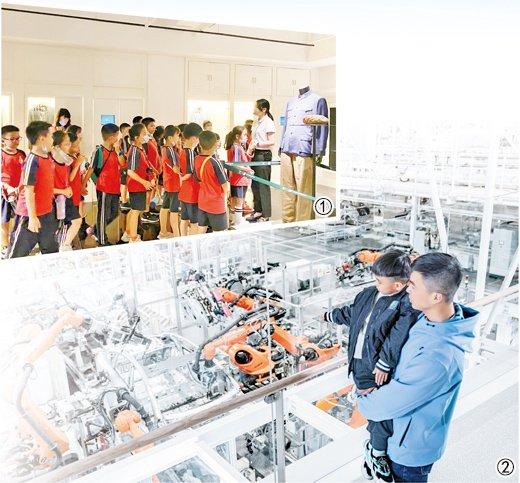
参观生产线 体验高科技 “种草”新产品 到智能工厂感受新质生产力(探访)
Ren Min Ri Bao· 2025-08-28 21:47
Group 1: Industrial Tourism Overview - Factory tours are becoming a popular form of industrial tourism, allowing visitors to experience modern manufacturing processes and understand industrial culture [1][2] - The Ministry of Industry and Information Technology has initiated a survey to support the protection, transmission, and development of industrial cultural resources [1] Group 2: NIO Factory Tour - NIO's factory in Hefei has opened to the public, receiving nearly 50,000 visitors last year, with high demand for tour slots during holidays [2][4] - The factory features advanced technology, including a "magic cube" vehicle storage platform that can store and retrieve up to 753 car bodies [2][4] - The Hefei advanced manufacturing base was selected as a demonstration base for industrial tourism in 2024, with plans to enhance visitor facilities and services [4] Group 3: Luosifen Production Tour - The Luobawang Industrial Park in Liuzhou offers a comprehensive experience of the production process of instant Luosifen, attracting around 300,000 visitors since its opening in March 2021 [6][7] - Visitors can engage in hands-on activities, such as customizing their own Luosifen, and learn about the cultural significance behind the product [6][7] - The park has implemented a transparent production process, which has led to improvements in production quality and efficiency [7] Group 4: Qipilang Men's Clothing Museum - The Qipilang Men's Clothing Museum in Jinjiang has become a popular destination, showcasing the history and technology of men's clothing production [8][10] - The museum features a small production workshop where visitors can observe the garment manufacturing process, highlighting the technological advancements in the industry [8][9] - In the first half of 2023, the museum attracted over 300,000 visitors, with significant revenue generated from merchandise sales [10]
开润股份20250828
2025-08-28 15:15
Summary of KaiRun Co., Ltd. Conference Call Company Overview - **Company**: KaiRun Co., Ltd. - **Date**: August 28, 2025 Key Points Financial Performance - **Revenue**: In the first half of 2025, revenue reached 2.43 billion yuan, a year-on-year increase of 32.5% [2][3] - **Net Profit**: The net profit attributable to shareholders was 187 million yuan, with a year-on-year operational net profit growth of approximately 23% after excluding one-time gains [2][3] - **Segment Performance**: - **ToB Manufacturing**: Revenue of 2.098 billion yuan, up 37.22% [3] - **ToC Business**: Revenue of 310 million yuan, up 8.87% [3] Segment Analysis - **Luggage Segment**: Revenue of 1.42 billion yuan, a 13% increase year-on-year; the growth in the luggage manufacturing segment approached 50% due to new clients like Queens and VF [2][4][5] - **Apparel Segment**: Revenue of 680 million yuan, a significant increase of 148% year-on-year; gross margin improved to approximately 16% due to product structure optimization and efficiency improvements [2][4][6] Operational Improvements - **Production Efficiency**: Efficiency in Indonesian garment factories improved by about 8%, while Chinese factories saw a 6% increase [6] - **Supply Chain Management**: Implementation of SAP systems to enhance supply chain control and management capabilities [6] Capacity Expansion - **Indonesian Production**: Ongoing expansion of the Indonesian Baodao factory, with a projected 40% increase in soft package production lines and around ten new production lines for luggage by 2026 [7][8] - **Employment Impact**: Over 20,000 jobs created in Indonesia, with strong local government partnerships [12] Market Dynamics - **Tariff Impact**: The new U.S. tariff policy has led to a shift in procurement towards Indonesia, with many clients planning to move at least one-third of their supply chains there [12][24] - **Client Performance**: Major clients like Uniqlo and Adidas showed strong growth, while Nike and Decathlon's growth was below average due to their own performance issues [9][17] Future Outlook - **Growth Strategy**: The company plans to continue focusing on efficiency improvements while gradually increasing order intake, with expectations of double-digit growth in the second half of the year [10][18] - **Revenue Projections**: The target revenue for the apparel segment is approximately 1.8 billion yuan for the year, with a focus on maintaining operational efficiency [15][18] Brand Performance - **Brand Revenue**: Brand operations generated 310 million yuan, with Xiaomi contributing over 210 million yuan, reflecting a 25% growth [4][13] - **Profitability**: Brand gross margin was 24.14%, down 1.1 percentage points, but both Xiaomi and 90 Fen brands saw improvements in their respective margins [13][21] Customer Acquisition - **New Client Development**: The company is actively pursuing new clients, particularly in high-margin outdoor brands, while maintaining relationships with existing major clients [16][20] Challenges and Mitigation - **Tariff-Related Pricing Pressure**: The company is addressing pricing pressures from clients due to tariffs by enhancing product margins through operational improvements and new order development [25][26] Conclusion - Overall, KaiRun Co., Ltd. demonstrated strong financial performance in the first half of 2025, with significant growth in both the luggage and apparel segments. The company is strategically expanding its production capacity in Indonesia while navigating challenges posed by new tariff policies. The outlook for the second half of the year remains positive, with expectations for continued growth and efficiency improvements.
申洲国际(02313):1H25订单增长超预期,毛利率阶段性承压
Haitong Securities International· 2025-08-28 12:33
Investment Rating - The report assigns a rating of "Outperform" for Shenzhou International, indicating an expected total return over the next 12-18 months that exceeds the return of its relevant broad market benchmark [19]. Core Insights - Order growth exceeded market expectations, with revenue for the first half of 2025 reaching RMB 14.966 billion, a year-on-year increase of 15.3%, primarily driven by volume growth [2][7]. - Gross profit was RMB 4.058 billion, up 7.9% year-on-year, but gross margin decreased by 1.9 percentage points to 27.1% due to rising labor costs, increased raw material and freight costs, and inefficiencies in newly commissioned factories [2][7]. - Net profit attributable to shareholders rose 8.4% year-on-year to RMB 3.177 billion, with a net margin of 21.2%, down 1.4 percentage points year-on-year [2][7]. - The interim dividend was HKD 1.38 per share, reflecting a 10.4% increase year-on-year, with a maintained payout ratio of 60% [2][7]. Customer Structure and Performance - The four core customers accounted for 82.1% of revenue, an increase of 2.6 percentage points year-on-year, with significant order growth from Uniqlo and Adidas at nearly 30% year-on-year [2][8]. - Nike's orders increased by mid-single digits, while Puma's orders grew by mid-teens year-on-year, indicating stable relationships with core clients [2][8]. - New clients such as Polo and Lacoste also showed strong order growth, demonstrating the company's capability in client development [2][8]. Regional and Product Performance - Sportswear revenue increased by 9.9% year-on-year to RMB 10.129 billion, while casual wear surged by 37.4% year-on-year to RMB 3.792 billion, driven by overseas demand recovery [3][9]. - The U.S. market saw the most significant growth, with revenue up 35.8% year-on-year to RMB 2.555 billion, while domestic sales in China fell by 2.1% year-on-year to RMB 3.646 billion due to weak demand for sports products [3][9]. Capacity Expansion and Future Outlook - The company is expanding capacity through multiple initiatives, including a new fabric plant in Vietnam and a garment plant in Cambodia, with a total capital expenditure of RMB 1.53 billion in the first half of 2025 [4][10]. - Management expects stable orders for the full year, with limited impact from tariffs, as the company focuses on high-value-added products to maintain leading gross margins [4][11].
开润股份(300577) - 2025年8月28日投资者关系活动记录表(2)
2025-08-28 10:02
Group 1: Financial Performance - In the first half of 2025, the company achieved operating revenue of 242,733.63 million RMB, a year-on-year increase of 32.53% [2] - The net profit attributable to shareholders was 18,667.70 million RMB, a year-on-year decrease of 24.77% due to a high base from the previous year [2] - The net profit excluding non-recurring gains and losses was 18,068.38 million RMB, reflecting a year-on-year growth of 13.98% [2] Group 2: Business Growth Drivers - The OEM manufacturing business generated revenue of 209,756.73 million RMB, up 37.22% year-on-year, driven by a core strategy focused on major clients and digital transformation [2][3] - The company maintained strategic communication with top global brands like Nike and Adidas to ensure stable orders and optimize order structure [3] Group 3: Brand Management - The company launched several new products under the Xiaomi brand, enhancing brand visibility and contributing to growth in brand management [3] - The self-owned brand "90 Points" improved operational efficiency in traditional online channels and expanded into new distribution channels, including overseas markets [3] Group 4: Shanghai Jiale Integration - After acquiring Shanghai Jiale, the company reported revenue of 685 million RMB and a net profit of 34.75 million RMB in the first half of 2025, with a net profit margin of 5.08%, an increase of 1.79 percentage points year-on-year [3] Group 5: Dividend Plan - The board proposed a cash dividend of 1.57 RMB per 10 shares, totaling 37,351,532.13 RMB, pending approval at the upcoming shareholder meeting [4]
开润股份(300577):25H1业绩高增长,代工业务利润率进一步提升
Huaan Securities· 2025-08-28 09:22
Investment Rating - The report maintains a "Buy" rating for the company, indicating an expected investment return that will outperform the market benchmark by over 15% in the next 6-12 months [9]. Core Viewpoints - The company reported a significant revenue growth of 32.53% year-on-year for H1 2025, achieving a total revenue of 2.427 billion yuan. However, the net profit attributable to shareholders decreased by 24.77% to 187 million yuan, primarily due to a high base effect from one-time investment gains in the previous year [5][6]. - The company's OEM business continues to grow robustly, with revenue from manufacturing reaching 2.098 billion yuan, a year-on-year increase of 37.22%. The apparel manufacturing segment saw a remarkable growth of 148.25% [6]. - The gross margin improved to 24.66%, up 0.72 percentage points year-on-year, driven by product structure optimization and enhanced production efficiency [7]. Summary by Sections Financial Performance - For H1 2025, the company achieved a revenue of 2.427 billion yuan, with a net profit of 187 million yuan, and a non-GAAP net profit of 181 million yuan, reflecting a 13.98% increase [5]. - The second quarter of 2025 saw a revenue of 1.194 billion yuan, with a net profit of 101 million yuan, marking a 42.78% decline year-on-year [5]. Business Segments - The OEM manufacturing business generated 2.098 billion yuan in revenue, with the apparel segment growing by 148.25% to 679 million yuan [6]. - The brand management segment reported a revenue of 306 million yuan, an 8.87% increase, supported by collaborations with Xiaomi [6]. Cost and Margin Analysis - The overall gross margin for H1 2025 was 24.66%, with a slight increase in the OEM business margin to 24.67% [7]. - The company’s expense ratios for sales, management, R&D, and finance were 3.83%, 5.76%, 2.19%, and 1.84%, respectively, showing a decrease in sales and management expenses [7]. Future Outlook - The company is expected to achieve revenues of 5.234 billion yuan, 6.140 billion yuan, and 7.055 billion yuan for 2025, 2026, and 2027, respectively, with corresponding net profits of 367 million yuan, 459 million yuan, and 557 million yuan [11]. - The projected EPS for 2025, 2026, and 2027 are 1.53 yuan, 1.91 yuan, and 2.32 yuan, with P/E ratios of 14.96, 11.98, and 9.87 [11].
中金:维持申洲国际跑赢行业评级 上调目标价至73.72港元
Zhi Tong Cai Jing· 2025-08-28 01:35
Core Viewpoint - The report from CICC maintains the earnings per share (EPS) estimates for Shenzhou International (02313) at 4.39/4.80 HKD for 2025/26, with the current stock price corresponding to 12/11 times the 2025/26 price-to-earnings (P/E) ratio, and maintains an outperform rating for the industry. The target price is raised by 5.5% to 73.72 HKD, implying a 24% upside potential based on a 15/14 times P/E ratio for 2025/26 [1]. Group 1 - The company's 1H25 performance aligns with expectations, reporting a revenue increase of 15% to 15 billion HKD and a net profit increase of 8% to 3.2 billion HKD. The company declared an interim dividend of 1.38 HKD per share, with a payout ratio of 60% [2]. - Revenue growth of 15% exceeded expectations, primarily driven by rapid sales growth and continued market share gains among major clients. Revenue from four key brands—Uniqlo, Nike, Adidas, and Puma—grew by 27%, 6%, 28%, and 15% respectively. Regionally, revenue from China, Europe, Japan, and the US grew by -2%, 20%, 18%, and 36%, respectively, with respective shares of 24%, 20%, 17%, and 17% [3]. - The gross margin decreased by 1.9 percentage points to 27.1% due to several factors, including significant wage increases starting in 2H24, rising employee numbers in Cambodia, and changes in customer structure. Other income sources, such as government subsidies and foreign exchange gains, increased by 230 million HKD year-on-year, but were offset by a higher tax rate, leading to an overall net profit increase of 8% [3]. Group 2 - The impact of tariffs is manageable, with stable order rhythms and pricing agreements under current tariff arrangements. The company continues to increase its workforce in Cambodia and Vietnam, enhancing production efficiency and indicating a growing share of Southeast Asian capacity in the overall production [4]. - Management maintains guidance for low double-digit order growth in 2025, with expectations for high single-digit year-on-year order growth in 2H25. The company anticipates improvements in gross margin in 2H25 as the one-time wage increases and customer structure changes are expected to stabilize [5].
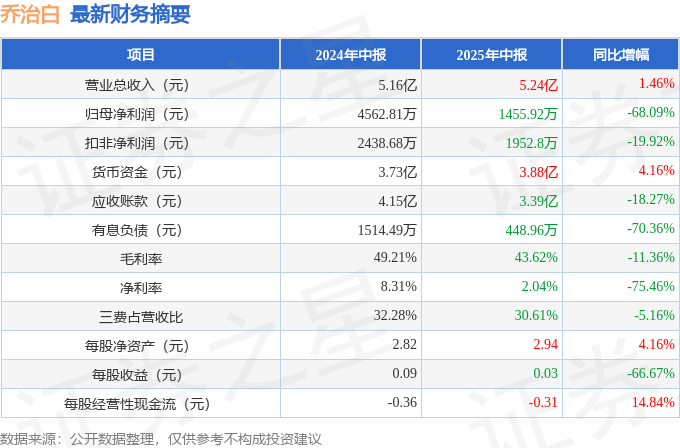
乔治白2025年中报简析:增收不增利,公司应收账款体量较大
Zheng Quan Zhi Xing· 2025-08-27 22:56
Core Insights - The company George White (002687) reported a total revenue of 524 million yuan for the first half of 2025, reflecting a year-on-year increase of 1.46%, while the net profit attributable to shareholders decreased by 68.09% to 14.56 million yuan [1] Financial Performance - Total revenue for the second quarter of 2025 was 247 million yuan, showing a decline of 7.15% year-on-year [1] - The net profit for the second quarter was -0.94 million yuan, a significant drop of 104.08% year-on-year [1] - The gross margin decreased to 43.62%, down 11.36% year-on-year, while the net margin fell to 2.04%, a decrease of 75.46% [1] - Total operating expenses (sales, management, and financial expenses) amounted to 160 million yuan, accounting for 30.61% of revenue, which is a decrease of 5.16% year-on-year [1] - Earnings per share (EPS) dropped to 0.03 yuan, a decline of 66.67% year-on-year [1] Balance Sheet Highlights - Accounts receivable reached a significant level, with accounts receivable to net profit ratio at 383.8% [1][4] - Cash and cash equivalents increased by 38.84%, attributed to the redemption of financial products [3] - The company’s net asset value per share increased by 4.16% to 2.94 yuan [1] Cash Flow Analysis - The net cash flow from investing activities increased by 5.15%, due to more financial products maturing compared to the previous period [3] - The net cash flow from financing activities surged by 96.31%, influenced by stock buybacks in the previous year [3] Business Model and Performance Metrics - The company's return on invested capital (ROIC) was 5.46%, indicating average capital returns, with a historical median ROIC of 9.38% over the past decade [3] - The company's performance is primarily driven by research and marketing efforts, necessitating a thorough examination of these underlying drivers [3]

安正时尚: 安正时尚集团股份有限公司投资者关系管理制度
Zheng Quan Zhi Xing· 2025-08-27 16:40
Core Viewpoint - The company establishes an investor relations management system to enhance communication with investors, protect their rights, and improve corporate governance and overall value [1][2][3] Group 1: Objectives and Principles of Investor Relations Management - The purpose of investor relations management is to create a two-way communication channel with investors, enhance their understanding and support of the company, and maximize overall benefits for the company and shareholders [2][3] - The management should adhere to principles of compliance, equality, and proactivity, ensuring all investors are treated fairly and that their opinions are actively sought [3][5] Group 2: Communication Methods and Content - The company will communicate with investors through various means, including regular and interim reports, dedicated investor consultation channels, and shareholder meetings [6][7] - Key communication content includes the company's development strategy, legal disclosures, operational management information, and responses to investor inquiries [8] Group 3: Responsibilities and Management Structure - The board of directors is responsible for investor relations management, with the board secretary overseeing daily operations [14] - Responsibilities include handling investor inquiries, organizing communication events, and ensuring compliance with information disclosure regulations [11][12]
