
连锁餐饮

Search documents
西贝创始人贾国龙称将起诉,罗永浩回应
证券时报· 2025-09-11 14:16
据新黄河消息,9月11日,在结束回应"预制菜"风波的新闻发布会后,西贝创始人、董事长贾国 龙在接受采访时,就"是否会起诉罗永浩"一问做出明确且强硬的表态。 "一定会,我们一定会起诉他,一定一定会起诉他!"贾国龙连用三个"一定"来强调他的决心。他表示:"他 对我们的伤害是很大的,一定会起诉。" 贾国龙在采访中表示,明天开始西贝全国370家店全部开放,厨房、原料、工艺都向大众透明。任何人都 可以到西贝任何一家门店的厨房参观,只是需要申请并佩戴防护工具,员工会带领参观,想看任何一道菜 都可以。 谈及预制和预制菜,贾国龙表示,此前自己确实发表过类似于"高级菜才预制"的言论,例如鱼翅鲍鱼等高 级菜肴都需要长时间地预制,"预制就是预加工,但我们不是预制菜,国家对预制菜有严格定义。按国家 的规定,我们没有一道菜是预制菜,做熟环节都在门店进行。不过,贾国龙也指出,馒头是在中央厨房做 熟的,在国家标准中,主食类和面点类是允许在工厂做,再到门店加热,它不属于预制菜。 "预制菜未来一定是大趋势。"谈及对预制菜的看法,贾国龙表示,西贝目前虽然不用预制菜,但也不黑预 制菜。预制菜也分三六九等,分高品质和低品质。预制菜也有好处,例如整体 ...


西贝创始人称将起诉罗永浩!公司称罗永浩所点菜品“没有一道是预制菜”!罗永浩回应
Sou Hu Cai Jing· 2025-09-11 12:24
Core Viewpoint - The incident involving Luo Yonghao criticizing the restaurant chain Xibei for allegedly serving pre-prepared dishes has sparked significant attention, leading to a strong response from Xibei's management [1][2]. Group 1: Incident Overview - Luo Yonghao publicly criticized Xibei on social media, claiming that the dishes he ordered were mostly pre-prepared and overpriced, urging for legislation to require restaurants to disclose the use of pre-prepared dishes [1]. - Xibei held a press conference to refute Luo's claims, stating that none of the dishes ordered were pre-prepared according to the latest national definitions [1][7]. - During the meal, Luo and his party ordered a total of 15 dishes, with only two left unfinished, which were served last [1]. Group 2: Legal Actions and Responses - Xibei's founder and chairman, Jia Guolong, announced a firm intention to sue Luo Yonghao for the damage caused by his statements [2][3]. - Jia emphasized the seriousness of the situation, stating that the harm caused by Luo's comments was significant and that legal action would be pursued [3]. - Luo responded to the situation by questioning the quality of the food served, suggesting that if the dishes were not pre-prepared, it would indicate advanced culinary technology [5][7]. Group 3: Industry Implications - The incident highlights the ongoing debate within the restaurant industry regarding the use of pre-prepared dishes and the transparency required in food preparation practices [1][7]. - Xibei's management indicated that while the industry does not shy away from using pre-prepared ingredients, they firmly believe their offerings do not fall under that category as per national regulations [7].
罗永浩连续两天喊话西贝,餐饮店使用预制菜到底要不要明示
Di Yi Cai Jing· 2025-09-11 11:01
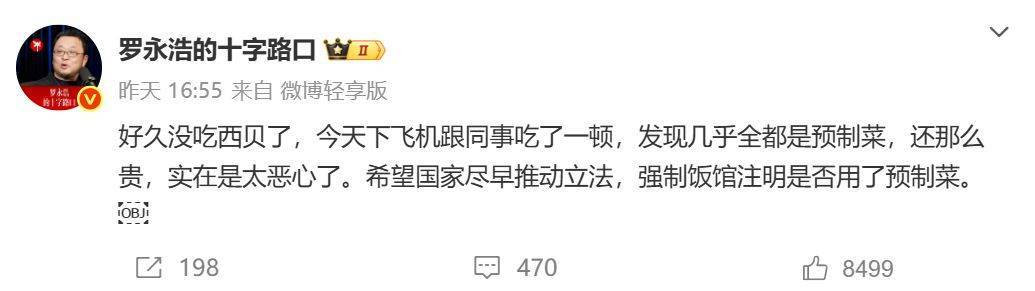
近日,罗永浩在社交账号"罗永浩的十字路口"表示,自己和同事去西贝吃饭,发现几乎全都是预制菜,还那么贵,希望国家尽早推动立法,强制饭馆注明是 否用了预制菜。 目前还没有一条法律明文规定必须对预制菜进行明示,但这种行为正被大力推广。 不过,第一财经记者在某本地生活app看到,目前北京的贾国龙功夫菜均已闭店。 9月11日下午,罗永浩又在社交账号表示,"有没有什么专业设备和方法能够检测出食物被烹制的时间?或用什么其他方式能检测出食物是不是预制菜?设备 多昂贵都没关系,我想买一台或租一台,把用了预制菜后不肯说实话的餐馆横扫一遍。"罗永浩进一步解释称,"从市场经济的角度来说,预制菜贵不贵倒是 没那么重要(虽然预制菜卖得贵确实更讨厌),重要的是知情权。" 从罗永浩的发声可以看出,他一方面对餐厅使用预制菜却没有告知消费者感到不满,另一方面认为西贝价格偏高。 对于餐厅是否有预制菜,截至发稿,西贝方面暂无回复。有媒体致电西贝,客服人员表示,店内的招牌菜,牛大骨是每天早上现煮的,莜面也是店内工作人 员现场手搓的,不存在预制。另外,店内的炒菜每天都是新鲜的蔬菜到店,现场炒制。 其实,西贝集团曾通过设立新品牌进入预制菜赛道。西贝集团旗 ...
西贝回应“被罗永浩吐槽是预制菜”
Sou Hu Cai Jing· 2025-09-11 04:00
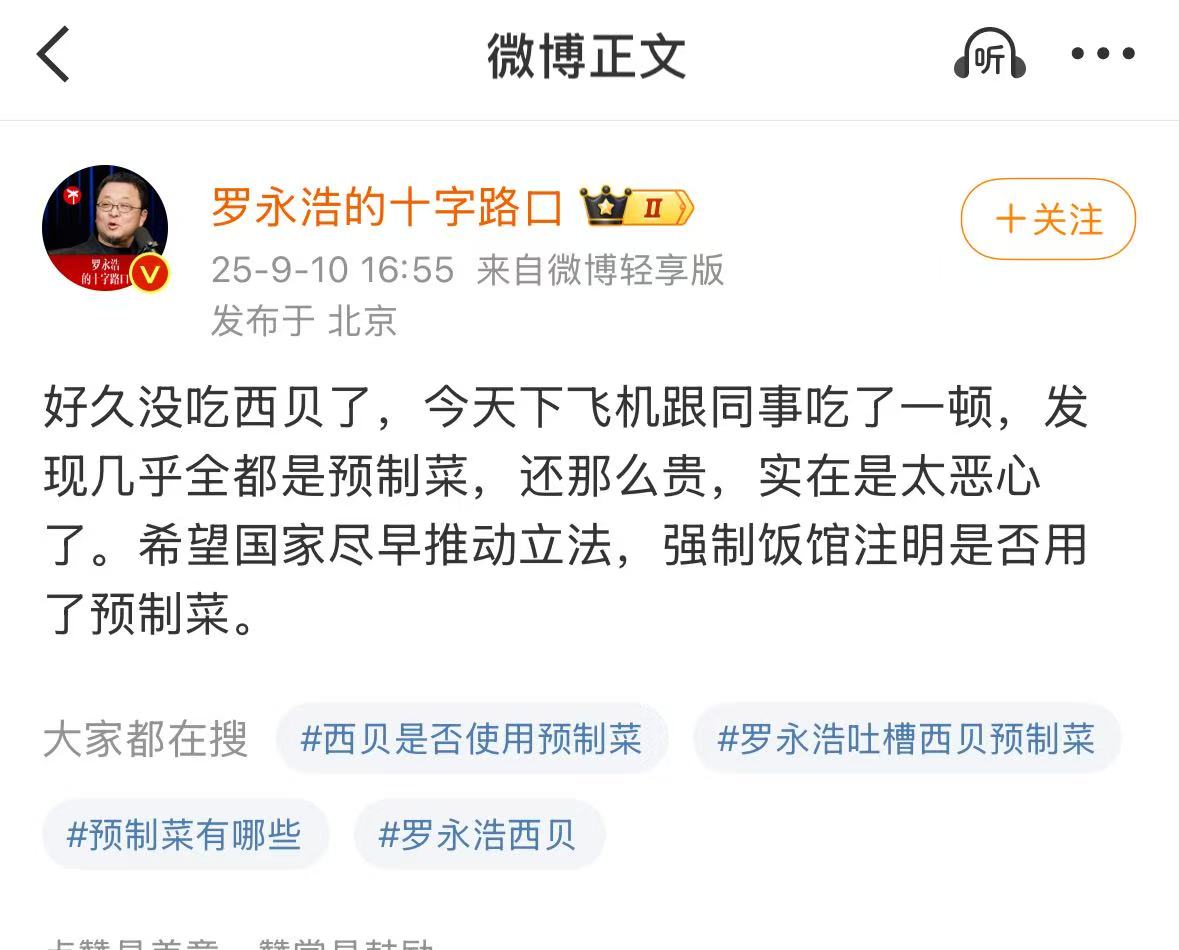
9月10日,知名企业家罗永浩在社交媒体上公开吐槽知名连锁餐饮品牌西贝,直言:"好久没吃西贝了,今天下飞机跟同事吃了一顿,发现几乎全都是预制 菜,还那么贵,实在是太恶心了。希望国家尽早推动立法,强制饭馆注明是否用了预制菜。" 值得注意的是,这不是罗永浩第一次吐槽预制菜了,早在去年11月,罗永浩就在微博发文称:"不反对预制菜,但餐厅卖预制菜并且不注明的,本质就是 欺骗。即使真的做到了宣传的'安全美味',它也是欺骗。" 去年8月,西贝合伙人、联合创始人樊大卫去西贝北京华贸店(商场店)做了一期视频,最后总结,只有馒头和黄馍馍是从中央工厂配送过来的,剩下的 从凉菜到热菜,到大菜、主菜全部是明档现场制作。 预制菜也称预制菜肴,是以一种或多种食用农产品及其制品为原料,使用或不使用调味料等辅料,不添加防腐剂,经工业化预加工(如搅拌、腌制、滚 揉、成型、炒、炸、烤、煮、蒸等)制成,配以或不配以调味料包,符合产品标签标明的贮存、运输及销售条件,加热或熟制后方可食用的预包装菜肴。 连锁餐饮企业广泛应用中央厨房模式,其自行制作并向自有门店配送的净菜、半成品、成品菜肴,应当符合餐饮食品安全的法律法规和标准要求。中央厨 房制作的菜肴,不 ...
宋向前——头号玩家的从容和笃定,消费产业的价值守望者
投中网· 2025-09-10 06:33
Core Viewpoint - The article emphasizes the need for finance to return to its essence of serving the real economy, advocating for a "real industry over capital" approach in investment strategies [4][5]. Group 1: Resource Allocation - Capital should flow towards efficient sectors rather than short-term arbitrage opportunities, with a focus on consumer-driven economic growth as a stabilizing force [6][7]. - The investment landscape has been distorted by excessive capital inflow, leading to a focus on rapid expansion and market capture rather than sustainable business practices [8][9]. Group 2: Governance and Empowerment - The investment philosophy of the company is characterized by deep involvement in the operational aspects of the businesses it invests in, moving beyond mere financial support to strategic partnership [10][11]. - Successful case studies, such as the investment in Xiaocaiyuan, demonstrate the effectiveness of this approach, resulting in significant market achievements and returns [12][13]. Group 3: Brand Behind the Brand - The company seeks to invest in businesses with "real industry genes," focusing on consumer sectors that exhibit high-frequency demand and scalability [19][20]. - Notable investments include brands like Qiaqia Foods and Babimantou, which have become industry leaders due to their alignment with the company's investment philosophy [21][23]. Group 4: Capital's Mission - The company is positioned to play a crucial role in transitioning society towards a consumption-driven economy, emphasizing the importance of enhancing disposable income and improving living standards [28][30]. - The investment strategy aims to create social value that translates into stable economic returns, highlighting the need for a shift from being mere investors to becoming co-creators in the industries they support [31][33].



Brinker International(EAT) - 2025 Q2 - Earnings Call Transcript
2025-09-05 13:00
Financial Data and Key Metrics Changes - In the first half of 2025, revenues reached approximately €1,262 million, reflecting a 2.5% year-on-year increase, or 3.9% when excluding the impact of deconsolidation from sold assets [5][6][10] - Year-to-date adjusted EBITDA was over €196 million, roughly flat compared to the previous year, while EBIT improved to €47.5 million, resulting in an EBIT margin of 3.8% compared to 1.9% in the first half of 2024 [5][16] - The company maintained a leverage ratio of 2.1 times, at the low end of its internal target range, and executed 36 cross-openings and 123 renovations during the first half [5][23] Business Line Data and Key Metrics Changes - KFC introduced seasonal innovations and campaigns, including a collaboration with Netflix's Squid Game, which drove engagement and sales [6][7] - Burger King focused on a diverse breakfast menu, while Starbucks continued to innovate with seasonal beverages, contributing to strong sales [7][8] - Pizza Hut launched Wing Street, a new product category, enhancing its market presence [9] - Blue Frog and Latte Gratiella continued to strengthen brand engagement through innovative campaigns and rebranding efforts [9][10] Market Data and Key Metrics Changes - Central and Eastern Europe generated sales of nearly €400 million, an 8% increase year-on-year, with Poland showing a 10% revenue growth [25] - Western Europe saw sales decline by almost 2% to €220 million, with significant variances across countries; Spain and Germany grew, while France experienced a steep decline of 14% [25][26] - In China, sales decreased by over 9% to €22.6 million, attributed to a challenging macroeconomic environment [26] Company Strategy and Development Direction - The company aims to protect value and convenience across brands, scale digital engagement, maintain cost control, and prioritize capital allocation to high-return opportunities [28][29] - Strategic adjustments to non-performing businesses have been made to sharpen capital allocation and focus on resilient formats [12][13] Management's Comments on Operating Environment and Future Outlook - The management acknowledged the challenging macroeconomic environment and consumer sentiment decline but emphasized the resilience of the business model [19][20] - The company maintains its guidance for the year, despite potential delays in store openings, particularly in the fourth quarter [35][36] Other Important Information - The company reported a net profit of nearly €8 million in the quarter, a significant improvement from a loss of €23 million a year ago [21] - Operating cash flow increased to €106 million, reflecting strong cash generation [20][21] Q&A Session Summary Question: Outlook for the rest of the year and guidance confirmation - The company confirmed it is maintaining its guidance for the year, with potential delays in store openings [35][36] Question: Inorganic growth opportunities - The management acknowledged the depressed sector and is continuously evaluating acquisition opportunities while maintaining financial discipline [37] Question: Performance in China - The management clarified that while macroeconomic indicators may suggest growth, consumer sentiment and consumption patterns remain challenging [42][43] Question: Financial communication clarity - The company is open to improving financial communications and will consider organizing discussions with the Investor Relations team [38][39]

场景化探索助力品牌焕新 绝味食品半年报展现经营韧性
Quan Jing Wang· 2025-09-02 01:01
Core Insights - The core viewpoint of the news is that Juewei Foods has demonstrated resilience and adaptability in a changing market environment, focusing on digital operations, supply chain enhancements, and targeted marketing strategies to maintain its competitive edge and drive growth. Group 1: Financial Performance - In the first half of 2025, Juewei Foods achieved an operating income of 2.82 billion yuan and a net profit attributable to shareholders of 175 million yuan [1] Group 2: Digital Operations - Juewei Foods' investment in digital operations has been a crucial support for its operational resilience, utilizing data-driven systems to track consumer demand changes and adjust product and marketing strategies accordingly [2] - The company has enhanced member engagement and gained insights into regional market differences through its digital initiatives, allowing for more accurate market strategies [2] Group 3: Supply Chain Management - The supply chain system is a core foundation for Juewei Foods' stable operations, with a nationwide cold chain distribution network ensuring product freshness and safety [2] - This robust supply chain supports rapid replication of store operations and is seen as a key competitive advantage for future expansion and innovation [2] Group 4: Marketing Strategy - Juewei Foods is actively integrating its brand into diverse lifestyle scenarios, such as music festivals and camping, to enhance communication with younger consumers [3] - The company is focusing on building consumer profiles and optimizing products, marketing, and services based on the differentiated characteristics of various consumer groups, particularly targeting Generation Z [3] Group 5: Overall Strategy - The 2025 half-year report reflects Juewei Foods' approach as a leading chain enterprise in navigating a complex market environment, balancing stability and innovation to solidify long-term brand value [4]


投诉“鲁迅抽烟墙画”当事人被封号;刘强东现身苏超赛场;李斌内部讲话:蔚来四季度必须盈利;霸王茶姬张俊杰谈“外卖大战”丨邦早报
创业邦· 2025-08-31 01:07
Group 1 - NIO aims to achieve profitability in Q4 2023, with CEO Li Bin emphasizing the need for the company to rely on its own capabilities to recover from recent losses [3][6] - The launch of the L90 and new ES8 models has shown improved execution and market response, indicating a shift towards a more competitive electric vehicle landscape [3][9] - Li Bin highlighted the increasing benefits of battery swapping technology, suggesting a turning point in the electric vehicle market towards pure electric models [9][24] Group 2 - JD.com founder Liu Qiangdong was seen supporting his hometown football team, coinciding with the opening of new discount stores in the area [4][6] - Huawei's rotating chairman Xu Zhijun announced that the HarmonyOS ecosystem is well-established, with major applications adapting to the platform [8][9] - Xiaopeng Motors' CEO He Xiaopeng expressed confidence in the new P7 model's pricing strategy, indicating a competitive environment in the automotive sector [9][24] Group 3 - Bawang Tea's CEO Zhang Junjie discussed the company's strategy to avoid price wars and focus on high-value branding amidst fierce competition in the food delivery market [9][24] - Meta is exploring partnerships with Google and OpenAI to enhance its AI capabilities, while also facing scrutiny for using celebrity likenesses without permission [10][13] - SpaceX achieved a milestone with its Falcon 9 rocket, completing its 30th launch and recovery, showcasing advancements in reusable rocket technology [17][24]





炒菜机“炒热”市场:连锁餐饮涌入炒菜机赛道,团餐大型炒菜机3万元起步;炒菜机能代替厨师吗?
Sou Hu Cai Jing· 2025-08-28 03:31
Core Insights - The implementation of new judicial interpretations regarding social insurance fees has sparked discussions on cost reduction strategies among companies, particularly in the restaurant industry [2] - The rise of cooking robots is seen as a viable solution for reducing labor costs and improving operational efficiency in restaurants [2][4] Industry Trends - The Chinese cooking robot market is projected to reach 31.7 billion yuan by 2024 and is expected to exceed 37 billion yuan by 2025, with a continuous growth trend anticipated to surpass 117 billion yuan by 2030 [4][5] - Major restaurant chains like Nanchengxiang, Xiaolongkan, and Laoxiangji have begun integrating cooking robots into their operations to enhance efficiency and reduce repetitive labor [6] Cost and Efficiency - Cooking robots can significantly lower labor costs, with estimates showing that the employee cost for a single restaurant could decrease from 2.347 million yuan to 2.256 million yuan, reducing the employee cost ratio from 26% to 25% [10] - The introduction of cooking robots allows for a reduction in kitchen space requirements, with some restaurants needing only 25 square meters compared to the traditional 70-80 square meters [10] Technological Advancements - Cooking robots are equipped with AI capabilities that enable them to customize recipes and maintain consistent food quality, achieving over 90% dish fidelity and an 80% increase in labor efficiency [10][11] - The technology allows for dynamic recipe generation and user interaction, enhancing the overall dining experience [11] Market Challenges - The initial investment for cooking robots ranges from 30,000 yuan to 200,000 yuan, which may deter some smaller businesses from adopting this technology [3][12] - Current cooking robots primarily assist in the frying process, and there are concerns about their ability to fully replace chefs, particularly for complex dishes that require a human touch [13]
费大厨辣椒炒肉全国门店数突破190家
Bei Jing Shang Bao· 2025-08-27 10:20
Group 1 - The core viewpoint of the article highlights that Fei Dazhu has surpassed 190 directly-operated stores nationwide, covering major cities such as Changsha, Beijing, Shanghai, Guangzhou, Shenzhen, Hangzhou, Chengdu, Xi'an, and Wuhan [1] - Fei Dazhu is the first Hunan cuisine chain brand to expand into first-tier cities with a nationwide presence [1] - The company is actively preparing to open more stores in cities like Chengdu, Wuhan, Xi'an, and Guangzhou [1] Group 2 - In response to the growing consumer demand for healthy eating, Fei Dazhu has been upgrading its products and exploring new health-oriented directions [1] - The brand has effectively captured the core consumer demands for "delicious, fresh, and healthy" by combining "stir-fry experience with health upgrades" to establish its unique competitive advantage [1] - Unlike many competitors in the fiercely competitive takeaway industry, Fei Dazhu has committed to maintaining a dine-in only model, emphasizing "only direct operation, no franchising, and only dine-in, no takeaway" [1]