
餐饮业

Search documents
反内卷改善企业预期!7月份PMI数据出炉
券商中国· 2025-07-31 05:59
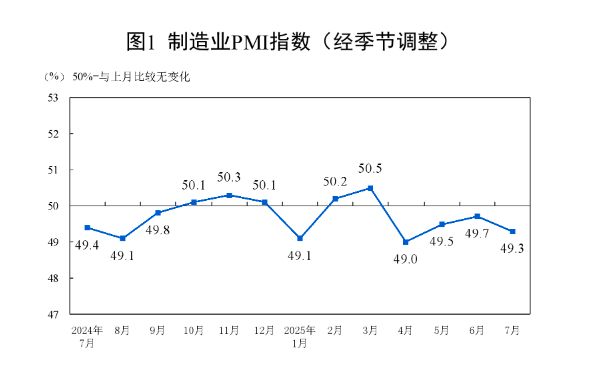
Core Viewpoint - The manufacturing PMI for July is 49.3%, a decrease of 0.4 percentage points from the previous month, primarily influenced by seasonal production slowdowns and adverse weather conditions [1][3]. Group 1: Economic Recovery and Manufacturing Performance - The foundation for economic recovery remains solid, with the equipment manufacturing and high-tech manufacturing PMIs continuing to expand, indicating ongoing structural optimization [2][3]. - Large enterprises are maintaining stable expansion, acting as a "ballast" for the economy [2][3]. - The rebound in the major raw material purchasing price index, which rose above the critical point for the first time since March, reflects improved market conditions in certain industries [4]. Group 2: Impact of Anti-Competition Measures - The anti-competition measures have positively influenced corporate expectations, as indicated by rising indices for purchasing prices, output prices, employment, supplier delivery times, and production activity expectations [4][5]. - The purchasing price index for major raw materials increased to 51.5%, while the output price index rose to 48.3%, showing significant recovery in specific sectors like petroleum and black metal processing [4]. Group 3: Consumer Activity and Seasonal Trends - The non-manufacturing business activity index for July is 50.1%, reflecting a slight decline but showing initial signs of summer consumption boosting economic activity [6][7]. - Retail activity is on the rise, with the retail business activity index surpassing the critical point, and new order indices showing significant increases [7]. - Travel and leisure activities are also gaining momentum, with indices for railway and air transport exceeding 60%, indicating strong consumer willingness to travel [7][8]. Group 4: Future Outlook - The summer consumption boost is expected to continue into August, supported by ongoing macroeconomic policies aimed at expanding domestic demand [8].

反内卷改善企业预期!短期因素造成制造业PMI环比微降
证券时报· 2025-07-31 05:47
Core Viewpoint - The manufacturing PMI for July is reported at 49.3%, a decrease of 0.4 percentage points from the previous month, primarily influenced by seasonal production slowdowns and adverse weather conditions [1][5][6]. Group 1: Manufacturing Sector Analysis - The manufacturing PMI reflects a contraction, but the underlying economic recovery remains solid, with equipment manufacturing and high-tech manufacturing PMIs continuing to expand [3][7]. - Large enterprises are maintaining stable expansion, acting as a stabilizing force in the economy [3][7]. - The rebound in the major raw material purchasing price index indicates a positive shift in business expectations due to anti-involution measures [10][12]. Group 2: Non-Manufacturing Sector Insights - The non-manufacturing business activity index stands at 50.1%, showing a slight decline but remaining above the critical point, indicating ongoing activity in the sector [2][14]. - Summer consumption is beginning to show positive effects, with significant increases in retail and travel activities, although the accommodation and catering sectors remain below the critical point [14][15][16]. Group 3: Future Economic Outlook - The implementation of policies aimed at expanding domestic demand is expected to support stable economic growth and quality improvement in the second half of the year [8][17]. - Analysts predict that the positive impact of summer consumption will continue into August, contributing to a gradual increase in investment and consumption activities [16][17].

反内卷改善企业预期!短期因素造成制造业PMI环比微降
Zheng Quan Shi Bao· 2025-07-31 05:45
Core Points - The manufacturing PMI for July is reported at 49.3%, a decrease of 0.4 percentage points from the previous month, primarily influenced by seasonal production slowdowns and adverse weather conditions [1][3] - The non-manufacturing business activity index and the composite PMI output index are at 50.1% and 50.2%, respectively, both showing a decline but remaining above the critical point [1][3] - Economic recovery fundamentals remain solid, with the equipment manufacturing and high-tech manufacturing PMIs continuing to expand, indicating ongoing structural optimization [1][3] Manufacturing Sector - The manufacturing PMI's decline is attributed to traditional production off-seasons and extreme weather events, leading to a weaker demand side [2][3] - Despite the overall PMI decline, production activities in manufacturing are still expanding, particularly in the equipment and high-tech sectors, which are crucial for economic growth [3][5] Price Indices - Among the 13 sub-indices of the manufacturing PMI, the purchasing price index and the ex-factory price index have risen, indicating improved market conditions in certain sectors [5] - The main raw material purchasing price index has risen to 51.5%, marking the first increase above the critical point since March, suggesting a potential recovery in material costs [5] Non-Manufacturing Sector - The non-manufacturing business activity index is at 50.1%, reflecting a slight decline, but summer consumption is beginning to show positive effects in retail, travel, and entertainment sectors [7][9] - Retail activity is increasing, with the retail business activity index rising above the critical point, indicating strong consumer purchasing intentions [8] Future Outlook - The implementation of policies aimed at expanding domestic demand, such as "two new" and "two heavy" initiatives, is expected to support stable economic expansion and quality improvement in the second half of the year [1][9] - The positive impact of summer consumption is anticipated to continue into August, contributing to economic recovery [9]
制造业PMI季节性回落至49.3%,下阶段走势如何
Di Yi Cai Jing Zi Xun· 2025-07-31 03:29
Economic Overview - The manufacturing Purchasing Managers' Index (PMI) for July is reported at 49.3%, a decrease of 0.4 percentage points from the previous month, indicating a slight contraction in manufacturing activity [1] - The non-manufacturing business activity index stands at 50.1%, also down by 0.4 percentage points, reflecting a slowdown in growth [1] - The composite PMI output index is at 50.2%, down 0.5 percentage points, but still above the critical point, suggesting overall expansion in business activities [1] Manufacturing Sector Insights - The new orders index for manufacturing is at 49.4%, a decline of 0.8 percentage points, indicating a tightening in market demand [3] - The new export orders index is reported at 47.1%, down 0.6 percentage points, further highlighting weak demand [3] - Despite the demand weakness, the production index remains at 50.5%, indicating continued expansion in manufacturing activities for the third consecutive month [3] - The raw material purchase price index has risen to 51.5%, an increase of 3.1 percentage points, suggesting a recovery in raw material prices [3] Price Trends - The ex-factory price index for manufactured goods is at 48.3%, up 2.1 percentage points, marking the second-highest point this year [3] - The basic raw materials sector is driving the stabilization and recovery of market prices, with the purchase price index rising over 7 percentage points to 52% [4] Business Confidence and Expectations - The production and business activity expectation index is at 52.6%, an increase of 0.6 percentage points, indicating improved confidence among manufacturing enterprises [4] - Large enterprises maintain a PMI of 50.3%, while medium-sized enterprises show improvement with a PMI of 49.5%, and small enterprises have a PMI of 46.4%, indicating varying levels of economic health across different company sizes [4] Non-Manufacturing Sector Performance - The non-manufacturing business activity index is at 50.1%, reflecting a slowdown but still within the expansion range [8] - The construction sector's business activity index is at 50.6%, down 2.2 percentage points, indicating a slowdown due to seasonal weather impacts [8] - Consumer spending during the summer shows positive trends, with retail and postal service indices rising above 50% and 60%, respectively, indicating strong consumer purchasing intentions [9] Future Outlook - The construction sector is expected to rebound post-rainy season, with infrastructure activities projected to continue steady growth [8][9] - The overall economic foundation remains solid, with expectations for continued stable expansion and quality improvement in the second half of the year, supported by ongoing macroeconomic policies [5]
上半年深圳GDP增5.1% 进出口降幅收窄
Nan Fang Du Shi Bao· 2025-07-30 23:15
Economic Performance - Shenzhen's GDP for the first half of 2025 reached 18322.26 billion yuan, with a year-on-year growth of 5.1% [1] - The primary industry added value was 10.33 billion yuan, growing by 2.8%; the secondary industry added value was 6505.56 billion yuan, increasing by 3.3%; and the tertiary industry added value was 11806.37 billion yuan, rising by 6.1% [1] Industrial and Service Sector Growth - The city's industrial added value for large-scale enterprises grew by 4.3%, with manufacturing increasing by 4.2% and electricity, heat, gas, and water production and supply growing by 11.8% [2] - High-tech product output saw significant growth, with civil drones, industrial robots, and 3D printing equipment increasing by 59.0%, 38.0%, and 35.8% respectively [2] - The service sector's added value was 11806.37 billion yuan, with a year-on-year growth of 6.1%, driven by finance (10.9%), transportation and warehousing (9.0%), and information technology services (8.1%) [2] Investment Trends - Fixed asset investment in Shenzhen decreased by 10.9%, with real estate development down by 15.1% but infrastructure investment up by 7.7% and industrial technology renovation investment soaring by 47.1% [3] - Investment in information transmission, software, and IT services grew by 47.7%, while transportation and warehousing investment rose by 32.5% [3] Consumer Market Insights - The total retail sales of social consumer goods reached 4948.68 billion yuan, with a year-on-year growth of 3.5% [3] - Online retail sales through the internet increased by 19.4%, indicating a strong trend towards e-commerce [3] Trade and Financial Sector - The total import and export volume for the first half of the year was 21675.45 billion yuan, a decrease of 1.1%, with exports down by 7.0% and imports up by 9.5% [4] - By the end of June, the balance of deposits in financial institutions reached 141600.14 billion yuan, growing by 5.7% [4] Cross-Border E-commerce Development - The Google Cross-Border E-commerce Acceleration Center in Shenzhen officially commenced operations, enhancing the cross-border e-commerce ecosystem in the region [6] - The center aims to provide comprehensive services for cross-border e-commerce companies, supporting their global business expansion [6]
陈茂波:香港营商环境优势凸显 金融市场亮眼、创科产业快速发展
智通财经网· 2025-07-30 14:06
Economic Outlook - The Hong Kong economy is expected to maintain growth in the second half of the year, following a 3.1% growth in Q1 and a positive outlook for Q2 [7][18] - The government is actively supporting industries undergoing transformation, particularly in funding and digital upgrades for local retail and dining sectors [8][20] Investment and Business Environment - International investor confidence in Hong Kong is rising, with the Hang Seng Index increasing by 27% this year after an 18% rise last year [4] - The number of companies registered in Hong Kong from overseas has increased by 10% year-on-year, with 84 key enterprises expected to invest approximately HKD 500 billion, creating 20,000 jobs [4][5] Real Estate and Office Space - The government is not selling commercial land to allow the market to absorb existing office space, while also encouraging private entities to purchase office properties [2][13] - There has been significant demand for office space from multinational financial institutions, particularly in wealth and asset management sectors [2][14] Retail and Consumer Trends - Retail sales have shown signs of recovery, with a 2.4% increase reported in May after 14 months of decline [8] - The number of visitors to Hong Kong has increased significantly, with a double-digit growth rate in international tourists during the first half of the year [6][9] Talent Acquisition - Approximately 500,000 applications have been received for talent importation programs, with 330,000 approved and around 220,000 individuals having arrived in Hong Kong [5][20] Financial Sector Stability - Hong Kong's banking sector remains robust, with a capital adequacy ratio of approximately 21%, significantly above the global standard of 8% [15][20] - The overall banking system is characterized by strong liquidity and prudent provisioning for potential bad debts [15]
金陵饭店(601007)7月30日主力资金净流入1073.13万元
Sou Hu Cai Jing· 2025-07-30 09:52
Core Insights - The stock price of Jinling Hotel (601007) closed at 7.85 yuan on July 30, 2025, reflecting a 2.61% increase with a turnover rate of 6.52% and a trading volume of 254,100 hands, amounting to 199 million yuan in transaction value [1] Financial Performance - For the first quarter of 2025, Jinling Hotel reported total operating revenue of 447 million yuan, a year-on-year decrease of 20.48% - The net profit attributable to shareholders was 6.45 million yuan, down 18.26% year-on-year, while the non-recurring net profit was 5.21 million yuan, showing a year-on-year increase of 3.34% - The current ratio stood at 1.641, the quick ratio at 0.934, and the debt-to-asset ratio at 31.42% [1] Investment and Business Activities - Jinling Hotel has made investments in 15 companies and participated in 93 bidding projects - The company holds 31 trademark registrations and 2 patents, along with 18 administrative licenses [2]

“苏超”前六轮实现服务营收近380亿元!出行、餐饮场景的江苏省外游客支付占比分别达28.8%、19.7%
Ge Long Hui· 2025-07-30 05:28
Core Insights - Jiangsu Province's economic and social development report for the first half of 2025 indicates significant growth in service revenue, particularly in tourism, travel, dining, accommodation, and sports sectors [1] Group 1: Economic Performance - The total service revenue from the monitored sectors in Jiangsu reached 37.96 billion yuan, reflecting a year-on-year increase of 42.7% [1] - Among the service revenue, the share of payments from out-of-province tourists in the travel and dining sectors accounted for 28.8% and 19.7%, respectively [1]
流量变增量!华强北携手饭店业协会以资源整合撬动百业兴旺
Nan Fang Du Shi Bao· 2025-07-30 04:18
Core Insights - The article discusses the collaboration between the Futian district of Shenzhen and the Shenzhen Hotel Industry Association to address challenges in the restaurant and hotel sectors, focusing on transforming "traffic into growth" through resource integration [1][3][5] Group 1: Industry Challenges and Responses - The restaurant average spending per customer is declining, and hotel revenues are under pressure, prompting proactive measures from local authorities [1] - The Shenzhen Hotel Industry Association, established in 2004, has over 400 member hotel groups and aims to create a comprehensive service system for the industry [1] Group 2: Strategies for Growth - A joint plan was developed to convert event traffic into sustained consumer spending by linking sports events with dining and hotel accommodations [3] - Initiatives include designing exclusive hotel packages for event attendees and organizing themed night markets to extend the consumer engagement chain [3] Group 3: Sustainable Development Initiatives - The focus on green and smart development is emphasized, with efforts to promote green certifications and low-carbon designs among leading hotels in the area [4] - The integration of smart technology in hospitality, such as smart restaurants and unmanned hotels, is being explored to enhance operational efficiency [4] Group 4: Internationalization and Branding - The initiative aims to position Shenzhen as an international consumption center by facilitating partnerships between local brands and international hotel chains [5] - Events like the "Shenzhen Hotel Industry Brand High-Quality Development Conference" are organized to enhance the international image of the region [5] Group 5: Economic Impact - The integration of various sectors is expected to transform single-point traffic into comprehensive industry growth, contributing to Shenzhen's economic ecosystem [5] - The article highlights the potential for creating a new productive force in the "Electronic First Street" of Shenzhen, driving high-quality development goals [5]
“苏超”前六轮线下营收近380亿元出行餐饮场景中省外游客支出占比不低
Xin Hua Ri Bao· 2025-07-29 22:42
Group 1 - The core report indicates that Jiangsu Province's economic performance in the first half of 2025 is stable and shows progress, achieving a GDP of nearly 6.7 trillion yuan, which accounts for over 10% of the national total, with a year-on-year growth of 5.7%, surpassing the national average by 0.4 percentage points [2] - The "Su Chao" events have significantly contributed to the local economy, with service revenue from five monitored scenarios reaching approximately 380 billion yuan, indicating a year-on-year increase of 42.7% [1] - The report highlights that out-of-province tourist spending in the travel and dining sectors accounted for 28.8% and 19.7% of the total service revenue, respectively, suggesting a strong impact from external visitors [1] Group 2 - The provincial government has successfully met 22 out of 41 planned economic indicators for the year, with seven indicators, including GDP and revenue from the productive service industry, progressing faster than scheduled [2] - The report emphasizes the importance of creating more integrated experiences around events, such as food and entertainment, to further stimulate economic activity [1]