
卫星通信

Search documents
中国意外发现星链大秘密!从此不怕马斯克支援台湾
Sou Hu Cai Jing· 2025-11-29 02:26
Core Insights - The article discusses the implications of SpaceX's Starlink system in modern warfare, particularly in the context of the Ukraine conflict and potential scenarios in the Taiwan Strait [1][3][5][7] - It highlights China's response strategies to counter the Starlink network, emphasizing the shift in electronic warfare tactics and the importance of spectrum control [3][5][7] Group 1: Starlink System Capabilities - Starlink is not merely a civilian project; it has evolved into a critical military communication tool, enabling seamless communication among drone swarms and providing real-time targeting for remote firepower [1] - The system's resilience is demonstrated by its ability to recover from signal interference through remote software upgrades, indicating a need for advanced countermeasures [1][5] Group 2: China's Countermeasures - Chinese researchers have identified that suppressing Starlink signals over Taiwan would require at least 935 drones equipped with jamming devices, reflecting a new definition of "electromagnetic sovereignty" [3] - The strategy involves a distributed jamming approach using numerous low-power nodes rather than relying on a few high-power jamming stations, enhancing effectiveness in localized areas [3][5] Group 3: Advanced Technologies and Strategies - China is exploring various countermeasures, including high-power microwave weapons capable of generating 10 gigawatts of pulse energy to damage satellite electronics, and laser submarine systems for stealth attacks [5] - The development of China's own low Earth orbit satellite network, known as the "Qianfan" constellation, is underway to counter Starlink's influence [5][7] Group 4: Technological Arms Race - The article suggests that the ongoing developments signal a new electronic arms race, with the U.S. military recognizing the potential of soft-kill methods combined with artificial intelligence to suppress low Earth orbit constellations [7] - The core competition is framed as a battle between distributed intelligence and centralized intelligence, emphasizing the need for adaptive and evolving counter-systems in modern electronic warfare [7]


科技巨头“卷”向太空
财联社· 2025-11-28 14:58
Core Viewpoint - The article discusses the emerging trend of deploying AI capabilities in space, highlighting the plans and advancements made by both domestic and international companies in establishing space-based data centers and computing power [1][3]. Domestic Developments - Beijing has proposed a clear timeline for the construction of space data centers, with projects like "Star Computing" and "Trinity Computing Constellation" making progress [3]. - Companies such as Guokong Chuangxin and Zhijiang Laboratory are planning to build large-scale data centers in low Earth orbit, aiming for significant AI computing power deployment by 2035 [6][10]. - The "Star Computing" plan aims to launch 2,800 computing satellites, with a total computing power target of 5 Peta Operations Per Second (POPS) by 2025 [6]. International Developments - Major companies like Google, SpaceX, and Amazon are also investing in space computing initiatives. Google plans to launch satellites equipped with AI chips by 2027, while SpaceX aims to deploy a data center capable of 100 GW within the next few years [9][10]. - Amazon's Project Kuiper envisions building a data center in space within the next 10 to 20 years, indicating a long-term commitment to space-based computing [9]. Advantages of Space Computing - Space computing offers unique advantages such as energy efficiency through solar power, reduced cooling requirements due to the cold environment, and the ability to operate continuously without terrestrial resource constraints [4][5]. Industry Chain Overview - The article outlines various companies involved in the space computing industry chain, including those focused on computing infrastructure, satellite manufacturing, and data processing [11]. Key players include: - Hangang Co., Ltd. (computing infrastructure) - China Satellite (satellite manufacturing) - Cambricon (chips) - Softcom Power (data processing) [11].




制造团队联合展望 - 2026年度策略报告汇报会议
2025-11-28 01:42
Summary of Key Points from Conference Call Records Industry Overview - The global energy storage market is experiencing explosive growth, particularly in China and North America, driven by data center development. It is expected that the Chinese energy storage market will double next year, with overseas growth rates reaching 40-50% [1][6][5]. - The integration of renewable energy into the grid has led to insufficient grid absorption capacity, necessitating significant increases in grid investment, especially in China and Europe. Energy storage and grid construction will jointly address regional power supply imbalances [1][2][7]. Core Insights and Arguments - **Energy Storage Demand**: There is a notable increase in demand for end-user energy storage, with residential and commercial storage solutions driving market growth. The economic tipping point has been reached, indicating significant future growth [1][2][6]. - **Investment Strategies**: The investment strategy for the 2026 power equipment and renewable energy sector focuses on four key areas: large-scale energy storage, increased grid investment, rising end-user storage demand, and the development of efficient, low-carbon, high-density energy sources such as offshore wind and gas turbines [2][3]. - **Data Center Power Systems**: Data center power systems are undergoing revolutionary changes, with trends towards 800V HVDC power architecture and SST power solutions, significantly increasing energy storage demand in North America [1][8]. Important but Overlooked Content - **Valuation and Company Selection**: Companies can be screened for investment by analyzing fixed asset growth rates in their balance sheets. A quadrant model can be used to identify companies with favorable supply-demand conditions and high profitability potential, particularly in sectors like large-scale energy storage and lithium batteries [3][4]. - **Long-term Investment Directions**: Key long-term investment areas in the energy storage industry include global storage development, data center innovations, grid investments, and high-density power construction [9]. - **Military Trade Growth**: The Chinese military trade sector is expected to see a significant increase in market share from 5.9% to 12-15% over the next decade, driven by the successful practical application of military technology in civilian markets [31][32]. Conclusion The energy storage market is poised for substantial growth, driven by technological advancements and increasing demand across various sectors. Investment strategies should focus on identifying companies with strong growth potential in energy storage and related technologies, while also considering the implications of military trade developments on the broader market landscape.
Is IRDM Stock Ready To Rebound?
Forbes· 2025-11-26 17:35
Core Viewpoint - Iridium Communications (IRDM) is currently trading at a significant discount despite its steady expansion and strong cash generation, raising questions about whether the stock is undervalued and poised for a rebound [2][3]. Current Developments with IRDM - IRDM has seen a 42% decline in stock price this year, trading at a substantial discount compared to its recent peaks over 3 months, 1 year, and 2 years [4]. - The decline is attributed to tightened service revenue growth forecasts for 2025, delays in positioning, navigation, and timing (PNT) revenue, and a decrease in government subscribers [4]. - Positive developments include a 7% increase in commercial IoT revenue in Q3 2025, with expectations for double-digit growth for the full year, and over 30% growth in revenue from engineering/support services due to government contracts [5]. - Project Stardust, a new service, is set for testing in 2025 with a launch planned for 2026, and the acquisition of Satelles in 2024 will establish a new PNT service stream [5]. - Strong cash flow has allowed for a 5% dividend increase and share repurchases in 2024, with overall debt leverage expected to decline significantly by 2025 [5]. Strong Fundamentals for IRDM - IRDM's fundamentals show a cash flow yield of 17.5% and a revenue increase of 7.3% over the last twelve months, indicating continued growth in cash reserves [8]. - The stock is currently trading 34% below its 3-month peak, 49% below its 1-year peak, and 59% below its 2-year peak, highlighting a significant valuation discount [8][9].


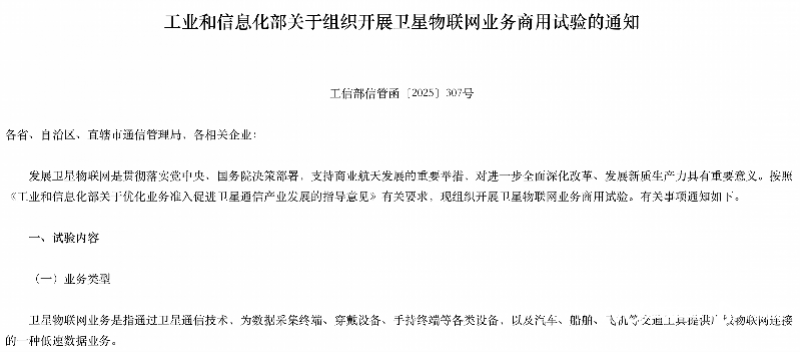
工信部官宣启动卫星物联网商用试验,试验期为两年
Nan Fang Du Shi Bao· 2025-11-26 10:53
Core Points - The Ministry of Industry and Information Technology (MIIT) has officially launched commercial trials for satellite IoT services across the country, marking a significant step in the industrialization of China's satellite communication sector [1][3] - The initiative aims to enrich the satellite communication market, stimulate market vitality, enhance service capabilities, and establish a safety regulatory system to support the healthy development of emerging industries such as commercial aerospace and low-altitude economy [3][4] Group 1: Commercial Trial Details - The commercial trial will involve enterprises constructing satellite IoT systems and related support systems (BSS, OSS, MSS) to legally conduct satellite IoT business nationwide [3] - The trial period is set for two years, during which participating companies must ensure network security, real-name management, data protection, and fraud prevention, while regularly reporting business data [3][4] Group 2: Industry Implications - The satellite IoT business connects various IoT devices through satellite communication technology, providing wide-area IoT connectivity for data collection terminals, wearable devices, and transportation tools [4][5] - The MIIT has indicated that the satellite communication sector is entering a rapid development phase, with 13 low-orbit satellites successfully launched and 108 satellites deployed as part of the "Thousand Sails" constellation [5][6] Group 3: Market Expansion and Collaboration - The MIIT encourages private enterprises to utilize various satellite resources through leasing, value-added services, and distribution partnerships to enhance the satellite communication market [5] - Major telecom operators, including China Telecom, China Unicom, and China Mobile, have received licenses to conduct satellite mobile communication services, expanding their service offerings in emergency communication and remote area connectivity [6]
通信行业2026年上半年投资策略:算力、5G-A建设持续推进,关注硬件端发展机遇
Dongguan Securities· 2025-11-26 07:12
Group 1 - The communication sector shows steady growth with a year-on-year increase in profit margins, with total revenue reaching 20,663.80 billion yuan in the first three quarters of 2025, a 4.23% increase, and net profit of 1,990.01 billion yuan, up 8.78% year-on-year [5][19] - The performance of major cloud service providers (CSPs) continues to improve, with capital expenditures from North America's top four cloud companies reaching approximately 112.47 billion USD in Q3 2025, marking an 18.38% quarter-on-quarter increase, the highest level since 2019 [26][27] - The ongoing rollout of 5G-A networks is expected to create new growth opportunities for various hardware sectors, as 5G-A offers superior performance compared to existing 5G networks, driving new business models and market spaces [5][6] Group 2 - The investment outlook for the communication industry remains positive, with a recommendation to overweight the sector, as the overall operation of the communication industry is stable, and the construction of network infrastructure continues to advance [5][6] - The capital expenditure guidance for computing power is optimistic, with significant investments from major operators in cloud and digitalization, indicating a shift towards increased spending in these areas [29][30] - The demand for optical modules is expected to remain strong, driven by increased capital expenditures and the acceleration of AI applications, with projected growth rates of 93% in the Ethernet optical module market in 2024 [51][52]


工业和信息化部组织开展卫星物联网业务商用试验
Xin Hua Cai Jing· 2025-11-26 05:20
Core Viewpoint - The Ministry of Industry and Information Technology has announced the organization of commercial trials for satellite IoT services, aiming to enhance market supply and support the development of emerging industries such as commercial space and low-altitude economy [1] Group 1: Satellite IoT Business Trials - Companies applying for satellite IoT commercial trials must establish a satellite IoT system along with business support systems (BSS), operational support systems (OSS), and management support systems (MSS) [1] - The initiative aims to enrich the satellite communication market supply and stimulate market vitality [1] Group 2: Industry Development Goals - The trials are intended to improve industry service capabilities and establish a safety supervision system [1] - The goal is to create replicable and scalable experiences and models to support the safe and healthy development of emerging industries [1]
北京北斗星通导航技术股份有限公司 第七届董事会第二十三次会议决议公告
Zhong Guo Zheng Quan Bao - Zhong Zheng Wang· 2025-11-26 04:25
Core Viewpoint - Beijing Beidou Star Navigation Technology Co., Ltd. (the "Company") approved a new related party transaction with Beidou Zhili Technology Co., Ltd. during its board meeting on November 25, 2025, involving a total transaction amount of 29.15714 million yuan, which accounts for 0.57% of the Company's latest audited net assets [1][8][20]. Summary by Sections Related Party Transactions - The Company’s wholly-owned subsidiary, Beidou Star Navigation (Chongqing) Intelligent Technology Development Co., Ltd. will lease properties to Beidou Zhili for a total of 24.65714 million yuan, including utility fees [1][8]. - The Company’s subsidiary, Jiaxing Jiali Electronics Co., Ltd., is expected to sell antenna products to Beidou Zhili and its subsidiaries for an estimated amount of 1.5 million yuan from November to December 2025 [1][8]. - Another subsidiary, Hexin Star Technology (Beijing) Co., Ltd., is expected to sell chips and modules to Beidou Zhili and its subsidiaries for an estimated amount of 3 million yuan during the same period [1][8]. - The total related party transaction amount is 29.15714 million yuan, which represents 0.57% of the Company’s latest audited net assets [1][2][20]. Approval and Compliance - The board meeting was legally convened with all seven directors present, and the related party transaction was approved unanimously [1][8]. - The independent directors reviewed and approved the proposal, confirming that the transactions are based on fair market principles and do not harm the interests of the Company or its shareholders [3][20]. Financial Impact - As of the announcement date, the total related party transactions with Beidou Zhili and its subsidiaries over the past twelve months amount to 49.87177 million yuan, which is 0.98% of the Company’s audited net assets for the fiscal year 2024 [2][21]. - The transactions are considered routine business activities and are expected to have no adverse impact on the Company's financial condition or operational independence [20].

工业和信息化部发布关于组织开展卫星物联网业务商用试验的通知
Mei Ri Jing Ji Xin Wen· 2025-11-26 01:33
Core Viewpoint - The Ministry of Industry and Information Technology (MIIT) has announced the launch of commercial trials for satellite Internet of Things (IoT) services, emphasizing its significance in supporting commercial aerospace development and enhancing new productivity [1]. Group 1: Trial Content - Satellite IoT services involve low-speed data communication through satellite technology for various devices, including data collection terminals, wearable devices, and transportation tools like cars and ships [2]. - Enterprises applying for the commercial trials must establish a satellite IoT system along with business support systems (BSS), operational support systems (OSS), and management support systems (MSS) [3]. - The target users for these services include industries such as manufacturing, transportation, energy, agriculture, and emergency services that utilize satellite IoT for data collection and transmission [4]. - The goal of the trials is to enrich the satellite communication market, stimulate market vitality, enhance service capabilities, and establish a regulatory framework to support the healthy development of emerging industries like commercial aerospace and low-altitude economy [5]. Group 2: Application and Approval Process - Enterprises must meet specific conditions to apply for the trials, including being a legally established company, having adequate funding and professionals, and possessing necessary facilities that comply with relevant regulations [6]. - The application process involves submitting materials to the local communication management bureau, which will conduct a preliminary review before forwarding to MIIT for expert evaluation and approval [8]. Group 3: Business Operation Requirements - Approved enterprises must fulfill responsibilities such as constructing the satellite IoT system, ensuring network security, and providing long-term services to users [9]. - They are required to reserve satellite communication resources, sign contracts with users, and comply with various safety and management regulations [9][10]. Group 4: User Management - Enterprises utilizing satellite IoT must manage usage scenarios effectively, adhering to regulations regarding the management of IoT devices and prohibiting illegal activities [11]. Group 5: Exit Mechanism - MIIT can revoke trial qualifications for enterprises that fail to provide services on time or engage in serious violations, ensuring user rights are maintained during the exit process [12]. Group 6: Organizational Management - MIIT is responsible for the organization, supervision, and evaluation of the commercial trials, while local communication management bureaus will handle applications and provide guidance [13][14]. Group 7: Trial Summary - The trial period is set for two years, during which approved enterprises must report their progress annually, and MIIT will evaluate and promote successful experiences and models [15].
工信部:组织开展卫星物联网业务商用试验
Zheng Quan Shi Bao Wang· 2025-11-26 01:23
Core Viewpoint - The Ministry of Industry and Information Technology has announced the organization of commercial trials for satellite IoT services, which utilize satellite communication technology to provide wide-area IoT connectivity for various devices and vehicles [1] Group 1: Satellite IoT Business Overview - Satellite IoT services refer to low-speed data services that connect data collection terminals, wearable devices, handheld terminals, and transportation tools such as cars, ships, and aircraft through satellite communication technology [1] Group 2: Requirements for Commercial Trials - Companies applying for satellite IoT commercial trials must construct a satellite IoT system along with business support systems (BSS), operational support systems (OSS), and management support systems (MSS) [1] - The trials must be conducted nationwide in accordance with laws and regulations [1]