智能手机

Search documents
瑞银贺立言:外资情绪边际改善 增量资金可期
Zhong Guo Zheng Quan Bao· 2026-01-27 20:57
Core Insights - International capital's interest in the Chinese market has significantly increased, with foreign investors reducing their underweight position from approximately 2.5% to about 1.3%, a decrease of 1.2 percentage points [1][2] - UBS forecasts an 18% increase in the Chinese stock market by 2026, with a 10% growth in earnings, highlighting sectors such as robotics, artificial intelligence, new energy vehicles, and biotechnology as key areas of focus [1][5] Group 1: Foreign Investor Sentiment - Foreign investor sentiment has shifted from a cautious stance to a "cautiously optimistic" outlook, driven by improved market performance and valuation advantages in the Chinese market [1][2] - The Shanghai Composite Index saw an annual increase of 18.41%, while the CSI 300 Index rose over 17%, attracting global investor attention [1][3] Group 2: Valuation and Asset Allocation - The valuation advantage of the Chinese market is evident, with the forward P/E ratio of the CSI 300 Index at approximately 16.7 times compared to over 28 times for U.S. stocks, indicating potential for value re-evaluation of Chinese assets [2][3] - The trend of reducing underweight positions among foreign investors suggests a potential influx of capital into the Chinese market [2][3] Group 3: Types of Foreign Capital - Currently, trading funds dominate the foreign capital active in the A-share market, with quantitative funds showing significant activity and growth in assets under management (AUM) [2][3] - There is an emerging trend of long-term capital from Europe and the U.S. entering the Chinese market, alongside early investments from Middle Eastern funds [2][3] Group 4: Institutional Interest and Governance - Institutional investors are increasing their research efforts in the Chinese market, preparing for potential investments as macro uncertainties diminish [3][4] - Improvements in corporate governance, such as increased dividend payouts and share buybacks, are enhancing foreign investor confidence in Chinese companies [3][4] Group 5: Focus on Technological Innovation - Foreign investors are particularly interested in sectors where China holds competitive advantages, such as robotics, AI, new energy vehicles, and biotechnology [4][5] - The integration of AI with various industries positions China favorably, with significant advancements in applications like automated inventory management and intelligent production [4][5] Group 6: Brand Recognition and Market Outlook - Chinese brands are gaining international recognition, with companies like BYD and Xiaomi becoming prominent in global markets, reflecting a trend of increasing acceptance of Chinese products [5] - UBS anticipates continued active equity financing activities in both Hong Kong and A-share markets, with a focus on AI companies going public [5]

三星三折叠屏手机美国售价2899美元 将于1月30日上市
Xin Lang Cai Jing· 2026-01-27 14:55
Core Viewpoint - Samsung Electronics is set to launch its first tri-fold smartphone, the Galaxy Z TriFold, in the U.S. on January 30, priced at $2,899, significantly higher than any other smartphone in the market [1][4]. Pricing and Sales Strategy - The Galaxy Z TriFold's price is notably higher than Samsung's own Galaxy Z Fold 7, which retails for $2,000, and is on par with Apple's top-tier iPhone 17 Pro Max [1][4]. - The device will be sold exclusively through Samsung's official website and experience stores, with no availability through major carriers like Verizon, T-Mobile, and AT&T [1][4]. Product Specifications - The TriFold can unfold into a 10-inch tablet, with a minimum thickness of 3.9 mm and a folding lifespan of 200,000 times [3][6]. - The U.S. version will feature 512GB of storage and will only be available in black [3][6]. - The device was initially launched in South Korea on December 2, priced at 3.59 million KRW (approximately $2,450 at that time) [3][6]. Market Position and Reception - Early reviews highlight the device's large inner screen, which offers a more immersive experience for movies and videos compared to other foldable models like the Fold 7 and Google Pixel 10 Pro Fold [3][6]. - However, the TriFold's weight of 309 grams (0.68 pounds) and its thickness when folded are seen as significant drawbacks [3][6]. - The software capabilities of the device are often viewed as not sufficiently mature given its premium pricing, positioning the Galaxy Z TriFold as a niche luxury item rather than a mass-market product [3][6]. Competitive Landscape - Apple is expected to release its first foldable iPhone later this year, focusing on eliminating visible creases on the inner screen [3][6].


换帅一年,荣耀沦为“Others”
Xin Lang Cai Jing· 2026-01-27 09:18
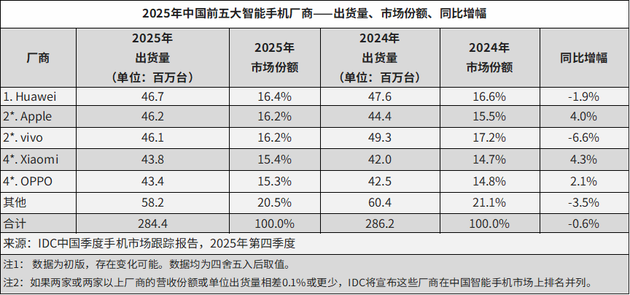
文 | 山上 何简 编辑 | 蒋浇 中国智能手机市场格局多年来一直都没有太大变化,除了华为的崛起。但随着华为遭遇美方制裁,华为一度暂别,剥离独立旗下荣耀品牌。 现在,5年之后,华为手机终于重回中国智能手机市场第一。三家主流市场研究机构 IDC、Omdia 以及 Counterpoint 公布的统计数据均显示,在 2025 年中 国智能手机全年出货量同比微降的趋势下,华为超越苹果拿下市场第一。 但 2025 年榜单中失落最大的并不是苹果,而是一度被视作华为平替的荣耀。三家市场研究机构的统计数据均显示,荣耀在 2025 年已经掉出中国前五大智 能手机厂商榜单,沦为 Others 阵营。这是荣耀自独立以来首次未能位列中国前五。 | IDC 统计数据 | | --- | 过去一年,荣耀经历了自独立以来的最大调整。去年初,公司灵魂人物、原 CEO 赵明卸任离开。新任 CEO 李健上台之后,荣耀管理团队大幅换血,多名 核心高管离职,中层洗牌调整。去年第一季度,荣耀市占率下降至 13.7%,跌出前五名。 李健彼时对外强调,"荣耀没死,反而是重生了。"针对自管理层换血后荣耀销量承压的窘境,他称销量并不是一个特别大的挑战,"因 ...
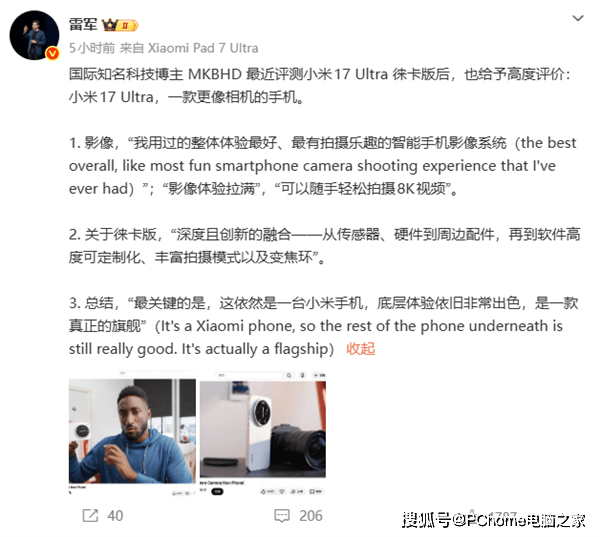
雷军分享国际博主评价小米17 Ultra徕卡版:这是更像相机的手机
Sou Hu Cai Jing· 2026-01-27 08:59
Core Insights - Xiaomi's CEO Lei Jun shared a positive review from renowned tech blogger MKBHD regarding the Xiaomi 17 Ultra Leica Edition, highlighting its camera-like features [1] Group 1: Product Overview - The Xiaomi 17 Ultra Leica Edition was officially launched in December 2025, featuring Leica's classic red logo on the rear camera and deeply integrating Leica camera principles into its hardware and user experience [2] - MKBHD emphasized the smartphone's imaging system, describing it as "the best overall, like most fun smartphone camera shooting experience that I've ever had," and noted the ability to easily shoot 8K videos [2] Group 2: Technical Features - The device includes a physical master zoom ring with a precise mechanical transmission structure, capable of detecting a minimum displacement of 0.03mm, converting external rotation into accurate digital signals, and replicating the professional camera experience [4] - Users can customize zoom range, focus, and exposure compensation, enhancing the overall shooting experience [4] Group 3: Pricing and Availability - The Xiaomi 17 Ultra Leica Edition is currently available for purchase in two configurations: 16GB+512GB priced at 7999 yuan and 16GB+1TB priced at 8999 yuan, offered in black and cream color options [4]

雷军三度直播回应质疑,小米2026年该如何“逆战”?
Sou Hu Cai Jing· 2026-01-27 06:47
Core Viewpoint - Xiaomi's automotive division has shown significant growth in delivery volumes, but the company's stock price has been declining, reflecting market concerns and challenges faced by the brand [2][5]. Group 1: Automotive Performance - In December 2025, Xiaomi's monthly delivery volume exceeded 50,000 units, marking its entry into the top ten of new energy passenger car sales [2]. - Xiaomi's annual retail sales for 2025 reached 411,837 units, representing a year-on-year increase of 200.9%, significantly outpacing most leading brands [3]. - The latest financial report indicates that Xiaomi's smart electric vehicle and AI innovation segment generated revenue of 29 billion yuan in Q3, with a year-on-year growth of over 199% [3]. Group 2: Future Goals and Market Position - For 2026, Xiaomi aims to deliver 550,000 vehicles, projecting a growth of approximately 34% compared to 2025 [4]. - Xiaomi's target volume positions it to compete with traditional luxury car brands like Mercedes-Benz and BMW, which have lower production forecasts for their domestic models [4]. - The automotive industry is expected to undergo intense competition, with Xiaomi's gross margin anticipated to decline in 2026 compared to 2025 [4]. Group 3: Stock Performance and Market Sentiment - Xiaomi's stock price has fallen to 35.4 HKD, with a market capitalization of approximately 923.2 billion HKD, representing a nearly 40% decrease from its peak of 1.5 trillion HKD a year ago [2][6]. - The company announced a share buyback plan of up to 2.5 billion HKD in response to the declining stock price [2]. Group 4: Public Relations and Market Response - Xiaomi's founder, Lei Jun, has conducted three live broadcasts to address public concerns and criticisms, aiming to stabilize market confidence [7]. - In these broadcasts, Lei Jun responded to various negative perceptions, including safety issues and marketing practices, emphasizing transparency and accountability [8][9]. - The company acknowledged the need for clearer product communication and has committed to improving its marketing practices in response to public feedback [8][9].

为“简单”买单,iPhone 4S爆火背后
Jing Ji Guan Cha Wang· 2026-01-27 03:34
Core Insights - The resurgence of the iPhone 4S, originally released 15 years ago, has captured significant market attention, particularly on the Pinduoduo platform, where it sold over 3,000 units in 30 days and had a group purchase volume exceeding 28,000 [1][2] Group 1: Market Dynamics - The iPhone 4S is experiencing a revival due to its nostalgic value among younger consumers, particularly those born in the 90s and 00s, who associate it with their first experiences with Apple products [1][2] - The device's low price point, with second-hand units available for as low as 45 yuan, makes it an attractive option compared to newer models that can exceed 10,000 yuan [2] - Market research indicates that the iPhone 4S's popularity is driven by its retro appeal and the inclusion of pre-installed classic games, catering to consumers' nostalgia [1][2] Group 2: Consumer Behavior - For Generation Z, purchasing the iPhone 4S serves as an emotional connection to a simpler time, allowing them to escape the complexities of modern technology [3] - The trend of retro products is supported by social media platforms, where consumers are increasingly drawn to older digital devices, reflecting a broader cultural shift towards valuing "imperfection" in technology [3][4] - The iPhone 4S is also seen as a practical choice for parents looking for a simple device for their children, as well as for users seeking to repurpose it for specific functions like a music player or smart home remote [3] Group 3: Industry Trends - The revival of the iPhone 4S is part of a larger trend that began in 2025, where tech companies are recognizing the demand for retro elements combined with modern technology [5] - Other brands, such as OPPO and vivo, have started to incorporate retro features into their new models, indicating a shift in consumer preferences towards simpler, nostalgic designs [5] - The resurgence of older models like the Nokia 808 and Canon IXUS130 highlights a market segment that values simplicity and nostalgia over advanced specifications and algorithms [5]

豆包手机回应马化腾质疑;阿里深夜发布最强推理模型
2 1 Shi Ji Jing Ji Bao Dao· 2026-01-27 03:01
Group 1: Tencent Developments - Tencent's Chairman Ma Huateng expressed concerns about the security of the Doubao phone, emphasizing the company's opposition to using black market tools that compromise user privacy [2] - Ma Huateng highlighted Tencent's AI strategy, stating that the company is integrating AI products into its platform and will focus on decentralized approaches for WeChat's AI ecosystem [5] - Tencent's AI assistant "Yuanbao" is undergoing a new version beta test, introducing a social feature called "Yuanbao Club" that allows users to create or join groups for shared activities [6] Group 2: Alibaba Innovations - Alibaba launched its flagship reasoning model Qwen3-Max-Thinking, claiming it rivals top models like GPT-5.2 in 19 benchmark tests, with significant improvements in various capabilities [3] - The model introduces innovations such as adaptive tool invocation and test-time scaling to enhance reasoning performance [3] Group 3: Industry Trends - Microsoft announced its next-generation AI chip, Maia 200, which utilizes TSMC's 3nm process and offers a 30% performance improvement per dollar compared to its previous hardware [9] - Apple released a new version of AirTag with enhanced features, maintaining the same pricing as the previous generation [9] Group 4: Other Notable Events - Yushutech confirmed its partnership with the Central Radio and Television Station for the 2026 Spring Festival Gala, marking its third appearance at the event [4] - Qwen responded to concerns about its AI phone reservation feature, clarifying that it uses advanced emotion and intent recognition technology to enhance user interaction [8]


豆包手机助被质疑安全隐私问题,努比亚总裁倪飞:用户隐私安全,是始终恪守的底线
Xin Lang Cai Jing· 2026-01-27 01:49
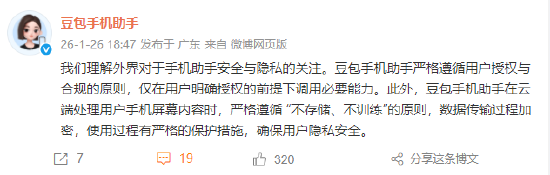
据报道,在腾讯2025年度员工大会上,腾讯创始人马化腾在公司年会上提到了字节和中兴手机联合推出 的豆包手机,表示,腾讯一贯旗帜鲜明地反对用黑产外挂的方式把用户的手机和电脑屏幕录屏传到云 端,因为这是"极其不安全""不负责任的"。 对此,豆包手机助手在微博发文称,我们理解外界对于手机助手安全与隐私的关注。豆包手机助手严格 遵循用户授权与合规的原则,仅在用户明确授权的前提下调用必要能力。此外,豆包手机助手在云端处 理用户手机屏幕内容时,严格遵循 "不存储、不训练"的原则,数据传输过程加密,使用过程有严格的 保护措施,确保用户隐私安全。 据报道,在腾讯2025年度员工大会上,腾讯创始人马化腾在公司年会上提到了字节和中兴手机联合推出 的豆包手机,表示,腾讯一贯旗帜鲜明地反对用黑产外挂的方式把用户的手机和电脑屏幕录屏传到云 端,因为这是"极其不安全""不负责任的"。 对此,豆包手机助手在微博发文称,我们理解外界对于手机助手安全与隐私的关注。豆包手机助手严格 遵循用户授权与合规的原则,仅在用户明确授权的前提下调用必要能力。此外,豆包手机助手在云端处 理用户手机屏幕内容时,严格遵循 "不存储、不训练"的原则,数据传输过程加 ...
雷军分享国际博主MKBHD评测小米17 Ultra徕卡版:一款更像相机的手机
Xin Lang Cai Jing· 2026-01-27 01:43
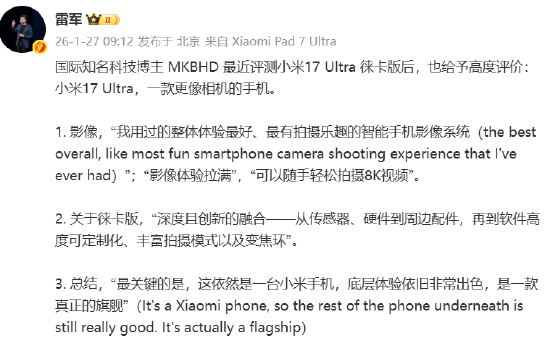
Core Viewpoint - The Xiaomi 17 Ultra, particularly the Leica version, has received high praise from renowned tech blogger MKBHD, highlighting its exceptional camera capabilities and overall flagship experience [2][5][7]. Group 1: Camera Performance - MKBHD describes the Xiaomi 17 Ultra as having "the best overall, like most fun smartphone camera shooting experience that I've ever had," emphasizing its superior imaging capabilities [2][7]. - The device allows users to easily shoot 8K videos, showcasing its advanced video recording features [2][7]. Group 2: Leica Integration - The Leica version of the Xiaomi 17 Ultra is noted for its "deep and innovative integration," which includes enhancements from the sensor and hardware to accessories and highly customizable software with rich shooting modes and a zoom ring [2][7]. Group 3: Overall Experience - MKBHD concludes that despite its advanced camera features, it remains fundamentally a Xiaomi phone, with an excellent underlying experience, affirming it as a true flagship device [2][5][7].
早报|马化腾内部讲话:微信AI全家桶未必大家都喜欢/李想开会近两小时只谈AI:一定会做机器人/肯德基回应涨价:仍具性价比
Sou Hu Cai Jing· 2026-01-27 00:45
Group 1 - Tencent plans to distribute 1 billion red envelopes during the Spring Festival, emphasizing user rewards over marketing expenses, according to CEO Ma Huateng [5][3] - Tencent's AI strategy focuses on long-term product competitiveness and user experience, with a decentralized approach to the WeChat ecosystem [5] - The company reported significant milestones in its cloud business, achieving scalable profitability [5] Group 2 - StepFun, a large model startup, secured over 5 billion RMB in financing, marking the highest single financing record in the large model sector in the past 12 months [8] - The funding will primarily support foundational model research and accelerate the "AI + terminal" strategy [8] - The company has established deep collaborations with major smartphone brands, achieving a model installation volume of over 42 million units [10] Group 3 - The global laptop shipment is projected to decline by 14.8% in Q1 2026 due to rising prices of key components like CPUs and memory [37] - The report indicates that the cost of laptop components, including DRAM and SSD, is expected to increase significantly, impacting overall production and shipment schedules [37][38] - The overall laptop shipment forecast for the year has been revised down from a 5.4% decline to a 9.4% decline [37] Group 4 - The UK has experienced the highest net job losses due to AI, with an 8% reduction in jobs over the past year, which is double the international average [42] - Despite a 11.5% increase in productivity due to AI, UK companies have reduced jobs, contrasting with job growth in the US [42] - The report highlights that the UK labor market is under pressure from rising wage costs and economic uncertainties, leading to the fastest layoff rates since 2020 [42][43] Group 5 - Porsche plans to reduce its dealer network in China from 114 to approximately 80, focusing on cost reduction and network optimization [32] - The company aims to enhance its competitiveness in the Chinese market by prioritizing quality over quantity in its sales strategy [32] - Porsche's sales in China have faced significant declines, with a 26% drop in deliveries in 2025 compared to the previous year [32]