啤酒

Search documents
史上最长春节假期有望激活消费热情!港股通消费ETF汇添富(159268)收涨1.4%再创阶段新高!消费ETF(159928)震荡飘红!
Xin Lang Cai Jing· 2026-02-09 07:49
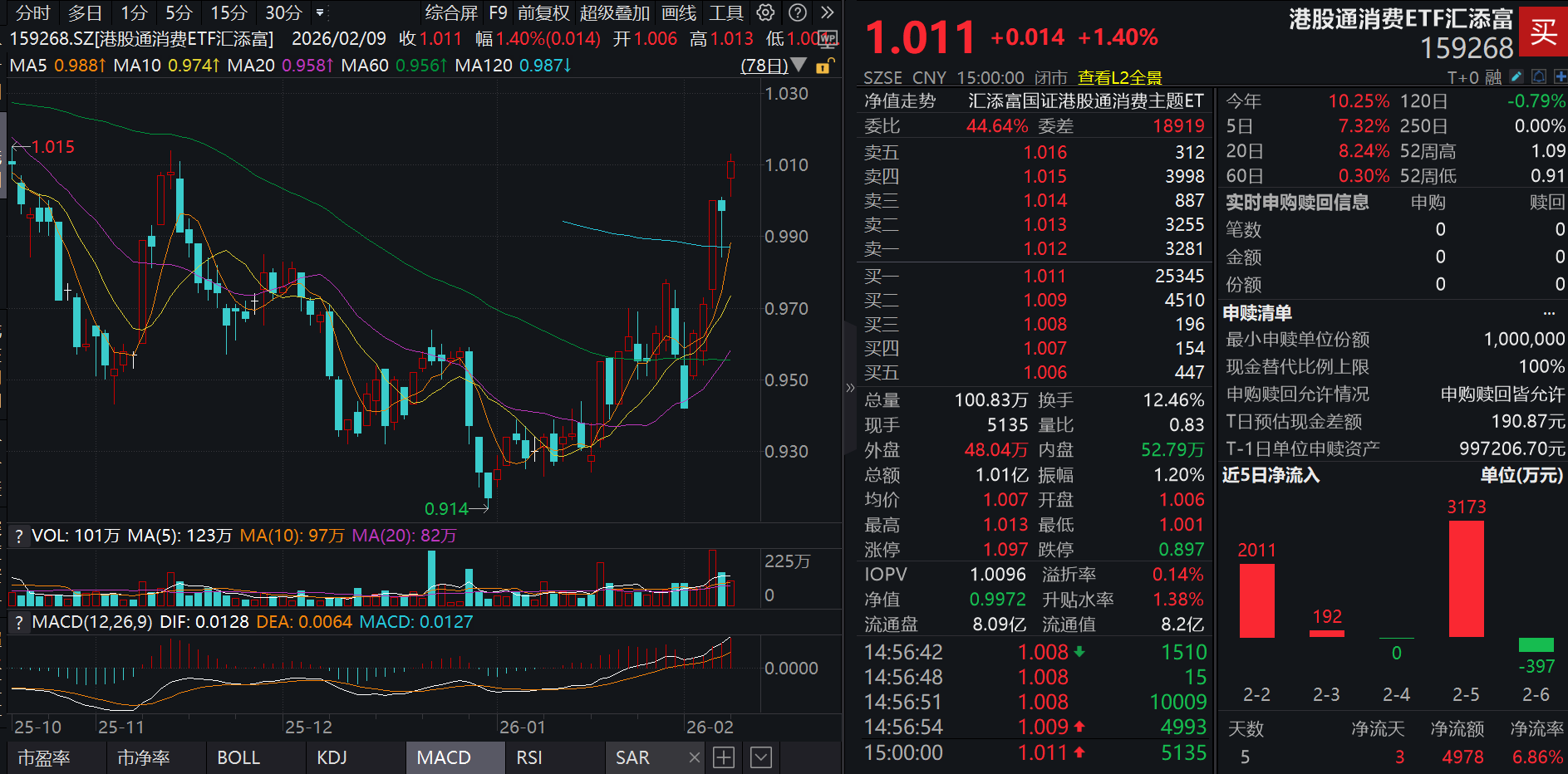
Group 1: Market Performance - The Hong Kong Stock Connect Consumption ETF (159268) rose by 1.4%, reaching a new high, with net inflows of nearly 50 million yuan over the past five days [1] - The A-share leading consumption ETF (159928) experienced a flat trading day with a total transaction volume exceeding 570 million yuan [3] - Popular constituent stocks such as China Duty Free and Pop Mart saw significant gains, with increases of over 8% and 5% respectively [1][3] Group 2: Consumer Trends and Policies - As the Spring Festival approaches, the A-share consumer sector is becoming more active, with expectations for increased retail in gold, travel, and dining services [5] - A new policy for Hainan Free Trade Port allows residents to purchase imported goods tax-free, enhancing consumer sentiment [5] - The "2026 'Happy Shopping Spring' Special Activity Plan" aims to stimulate consumption across various sectors, including digital and green consumption [5] Group 3: Alcohol and Beverage Industry Insights - The price of Moutai has rebounded, with a recent increase from 1570 yuan to 1610 yuan, reflecting a 2.5% rise [6] - The white liquor sector is showing signs of weak recovery, with expectations for a gradual improvement in demand due to better economic forecasts [6][9] - The beer market is projected to face pressure in 2025, but a mild recovery is anticipated in 2026 due to the growth of non-traditional retail channels [6] Group 4: Food and Beverage Sector Developments - The National Standard for Pre-prepared Dishes is under review, which is expected to enhance the development of the pre-prepared food industry [7][10] - The dairy sector is expected to stabilize, with a potential rebound in milk prices as supply and demand reach a turning point [7] - The snack food segment is experiencing growth, driven by the expansion of discount snack stores and innovations in social e-commerce channels [6][7] Group 5: Livestock and Meat Products - The profitability of self-bred pigs has turned negative, with a 26.4% decline in profits from purchased piglets [8] - Prices for white feather chickens and egg-laying hens have shown slight week-on-week declines [8]



食品饮料周报(26年第6周):白酒春节动销渐起,预制菜国标公开征求意见-20260209
Guoxin Securities· 2026-02-09 05:07
Investment Rating - The report maintains an "Outperform the Market" rating for the food and beverage sector [4][5][18] Core Views - The food and beverage sector is expected to perform well in 2026, driven by several key themes including cost benefits, efficiency improvements, innovation, and potential recovery opportunities in the liquor segment [3][10][11] - The report highlights the ongoing differentiation in the fundamentals of various categories, with liquor outperforming food and beverages [2][10] Summary by Relevant Sections Liquor - The report indicates that the sales of liquor, particularly high-end brands like Moutai, are showing positive trends as the Spring Festival approaches, with Moutai expected to see double-digit growth [2][10] - Investment recommendations include Moutai, Shanxi Fenjiu, and Luzhou Laojiao, with a focus on brands that are gaining market share despite overall market challenges [2][10][11] Beer - The beer industry is currently managing inventory well and is poised for recovery as demand is expected to improve [11] - Recommended companies include Yanjing Beer and China Resources Beer, which are seen as strong players in the market [11] Snacks - The report emphasizes the importance of focusing on companies with strong growth potential in the snack sector, particularly those involved in konjac products, which are expected to continue their growth trajectory [12][18] - Key players in this segment include Weidong and Yanjinpuzi, which are noted for their innovative product offerings [12][18] Prepared Dishes - The report discusses the public consultation on national standards for prepared dishes, which may lead to a clearer industry structure and the elimination of less compliant players [13][14] - Recommended companies in this space include Yihai International and Haidilao, which are expected to benefit from improved compliance and operational efficiency [13][14] Dairy Products - The dairy sector is experiencing a steady recovery, with a focus on leading companies like Yili, which are expected to benefit from improved margins and reduced inventory pressures [14][15] - The report suggests that the demand for dairy products will continue to improve, particularly in the second half of 2026 [14][15] Beverages - The beverage sector is currently in a seasonal inventory reduction phase, with stable preparations for the Spring Festival [15] - Companies like Nongfu Spring and Dongpeng Beverage are highlighted for their strong operational performance and market expansion strategies [15][16]

食品饮料行业周报(2.8):茅台景气领先,大众品继续推荐顺周期-20260209
CMS· 2026-02-09 02:08
Investment Rating - The report maintains a positive investment rating for the liquor industry, particularly recommending Moutai and other consumer goods as cyclical investments [15][17]. Core Insights - Moutai continues to show strong performance, with demand recovery following the alcohol ban and a significant increase in sales volume exceeding expectations. The price of Moutai has recently surged to 1700 RMB [2][15]. - The overall industry is experiencing a double-digit decline in sales, which aligns with expectations. However, Moutai's performance remains robust, indicating a strong market position [15]. - The report highlights the potential for recovery in the dining chain sector, particularly in the condiment and beer segments, driven by policy catalysts and positive holiday consumption data [15][17]. Summary by Sections Core Company Tracking - Moutai's sales performance is expected to be strong, with a significant portion of its annual quota being allocated in the first quarter. The demand for non-standard products remains high, while Wuliangye's sales show mixed results [3][11]. - The report notes that Wuliangye's distributors are less willing to make payments, with this year's signing plans being only half of last year's [3][12]. - Other brands like Jinshiyuan and Yanghe are experiencing sales declines, with Jinshiyuan performing better than Yanghe in certain markets [11][12]. Investment Recommendations - The report emphasizes the cyclical recovery of consumer goods, particularly in the dining chain sector, and suggests increasing recommendations for companies like Chongqing Beer and Qianhe Flavor Industry, which are expected to see improved performance [15][17]. - The report also highlights the importance of maintaining a significant position in Moutai and recommends other brands such as Shanxi Fenjiu and Wuliangye, which are expected to perform better than the industry average [17]. Industry Overview - The food and beverage industry is projected to face challenges, with overall sales expected to decline. However, Moutai's strong market presence and pricing power provide a buffer against these challenges [2][15]. - The report indicates that the industry is at a historical low in institutional holdings, suggesting potential for performance and valuation recovery as negative factors gradually dissipate [16][17].
食品饮料周观点:白酒茅台持续引领,大众品关注春节催化
GOLDEN SUN SECURITIES· 2026-02-08 12:24
Investment Rating - The report suggests a positive investment outlook for the liquor and beverage industry, particularly highlighting the strong performance of leading brands like Moutai during the upcoming Spring Festival season [1][2]. Core Insights - The report emphasizes that the liquor sector is experiencing a recovery driven by seasonal demand, with Moutai leading the way in sales and pricing improvements. The anticipated increase in social consumption due to the extended Spring Festival holiday in 2026 is expected to further boost demand [2]. - In the beer and beverage segment, Chongqing Beer is projected to achieve stable growth in 2025, with revenue expected to reach 14.72 billion yuan, reflecting a year-on-year increase of 0.5%. The company is actively expanding its product offerings and optimizing its market strategy [3]. - The report notes that the snack and dairy sectors are poised for growth due to the delayed Spring Festival, which is expected to enhance sales in these categories. The low base effect from the previous year is anticipated to contribute positively to the performance of these sectors [4][7]. Summary by Sections Liquor Sector - Moutai is expected to outperform other brands, benefiting from effective customer engagement and a supportive pricing strategy. The brand's online platform has seen significant user engagement, with over 15.31 million active users and substantial sales figures [2]. - The report suggests focusing on both short-term and long-term investment opportunities within the liquor sector, recommending brands like Guizhou Moutai and Wuliangye for immediate gains, while suggesting long-term holds on leading brands [1]. Beer and Beverage Sector - Chongqing Beer is projected to maintain a steady growth trajectory, with a focus on expanding non-traditional beverage channels and enhancing product diversity. The report indicates that the beer sector is currently undervalued, presenting potential investment opportunities if market conditions improve [3]. - East Peng Beverage's recent IPO and its strategic partnership for international expansion are highlighted as significant developments in the beverage sector, indicating a strong market position and growth potential [3]. Snack and Dairy Sector - The report identifies the snack and dairy sectors as key areas for growth, particularly during the Spring Festival preparation phase. The anticipated increase in demand for gift-oriented products is expected to drive sales in these categories [4][7]. - The dairy sector is expected to benefit from a recovery in milk prices and improved profitability in the dairy farming industry, which could enhance the overall growth prospects for dairy products [7].
食品饮料周观点:白酒茅台持续引领,大众品关注春节催化-20260208
GOLDEN SUN SECURITIES· 2026-02-08 12:04
Investment Rating - The report suggests a positive investment outlook for the liquor and beverage industry, particularly highlighting the strong performance of leading brands like Moutai during the upcoming Spring Festival season [1][2]. Core Insights - The report emphasizes that the liquor sector is experiencing a recovery driven by seasonal demand, with Moutai leading the way in sales and pricing improvements. The anticipated increase in social consumption due to the extended Spring Festival holiday in 2026 is expected to further boost demand [2]. - In the beer and beverage segment, Chongqing Beer is projected to achieve stable growth in 2025, with revenue expected to reach 14.72 billion yuan, a year-on-year increase of 0.5%. The company is actively expanding its product offerings and optimizing its market strategy [3]. - The report notes that the food sector is benefiting from a delayed Spring Festival, which is likely to enhance sales of snacks and dairy products, particularly those with gifting attributes [4]. Summary by Sections Liquor Sector - The Spring Festival season is expected to catalyze sales, with Moutai showing strong performance and leading the market recovery. The brand's effective customer engagement strategies have resulted in significant user growth and order volume [2]. - The report anticipates that the overall liquor market will see a positive turnaround, supported by favorable policies and improved consumer sentiment [2]. Beer and Beverage Sector - Chongqing Beer reported a revenue of 14.72 billion yuan for 2025, with a net profit of 1.23 billion yuan, reflecting a 10.4% increase year-on-year. The company is focusing on expanding its non-alcoholic beverage channels and enhancing its product mix [3]. - East Peng Beverage's recent IPO and its strategic partnership for international expansion are highlighted as significant developments in the beverage sector [3]. Food Sector - The report indicates that the delayed Spring Festival in 2026 will create opportunities for growth in the snack and dairy product categories, particularly those with gifting potential. The low base effect from the previous year is expected to facilitate a strong start for these products [4][7].
复苏态势明朗,板块预期乐观
KAIYUAN SECURITIES· 2026-02-08 04:11
Investment Rating - The industry investment rating is "Positive" (maintained) [1] Core Viewpoints - The food and beverage sector is experiencing a strong upward trend, driven by multiple factors including policy support, trading dynamics, fundamental improvements, and external catalysts, indicating clear investment value [3][9] - The food and beverage index increased by 4.3% from February 2 to February 6, outperforming the CSI 300 by approximately 5.6 percentage points, with sub-sectors like liquor, soft drinks, and beer leading the performance [9][11] - The liquor industry is entering a new development cycle, with Guizhou Moutai's market-oriented reforms marking a significant phase, and the pricing system gradually returning to a supply-demand driven model [10] Summary by Sections Market Performance - The food and beverage index rose by 4.3%, ranking first among 28 sectors, with liquor (+5.3%), soft drinks (+4.7%), and beer (+4.5%) showing relative strength [11][12] - Individual stocks such as Huangtai Liquor, Hai Xin Food, and Ri Chen Co. saw significant gains, while *ST Yedao, *ST Chuntian, and Li Ziyuan experienced declines [11][14] Upstream Data - Some upstream raw material prices are declining, with the price of whole milk powder at $3,614 per ton, down 13.3% year-on-year, and fresh milk prices at 3.04 yuan per kilogram, down 2.9% year-on-year [15][31] - The price of pork is down 20.1% year-on-year, with live pig prices at 12.2 yuan per kilogram, reflecting a broader trend of price adjustments in the sector [21][24] Liquor Industry News - Some distributors of Moutai have sold out their first batch of flying Moutai quotas for March, indicating strong demand during the Spring Festival [36] - The Qingdao Beer production base has commenced operations, aiming to produce high-end products and achieve an annual output value of approximately 1 billion yuan [36] Investment Recommendations - Focus on leading liquor stocks such as Guizhou Moutai, Wuliangye, Luzhou Laojiao, and Shanxi Fenjiu, as well as elastic stocks like Shede Liquor and benefiting stocks like Jiu Gui Liquor [10] - In the consumer goods sector, three main lines are suggested: the snack sector, dairy products, and the restaurant supply chain, with specific companies highlighted for potential growth [10][43]



食品饮料行业周报 2026年第6期:顺周期预期企稳,消费价值凸显
GUOTAI HAITONG SECURITIES· 2026-02-08 02:25
Investment Rating - The report assigns an "Accumulate" rating for the food and beverage industry [1] Core Insights - Recent policies have strengthened consumer expectations, leading to marginal improvements in consumption during the Spring Festival season. The performance of high-end liquor, particularly Moutai, has rebounded, boosting market confidence. The focus is on growth in consumer staples and the recovery of the Consumer Price Index (CPI) [3][4] Summary by Sections Investment Recommendations - The report suggests that with the stabilization of real estate expectations and positive changes in cyclical consumption, the following stocks are recommended: 1. High-end liquor with price elasticity: Guizhou Moutai, Wuliangye, Luzhou Laojiao, and potential clearance stocks: Yingjia Gongjiu, Gujing Gongjiu, Shanxi Fenjiu, Jianshiyuan, Zhenjiu Lidu, Shede Liquor, and Jinhui Liquor 2. Beverages benefiting from travel: Dongpeng Beverage, Nongfu Spring (Hong Kong), with a focus on undervalued high-dividend stocks: China Foods (Hong Kong), Master Kong Holdings (Hong Kong), and Uni-President China (Hong Kong) 3. Growth stocks in snacks and food raw materials: Recommended are Bailong Chuangyuan, Weilong Delicious (Hong Kong), Yanjinpuzi, and Ximai Foods 4. Beer recommendations include Qingdao Beer, Zhujiang Beer, and Bairun Co., with China Resources Beer (Hong Kong) 5. Seasoning and catering are expected to recover, with recommendations for Qianhe Flavor Industry, Baoli Foods, Babi Foods, Anjii Foods, Haitian Flavoring, Angel Yeast, Yili Group, New Dairy, Youran Pastoral (Hong Kong), and Modern Dairy (Hong Kong) [4][7] Liquor Sector - The high-end liquor sector is leading the market, with Moutai's sales boosting confidence. The report notes that the liquor sector has seen significant gains recently, attributed to positive data and market sentiment. Moutai's monthly active users exceeded 15.31 million in January, with over 2.12 million transactions, indicating a recovery in channel sentiment [8][9] - The report anticipates that the liquor industry is at the bottom of its cycle, with potential catalysts for stock prices from improvements in market conditions, price increases, and inventory reductions. If positive trends in price, sales, and inventory continue post-Spring Festival, further catalysts may emerge [9] Consumer Staples - The approval of D-allohexose-3-epimerase as a food additive is expected to expand the domestic market for allulose, benefiting leading companies like Bailong Chuangyuan. The report highlights the potential for growth driven by health-conscious consumption trends [10][11] - The catering supply chain is expected to recover, with the report noting that the competition in the catering industry has reached a low point, and demand is anticipated to improve. The report also mentions that Babi Foods has shown positive growth, with a revenue of 1.859 billion in 2025, up 11.22% year-on-year, and a net profit of 245 million, up 16.49% year-on-year [11]
北京燕京啤酒股份有限公司关于变更签字注册会计师的公告
Zhong Guo Zheng Quan Bao - Zhong Zheng Wang· 2026-02-06 22:52
Core Viewpoint - The company has appointed a new signing registered accountant for the 2025 fiscal year due to a personnel change, ensuring continuity in its financial and internal control audits [2][6]. Group 1: Changes in Signing Registered Accountant - The company received a notice from Zhongxinghua Accounting Firm regarding the change of the signing registered accountant for the 2025 fiscal year, with Guo Zhengwei replacing Liu Lian as the signing registered accountant [2]. - Liu Junxiao will continue as the signing registered accountant alongside Guo Zhengwei for the 2025 audit services [2]. Group 2: Background of New Signing Registered Accountant - Guo Zhengwei has been a certified public accountant since 2008 and has experience in auditing listed and registered companies since 2012, currently practicing at Zhongxinghua since 2020 [3]. - He has signed audit reports for one listed company and two registered companies in the past three years, demonstrating his professional competence [3]. Group 3: Integrity and Independence - Guo Zhengwei has no criminal penalties or administrative sanctions from regulatory bodies in the past three years, indicating a clean professional record [4]. - He complies with the independence requirements set forth by the Chinese CPA independence standards and has no conflicts of interest, such as holding or trading the company's stock [5]. Group 4: Assurance of Audit Continuity - The company and its board guarantee the accuracy and completeness of the information disclosed, ensuring that the change in the signing registered accountant will not affect the 2025 financial statements and internal control audit [6].

燕京啤酒:关于变更签字注册会计师的公告
Zheng Quan Ri Bao· 2026-02-06 12:13
Core Viewpoint - Yanjing Beer announced a change in its auditing team for the 2025 fiscal year, appointing a new signing auditor due to personnel changes at the auditing firm [2] Group 1: Company Announcement - Yanjing Beer received a notice from Zhongxinghua regarding the change of signing auditors for the 2025 fiscal year [2] - The original signing auditors were Liu Lian and Liu Junxiao, with Liu Lian no longer serving due to work changes [2] - Guo Zhengwei has been appointed as the new signing auditor to continue the audit work for the 2025 financial report and internal control audit [2] - The project partner and signing auditors for the 2025 audit will now be Liu Junxiao and Guo Zhengwei [2]
食饮出海征途:从模式探索到价值突围--聚焦“供应链出海”路径深度解析
野村东方国际证券· 2026-02-06 10:49
Core Viewpoint - The article discusses the strategic shift of food and beverage companies in China towards international markets as a response to domestic saturation and increasing competition, highlighting the potential for growth and brand enhancement through overseas expansion [2]. Group 1: Industry Logic - The Chinese food and beverage industry has developed mature capabilities in product research and development, supply chain management, and digital operations, making it ready for international expansion [4]. - National policies such as "dual circulation" and the "Belt and Road Initiative" provide support for companies looking to expand overseas by facilitating customs, tax, and investment processes [4]. - China's global leadership in e-commerce infrastructure, mobile payments, and agile supply chains empowers brands to penetrate emerging markets like Southeast Asia effectively [4]. Group 2: Data Insights - There is a growing overseas demand, particularly in online consumption, and Chinese consumer brands are increasingly gaining influence beyond the Chinese diaspora, reaching local populations [4]. - The export value of Chinese food products has shown significant growth over the past five years, indicating a positive trend in international demand [6]. - The cultural elements of Chinese products, such as tea culture, are gaining popularity on global social media platforms, contributing to the rise of "Chinese cultural fever" abroad [4]. Group 3: Sector-Specific Insights - Different segments within the food and beverage industry show varying levels of overseas revenue contribution, with health products at 40.74%, meat products at 10.91%, while soft drinks and baked goods lag significantly behind at 0.08% and 0.61% respectively [8]. - Higher overseas revenue contributions are typically seen in categories with strong standardization and cultural adaptability, while lower contributions in segments like soft drinks and baked goods face challenges related to cold chain logistics and local taste preferences [8]. Group 4: Focus on Supply Chain - The analysis emphasizes a focus on companies transitioning from market penetration to full-scale expansion, particularly through supply chain strategies, which leverage China's manufacturing efficiency and supply chain management advantages [9].