
电池

Search documents
韩联社:韩国唯一保持领先的技术,被中国反超
Xin Lang Cai Jing· 2026-02-23 09:21
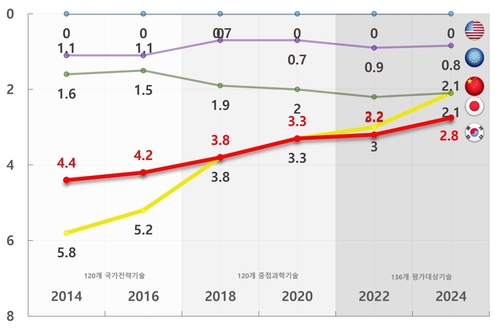
Core Insights - The technology gap between South Korea and China in key scientific and technological fields is widening from 2022 to 2024, particularly in strategic technologies like secondary battery technology, where China has overtaken South Korea [1] Group 1: Technology Assessment - According to the draft report submitted by the South Korean Ministry of Science and ICT, the technology gap between South Korea and the United States is projected to be 2.8 years in 2024, down from 3.2 years, indicating a reduction of 0.4 years [1] - The gap between China and the United States is estimated at 2.1 years, with South Korea and China having a difference of 0.7 years [1] - In 2022, South Korea was leading in secondary battery technology by 0.9 years, but by 2024, China has taken the lead, creating a technology gap of 0.2 years between the two countries [1]
纯锂新能源加速拓展固态电池应用场景,力争2026年营收破亿
Xin Lang Cai Jing· 2026-02-23 09:21
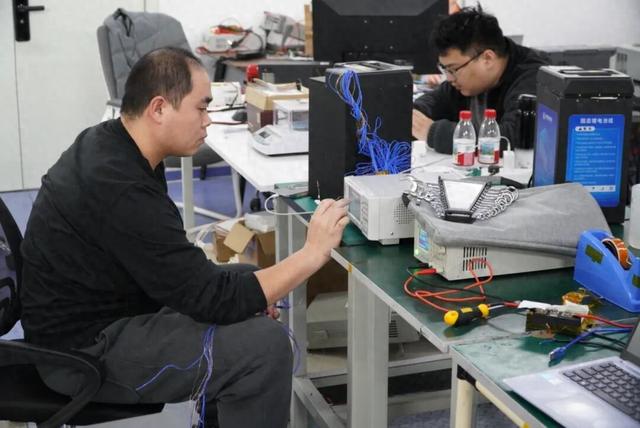
"2026年,我们将推动固态电池产品从小批量测试生产迈入规模化市场布局新阶段,拓展机器人、无人 机、汽车等应用场景,力争全年营收达到亿元规模。"近日,北京经开区企业北京纯锂新能源科技有限 公司(以下简称"纯锂新能源")董事长杨帆表示。 当前,固态电池凭借高能量密度、高安全性、宽温域适配、长循环寿命等特点,正重塑新能源汽车、储 能等行业的发展格局,成为企业抢占未来电池技术领域先机的重要发力方向。作为这一赛道的先行者, 纯锂新能源拥有领先的技术优势,不仅在材料方面首创有机无机融合电解质,突破传统聚合物性能局 限,实现高安全、宽温域与低成本的完美兼容,还在生产工艺方面独创超临界包覆技术,通过虹吸效应 破解固态电池固固界面接触的世界级难题,实现国内首条全固态电池产线商业化量产。 工作人员 接下来,纯锂新能源将持续拓展固态电池的应用场景,正在开发的第二代固态电池产品将重点聚焦机器 人、无人机、乘用车、电动船舶等行业,提供更加高效的能源解决方案。杨帆表示:"2026年1月,公司 正在与多家储能及物流行业领军企业探讨新一轮合作。今年,在加速固态电池量产交付、开发新一代产 品的同时,我们还将在亦庄拓展电动自行车换电项目试点规 ...

AI+能源“新基建”,入场券发给了谁?
高工锂电· 2026-02-22 11:17
Core Viewpoint - The article discusses the emerging high-premium battery market driven by AIDC energy storage and Robotaxi, emphasizing the competitive landscape and the implications for Chinese battery manufacturers in the U.S. market [1][2][3]. Group 1: AIDC Energy Storage Market - The demand for AIDC energy storage is projected to grow significantly, with UBS estimating a nearly 40% year-on-year increase in global energy storage demand by 2026, driven by U.S. AI data centers and high renewable energy integration [6][9]. - Goldman Sachs predicts that electricity consumption by data centers could increase by approximately 175% by 2030, with AI workloads being a major driver [7]. - The global battery demand is expected to grow at around 30% annually by 2026, with energy storage batteries outpacing the growth of power batteries [9][10]. Group 2: Key Players in the U.S. Market - LG Energy Solution (LGES) has raised its global energy storage battery capacity target from 30GWh to 50GWh, with about 80% planned for production and sales in North America [13][14]. - Analysts have adjusted LGES's business structure, projecting a significant increase in North American energy storage system (ESS) shipments from 5GWh in 2024 to nearly 45GWh by 2026 [15]. - Samsung SDI is also expanding its ESS production in the U.S. and negotiating supply agreements with Tesla for energy storage projects [17][18]. Group 3: Robotaxi as a New Demand Source - Panasonic has signed a long-term agreement to supply 2170 cylindrical batteries to Amazon's autonomous ride-hailing service Zoox, starting in 2026 [23][24]. - The Robotaxi market is seen as a potential structural demand source for power batteries, with the initial supply chain dominated by U.S. and Japanese manufacturers [28]. - The financial contribution from the Zoox order is limited, but it positions Panasonic favorably in the narrative of new infrastructure investments [26]. Group 4: Implications for Chinese Battery Manufacturers - Chinese battery manufacturers are losing participation in high-premium scenarios like AIDC energy storage and Robotaxi, which not only affects their shipment volumes but also their pricing power and influence over standards [29][30]. - The localization and safety requirements in the U.S. market favor local and Japanese suppliers, leading to a perception that Chinese firms are marginal players in these critical segments [21][22]. - The article raises concerns about whether Chinese battery companies can establish a high-value scenario outside the U.S. market, particularly in regions like the Middle East and Southeast Asia [44][45].

兴业证券:美关税判决是行政权受限带来的长期叙事变化 关注税率下降对A股出口链影响
智通财经网· 2026-02-22 10:56
Core Viewpoint - The U.S. Supreme Court ruled 6-3 that the tariffs imposed by the U.S. on China, including the fentanyl tariffs, are unconstitutional, which is expected to impact asset prices, supporting U.S. stocks while putting pressure on U.S. bonds [1] Group 1: Legal and Regulatory Implications - The ruling emphasizes that the power to impose tariffs belongs to Congress, as stated in the Constitution, and cannot be delegated to the executive branch without clear and explicit language [2] - The ruling reaffirms the "major questions doctrine," which requires that significant economic and political regulations must have explicit authorization from Congress, limiting the expansion of executive power [3] - The interpretation of the IEEPA statute indicates that it does not grant the president the authority to impose tariffs, as the statute has never been used for such purposes in its 50-year history [4] Group 2: Economic and Market Impact - The reduction in tariffs is expected to lead to a decrease in government revenue and a slight decline in U.S. consumer prices, while the fiscal deficit may increase [8] - The ruling is anticipated to create a long-term narrative shift in U.S. politics, potentially increasing chaos in future policies and stimulating demand for precious metals and other "weak dollar assets" [8] - Industries with significant revenue exposure to the U.S. and substantial production capacity in ASEAN regions, such as light industry appliances, consumer electronics, batteries, automotive parts, and medical devices, are expected to benefit from the tariff reductions [8][12] Group 3: Political Dynamics - The ruling may lead to ongoing disputes over tariff authority, with Congress likely to strengthen its oversight of executive actions, impacting the speed and flexibility of future tariff policies [13] - The conflict between executive and legislative powers is expected to intensify, with Congress potentially seeking to limit Trump's other executive powers on various issues [13] - The potential for alternative tariffs may affect international relations, particularly with China, as the ruling could be seen as an opportunity for tariff reductions in U.S.-China relations [13]

韩媒称韩国“唯一领先战略技术”二次电池,被中国反超
Guan Cha Zhe Wang· 2026-02-22 10:27
Core Insights - The technology gap between South Korea and China in key strategic sectors is widening, particularly in the secondary battery field, where China has overtaken South Korea as of 2024 [1][3] - South Korea's overall technology level is assessed at 82.8% compared to the United States, with a significant gap of 2.8 years, while the gap with China has increased to 0.7 years [3] Group 1: Technology Assessment - In the secondary battery sector, South Korea was leading by 0.9 years in 2022 but has fallen behind China by 0.2 years in 2024 [1] - The evaluation covered 136 core technologies across 11 sectors, analyzing papers and patents from South Korea, China, Japan, Europe, and the United States [1] - South Korea's semiconductor and display sectors have also seen a decline, with a lag of 0.7 years behind the U.S. and 0.8 years behind China as of 2024 [3] Group 2: Market Dynamics - The global market share of South Korean electric vehicle battery manufacturers has decreased from 35% in 2020 to 23% in 2023, with projections of further decline to 16% by October 2025 [5] - Despite the growth in global electric vehicle sales, the growth rate is expected to drop significantly from 25%-28% to around 15% by 2025 [4] - South Korean battery companies are facing intense competition from Chinese firms like CATL and BYD, which have a substantial market presence [5] Group 3: Domestic Market Disparities - The domestic market for South Korean secondary batteries is only about 2% of China's, with the energy storage market at approximately 1% [6] - South Korean companies have over 90% of their production facilities located overseas, while Chinese firms like CATL and BYD have about 97% of their capacity concentrated domestically [6] - The market share of South Korean companies in Europe has dropped from over 60% in 2022 to below 40% recently due to strong competition from Chinese firms [6] Group 4: Material Dependency - South Korean battery manufacturers are heavily reliant on China for core materials that constitute 60% of secondary battery costs, with Chinese companies controlling around 80% of the global market for these materials [7]


韩媒:韩国“唯一保持领先的技术”,也被中国反超了
Huan Qiu Wang· 2026-02-22 07:44
Core Insights - The technology gap between South Korea and China in 11 key areas is widening, with South Korea's once-leading secondary battery technology now surpassed by China [1][2] - As of 2024, the technology gap between South Korea and the US is 2.8 years, while the gap between China and the US is 2.1 years, indicating a narrowing gap for South Korea but an expanding gap with China [1] - The assessment of 136 core technologies shows that South Korea's overall technology level is at 82.8%, compared to 86.8% for China and 93.8% for the EU, with the US at 100% [1] Technology Assessment - In the evaluation of 50 strategic technologies, South Korea's gap with the US has decreased from 3 years in 2022 to 2.6 years in 2024, while China's gap has narrowed by 0.8 years during the same period [2] - South Korea was previously leading in the secondary battery sector by 0.9 years in 2022, but by 2024, China has taken the lead with a 0.2-year advantage [2] - In the semiconductor and display sectors, South Korea is lagging behind the US by 0.7 years and China by 0.8 years, with technology levels at 91.2% for South Korea and 91.5% for China [2]
崔东树:1月我国电池供需逐步改善 重卡电池暴增
智通财经网· 2026-02-22 06:12
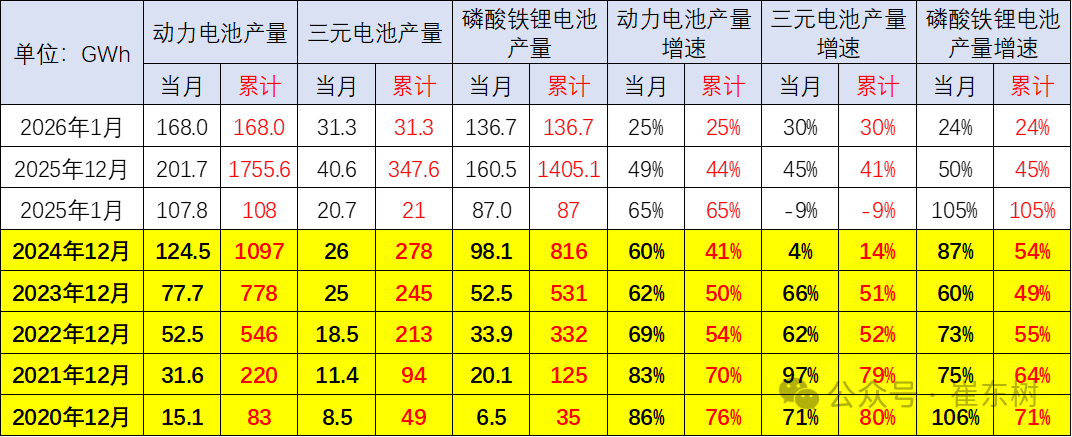
Core Insights - The overall performance of the power battery market in January 2026 is weak, with both exports and domestic sales showing mediocre results, leading to a decline in the growth rate of battery production from over 40% to 25% year-on-year [1][3][9] Group 1: Battery Production and Demand - In January 2026, the total production of power and other batteries reached 168 GWh, marking a 25% increase year-on-year [1] - The demand for installed batteries is heavily reliant on the surge in heavy-duty vehicle batteries due to high subsidies [1][3] - The installation rate of power batteries has decreased significantly, dropping to 25% in January 2026, with ternary batteries at 30% and lithium iron phosphate batteries at 24% [2][4] Group 2: Market Trends and Changes - The demand for batteries in the energy storage sector has increased rapidly, influenced by the global energy crisis stemming from the Russia-Ukraine conflict, leading to a notable decline in the proportion of installed batteries [3][8] - The growth rate of power batteries has lagged behind the growth of complete vehicles in 2021 and 2022, with a low installation rate expected for 2023 and 2024 [3][4] - The market for pure electric passenger vehicles continues to dominate, while plug-in hybrid passenger vehicles have risen to second place in terms of battery demand [7][8] Group 3: Competitive Landscape - The competitive landscape of battery manufacturers remains relatively stable, with the number of supporting battery companies at a low of 33 in January 2026 [10][11] - CATL's market share increased to 50.1% in the first quarter of 2026, while BYD's share decreased to 17.5%, indicating a significant concentration of market power among leading manufacturers [15] - The trend of vehicle manufacturers increasingly collaborating with battery producers is becoming more pronounced, suggesting a shift towards integrated supply chains in the industry [12][15]
低温、循环、成本:钠电为何可能吃下电动化下半场
高工锂电· 2026-02-21 11:49
Core Viewpoint - The article emphasizes the growing importance of sodium batteries in the electric vehicle (EV) market, particularly in cold climates, and suggests that sodium batteries will play a crucial role in the second half of the electrification process, alongside lithium batteries [4][5]. Group 1: Market Trends and Projections - According to the China Association of Automobile Manufacturers, by 2025, the share of new energy vehicles in total domestic car sales will exceed 50%, reaching 50.8%, with some months last year seeing penetration rates close to 60% [4]. - The article highlights the challenges faced by lithium batteries in northern markets, particularly regarding performance in low temperatures, which sodium batteries are well-suited to address [4][6]. Group 2: Sodium Battery Advantages - Sodium batteries have significant advantages in low-temperature scenarios and cycle life, making them particularly suitable for cold environments in northern regions [4][6]. - Testing conducted by CATL and Changan Automobile showed that vehicles equipped with sodium batteries maintained nearly three times the discharge power at -30°C compared to conventional lithium iron phosphate models, and over 90% capacity retention at -40°C [6]. Group 3: Commercialization and Product Development - CATL has been actively delivering sodium battery products and has a clear commercialization strategy, moving from commercial vehicle trials to passenger vehicle winter testing [7][8]. - The company has launched various sodium battery products, including those for heavy-duty trucks and passenger vehicles, and has emphasized the importance of low-temperature performance in its marketing [9][10]. Group 4: Strategic Partnerships and Infrastructure - CATL plans to establish over 3,000 battery swap stations across more than 140 cities by 2026, particularly in cold regions, to enhance the efficiency of sodium battery usage [11][12]. - The integration of sodium batteries with battery swap networks is expected to alleviate consumer concerns about range anxiety and open up new market opportunities [12][13]. Group 5: Supply Chain and Technological Synergies - The expansion into the sodium battery market is anticipated to drive significant changes in the supply chain, leveraging similarities between lithium and sodium supply systems [14][15]. - CATL's partnership with Rongbai Technology for sodium battery cathode materials is expected to boost production capacity significantly, with a projected 101% year-on-year increase in sodium battery cathode production by 2025 [16][17]. Group 6: Future Applications and Market Impact - CATL is expected to apply sodium batteries extensively in the energy storage sector by 2026, aligning with recent regulatory changes that reduce investment uncertainties in storage solutions [18][19]. - The introduction of new pricing mechanisms for independent storage systems is likely to enhance the investment appeal of sodium battery storage solutions [19][20].
兴业证券:2026年关注电新、TMT、新消费等出海机会
智通财经网· 2026-02-21 07:29
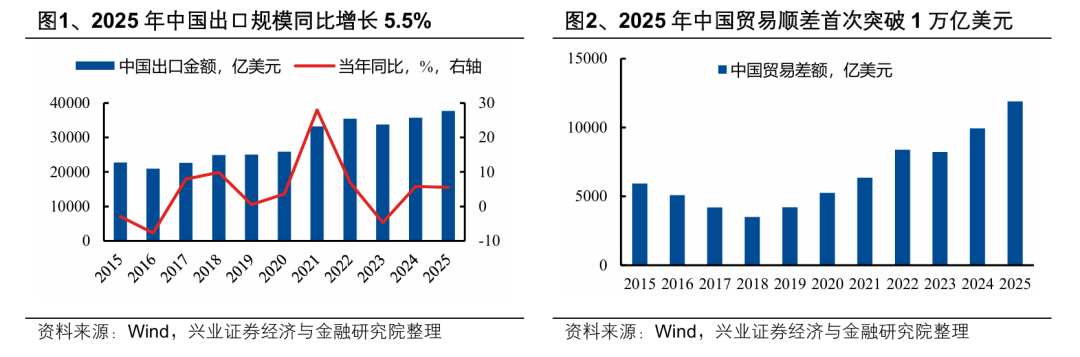
Core Viewpoint - The global industrial system is undergoing a significant paradigm shift from "efficiency first" to "security and autonomy," leading to increased demand for infrastructure and industrial construction, with China transitioning from a "final product exporter" to a "global basic industrial provider" [1][39]. Group 1: China's Foreign Trade Trends - China's foreign trade is diversifying and moving towards higher-end products, with exports reaching a historical high of $2.5 trillion in 2025, a year-on-year increase of 5.5% [2]. - The trade surplus surpassed $1 trillion for the first time, marking a significant year-on-year increase of 19.8% [2]. - Net exports contributed 1.64 percentage points to GDP growth in 2025, the second-highest level since 2007 [5]. Group 2: Regional and Product Structure - The diversification of external demand is strengthening, with emerging markets compensating for declines in the U.S. market. Exports to the U.S. fell by 19.79% year-on-year, while exports to ASEAN, Africa, and the Middle East grew by 13.64%, 25.9%, and 9.7%, respectively [8]. - High-end manufacturing products such as electrical machinery, machinery, automobiles, and ships remain the mainstay of exports, contributing 44.10%, 17.67%, 16.05%, and 6.99% to the total export scale [13]. Group 3: Opportunities for Overseas Expansion - In 2026, there are strong overseas opportunities in sectors such as electric new (batteries, grid equipment), machinery, TMT (electronics, communication, gaming), innovative pharmaceuticals, new consumption, shipbuilding, commercial vehicles, automotive parts, and chemical products [57]. - The restructuring of global supply chains is accelerating the globalization of Chinese enterprises' production capacity, with 229 companies establishing production facilities or subsidiaries in ASEAN, India, and Mexico by 2025, nearly doubling from 2024 [29]. Group 4: AI Expansion Cycle - The AI expansion cycle is a core focus in the Chinese capital market, with significant capital expenditure expected from major tech companies. For instance, capital expenditures from major cloud service providers in North America are projected to reach $598.7 billion in 2026, a 67% increase year-on-year [45][46]. - The demand for AI-related hardware is expected to drive growth in related sectors, benefiting domestic manufacturing leaders in robotics and consumer electronics [48]. Group 5: Cultural and Technological Output - Chinese enterprises are also focusing on cultural and technological exports, with significant growth in overseas revenue from IP (e.g., toys, games) and lifestyle brands (e.g., new tea drinks, e-commerce) [49][50]. - The innovative pharmaceutical sector is becoming a key player in the global market, with several new drugs commercialized in the U.S. and Europe, indicating strong potential for further overseas opportunities in 2026 [53].
宁德时代终止股权置换交易,股价波动引关注
Jing Ji Guan Cha Wang· 2026-02-21 06:42
经济观察网 2026年2月中旬,宁德时代与永太科技的股权置换交易终止成为焦点。永太科技于2月14日 公告,因交易各方未能就方案达成一致,决定终止筹划以发行股份购买宁德时代持有的永太高新25%股 权。行业分析指出,天赐材料子公司诉永太科技商业秘密侵权,索赔金额达8.87亿元,是交易的主要障 碍,直接影响估值与合作信任。此外,宁德时代于2月16日被纳入恒生指数成分股,可能带来被动资金 配置。 股票近期走势 财报分析 根据2026年2月19日的市场解读,宁德时代2025年三季报显示稳健表现:前三季度归母净利润近500亿 元,同比增长显著;储能业务成为第二增长曲线,毛利率高于动力电池;经营现金流超800亿元,体现 强健的财务质量。分析认为,公司成本控制与产品结构优化支撑了盈利韧性。 以上内容基于公开资料整理,不构成投资建议。 宁德时代股价在2026年2月13日出现波动,收盘报365.34元,单日下跌2.80%,振幅3.19%;主力资金净 流出11.52亿元,换手率0.52%。同期,电力设备板块下跌2.03%,电池板块下跌1.59%。截至2月13日, 宁德时代5日涨跌幅为-1.02%,20日涨跌幅为3.70%,市盈率( ...