Internet

Search documents
AI大战的双重剧本:美国在革新工具效率,中国在重塑生活范式
2 1 Shi Ji Jing Ji Bao Dao· 2026-02-06 14:10
30亿请全国人民吃喝玩乐 阿里千问的春节战役第一枪,选择了看起来最"轻盈"的切入点。 "千问,帮我点一杯奶茶。" 在腾讯的元宝红包挤满群聊和朋友圈后,阿里千问的30亿元免单计划也正式上线了,第一波福利就瞄准了奶茶这个"引流爆品"。 2月6日一早,消费者向千问发送"帮我点一杯奶茶"后,就获得一张25元免单卡,可在蜜雪冰城、瑞幸咖啡、霸王茶姬等全国30多万家奶茶店使用。 与往年互联网公司直接发放现金红包不同,千问这次将红包嵌入进一次完整的AI消费闭环中,策略更为巧妙。最新的消息是,截至下午4点,千问APP生 成的AI订单突破1000万单,彻底引爆AI购物。 此前千问下载量已经超越元宝和豆包,火速登顶苹果App Store免费榜第一,排序形成"千元豆"格局。 以免单形式请全国人民在春节期间吃喝玩乐,背后是阿里的整个生态。淘宝闪购、飞猪、大麦、盒马、天猫超市、支付宝等阿里生态业务也将加入千问春 节攻势。 据悉,此次的30亿元,在阿里历史上的春节活动中投入最大,可见其抢占AI入口的决心。通过一个个最日常、最高频的消费场景,阿里试图让用户在真 实交易中开始习惯"有事找AI"。 在点单的过程中,用户需要完成一个完整的闭环操 ...



X @Messari
Messari· 2026-02-06 14:00
Today's Spotlight: @DabbaNetworkDabba is revolutionizing broadband internet throughout India 🇮🇳 through their DePIN network built on SolanaTheir network has demonstrated strong product-market fit, scaling to over 500k active users and deploying more than 100k hotspots. https://t.co/GcEuLCO2Og ...
元宝、千问轮番刷屏,“受伤”的却并非豆包
Xin Lang Cai Jing· 2026-02-06 13:24
Core Insights - The AI competition among Tencent, Alibaba, and ByteDance has intensified ahead of the Spring Festival, transforming the holiday into a battleground for AI applications and user engagement [1][14] - Unlike previous subsidy wars in the internet sector, this AI Spring Festival battle showcases distinct strategies from each company, focusing on ecosystem collaboration and the practical application of AI [1][14] Group 1: Company Strategies - Alibaba's Qianwen app launched a "30 billion yuan free tea" campaign, achieving over 2 million orders within 4 hours, leading to a surge in app downloads and a temporary crash of the app [1][2] - Tencent's Yuanbao faced challenges as its sharing links were restricted on WeChat, raising questions about internal collaboration and leading to a nearly 10% drop in stock price over five trading days [4][8] - ByteDance's Doubao is preparing for a major push during the Spring Festival, leveraging its unique features like voice and video chat, which are not easily replicated by competitors [11][13] Group 2: Market Impact - The competition is not just between the three companies but also poses a threat to traditional players like Meituan and Baidu, potentially reshaping the internet landscape [1][14] - Qianwen's focus on local life services directly challenges Meituan's core business, while Baidu's reliance on traditional search is increasingly vulnerable to the shift towards AI-driven interactions [14][16] - The AI Spring Festival battle is expected to lead to a significant reshuffling of the mobile internet order, with the potential for a "three-win" scenario among the competitors [1][11] Group 3: User Engagement and Experience - Qianwen's strategy aims to cultivate user habits around AI ordering, contrasting with Yuanbao's more straightforward approach, which has seen diminishing user engagement [10][11] - The rapid influx of users during promotional events raises concerns about user experience, highlighting the need for robust technical infrastructure to handle increased traffic [10][11] - The long-term success of these AI applications will depend on their ability to maintain user interest beyond promotional events, as the initial excitement may fade [17]


百度的窄门:当AI To C需要超级入口
3 6 Ke· 2026-02-06 12:53
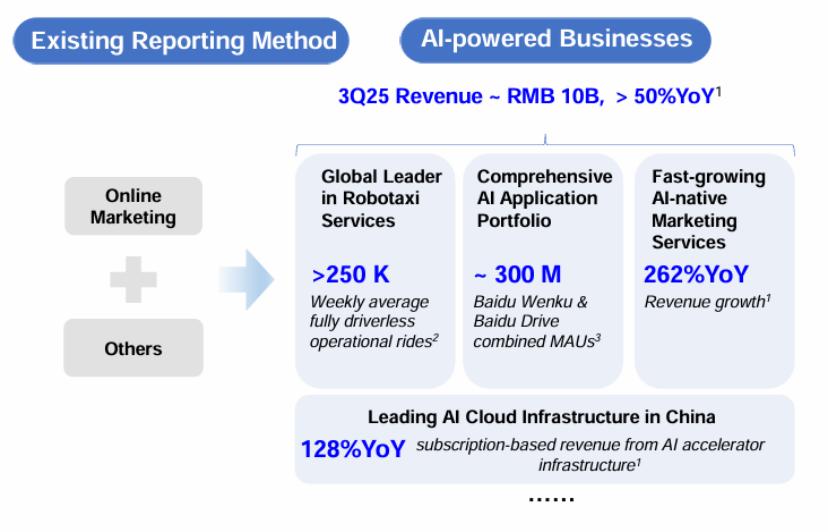
Core Insights - Baidu is facing significant pressure as its core online marketing revenue dropped by 18% in Q3 2025, while new business segments like AI, cloud, and autonomous driving are growing but not enough to create a reliable growth curve [1][2] - The establishment of the Personal Super Intelligent Group (PSIG) aims to integrate key AI assets like Baidu Wenku (Baidu Library) and Baidu Wangpan (Baidu Cloud) to enhance their commercial potential and address growth bottlenecks [1][3] Business Performance - AI cloud revenue reached 6.2 billion yuan, a 21% year-on-year increase, while AI application revenue was 2.6 billion yuan, accounting for over 25% of AI-driven business [5][8] - Baidu Wenku and Baidu Wangpan combined have approximately 300 million monthly active users, with Wenku's AI features achieving a 60% year-on-year growth in paid users [5][8] - AI native marketing services generated 2.8 billion yuan, a 262% increase year-on-year, now representing 18% of Baidu's core online marketing revenue, up from 4% a year ago [5][8] Strategic Developments - The integration of Baidu Wenku and Baidu Wangpan is expected to create a synergistic effect, enhancing user engagement and monetization through AI capabilities [9][10] - The launch of the Cangzhou OS and GenFlow tools indicates a strategic shift towards creating a comprehensive content operation system that enhances user productivity [9][10] - The PSIG's leadership under Wang Ying is seen as a strategic move to leverage the successful performance of Wenku and Wangpan, focusing on long-term growth potential [12][18] Competitive Landscape - Baidu's ambition to establish an "AI super entrance" faces challenges due to structural disadvantages compared to competitors like Tencent and Alibaba, which have more integrated ecosystems [19][23] - The lack of a robust transaction ecosystem and social engagement limits Baidu's ability to capture user behavior effectively, making it difficult to establish a "national-level entrance" in the AI To C market [23][25] - Baidu's AI journey has been complicated by missed opportunities in the mobile internet era, leading to a need for a balanced approach between B2B and B2C strategies [26][27]

昆仑万维All in AI 囧途:竞速、亏损与900亿梦想
2 1 Shi Ji Jing Ji Bao Dao· 2026-02-06 12:44
Core Viewpoint - Kunlun Wanwei is strategically shifting its focus from competing directly with major players in the AI field to building a differentiated competitive advantage in vertical markets and overseas expansion, aiming for long-term market positioning and ecological advantages rather than short-term profitability [2][9]. Financial Performance - For 2025, Kunlun Wanwei forecasts a net loss attributable to shareholders between 1.35 billion to 1.95 billion yuan, continuing the previous year's loss trend [2][3]. - The company expects a revenue increase of over 40% year-on-year for 2025, with a growing share of overseas revenue [2]. - The median loss forecast for 2025 is similar to the previous year's loss of 1.595 billion yuan [3]. Research and Development - Kunlun Wanwei's R&D expenditures from 2021 to 2024 were 628 million, 736 million, 1 billion, and 1.598 billion yuan respectively, with 2025's first three quarters seeing R&D spending of 1.211 billion yuan, primarily focused on AGI and AIGC [3][4]. Marketing and Sales - Sales expenses from 2021 to 2024 were 1.473 billion, 1.566 billion, 1.62 billion, and 2.304 billion yuan, with 2025's first three quarters reaching 2.891 billion yuan, aimed at global promotion of AI applications [4]. Product Development and Innovation - Kunlun Wanwei has developed various AI models and applications, including the Skywork series and the Skywork Super Agents, which focus on enhancing productivity and multi-modal content creation [5][6]. - The company has made significant advancements in AI music with Mureka, achieving a positive gross profit for the first time and generating an annual revenue of approximately 12 million dollars [6][7]. Market Positioning - The company has positioned itself as an "AI mid-tier" player, focusing on niche markets and avoiding direct competition with larger firms, which allows it to find survival space and opportunities for growth [3][9]. - The short drama segment has emerged as an unexpected growth point, with revenue expected to reach 1.68 billion yuan in 2025, reflecting a 900% year-on-year increase [8]. Future Outlook - Kunlun Wanwei anticipates that 2026 will be a pivotal year for transitioning from an investment phase to a revenue realization phase, with projections indicating a narrowing of losses and potential profitability by 2027 [10]. - The company's total market capitalization as of February 6 was 68.8 billion yuan, with a target market value estimated at 93.2 billion yuan based on a sum-of-the-parts valuation [11].

靠红包砸出来的热度,能持续多久
Qi Lu Wan Bao· 2026-02-06 12:44
Core Insights - The 2026 Spring Festival marketing battle has been significantly influenced by artificial intelligence, with major tech companies like Tencent, Alibaba, and Baidu investing over 4.5 billion yuan in the "red envelope war" [1][2] - AI has become the essential entry point for all platforms, transforming from a supplementary feature to the core component of the red envelope activities [2] Investment Scale - The total investment in the red envelope campaign has reached a record high, with Alibaba leading at 3 billion yuan, followed by Tencent with 1 billion yuan and Baidu with 500 million yuan, totaling over 4.5 billion yuan [2][3] Competitive Strategies - Different platforms are employing distinct strategies based on their ecosystems: Tencent focuses on social interactions through WeChat, Alibaba integrates AI into various consumer services, and Baidu leverages its search and content strengths [3][4] - The competition has evolved from merely attracting traffic to enhancing technical capabilities, scene coverage, and ecosystem collaboration [3] User Engagement and Retention Challenges - Despite the initial surge in user engagement, there are concerns about long-term user retention, as many platforms still rely on traditional growth tactics that may lead to user fatigue [4][5] - The homogeneity of AI functionalities across platforms raises questions about the ability to create unique value propositions and maintain user interest [4] Future Outlook - The red envelope campaign serves as a pressure test for the industry, highlighting the need for AI to transition from being a novelty to a necessity in daily life [6] - The long-term success of these platforms will depend on their ability to refine products, deepen user engagement, and integrate AI into everyday services, moving beyond short-term marketing tactics [6]
AI巨头春节狂撒45亿红包雨
Qi Lu Wan Bao· 2026-02-06 12:38
Core Insights - The competition among major internet companies for user engagement during the Spring Festival has intensified, with Tencent, Baidu, and Alibaba collectively distributing over 4.5 billion yuan in cash red envelopes, marking the beginning of a heated "AI red envelope war" [1] - The challenge for these companies is to convert users from "one-time visitors" to "retained users" through deeper integration of software with social media and various industry applications [1][6] Group 1: AI Red Envelope War - Tencent initiated the "Spring Festival AI Red Envelope War" by announcing a 1 billion yuan cash red envelope campaign through its Yuanbao app from February 1 to February 17 [1] - Baidu quickly followed with a 500 million yuan red envelope offer, integrating it with its AI product, Wenxin Assistant [1] - Alibaba's Qianwen launched a 3 billion yuan "Spring Festival Treat Plan" and secured exclusive naming rights for the Bilibili New Year's Eve gala [1] - ByteDance's Volcano Engine is set to participate in the 2026 CCTV Spring Festival Gala as the exclusive AI cloud partner, enhancing its interactive features [1] Group 2: User Engagement and Retention - Users are downloading apps primarily due to promotional activities, but there is skepticism about continued usage post-campaign, as indicated by user feedback [2] - The "AI red envelope war" is seen as a strategy to transition AI from simple search functions to more interactive capabilities [2] - QuestMobile data shows that by Q4 2025, Doubao's monthly active users (MAU) could reach 230 million, while Alibaba's Qianwen app may achieve 100 million MAU [2] Group 3: Historical Context and Strategy - The strategy of using red envelopes to attract users is not new; it was successfully employed during the 2015 Spring Festival with WeChat's "shake to grab red envelopes" feature, which significantly increased user engagement [3] - The current competition focuses on establishing the first point of interaction with AI applications, which is crucial for future user engagement [3] - The "AI red envelope war" is expected to shorten the adoption cycle of AI applications, transitioning into a phase focused on user loyalty [3] Group 4: Long-term User Retention Challenges - The primary challenge remains how to retain users after initial engagement, as past experiences show that high initial user numbers do not guarantee long-term retention [5] - Experts suggest that simply attracting users with red envelopes is insufficient; deeper interaction is necessary to form habitual usage [5] - The success of Yuanbao's red envelope initiative is contingent on its ability to leverage the WeChat ecosystem and provide ongoing value beyond the initial cash incentive [5]
新华微评·万马奔腾开新局:数智之光照见未来
Xin Hua She· 2026-02-06 11:44
Core Insights - The article highlights the rapid development of the internet in China, with a user base reaching 1.125 billion and an internet penetration rate exceeding 80% [1] - The scale of generative artificial intelligence users has surpassed 600 million, indicating significant adoption and integration into various sectors [1] - The advancements in digital infrastructure and AI applications are enhancing productivity across industries and improving digital services for households [1] Group 1 - The internet user base in China has reached 1.125 billion, reflecting a robust growth in digital engagement [1] - The internet penetration rate in China has surpassed 80%, showcasing widespread access to online services [1] - The number of generative AI users has exceeded 600 million, indicating a strong trend towards AI integration in daily life and business [1] Group 2 - The development of digital infrastructure is described as increasingly solid, supporting the growth of various sectors [1] - AI applications are empowering numerous industries, enhancing operational efficiency and service delivery [1] - The article emphasizes that digital services are benefiting a wide range of households, contributing to overall societal well-being [1]
千问请喝奶茶的免费效应下,Agent会迎来爆发吗?
3 6 Ke· 2026-02-06 11:43
Core Insights - The article highlights the significant role of AI Agents in enhancing user experience and operational efficiency, particularly during the Chinese New Year, with major companies like Alibaba and Tencent leading initiatives to promote AI technology [1][2][11]. Group 1: AI Agent Development and Adoption - Alibaba's "Qianwen" app launched a "30 billion free order" campaign, allowing users to interact with AI for various tasks, marking a significant step in user education about AI capabilities [1][2]. - The integration of AI Agents into Alibaba's ecosystem, including services like Taobao and Alipay, demonstrates the potential for seamless user experiences without switching between apps [2][10]. - A survey by LangChain indicates that 57% of organizations are already running AI Agents in production environments, with predictions that the integration of autonomous AI in enterprise software will rise from less than 1% in 2024 to 33% by 2028 [6]. Group 2: Business Model and Market Strategy - AI Agents provide a viable monetization path for large model vendors, addressing the long-standing issue of high costs and low returns associated with large models [8]. - Companies can adopt a "Robots as a Service" (RaaS) model, charging clients based on delivered results, which allows for deeper integration into core business processes [8][9]. - Consumer-facing AI Agents are expected to penetrate daily life through subscription models, enhancing user efficiency and creating a complete service loop within ecosystems [10]. Group 3: Competitive Landscape - Major tech companies are accelerating their AI Agent strategies, with ByteDance and Tencent also investing heavily in this area to create comprehensive service ecosystems [11][12]. - The smartphone industry is witnessing a race to integrate AI Agent capabilities, with companies like Honor and Xiaomi positioning themselves to lead in this new competitive dimension [12]. Group 4: Challenges and Future Outlook - Despite the consensus on the importance of AI Agents, challenges remain in terms of service delivery, user trust, and the need for effective multi-Agent collaboration [13][14]. - The stability of output quality and data security are identified as primary concerns for enterprises adopting AI Agents, indicating that overcoming these barriers will be crucial for widespread adoption [14].

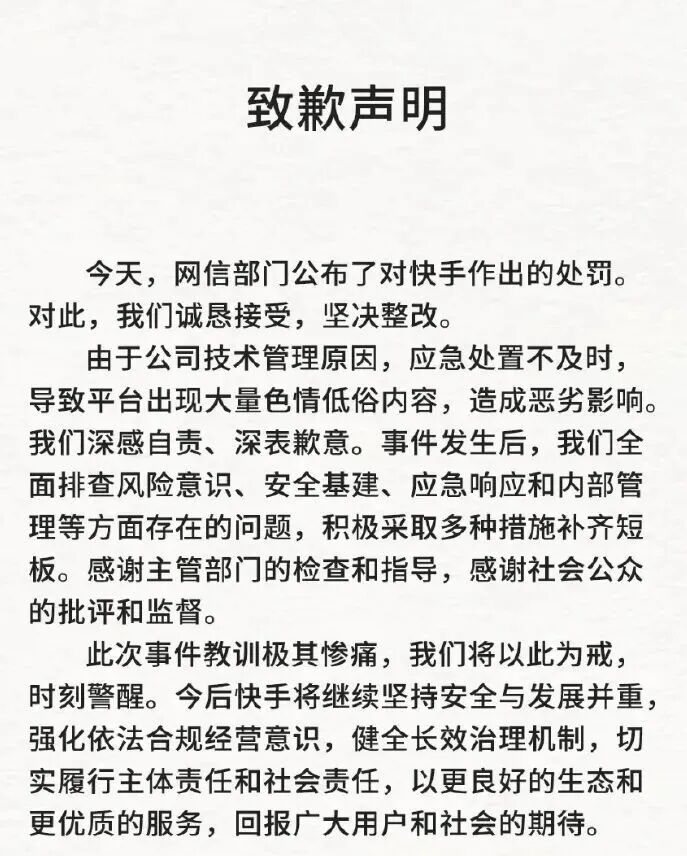
网信部门对快手平台依法作出处罚,快手发布致歉声明
Xin Lang Cai Jing· 2026-02-06 11:26
2月6日,北京市互联网信息办公室依据《中华人民共和国网络安全法》《中华人民共和国行政处罚法》等法律法规,对北京快手科技有限公司处警告、 1.191亿元人民币罚款处罚,同时责令其限期改正、依法依约处置账号、从严处理责任人。 北京市互联网信息办公室将持续加大网络执法力度,依法严厉打击各类违法行为,督促网站平台严格落实主体责任,切实保障网络安全,保护人民群众合 法权益,维护网络空间天朗气清。 刚刚,快手发布致歉声明,回应被罚。 今天,网信部门公布了对快手作出的处罚。对此,我们诚恳接受,坚决整改。 由于公司技术管理原因,应急处置不及时,导致平台出现大量色情低俗内容,造成恶劣影响。我们深感自责、深表歉意。事件发生后,我们全面排查风险 意识、安全基建、应急响应和内部管理等方面存在的问题,积极采取多种措施补齐短板。感谢主管部门的检查和指导,感谢社会公众的批评和监督。 此次事件教训极其惨痛,我们将以此为戒,时刻警醒。今后快手将继续坚持安全与发展并重,强化依法合规经营意识,健全长效治理机制,切实履行主体 责任和社会责任,以更良好的生态和更优质的服务,回报广大用户和社会的期待。 (来源:江苏新闻) 据"网信北京"消息,针对近期快 ...