
云计算

Search documents
继续为AI雄心筹资!兜售200亿美元债后,谷歌(GOOGL.US)再发英镑与瑞郎债
Zhi Tong Cai Jing· 2026-02-10 10:37
Group 1: Core Insights - Alphabet's parent company, Google, is issuing bonds denominated in British pounds and Swiss francs, including a rare 100-year bond, following a $20 billion bond issuance in the U.S. [1] - The issuance includes five tranches of bonds in pounds and francs, with maturities ranging from 3 to 32 years for pounds and 3, 6, 10, 15, and 25 years for francs [1][3] - The $20 billion issuance in the U.S. attracted over $100 billion in subscriptions, setting a strong precedent for the current bond offerings [1][2] Group 2: Market Context - The issuance of the 100-year bond is the first by a tech company since Motorola in 1997, highlighting the rarity of such long-term corporate debt [3] - Demand for long-term financing in the UK market is driven by pension funds and insurance companies, making it an attractive venue for issuers [3] - Other tech companies, including Meta and Microsoft, are also planning significant capital expenditures, contributing to a broader trend of increased borrowing in the sector [2] Group 3: Financial Institutions Involved - The bond issuance is being arranged by major banks including Bank of America, Goldman Sachs, and JPMorgan, with Barclays, HSBC, and National Westminster Bank participating in the pound issuance [4] - French bank BNP Paribas and Deutsche Bank are involved in the Swiss franc bond issuance [4]

对标微软?亚马逊拟推出AI内容交易平台,协助出版商向大模型“按量计费”
Hua Er Jie Jian Wen· 2026-02-10 08:59
Core Viewpoint - Amazon is planning to establish a new content marketplace that connects publishers with AI developers, providing infrastructure for monetizing digital content in the AI era [1][2]. Group 1: Content Marketplace Development - The platform aims to create a standardized trading mechanism allowing publishers to sell content access rights to AI companies, addressing the demand for a more sustainable payment model based on usage rather than one-time buyouts [1][3]. - Amazon's initiative is a response to Microsoft's recent actions and is a crucial step in building an AI ecosystem on top of its cloud computing dominance [2]. Group 2: Integration with AWS - Amazon is attempting to integrate this content marketplace with its core AI tools, positioning it as a business tool for publishers to host content on AWS and license it to AI companies also operating on the same platform [3]. - This approach aligns with the growing demand from publishers for a payment model based on content usage frequency, which is seen as more sustainable than traditional copyright buyouts [3]. Group 3: Industry Tensions - The relationship between publishers and tech platforms is becoming increasingly strained, with publishers expressing concerns that generative AI is altering user search habits and diverting traffic away from news sites [4]. - Legal conflicts are escalating, exemplified by a lawsuit from Penske Media against Google, alleging that AI-generated summaries harm publisher revenues [4]. Group 4: Market Challenges - Despite the rapid development of the platform, there are concerns regarding actual demand from AI companies on the buyer side of the content marketplace [5][6]. - Technical challenges exist, as some AI bots disguise themselves as human users to avoid payment, complicating the enforcement of content access fees [6]. - The competition between Amazon and Microsoft in the AI data trading infrastructure is expected to intensify, with the success of this model hinging on addressing technical vulnerabilities and attracting sufficient buyers [6].


200亿美元还不够!Alphabet首发瑞郎债,为1850亿美元AI雄心借遍全球
Hua Er Jie Jian Wen· 2026-02-10 08:30
Core Viewpoint - Alphabet is launching an unprecedented financing campaign globally, having completed a record $20 billion bond issuance and is now entering the European market with Swiss franc bonds and rare 100-year pound bonds to meet its $185 billion AI infrastructure investment needs [1]. Group 1: Bond Issuance Details - Alphabet has begun selling Swiss franc-denominated bonds with maturities of 3, 6, 10, 15, and 25 years, marking its first entry into the Swiss bond market [1]. - The company is also planning to issue its first pound bonds with maturities of 3, 6, 15, 32, and 100 years, which would be the first issuance of such long-term bonds by a tech company since Motorola in 1997 [1]. - The recent bond issuance is driven by Alphabet's announcement of a record capital expenditure plan of $185 billion for this year, which is double last year's spending and exceeds the total of the past three years [1]. Group 2: Demand and Market Trends - The $20 billion dollar bond issuance attracted over $100 billion in peak subscription orders, making it one of the strongest demand corporate bond issuances in history [2]. - The strong market demand led to significant pricing tightening, with the 3-year bond pricing at a premium of only 0.27 percentage points over U.S. Treasuries, down from an initial discussion of 0.6 percentage points [2]. - The issuance trend is part of a broader financing wave in the tech sector, with the five major AI cloud computing giants issuing $121 billion in corporate bonds last year, compared to an average of $28 billion from 2020 to 2024 [3]. Group 3: Future Projections - Morgan Stanley projects that borrowing by cloud computing giants will surge from $165 billion in 2025 to $400 billion [3]. - The total investment-grade bond issuance is expected to reach a record $2.25 trillion this year, driven by the current wave of bond issuances [3]. - Bloomberg industry research estimates that capital expenditures for AI, cloud infrastructure, and data centers will total $3 trillion by 2029 [3]. Group 4: Market Concerns - The surge in bond issuance is raising concerns about bond valuation pressures, with expectations that the large volume will widen corporate bond spreads [4]. - Current market conditions are likened to those of 1997-98 or 2005, indicating potential credit performance issues, although not necessarily at the end of a cycle [4].

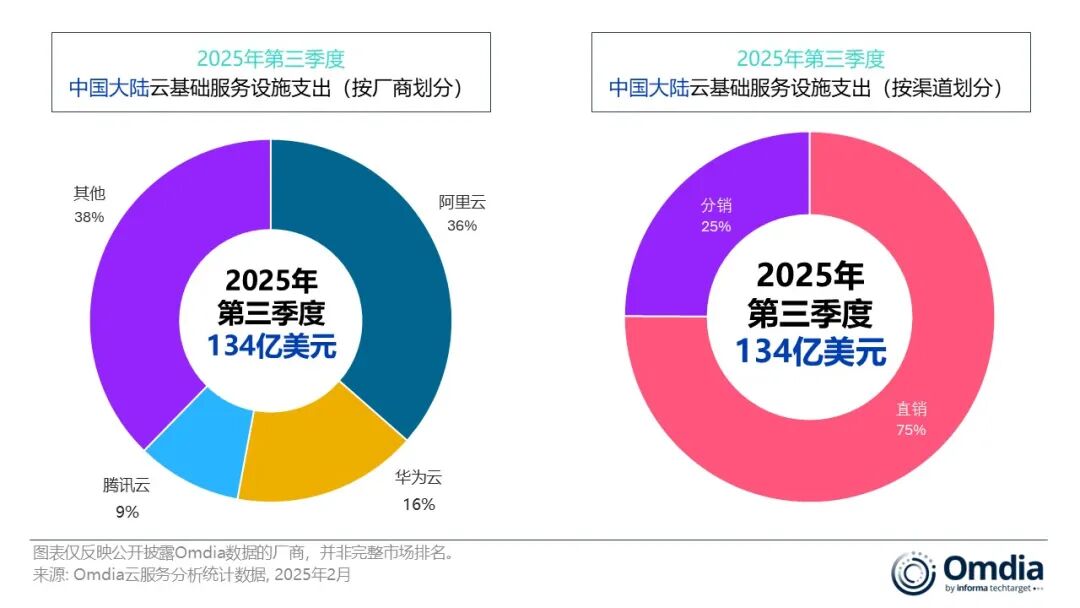
Omdia:2025年第三季度中国大陆云基础设施服务市场规模达到134亿美元 同比增长24%
Zhi Tong Cai Jing· 2026-02-10 08:28
Core Insights - The cloud infrastructure service market in mainland China reached $13.4 billion in Q3 2025, marking a 24% year-on-year growth, with AI demand driving this acceleration [1] - Major cloud providers are enhancing their AI capabilities and focusing on the productization of AI models, while improving the underlying toolchain and platform capabilities to support AI Agent platforms [1][2] - The market shares for leading cloud providers in Q3 2025 were 36% for Alibaba Cloud, 16% for Huawei Cloud, and 9% for Tencent Cloud [1] Group 1: Market Trends - The cloud infrastructure service market in mainland China has shown a consistent recovery, achieving over 20% year-on-year growth for two consecutive quarters [1] - AI is becoming the primary driver of new demand for core cloud infrastructure services, leading to increased consumption of computing, storage, and database resources [1][2] Group 2: Company Developments - Alibaba Cloud has maintained its market leadership with a 36% share, experiencing triple-digit year-on-year growth in AI-related revenue for nine consecutive quarters, driven by enterprise applications and strategic AI partnerships [5] - Huawei Cloud holds the second position in the market with a 16% share and a 14% year-on-year revenue growth, focusing on AI applications in key industries [6] - Tencent Cloud, with a 9% market share, is facing growth constraints due to limited advanced AI computing resources but is enhancing its internal operations and AI product capabilities [7] Group 3: AI Integration and Development - Leading cloud providers are embedding AI models into comprehensive platform systems, making them functional modules within the platform architecture [2] - The focus is shifting towards platform-level reliability and operational stability as AI deployment moves into large-scale production [2] - In Q3 2025, partner-driven cloud revenue accounted for 25% of the market, indicating a growing contribution from ecosystem collaboration in translating AI capabilities into business outcomes [3]

科创板周报(2.2-2.6):北美四大云巨头,2026年资本支出仍将大幅增加
Zhong Guo Yin He Zheng Quan· 2026-02-10 07:50
Group 1: Capital Expenditure Projections - The four major cloud giants are expected to significantly increase capital expenditures in 2026, with Microsoft forecasting a higher growth rate than in 2025[2] - Meta's capital expenditure for 2026 is projected to be between $115 billion and $135 billion[2] - Google's capital expenditure for 2026 is estimated to be between $175 billion and $185 billion[2] - Amazon anticipates a capital expenditure of approximately $200 billion for 2026[2] Group 2: Market Concerns and Financial Performance - Following the earnings reports, stock prices of the four giants experienced declines, raising concerns about investment returns[2] - Amazon's operating cash flow for 2026 is projected to be insufficient to cover its capital expenditures, potentially leading to a cash flow deficit[2] - Analysts predict that 2026 will see a heightened focus on AI revenue growth and the ability of AI to create a commercial loop[2] Group 3: Industry Trends and Comparisons - The overall trading activity in the STAR Market decreased, with an average daily trading volume of approximately ¥241.32 billion, down from ¥318.02 billion the previous week[6] - The STAR Market's average PE ratio stands at 75.75, significantly higher than other major boards, indicating a premium valuation[10] - The technology sector's performance in the STAR Market was mixed, with the beauty care sector showing the highest weekly gain of +12.0% and the computer sector experiencing the largest decline of -7.4%[15]

G42将在越南发展主权人工智能和云基础设施
Shang Wu Bu Wang Zhan· 2026-02-10 07:24
Group 1 - The core agreement involves a consortium led by Abu Dhabi's G42, along with Vietnam's FPT Group and Viet Thai Group, to develop sovereign artificial intelligence and cloud infrastructure in Vietnam [1] - The framework agreement outlines a planned investment of $1 billion to deploy cloud computing capabilities across three data centers in Vietnam, aimed at supporting the construction of an "AI-native society" and ensuring data sovereignty [1] - Additionally, there are plans to build a massive data center in Ho Chi Minh City, valued at $2 billion [1]
投顾晨报20260211-20260210
Orient Securities· 2026-02-10 07:13
Core Insights - The report emphasizes a bullish outlook on the agricultural and chemical sectors, suggesting that these areas are poised for growth as the market stabilizes and begins to recover from recent volatility [2][3][4]. Market Strategy - The market is expected to experience a slight upward trend before the holiday, with a focus on mid-cap blue-chip stocks. The agricultural and chemical sectors are highlighted as timely investment opportunities [3]. - Investors are advised to avoid impulsive trading behaviors and to focus on structural opportunities, particularly in the agricultural sector, while maintaining patience for potential gains [2][3]. Industry Strategy - The chemical industry, particularly PVC, is compared to the aluminum sector, indicating that PVC asset values may be re-evaluated due to underlying demand shifts and regulatory influences on production capacity [4]. - The report notes that while the PVC industry has faced challenges due to real estate impacts, a significant adjustment in demand structure is anticipated, which could lead to a resurgence in profitability similar to that seen in the aluminum sector [4]. Thematic Strategy - The report discusses the potential for AI applications, particularly OpenClaw, to drive demand in computing power and related software tools, suggesting that these sectors may benefit from the maturation of AI technologies [5]. - The deployment flexibility of OpenClaw, supporting both cloud and local installations, is expected to create new market opportunities, particularly in scenarios requiring high data security [5].
腾讯云推出一站式AI漫剧解决方案
Cai Jing Wang· 2026-02-10 07:04
Group 1 - Tencent Cloud has launched a one-stop AI comic drama solution that integrates its leading AIGC generation capabilities with media processing MPS technology to address production and operational pain points in the comic drama industry [1] - The solution automates and intelligently covers the entire process of asset generation in AI comic drama production, including script generation, character library creation, storyboard drawing, AI dubbing, video generation, and image quality enhancement [1] - The solution supports seamless integration with major models like Tencent's Mix Yuan and employs unique prompt optimization and multi-image reference techniques to resolve industry challenges such as inconsistent character appearances and abrupt style changes [1] Group 2 - AI-generated original videos often suffer from low resolution and visual glitches, but Tencent Cloud's media processing MPS capabilities can intelligently repair and enhance AI-generated content while achieving cost reduction [2] - The system can automatically identify and redraw "glitch points" in the visuals, restoring details at a hair-level and fixing lighting logic through deep deconstruction of visual patterns [2] - The combination of "AIGC generating low-resolution videos + Tencent Cloud media processing transcoding to high definition" allows creators to meet top comic drama material quality requirements while reducing computational power and production costs by approximately 50% [2] Group 3 - The comic drama sector has seen rapid development over the past year, with a report from DataEye indicating that 2025 is expected to be a breakout year for comic dramas, with total market views exceeding 70 billion and a market size projected to reach 16.8 billion yuan, potentially surpassing 24 billion yuan in 2026 [2]

KT(KT) - 2025 Q4 - Earnings Call Transcript
2026-02-10 07:02
Financial Data and Key Metrics Changes - Operating revenue increased by 6.9% year-on-year, reaching KRW 28,244.2 billion [25] - Operating profit surged by 205% year-on-year to KRW 2,469.1 billion, driven by core business performance and one-off gains from real estate projects [25] - Net income rose by 340.4% year-on-year to KRW 1,836.8 billion, while EBITDA increased by 35.5% year-on-year to KRW 6,349.3 billion [27] - Operating expenses remained flat year-on-year at KRW 25,775.1 billion, attributed to lower labor costs and efficient spending [29] - Debt-to-equity ratio at the end of 2025 was 120.7%, with net debt-to-equity ratio decreasing by 0.4 percentage points year-on-year to 37.4% [31] Business Line Data and Key Metrics Changes - Wireless revenue grew by 2.8% year-on-year to KRW 7,155.4 billion, driven by subscriber expansion in 5G, with 5G penetration at 81.8% by the end of 2025 [35] - Broadband revenue increased by 1.9% year-on-year to KRW 2,533.5 billion, supported by GiGA subscriber growth [37] - Media business revenue rose by 1.7% year-on-year, driven by higher IPTV subscriber additions [37] - B2B service revenue grew by 1.3% year-on-year, with AI and IT business growing by 3.1% year-on-year [41] - KT Cloud revenue surged by 27.4% year-on-year to KRW 997.5 billion, reflecting increased data center usage and AI cloud demand [43] Market Data and Key Metrics Changes - The company reported a flat revenue for content subsidiaries year-on-year, despite the divestment of PlayD, due to growth from StudioGenie, Nasmedia, and Millie's Library [41] - KT Estate revenue increased by 15.9% year-on-year to KRW 719.3 billion, driven by strong hotel business and new property developments [43] Company Strategy and Development Direction - The company is focusing on enhancing its fundamentals and regaining customer trust following a data breach incident, with a commitment to cybersecurity improvements [3][12] - Plans include a KRW 250 billion share buyback and cancellation as part of the Corporate Value Enhancement Plan [7][21] - The company aims to solidify its leadership in the AI cloud market with the launch of new products and partnerships with global tech companies [4] Management Comments on Operating Environment and Future Outlook - Management expressed confidence in achieving better performance in 2026 compared to 2025, despite the financial impact of customer compensation related to the data breach [57][61] - The new CEO is expected to maintain the company's shareholder return policy and growth strategy, with a focus on AX-driven innovation [69][70] Other Important Information - The year-end dividend for 2025 is set at KRW 2,400 per share, a 20% increase from 2024 [6] - The company is investing around KRW 1 trillion in security over five years to enhance its information security system [19] Q&A Session Summary Question: What is the financial impact of the customer compensation package regarding the data breach incident? - The estimated benefit for customers is about KRW 450 billion, but not all will be booked as costs, depending on usage [57] Question: Will the new CEO maintain the previous shareholder return stance? - The DPS has been increased by 20% for 2025, and future plans will be finalized by the new CEO and the Board of Directors [65][66] Question: What is the outlook for the wireless business growth following the data breach incident? - Approximately 230,000 subscribers left during the cancellation fee waiver period, but net additions were still positive [79] Question: Why is B2B growth slower compared to peers, and what is the outlook? - B2B growth is influenced by various segments, and when combined with KT Cloud, the growth rate is 6% year-on-year, with KT Cloud showing a 27.4% increase [85][87]

KT(KT) - 2025 Q4 - Earnings Call Transcript
2026-02-10 07:00
Financial Data and Key Metrics Changes - Operating revenue increased by 6.9% year-on-year, reaching KRW 28,244.2 billion [26] - Operating profit surged by 205% year-on-year to KRW 2,469.1 billion, driven by core business performance and one-off gains [26] - Net income rose by 340.4% year-on-year to KRW 1,836.8 billion, with EBITDA increasing by 35.5% to KRW 6,349.3 billion [28] - Operating expenses remained flat year-on-year at KRW 25,775.1 billion due to lower labor costs and efficient spending [30] - Debt-to-equity ratio at the end of 2025 was 120.7%, with net debt-to-equity ratio decreasing to 37.4% [32] Business Line Data and Key Metrics Changes - Wireless revenue grew by 2.8% year-on-year to KRW 7,155.4 billion, supported by subscriber expansion in 5G, which reached a penetration rate of 81.8% [36] - Broadband revenue increased by 1.9% year-on-year to KRW 2,533.5 billion, driven by growth in giga subscribers and value-added services [38] - Media business revenue rose by 1.7% year-on-year, attributed to higher IPTV subscriber additions [38] - B2B service revenue grew by 1.3% year-on-year, with AI and IT business growing by 3.1% [42] - KT Cloud revenue increased by 27.4% year-on-year to KRW 997.5 billion, reflecting strong demand for data center services [44] Market Data and Key Metrics Changes - The company is focusing on enhancing its market position in the AI and IT sectors, with significant investments planned for security and infrastructure [19][48] - The overall B2B market growth is projected to be stable, with KT Cloud's growth expected to continue at a high rate [86] Company Strategy and Development Direction - The company aims to solidify its fundamentals and regain customer trust following a data breach incident, with a focus on cybersecurity and network resilience [3][13] - KT plans to implement a corporate value enhancement plan, including a KRW 250 billion share buyback and increased dividends [6][22] - The new CEO is expected to maintain the company's growth strategy while potentially introducing tactical changes reflecting his philosophy [69] Management's Comments on Operating Environment and Future Outlook - Management expressed confidence in achieving better performance in 2026 compared to 2025, despite challenges from the data breach [61] - The company is committed to improving operational efficiency in the wireless business and expects stable growth in B2B services [80][83] Other Important Information - The company has set a year-end dividend of KRW 2,400 per share, a 20% increase from the previous year [6] - A new CEO has been appointed, expected to bring expertise in B2B and future technologies [11] Q&A Session Summary Question: Financial impact of customer compensation package and future shareholder return stance - The financial impact of the customer appreciation package is estimated at KRW 450 billion, but not all will be booked as costs [56] - The company plans to maintain a progressive shareholder return policy, with the new CEO and board finalizing future plans [65][67] Question: Outlook for wireless business growth and B2B performance - Approximately 230,000 subscribers left during the cancellation fee waiver period, but net additions were still positive [78] - B2B growth is slower compared to peers, but combined revenue growth, including KT Cloud, shows a 6% increase year-on-year [85][86]