
家用电器

Search documents
深市三季报:新质生产力发力,消费“AI+”生态初成
2 1 Shi Ji Jing Ji Bao Dao· 2025-11-10 07:21
Group 1: Overall Market Performance - Shenzhen-listed companies reported robust growth in revenue and net profit for the first three quarters of 2025, driven by macro policies and recovering market demand [2] - The power equipment, communication, and new energy sectors emerged as strong growth engines, contributing significantly to overall performance [2] Group 2: Power Equipment and New Energy Sector - The power equipment industry in Shenzhen achieved a total revenue of 1.32 trillion yuan, a year-on-year increase of 10%, with net profit reaching 946.09 billion yuan, up 29.53% [2] - Leading companies like Suyuan Electric, Tianci Materials, and Hengdian East Magnetics reported rapid growth due to high R&D investment and advanced technology [2] - The new energy sector generated a total revenue of 1.06 trillion yuan and net profit of 787.05 billion yuan, reflecting a year-on-year growth of 31.87% [3] Group 3: Key Company Performances - Suyuan Electric's revenue and net profit grew by 32.86% and 46.94% respectively, with a quarterly net profit increase of 48.73% [3] - Tianci Materials maintained strong profitability despite product price fluctuations, supported by over 2.6 billion yuan in R&D investment over the past three years [3] - Hengdian East Magnetics achieved revenue of 175.6 billion yuan, with a net profit increase of 56.8% [3] Group 4: Communication Industry Growth - The communication sector saw revenue and net profit growth of 14.34% and 36.65% respectively [5] - Newyi Technology reported a staggering revenue increase of 221.70% and net profit growth of 284.37% [5] - Guangxun Technology's revenue grew by 58.65%, supported by a comprehensive product chain from chips to subsystems [5] Group 5: Consumer Industry Developments - The consumer sector demonstrated resilience, with the home appliance industry net profit increasing by 9.14% [6] - Midea Group launched the first trillion-level data AI agent, enhancing brand value through technological integration [6] - TCL Smart Home achieved continuous net profit growth for 17 consecutive quarters, driven by innovative technologies in refrigeration and washing machines [6]

10月我国CPI环比转涨,消费ETF易方达(159798)、港股消费ETF易方达(513070)标的指数单边走强
Mei Ri Jing Ji Xin Wen· 2025-11-10 03:30
Core Viewpoint - The A-share market shows positive momentum with consumer sectors leading the gains, while the Hong Kong market experiences significant increases in new consumption stocks and AI application concepts, indicating a robust economic recovery and consumer demand [1]. Group 1: Market Performance - A-share indices opened high and experienced fluctuations, with sectors such as emulsions, duty-free shops, beverage manufacturing, and liquor leading the gains [1]. - The Hong Kong market saw a substantial rise in new consumption stocks, with related indices climbing steadily, including a 1.7% increase in both the CSI Consumer 50 Index and the CSI Hong Kong Stock Connect Consumer Theme Index [1]. Group 2: Economic Indicators - In October, the Consumer Price Index (CPI) rose by 0.2% year-on-year and month-on-month, reflecting improved supply-demand dynamics in certain domestic industries and the impact of international commodity prices [1]. - The Producer Price Index (PPI) also showed positive changes both year-on-year and month-on-month, indicating a strengthening economic vitality and the release of domestic demand potential [1]. Group 3: Future Outlook - Analysts suggest that the October price data signals a steady enhancement of economic vitality in China, with expectations for a moderate increase in CPI in the fourth quarter, driven primarily by a clearer upward trend in core CPI [1]. - The CSI Consumer 50 Index comprises 50 leading consumer companies with over 80% representation from the food and beverage and home appliance sectors, while the CSI Hong Kong Stock Connect Consumer Theme Index includes 50 liquid and large-cap consumer stocks from emerging sectors like trendy toys, tea drinks, e-commerce, and consumer electronics [1].
阳光电源上周获融资资金买入超162亿元丨资金流向周报
2 1 Shi Ji Jing Ji Bao Dao· 2025-11-10 02:59
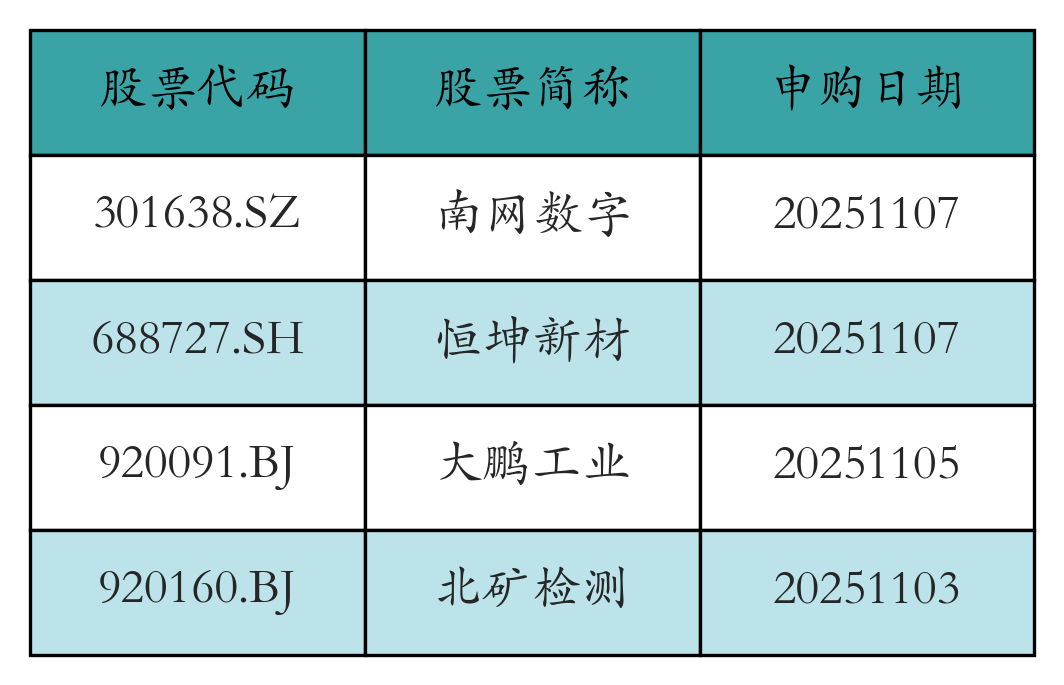
Market Overview - The Shanghai Composite Index rose by 1.08% last week, closing at 3997.56 points, with a peak of 4012.01 points [1] - The Shenzhen Component Index increased by 0.19%, ending at 13404.06 points, with a high of 13496.7 points [1] - The ChiNext Index saw a 0.65% rise, closing at 3208.21 points, reaching a maximum of 3240.34 points [1] - In contrast, major global indices experienced declines, with the Nasdaq Composite down by 3.04%, the Dow Jones Industrial Average down by 1.21%, and the S&P 500 down by 1.63% [1] - In the Asia-Pacific region, the Hang Seng Index increased by 1.29%, while the Nikkei 225 fell by 4.07% [1] New Stock Issuance - Four new stocks were issued last week, with details as follows: - Nanfang Digital (301638.SZ) on November 7, 2025 - Hengkun New Materials (688727.SH) on November 7, 2025 - Dapeng Industrial (920091.BJ) on November 5, 2025 - Beikuan Testing (920160.BJ) on November 3, 2025 [2] Margin Financing and Securities Lending - The total margin financing and securities lending balance in the Shanghai and Shenzhen markets reached 24857.39 billion, with a financing balance of 24675.74 billion and a securities lending balance of 181.65 billion [3] - This represents an increase of 72.69 billion compared to the previous week [3] - The Shanghai market's margin balance was 12691.71 billion, up by 74.28 billion, while the Shenzhen market's balance was 12165.68 billion, down by 1.59 billion [3] - A total of 3460 stocks had margin buying, with 178 stocks exceeding 1 billion in buying amount, led by Sunshine Power (162.82 billion), Zhongji Xuchuang (115.5 billion), and TBEA (100.09 billion) [3] Fund Issuance - A total of 21 new funds were issued last week, including various bond and mixed funds [5] - Notable funds include: - Lobo Mai CSI A500 Index Enhanced B - Huafu Fuze Six-Month Holding Period Bond A - Penghua Innovation Future Mixed (LOF) A [5] Share Buyback Announcements - There were 21 new share buyback announcements last week, with the highest execution amounts from: - COSCO Shipping Holdings (601919) - Lakala (300773) - Mars (300894) - Jiantou Energy (000600) - Zhongkong Technology (688777) [8] - The top three industries by buyback amount were transportation, non-bank financials, and household appliances [8]

兆驰股份股价涨5.88%,国泰基金旗下1只基金重仓,持有450.96万股浮盈赚取166.86万元
Xin Lang Cai Jing· 2025-11-10 02:16
Group 1 - The core viewpoint of the news is that Zhao Chi Co., Ltd. has seen a significant stock price increase of 5.88%, reaching 6.66 CNY per share, with a trading volume of 253 million CNY and a market capitalization of 30.149 billion CNY as of the report date [1] - Zhao Chi Co., Ltd. is based in Longgang District, Shenzhen, Guangdong Province, and was established on April 4, 2005, with its listing date on June 10, 2010. The company specializes in the research, manufacturing, sales, and service of home audio-visual and electronic products [1] - The company's main business revenue composition includes multimedia audio-visual products and operation services at 66.90% and the LED industry chain at 33.10% [1] Group 2 - From the perspective of major fund holdings, one fund under Guotai Fund has Zhao Chi Co., Ltd. as a significant investment. The Guotai CSI Home Appliance ETF (159996) held 4.5096 million shares in the third quarter, accounting for 1.8% of the fund's net value, ranking as the tenth largest holding [2] - The Guotai CSI Home Appliance ETF (159996) was established on February 27, 2020, with a current scale of 1.657 billion CNY. Year-to-date returns are at 14.37%, ranking 3318 out of 4216 in its category, while the one-year return is 13.05%, ranking 2749 out of 3917. Since inception, the return is 52.46% [2] - The fund manager of the Guotai CSI Home Appliance ETF is Miao Mengyu, who has been in the position for 4 years and 45 days, with a total asset scale of 7.268 billion CNY. The best fund return during the tenure is 57.51%, while the worst is -36.23% [2]

A股市场大势研判:A股全天震荡调整,三大指数均冲高回落
Dongguan Securities· 2025-11-10 00:08
Market Overview - The A-share market experienced fluctuations with all major indices retreating after initial gains, closing with the Shanghai Composite Index down 0.25% at 3997.56 points, the Shenzhen Component down 0.36% at 13404.06 points, and the ChiNext down 0.51% at 3208.21 points [1][3]. Sector Performance - The top-performing sectors included Basic Chemicals (+2.39%), Comprehensive (+1.45%), Oil & Petrochemicals (+1.38%), Building Materials (+1.22%), and Electric Equipment (+1.01%) [2]. - Conversely, the worst-performing sectors were Computer (-1.83%), Electronics (-1.34%), Household Appliances (-1.17%), Automotive (-1.16%), and Media (-0.87%) [2]. Concept Index Performance - Among concept indices, the Organic Silicon concept led with a gain of 4.65%, followed by Fluorochemical (+3.92%), Silicon Energy (+3.67%), Phosphate Chemical (+3.47%), and Titanium Dioxide (+3.37%) [2]. - The lagging concept indices included Sci-Tech New Shares (-2.27%), Sora Concept (Wensheng Video) (-1.87%), MLOps Concept (-1.82%), Reducer (-1.76%), and Registration System New Shares (-1.70%) [2]. Economic Indicators - In the first ten months of 2025, China's total goods trade value reached 37.31 trillion yuan, reflecting a year-on-year growth of 3.6%. Exports amounted to 22.12 trillion yuan, up 6.2%, while imports were 15.19 trillion yuan, remaining stable compared to the previous year [4]. Trading Volume and Market Sentiment - The total trading volume in the Shanghai and Shenzhen markets was 2 trillion yuan, a decrease of 562 billion yuan from the previous trading day [5]. - The report indicates that the Chinese economy is in a critical phase of momentum transition, with expectations for gradual improvement in the economic fundamentals in the fourth quarter, supported by policy measures [5]. Investment Strategy - The report suggests a balanced allocation strategy, focusing on sectors such as New Energy, Technology Growth, Dividend Stocks, and Non-ferrous Metals [5].
北交所策略专题报告:北交所“双指数”调仓前瞻:绩优成分再筛选,专精特新科技成长驱动新一轮布局
KAIYUAN SECURITIES· 2025-11-09 12:45
Group 1 - The North Exchange 50 Index and the Specialized and Innovative Index will undergo adjustments on December 15, 2025, with the North Exchange 50 Index experiencing its fourth adjustment and the Specialized and Innovative Index its first adjustment [10][12][15] - The North Exchange 50 Index closed at 1,522.73 points, reflecting a weekly decline of 3.79%, while the Specialized and Innovative Index closed at 2,532.06 points, down 5.43% [31][32] - The report emphasizes the importance of focusing on high-quality stocks and technology growth within the North Exchange 50 components, particularly those that have undergone significant price adjustments [3][42] Group 2 - The report identifies potential new additions to the North Exchange 50 Index, including companies such as Kaifa Technology, Gobika, and Wantong Hydraulic, with a focus on their average market capitalization and trading volume [12][13] - The North Exchange Specialized and Innovative Index is expected to include companies like Star Map Measurement and Senxuan Pharmaceutical, highlighting their market performance and growth potential [15][16] - The report suggests that the North Exchange's valuation structure shows a significant number of companies with high P/E ratios, indicating a potential investment opportunity in undervalued stocks [21][36][41] Group 3 - The report indicates that the average P/E ratio for key sectors such as high-end equipment, information technology, and chemical new materials are 42.83X, 91.31X, and 48.18X respectively, suggesting varying levels of valuation across industries [36][41] - The North Exchange's market performance shows a decline in trading volume, with an average daily turnover of 230.88 billion yuan, down 20.36% from the previous week [26][30] - The report highlights the importance of monitoring companies with strong quarterly performance and reasonable valuations as the North Exchange approaches its index adjustments [42][43]
家电周报:前三季度家电全产业链出口普遍强于内销,德昌股份定增获批-20251109
Shenwan Hongyuan Securities· 2025-11-09 05:15
Investment Rating - The report maintains a positive outlook on the home appliance industry, particularly highlighting the resilience of the white goods sector and the potential for growth driven by policy changes and market dynamics [3][5]. Core Insights - The home appliance sector has shown stronger export performance compared to domestic sales, with various segments experiencing differing trends in sales and production [4][12]. - The report identifies three main investment themes: white goods, export-driven companies, and core components, recommending specific companies within these categories for investment [5][6]. Summary by Sections Industry Performance - In September 2025, the air conditioning sector saw a total production of 10.57 million units, a year-on-year decrease of 13.5%, while total sales were 10.88 million units, down 10.2%. Domestic sales were 5.95 million units, down 2.5%, and exports were 4.94 million units, down 18.1% [4][34]. - The refrigerator sector reported a production of 8.72 million units, a slight decrease of 0.5%, with total sales of 8.34 million units, a marginal increase of 0.12%. Domestic sales fell by 7.35% to 3.87 million units, while exports rose by 7.63% to 4.47 million units [4][41]. - The washing machine sector experienced a production increase of 10.4% to 9.05 million units, with total sales rising by 7.52% to 8.85 million units. Domestic sales decreased by 6.88% to 4.06 million units, while exports surged by 23.76% to 4.79 million units [4][43]. Investment Themes - The white goods sector is expected to benefit from a reversal in real estate policies, with characteristics such as low valuation, high dividends, and stable growth making it attractive for investment. The report suggests that the "trade-in" policy could act as a catalyst for growth [5][6]. - For export-driven companies, the report recommends firms like Ousheng Electric and Dechang Co., which are expected to see revenue growth from large customer orders and expanding automotive parts businesses [5][6]. - In the core components segment, companies like Huaxiang Co. and Shun'an Environment are highlighted for their competitive advantages and growth potential in the context of rising demand for key components in the white goods sector [5][6]. Market Dynamics - The report notes that the overall home appliance index underperformed compared to the CSI 300 index, with a decline of 0.5% in the home appliance sector index while the CSI 300 rose by 0.8% [5][7]. - The report emphasizes the importance of emerging markets in driving export growth, particularly in regions like Africa and South America, despite challenges such as tariffs and high inventory levels [5][12].




2025年9月中国家用电器进出口数量分别为151万台和36656万台
Chan Ye Xin Xi Wang· 2025-11-09 03:23
Core Insights - The report by Zhiyan Consulting highlights the trends in China's home appliance and electronic products market from 2026 to 2032, indicating significant changes in import and export dynamics [1] Import Data - In September 2025, China imported 1.51 million home appliances, marking a year-on-year increase of 16.9% [1] - The import value for the same period reached $14.7 million, reflecting a year-on-year growth of 8.5% [1] Export Data - In September 2025, China exported 36.656 million home appliances, which represents a year-on-year decline of 3.7% [1] - The export value during this period was $7.73 billion, showing a year-on-year decrease of 9.6% [1] Industry Overview - Zhiyan Consulting is recognized as a leading industry consulting firm in China, specializing in in-depth industry research and providing comprehensive consulting services for investment decisions [1]

中国机电产品进出口商会:10月我国机电产品出口1903亿美元 同比增长1.3%
Zhi Tong Cai Jing· 2025-11-07 12:45
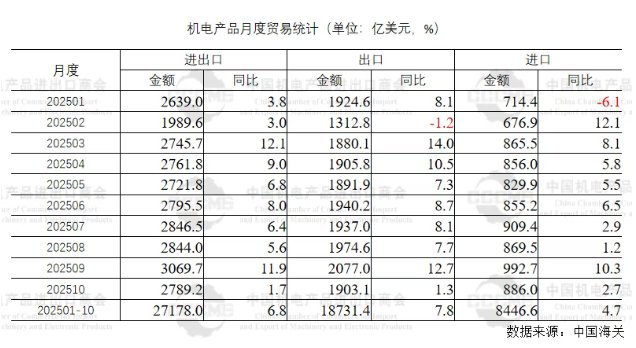
Core Insights - In October, China's electromechanical product exports reached $190.31 billion, marking the highest value for the same month in history, with a year-on-year growth of 1.3%, continuing an upward trend for the eighth consecutive month, although the growth rate has narrowed by 11.4 percentage points compared to the previous month due to high base effects from last year's fourth quarter and fewer working days in the month [1] Summary by Category Export Performance - In the first ten months of 2025, China's electromechanical product import and export value increased by 6.8% to $271.78 billion, with exports amounting to $1873.14 billion, a year-on-year increase of 7.8%, contributing 4.6 percentage points to overall export growth [2] - Key electromechanical products such as integrated circuits, complete automobiles, ships, audio-video equipment, and LCD display modules saw year-on-year export growth, while exports of computers, mobile phones, home appliances, auto parts, lighting equipment, and general machinery declined [4] - Integrated circuit exports grew by 27% year-on-year, achieving double-digit growth for seven consecutive months, while automobile exports increased by 41.8% to 828,000 units, setting a new monthly export record [4] Import Performance - In October, electromechanical product imports rose by 2.7% to $88.6 billion, marking the ninth consecutive month of year-on-year growth, with integrated circuit imports increasing by 10.4% to $37.77 billion, contributing 4.1 percentage points to import growth [6] - Computer product imports decreased by 27.1% to $6.68 billion, continuing a downward trend for four months and negatively impacting the overall growth rate of electromechanical imports by 2.9 percentage points [6] Key Product Data - Integrated circuits accounted for $16.79 billion in exports in October, with a year-on-year increase of 27%, while mobile phone exports fell by 16.5% to $15.52 billion [6] - The automotive sector, including chassis, saw exports of $14.31 billion, a year-on-year increase of 34.1% [6]
家用电器行业11月7日资金流向日报
Zheng Quan Shi Bao Wang· 2025-11-07 09:29
Market Overview - The Shanghai Composite Index fell by 0.25% on November 7, with 14 out of the 28 sectors rising, led by basic chemicals and comprehensive sectors, which increased by 2.39% and 1.45% respectively [1] - The computer and electronics sectors experienced the largest declines, with drops of 1.83% and 1.34% respectively [1] - Overall, the main funds in the two markets saw a net outflow of 40.396 billion yuan, with 6 sectors experiencing net inflows [1] Sector Performance - The basic chemicals sector had the highest net inflow of funds, totaling 5.943 billion yuan, coinciding with its 2.39% increase [1] - The power equipment sector also saw a positive performance, with a 1.01% increase and a net inflow of 4.253 billion yuan [1] - In contrast, the electronics sector faced the largest net outflow of funds, amounting to 10.212 billion yuan, followed closely by the computer sector with a net outflow of 10.005 billion yuan [1] Home Appliance Industry - The home appliance sector declined by 1.17%, with a net outflow of 2.290 billion yuan [2] - Out of 94 stocks in this sector, 31 rose while 61 fell [2] - The top three stocks with the highest net outflow included Sanhua Intelligent Control, Hanyu Group, and Ecovacs, with outflows of 1.567 billion yuan, 279 million yuan, and 914 million yuan respectively [2] Notable Stocks in Home Appliance Sector - Midea Group had the highest net inflow in the home appliance sector, with 63.618 million yuan [5] - Tianyin Electromechanical and Kangsheng Co. followed with net inflows of 58.216 million yuan and 28.8816 million yuan respectively [5] - The stocks with significant outflows included Sanhua Intelligent Control, Hanyu Group, and Ecovacs, which saw outflows of 1.567 billion yuan, 279 million yuan, and 914 million yuan respectively [2]

