医美

Search documents
停牌,这家上市公司被退市?
3 6 Ke· 2025-11-26 23:38
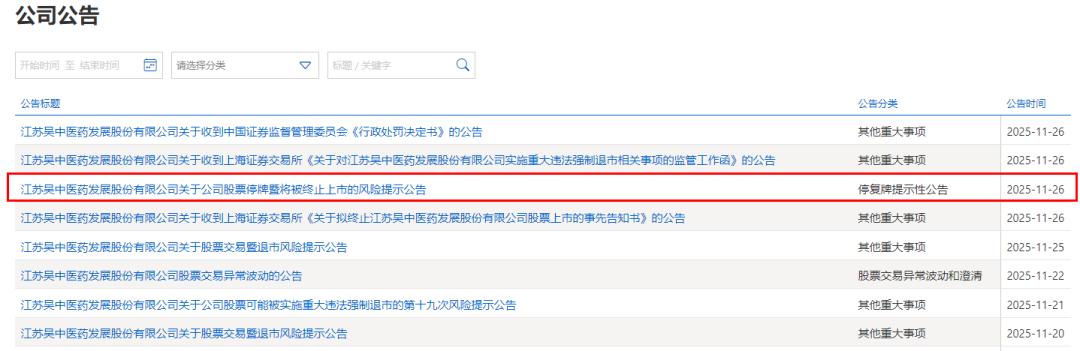
Core Viewpoint - Jiangsu Wuzhong Pharmaceutical Development Co., Ltd. is facing significant operational challenges, including a formal suspension and impending delisting due to multiple violations, including financial misconduct and governance issues [1][21]. Group 1: Company Violations and Penalties - Jiangsu Wuzhong has been penalized with a total fine of 30.5 million yuan for various violations, including failing to disclose the actual controller and inflating revenue and profits through fictitious transactions [11][18]. - The company reported inflated revenues of 4.95 billion yuan, 4.69 billion yuan, 4.31 billion yuan, and 3.77 billion yuan from 2020 to 2023, constituting 26.46%, 26.39%, 21.26%, and 16.82% of total revenues for those years respectively [5][26]. - The company also failed to disclose non-operational fund occupation by related parties, with amounts increasing from 1.27 billion yuan to 16.93 billion yuan over the same period, representing up to 96.09% of net assets by 2023 [8][26]. Group 2: Financial Performance and Risks - For the first three quarters of 2025, Jiangsu Wuzhong reported a net loss of 87.468 million yuan, a significant decline of 294.03% compared to the previous year, indicating deteriorating profitability [14][21]. - The stock price has plummeted, closing at 1.24 yuan per share on November 25, 2025, reflecting market concerns over the company's future [19][21]. Group 3: Industry Context and Implications - The medical aesthetics industry is witnessing increased survival thresholds, as evidenced by Jiangsu Wuzhong and other entrants like Aoyuan Meigu facing severe operational challenges and potential exits from the market [3][28]. - The reliance on exclusive agency rights and lack of self-developed products have weakened Jiangsu Wuzhong's risk resilience, highlighting the need for a sustainable business model in the medical aesthetics sector [27][28].


A股AI硬件板块爆发,反弹还会持续吗?
Sou Hu Cai Jing· 2025-11-26 13:11
Group 1 - Nvidia's Q3 earnings report exceeded expectations, yet warnings about an AI bubble persist, with Michael Burry predicting Nvidia as a precursor to market downturns [1] - Global markets, including A-shares, have experienced declines due to concerns over the AI bubble, a retreat in Federal Reserve rate cut expectations, and cautious investor sentiment [1] - The fundamental factors supporting the current Chinese stock market and its potential for upward movement remain in question [1] Group 2 - The recent volatility in global markets highlights the nature of the current tech bull market, driven by grand narratives and abundant liquidity, suggesting that any downturn may be a temporary "interlude" in a larger trend [3] - The AI revolution continues to provide significant market imagination, and as long as this narrative remains unchallenged and macro liquidity does not tighten drastically, the current market enthusiasm may persist [3] - The real challenge lies in understanding the current phase where narrative outweighs reality, rather than predicting each adjustment's peak [3] Group 3 - Kweichow Moutai, a symbol of traditional consumer upgrades, faces competition from emerging tech companies like Cambrian, indicating a shift in market dynamics [5] - The decline in the wholesale price of Moutai, which has fallen below 1700 yuan, suggests potential further adjustments in response to market supply and demand changes [6] - The rise of companies like CATL in the battery sector reflects a broader market trend where tech stocks are replacing traditional consumer and real estate stocks as market leaders [8] Group 4 - The semiconductor industry is facing challenges despite the rise of AI, with the Netherlands' ASML grappling with its position in the global supply chain amid AI-related anxieties [10] - Domestic alternatives in the semiconductor sector, particularly in photoresists, are gaining attention as the market shifts towards local production capabilities [12] - The competition in the facial mask market is intensifying, with leading brands like敷尔佳 experiencing market share declines due to increased competition and changing consumer preferences [16]




2026年上半年北交所投资策略:北交所市场持续扩容,关注科技与消费共振
Dongguan Securities· 2025-11-25 03:57
Group 1: Market Overview - The North Exchange 50 Index has shown a "volatile upward trend, repeatedly hitting new highs," with a cumulative increase of 32.27% as of November 21, 2025, reaching a peak of 1670.01 points on September 8, 2025 [12][4] - The trading volume in the North Exchange has significantly increased, with a total transaction amount of 56,719.06 billion yuan in the first ten months of 2025, representing a year-on-year growth of 240.46% [13][19] - The total market capitalization of the North Exchange reached 9,209.78 billion yuan by October 31, 2025, more than doubling since its inception, with the number of listed companies increasing from 81 to 280 [19][21] Group 2: Policy Impact - A series of policies based on the "Deep Reform 19 Articles" have enhanced market vitality and resilience, facilitating a transition from rapid "scale expansion" to high-quality development [22][24] - The North Exchange has introduced a more inclusive listing standard, directly serving innovative small and medium-sized enterprises, and has improved the listing mechanism to accommodate technology innovation companies [24][22] Group 3: Technology and Consumption Trends - The resonance between technology and consumption is identified as a core driver of economic growth, with significant advancements in artificial intelligence, robotics, and new consumption patterns [25][26] - The Chinese AI market is rapidly developing, with China holding 36% of the world's AI large models and leading in generative AI patents, having filed over 38,000 patents from 2014 to 2023 [26][28] - The humanoid robot market is projected to grow significantly, with the global market expected to reach approximately 642.22 billion yuan by 2030, reflecting a compound annual growth rate of 58.90% [44][46] Group 4: Consumer Market Recovery - Consumer spending has become a major driver of GDP growth in China, contributing 85.6% to economic growth in 2023 [55][56] - The medical beauty market in China is expected to grow from 2,669 billion yuan in 2023 to 2,964 billion yuan in 2024, with a compound annual growth rate of 15.60% from 2019 to 2024 [57][58] - The pet industry is also experiencing growth, with the number of pets in urban areas projected to reach 124.11 million by 2024, reflecting a 2.1% increase from 2023 [69][70]
申万宏源研究晨会报告-20251125
Shenwan Hongyuan Securities· 2025-11-25 00:45
Core Insights - The report highlights Qingmu Technology (青木科技) as a leading expert in full-domain operation services and brand incubation, driven by data and technology [2][4][14] - The company has established a high-synergy business model encompassing operation services, brand incubation, and technical solutions, serving well-known brands across various sectors [2][4][14] - Financial projections indicate significant revenue growth, with expected revenues of 15.1 billion, 19.0 billion, and 23.4 billion yuan for 2025 to 2027, representing year-on-year growth rates of 30.5%, 26.5%, and 23.0% respectively [4][14] Company Overview - Qingmu Technology was founded in 2009 and has focused on e-commerce operation since 2011, building a comprehensive service model that includes operation, brand incubation, and technology solutions [2][14] - The company has a stable ownership structure, with founders holding 39% of the shares, and a management team with over ten years of industry experience [2][14] - Revenue for 2024 and the first half of 2025 is projected at 1.15 billion and 670 million yuan, with year-on-year growth rates of 19.2% and 22.75% respectively [2][14] Competitive Advantages - Qingmu Technology's competitive edge lies in its data, technology, and brand matrix, which collectively enhance its operational value [3][4][14] - The data layer includes services across major platforms like Tmall, JD.com, Douyin, and Xiaohongshu, allowing the company to accumulate extensive user behavior and transaction data [3][14] - The technology layer features proprietary systems such as the Qingling AI platform and CRM, which streamline operations and reduce costs [3][14] Business Model and Growth Strategy - The company is expanding its service model from a single service fee to a combination of service fees, distribution price differences, and equity returns, thus sharing in brand growth [4][14] - Qingmu Technology is diversifying its product categories beyond apparel to include trendy toys, beauty products, health consumer goods, and pet food, enhancing its growth potential [4][14] - The company aims to maintain its status as a top service provider on platforms like Tmall and Douyin while increasing its international operations, particularly in Southeast Asia [4][14] Financial Projections - The report forecasts a steady increase in net profit, with expected figures of 1.31 billion, 1.85 billion, and 2.59 billion yuan for 2025 to 2027, reflecting growth rates of 45.2%, 40.4%, and 40.4% respectively [4][14] - The projected price-to-earnings (PE) ratios for the same period are 50, 35, and 25 times, indicating a favorable valuation outlook [4][14]

普丽妍发公告“封杀”新氧系门店,新氧回应:传播不实信息,已发律师函
Xin Lang Ke Ji· 2025-11-24 14:54
Core Viewpoint - The recent statements from Purity and New Oxygen highlight a significant dispute regarding the use and distribution of Purity's products, with both companies asserting their positions on product safety and legitimacy [1][2][3] Group 1: Purity's Statement - Purity has released a formal statement identifying several unauthorized medical institutions, including over 40 New Oxygen stores, which are now on a "never cooperate" blacklist [1] - The company emphasizes that the listed institutions did not procure products through official channels, thus denying any responsibility for the authenticity of the products used by these institutions [1] - Purity asserts that its products should only be used in officially approved medical institutions by qualified professionals who have received proper training [1] Group 2: New Oxygen's Response - New Oxygen has issued a statement refuting Purity's claims, asserting that all products used in their clinics are sourced from legally qualified suppliers with complete procurement documentation [2] - The company highlights that its clinics are legally approved medical institutions, and the doctors operate in compliance with medical laws and regulations [2] - New Oxygen condemns the dissemination of misleading information that could harm its reputation and consumer trust, stating that such actions disrupt fair market competition [3] Group 3: Legal Actions and Consumer Rights - New Oxygen has taken legal steps by commissioning a law firm to demand the removal of Purity's statements, seeking to protect its reputation and consumer rights [3] - The company emphasizes the importance of professional support from upstream manufacturers, arguing that it should not be manipulated for market control or to impose barriers on medical institutions [3]

“爱凑热闹”的中国人,给全球氪金13万亿
Sou Hu Cai Jing· 2025-11-24 11:59
Group 1 - A sudden cancellation of 500,000 tickets by Chinese travelers to Japan has led to a significant decline in Japanese consumer stocks, with Shiseido dropping 11.4%, the largest decline since April [1] - Major Japanese companies such as Fast Retailing and Muji saw their stock prices fall nearly 7% and over 9% respectively, while Japan Airlines experienced a drop of nearly 6% [1] - Japanese economic experts predict that a sharp decrease in Chinese tourists could result in losses exceeding 2 trillion yen for Japan [3] Group 2 - The Japan National Tourism Organization reported that from 2025's first three quarters, the number of Chinese tourists to Japan reached 7.487 million, a year-on-year increase of 42.7%, making China the largest source of inbound tourists to Japan [3] - In 2023, Japan issued 5.24 million visas to Chinese travelers, a 73% increase from the previous year, accounting for 70% of total visas issued [11] - Chinese tourists represented 18.9% of all foreign visitors to Japan, with a year-on-year growth of 187.9%, indicating that one in five foreign tourists in Japan is Chinese [13] Group 3 - The Chinese tourism industry is projected to contribute 13.7 trillion yuan to the global economy by 2025, accounting for 10.3% of global tourism GDP and creating 83 million jobs [5] - In 2023, Chinese tourists spent approximately 812 billion yuan in Japan, the highest among all countries, highlighting their significant economic impact [17] - The travel habits of Chinese tourists have led to increased demand for services and products tailored to their preferences in various countries, including Japan [27][29] Group 4 - The rapid growth of Chinese tourism is evident as they have become a major force in global travel, with 10 million Chinese tourists visiting Australia in January 2023, surpassing New Zealand as the largest source of overseas visitors [44] - Chinese tourists spend nearly double compared to New Zealand tourists, with an average expenditure of 5,081 AUD [45] - The presence of Chinese tourists has significantly boosted local economies, with prices in popular tourist areas rising dramatically due to increased demand [46][49]

中国银河证券医药业2026年度策略:寻找医药硬科技 从新出发
Zhi Tong Cai Jing· 2025-11-24 01:25
Core Viewpoint - The report from China Galaxy Securities highlights optimism for investment opportunities in the pharmaceutical industry by 2026, suggesting that after recent fluctuations, valuations have returned to relatively low levels, with a potential for a resurgence in growth [1] Investment Outlook - The pharmaceutical sector is expected to see significant differentiation in 2025, with various factors driving rapid growth in the innovative drug segment, particularly in the Hong Kong market [2] - China's innovative drug development is gaining a competitive edge globally due to cost advantages and efficient conversion capabilities, transitioning from a "technology follower" to a "leading participant" in the global pharmaceutical innovation landscape [2] Policy Outlook for 2026 - The 14th Five-Year Plan marks a year of deepening collaboration in the healthcare system, with policies expected to enhance the efficiency of medical insurance funds and support for innovative drugs and devices [3] - The focus will be on optimizing procurement rules to balance quality and innovation, driving domestic alternatives, and improving public health capabilities [3] Sector-Specific Investment Insights - **Innovative Drugs**: Anticipated breakthroughs in domestic innovative drugs, with several promising candidates entering late-stage clinical trials [4] - **Life Sciences and CXO Sector**: A structural recovery is expected as global financing conditions improve and domestic innovation ecosystems stabilize [4] - **Medical Devices**: Growth opportunities in the domestic medical device sector are anticipated, particularly in aging-related markets and overseas exports [4] - **Traditional Chinese Medicine and Biologics**: Market dynamics may shift due to clinical re-evaluations, with potential changes in profit margins for traditional Chinese medicine [4] Healthcare Services - The aging population presents a reliable opportunity in the healthcare services sector, emphasizing the importance of maintaining a strong position in this area [5] Aesthetic Medicine - Upgrades in ingredient formulations and the rise of domestic brands in aesthetic medicine are noteworthy, with a focus on specific segments like collagen and botulinum toxin [6] Pharmaceutical Commerce - Attention is drawn to accounts receivable turnover, with a positive outlook on new business models in Contract Sales Organizations (CSO) [7] Medical AI - The acceleration of artificial intelligence in healthcare is expected to significantly enhance clinical service capabilities and efficiency, particularly in medical diagnostics [7]

化妆品医美行业周报:品牌端渐入淡季积极备新,策略会共商未来发展-20251123
Shenwan Hongyuan Securities· 2025-11-23 14:41
Industry Overview - The cosmetics and medical beauty sector has shown stronger performance than the market, with the Shenwan Beauty Care Index declining by 4.5% from November 14 to November 21, 2025, outperforming the Shenwan A Index by 1.9 percentage points [3][4] - The cosmetics sales are expected to gradually decline as the peak shopping season ends, with domestic brands actively preparing new products for the off-season [9][10] Key Insights - The 2026 cosmetics and medical beauty strategy report indicates that brand growth is crucial, with upstream and downstream margins improving. Domestic brands are expected to grow against the trend during the industry consolidation phase [10][11] - The National Medical Products Administration has introduced 24 reform measures aimed at enhancing the regulatory framework for cosmetics, promoting high-quality industry development [26] Company Focus - Qingmu Technology (301110) is highlighted as a full-domain operation service expert, leveraging data and technology to drive growth. The company has established a strong brand matrix across various sectors, including fashion and beauty [15][16] - Investment recommendations include brands with strong channel and brand matrices such as Maogeping, Shangmei Co., and Proya, as well as companies in the medical beauty sector like Aimeike [12][14] Market Trends - The retail sales of cosmetics in October 2025 grew by 9.6%, driven by the Double 11 shopping festival, with a total retail sales of 381.3 billion yuan for cosmetics in the first ten months of 2025, reflecting a 4.6% year-on-year increase [21][23] - The domestic market for skincare products is expected to see further growth, with domestic brands gaining market share due to their competitive pricing and localized strategies [31][34]

——美容护理行业25Q3业绩回顾:需求端稳健发展,业绩端分化加剧
Shenwan Hongyuan Securities· 2025-11-23 09:11
Investment Rating - The report maintains a "Positive" outlook on the beauty and personal care industry, highlighting robust demand and the continued rise of domestic brands [2]. Core Insights - The beauty care industry is experiencing a stable demand phase, with domestic leading brands expected to grow during the industry consolidation period [3]. - The cosmetics sector showed resilience during the off-peak season, with retail sales reaching 98.2 billion yuan from July to September, reflecting a single-digit year-on-year growth and an acceleration compared to the first half of 2025 [2][3]. - The report emphasizes the strong performance of domestic brands during the Double 11 shopping festival, with Proya ranking first in Tmall's beauty sales [2][11]. Summary by Sections Cosmetics Sector Performance - The cosmetics sector's key A-share companies reported an average revenue growth rate of around 3% in Q3 2025, with overall improvement in net profit [2]. - Proya's cumulative revenue for the first three quarters of 2025 was 7.098 billion yuan, a year-on-year increase of 1.89%, while its Q3 revenue was 1.736 billion yuan, down 11.63% year-on-year [16]. - Other notable performances include: - Ruifucheng: Q1-Q3 revenue of 2.138 billion yuan, up 85.3% year-on-year, with Q3 revenue of 819 million yuan, up 123.4% year-on-year [16]. - Marubi: Q1-Q3 revenue of 2.45 billion yuan, up 25.5% year-on-year, with Q3 revenue of 686 million yuan, up 14.28% year-on-year [16]. Medical Aesthetics Sector Performance - The medical aesthetics sector showed slight fatigue but experienced marginal improvements in Q3 2025 [2]. - Notable performances include: - Aimeike: Q1-Q3 revenue of 1.865 billion yuan, down 21.49% year-on-year, with Q3 revenue of 566 million yuan, down 21.27% year-on-year [2]. - Longzi: Q1-Q3 revenue of 4.328 billion yuan, up 0.9% year-on-year, with Q3 revenue of 1.539 billion yuan, up 11.9% year-on-year [2]. Investment Recommendations - The report recommends focusing on companies with a well-established channel and brand matrix, such as Maogeping, Shangmei, and Shanghai Jahwa, which are expected to see high GMV growth [2][20]. - Companies anticipated to show marginal improvements in performance include Proya, Marubi, and Ruifucheng [2]. - In the medical aesthetics sector, the report highlights Aimeike as a key recommendation, with Longzi suggested for further observation [2]. Market Trends - The domestic market share of leading brands is increasing, with the top ten domestic brands capturing 16.6% of the market share in skincare, up from 11.8% in 2023 [4]. - The report notes that the cosmetics retail sales in October 2025 grew by 9.6% year-on-year, indicating a recovery in demand driven by promotional events [10][11].


美容护理行业25Q3业绩回顾:需求端稳健发展,业绩端分化加剧
Shenwan Hongyuan Securities· 2025-11-23 07:43
Investment Rating - The report maintains a positive outlook on the beauty and personal care industry, indicating a "Buy" rating for key players in the sector [2]. Core Insights - The demand side of the beauty industry is showing robust growth, with domestic brands gaining market share and performing well during promotional events like Double 11 [3][4]. - The overall performance of the cosmetics sector is mixed, with some companies showing strong growth while others face challenges [3][4]. - The report highlights the increasing market share of domestic brands, with significant improvements in their competitive positioning against international brands [5][9]. Summary by Sections Industry Overview - The beauty industry is entering a stable growth phase, with domestic leading brands expected to grow during the industry consolidation period [4]. - The retail sales of cosmetics reached 98.2 billion yuan from July to September, showing a high single-digit year-on-year growth, and continued strong performance in October with a growth rate exceeding 9% [3][4]. Company Performance - **Polaire**: For the first three quarters of 2025, Polaire reported a cumulative revenue of 7.098 billion yuan (up 1.89% year-on-year) and a net profit of 1.026 billion yuan (up 2.65%) [18]. - **Ru Yuchen**: The company achieved a revenue of 2.138 billion yuan (up 85.3% year-on-year) in the first three quarters, with a net profit of 105 million yuan (up 81.6%) [18]. - **Marubi**: Reported a revenue of 2.45 billion yuan (up 25.5% year-on-year) for the first three quarters, with a net profit of 240 million yuan (up 2.1%) [19]. - **Shanghai Jahwa**: Revenue for the first three quarters was 4.961 billion yuan (up 10.8% year-on-year), with a net profit of 405 million yuan (up 149%) [20]. Market Trends - The report notes that domestic brands are increasingly capturing market share, with the top ten domestic brands holding five spots and a combined market share of 16.6%, up from 11.8% the previous year [5]. - The cosmetic sector's gross margin continues to improve, although rising sales expenses are impacting net profit margins [3][4]. Investment Recommendations - Key recommendations include focusing on companies with strong channel and brand matrices, such as Mao Ge Ping and Shangmei, and those expected to see marginal improvements in performance, like Polaire and Marubi [3][4]. - In the medical beauty sector, companies with high barriers to entry and strong profitability, such as Aimeike, are highlighted as potential investment opportunities [3][4].