软件

Search documents
美股极其脆弱!从SaaS、PE到保险、物业甚至物流“轮流大跌”,高盛交易员“疲惫且震惊”
美股IPO· 2026-02-13 03:27
Group 1 - The core viewpoint of the article highlights a rare panic sell-off in the US stock market, driven by fears surrounding AI's disruptive potential across various sectors, leading to significant declines in technology, logistics, finance, and healthcare industries [1][3][5] - The market breadth is deteriorating, with 350 out of 500 S&P components declining, and major tech companies like Apple, Amazon, Microsoft, Meta, and Cisco contributing significantly to this downturn [6][7] - Defensive sectors such as utilities, consumer staples, and REITs are gaining traction, while previously strong tech stocks are experiencing widespread sell-offs, indicating a shift in investor sentiment [3][6][8] Group 2 - The latest trigger for market panic was a statement from a Microsoft AI executive suggesting that most white-collar jobs could be replaced by AI within 12 months, prompting a reevaluation of AI's impact [5][9] - Logistics has emerged as a new area of concern, with companies like CH Robinson experiencing extreme volatility, reflecting a broader fear that AI's influence is spreading from tech to traditional industries [7][8] - The healthcare sector is also under pressure, with contract research organizations (CROs) seeing a 32% drop this month, as companies like Pfizer announce plans to utilize AI for clinical trials [8][9]


未知机构:美国股市动态AI焦虑持续市场收盘数据标普50-20260213
未知机构· 2026-02-13 02:45
Summary of Key Points from Conference Call Industry Overview - The focus of the current market anxiety is primarily on the financial sector, with a notable sell-off spreading to the commercial real estate brokerage and services sector, indicating a lack of buyers even before the earnings report from CBRE [3][3]. Market Performance - The S&P 500 index closed flat at 6,942 points, with a significant sell order of $170 million executed at the end of the trading session [2][2]. - The Nasdaq index increased by 29 basis points, closing at 25,201 points, while the Russell 2000 index fell by 38 basis points to 2,669 points [2][2]. - The Dow Jones Industrial Average decreased by 13 basis points, ending at 50,121 points [2][2]. - Total trading volume on the NYSE reached 20.88 billion shares, surpassing the year-to-date average of 19.51 billion shares [2][2]. - The VIX (Volatility Index) dropped by 79 basis points to 17.65, indicating reduced market volatility [2][2]. - WTI crude oil rose by 169 basis points to $65.04 per barrel, while gold increased by 134 basis points to $5,092 per ounce [2][2]. Sector Dynamics - A systematic sell-off occurred in interest rate-sensitive stocks within the financial sector, excluding REITs, leading to further pressure due to position adjustments and deleveraging [3][3]. - There was a notable rotation in sectors, with software stocks experiencing a significant decline of 7.5%, while semiconductor stocks saw gains driven by positive data, with VRT up 25%, LSCC up 16%, and MU up 10% [3][3][3]. Economic Indicators - Non-farm payroll data showed a strong increase of 130,000 jobs in January, exceeding market expectations of 65,000 and previous rumors of 35,000 [5][5]. - Average hourly earnings rose by 40 basis points, higher than the expected 30 basis points, while the unemployment rate fell to 4.3%, below the anticipated 4.4% [5][5]. - The market is currently pricing in approximately two rate cuts for the year, with the first cut's timing pushed from June to July [5][5]. Trading Activity - Overall trading activity was rated at 4 out of 10, with a net buying flow of +133 basis points, significantly above the 30-day average of -81 basis points [5][5]. - Hedge funds recorded a net sell of approximately $1 billion, with sell-offs across all sectors, primarily in financials, technology, healthcare, and REITs [6][6]. Additional Insights - The overall trading flow exhibited a top-down driving characteristic, indicating sector-level buying and selling rather than individual stock movements [4][4]. - Adjustments to the "birth-death" model by the Bureau of Labor Statistics (BLS) are believed to have inflated the employment data for January, which may increase volatility in future monthly employment growth [6][6].
AI热潮再遇“当头棒喝”,纳指重挫逾2%
2 1 Shi Ji Jing Ji Bao Dao· 2026-02-13 02:38
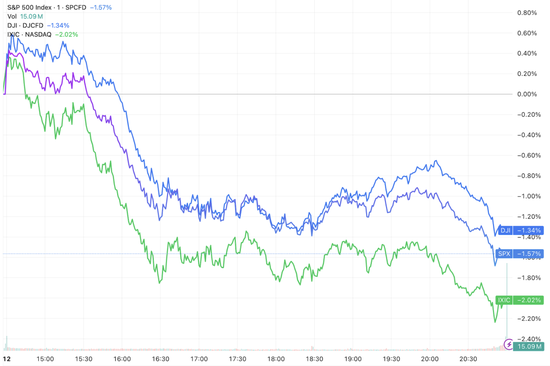
Group 1: Market Trends - The recent AI hype has led to a three-year bull market in US stocks, but this trend is now facing challenges, with major indices like the Dow Jones, S&P 500, and Nasdaq experiencing declines of 1.34%, 1.57%, and 2.03% respectively [1] - Concerns over the disruptive potential of AI have shifted market sentiment, impacting various sectors including software, legal services, and wealth management, as investors reassess company valuations [1] Group 2: Capital Expenditure Concerns - Major tech companies including Google, Meta, Microsoft, and Amazon are projected to spend a total of $650 billion on capital expenditures this year, primarily for AI infrastructure expansion [2] - There are worries that these tech giants may not achieve sufficient returns from their high capital expenditures, leading to significant stock price declines for Microsoft and Amazon post-earnings reports [2] - UBS has downgraded the US information technology sector to a "neutral" rating, citing soaring capital expenditures and increasing uncertainty in the software industry, with expectations that capital spending by large US firms could reach $700 billion this year, quadrupling from three years ago [2] Group 3: Sector Rotation - A noticeable trend of sector rotation is occurring in the US stock market, with funds moving from AI-related stocks to value stocks as concerns about tech giants' capital expenditures grow [3] - Bank of America suggests that the leadership of tech giants in the stock market is facing significant threats, especially with the upcoming midterm elections, prompting a shift towards small-cap stocks [3] - Despite the challenges, some analysts remain optimistic about the tech sector's future, citing strong revenue prospects supported by the AI boom and attractive buying opportunities in stocks like Microsoft and Intuit following recent declines [3][4] Group 4: Future Outlook - Analysts believe that the fundamental benefits of AI-enabled sectors remain positive, and companies applying AI to core business operations, rather than just developing technology and infrastructure, present more investment opportunities [4]




速递|AI新贵与传统巨头对决:希尔顿CTO称三年磨一Agent,不会为概念买单
Z Potentials· 2026-02-13 02:27
Core Insights - The article discusses the competitive landscape of AI agents, highlighting how traditional software companies are racing to develop AI products that can automate tasks previously performed by human workers [1][3][8] Group 1: AI Agent Development - Companies like Microsoft, ServiceNow, and Snowflake are launching AI agent products to help clients create customized AI agents that can interact with various enterprise applications [1][3] - The emergence of AI agent management dashboards raises questions about the necessity of multiple dashboards, suggesting that each client may ultimately only need one [2] Group 2: Key Players and Products - Major players in the AI agent space include Anthropic, OpenAI, and Google, with products designed to automate tasks across different applications [3][5] - OpenAI's Frontier project aims to assist companies like Uber and Thermo Fisher Scientific in developing multiple AI collaborative assistants [9][10] Group 3: Market Dynamics and Challenges - Microsoft CEO Satya Nadella predicts that traditional software applications will collapse in the era of AI agents, as they are merely databases with business logic [8] - Despite the potential of AI agents, significant security concerns and operational challenges remain, such as the risk of credential leaks and the high operational threshold for current products [8][11] Group 4: Industry Sentiment - Executives from traditional software companies express a mix of caution and optimism regarding the integration of AI agents, with some companies already utilizing AI technologies from OpenAI and Anthropic [11][12] - The sentiment in the industry is that software leaders feel they must either achieve a trillion-dollar valuation or face extinction due to the disruptive nature of AI [12]

大摩闭门会-软件行业的未来何在
2026-02-13 02:17
Summary of Key Points from the Conference Call Industry Overview - The software industry is experiencing a valuation multiple decline of 33%, reaching its lowest level since 2016, primarily due to uncertainties stemming from accelerated AI innovations that have increased discount rates [2][4][5]. - Despite the valuation drop, the fundamental trends in the software industry have not significantly deteriorated, with no major acceleration or deceleration in growth observed [4][5]. Company-Specific Insights Palantir - Palantir reported a strong fourth quarter with a growth rate of 70% and an operating margin of 57%, projecting over 60% growth for the next year [2][5]. - The company's success is attributed to its ontology data technology, which is crucial for understanding data relationships and requires deep domain knowledge and customized services [2][5][6]. - Palantir's Foundry platform is increasingly adopted by clients in industrial and oil & gas sectors, positioning it as a key supplier for companies looking to implement AI projects [5]. Atlassian - Atlassian's free cash flow multiple is approximately 14 times, indicating a low valuation compared to other high-growth companies [8]. - Despite good financial performance, the stock price has not improved, reflecting low market risk appetite and varying investor expectations regarding growth and profitability [8][9]. Snowflake - Snowflake's enterprise value/sales multiple has returned to levels seen in 2014-2016, with signs of growth emerging [3][14]. - The company has shown consistent product revenue growth of 28% over two consecutive quarters, with one quarter reaching 30% [14][15]. - Snowflake's core business remains stable, and its AI business is performing strongly, with product revenue growth expected to approach 30% [18]. Microsoft - Microsoft has demonstrated steady growth in its Azure platform, with a rolling 12-month fixed currency growth rate showing improvement [15]. - The Microsoft 365 business cloud segment is also improving, with a fixed currency growth rate of 15% in the last quarter [15]. Intuit - Intuit is expanding into the high-end market through global business solutions and is focusing on auxiliary services during tax season, which could open a $35 billion market opportunity [19]. ServiceNow - ServiceNow is advancing its new product cycle, with its Now Assist product currently generating an annual recurring revenue (ARR) of $600 million [20]. - The adoption rate of its Prosci product is expected to increase significantly in the coming years, contributing to stronger growth [20]. Market Sentiment and Future Outlook - The current market sentiment is cautious, with software stocks averaging a 20% decline this year, and prices at 55% of their 52-week highs [4][5]. - Investors are looking for signs of improvement in the participation of established software companies in large-scale innovation cycles to drive growth [14]. - The "AI is software" perspective suggests that AI represents an evolutionary change in software, with large language models being significant breakthroughs that enhance automation in workflows [10][11]. Valuation Considerations - The current enterprise value/sales multiple for the software industry is approximately 4.4 times expected sales, close to historical averages but not at the lowest point [13]. - GAAP earnings issues are affecting investor decisions, with some companies like Microsoft and ServiceNow showing positive GAAP earnings growth, yet not attracting significant market interest [13]. This summary encapsulates the key insights and trends discussed in the conference call, highlighting the current state of the software industry and specific company performances.


从房产到AI,风险全面引爆,美股金银罕见三杀
Xin Lang Cai Jing· 2026-02-13 02:15
Group 1: Market Reactions - The U.S. stock market experienced significant declines, with the Dow Jones falling over 2% to close at 49,451 points, marking a drop of 669 points or 1.3% [2] - Major tech stocks saw widespread losses, including Apple down 5%, Amazon and Meta down over 2%, and Nvidia down over 1% [2] - Concerns over the impact of artificial intelligence (AI) on various industries have led to a re-evaluation of stock valuations, causing a shift towards safer assets like U.S. Treasury bonds [2][3] Group 2: Real Estate Market - U.S. existing home sales in January totaled an annualized 3.91 million units, falling short of the expected 4.15 million and marking an 8.4% month-over-month decline, the largest drop since February 2022 [3][4] - The median home price increased by 0.9% year-over-year to $396,800, but affordability remains a significant issue, with the affordability index reaching its highest level since 2022, yet still below pre-pandemic levels [4] - Economic analysts suggest that high mortgage rates and increased housing inventory will continue to suppress home price growth in the short term [4] Group 3: AI Impact on Industries - Concerns about AI disrupting traditional business models have intensified, particularly affecting sectors like software, insurance, and real estate [5][6] - The anticipated capital expenditure for AI by 2026 is projected to reach $659 billion, a 60% increase from 2025, but the growth rate is expected to slow compared to previous years [5] - The logistics and transportation sectors are facing significant sell-offs due to fears that AI will disrupt traditional freight markets, with the Russell 3000 trucking index experiencing a drop of over 9% [6][8] Group 4: Investment Trends - There is a notable shift in investment from U.S. tech stocks to emerging markets and commodities, as the market experiences a late-cycle phase characterized by internal divergence [8] - Financial assets are beginning to lose ground to physical assets, indicating a potential historical shift in investment dynamics [8]

AI热潮再遇“当头棒喝”,纳指重挫逾2%|美股一线
2 1 Shi Ji Jing Ji Bao Dao· 2026-02-13 02:15
Group 1 - The core sentiment in the market has shifted to concerns over the disruptive potential of AI, impacting various sectors including software, legal services, and wealth management [1] - Major tech companies like Google, Meta, Microsoft, and Amazon have announced substantial capital expenditure plans totaling $650 billion for AI infrastructure expansion [1] - UBS has downgraded the rating of the US information technology sector to "neutral" due to soaring capital expenditures and increasing uncertainty in the software industry [1] Group 2 - UBS estimates that capital expenditures by large US enterprises could reach $700 billion this year, more than quadrupling from three years ago, consuming nearly 100% of their operating cash flow [2] - Concerns over the sustainability of cash flows for tech companies are affecting market sentiment, as their capital expenditures increasingly rely on debt or equity financing [2] - Bank of America suggests that the leadership of tech giants in the stock market is facing significant threats, urging investors to consider small-cap stocks as midterm elections approach [2] Group 3 - Analysts remain divided, with some like Morgan Stanley's Michael Wilson optimistic about the tech sector's revenue prospects supported by AI, suggesting that tech stocks still have room for further gains [3] - Wilson notes that companies applying AI to core business operations, rather than those developing technology and infrastructure, present more investment opportunities [3]
2.13犀牛财经早报:新基金发行火热 公募备战节后行情
Xi Niu Cai Jing· 2026-02-13 01:45
Group 1: Fund Issuance and Market Trends - In January 2026, the number of new fund issuances reached 169, the highest level since March 2023, with several funds selling out in one day and some triggering proportionate allotment due to oversubscription [1] - The number of newly established public FOFs (funds of funds) in 2026 has reached 31, a year-on-year increase of 244.44%, driven by strong demand for stable value-added products and continuous innovation in product offerings [1] Group 2: Bond Market and Investment Products - The issuance of pure bond funds has significantly declined in 2026, with only a few new pure bond funds launched, while "fixed income +" funds continue to dominate the new bond fund market [2] - The demand from residents and institutions for "fixed income +" funds is expected to support their development, although the industry faces challenges such as pressure on bond market yields and increased competition [2] Group 3: Corporate Developments - Mercedes-Benz is recalling 11,895 vehicles in the U.S. due to a potential fire risk from high-voltage batteries [3] - Dream Dragon Ice Cream reported a revenue of 65.175 billion yuan for the fiscal year 2025, but net profit plummeted by 48.4% to 2.533 billion yuan [3] - Lantu Motors announced plans to list on the Hong Kong Stock Exchange on March 19, 2026, with approximately 885.38 million H-shares [4] - Zhengzhou Bank's president resigned after one year due to personal reasons [4] Group 4: Financial Challenges and Risks - Baili Technology is facing overdue debts and is in communication with creditors to resolve the situation, which may impact its financing capabilities [5] - ST Haihua announced a projected revenue of 336 million yuan for 2025, with a net profit loss of approximately 70 million yuan, putting its stock at risk of delisting [5] - ST Zhongdi's stock experienced abnormal fluctuations, with a projected revenue of 180 to 220 million yuan for 2025, alongside significant expected losses [7] Group 5: Fundraising and Market Positioning - Fulongma plans to raise up to 1.005 billion yuan through a stock issuance to enhance its competitiveness in the environmental services market [8] - Xinlitai has submitted an application for H-share issuance and listing on the Hong Kong Stock Exchange [9]
美国三大股指全线收跌,投资者开始担忧AI建设的负面影响
Huan Qiu Wang· 2026-02-13 00:57
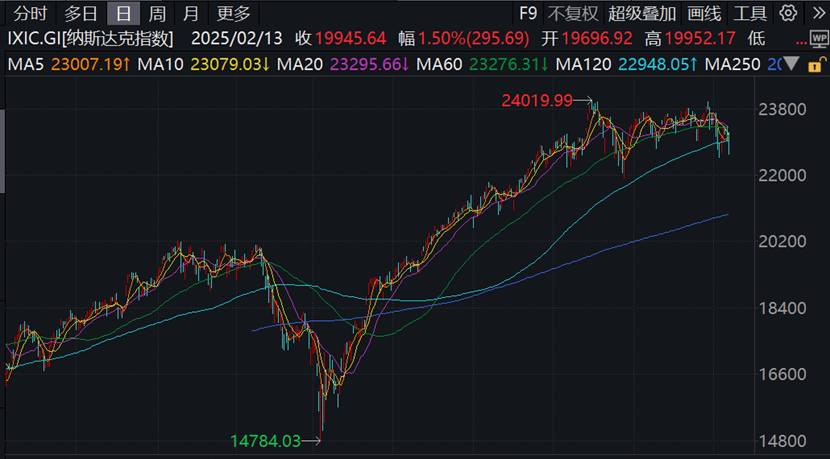
Market Performance - The three major U.S. stock indices all closed lower, with the Dow Jones down 1.34% at 49,451.98 points, the S&P 500 down 1.57% at 6,832.76 points, and the Nasdaq down 2.03% at 22,597.15 points [1] - Notable declines included Cisco, which fell over 12%, and Disney, which dropped more than 5%, leading the Dow [1] - The index tracking the seven major U.S. tech companies fell by 2.2%, with Apple down approximately 5% and Facebook down nearly 3% [1] Investor Sentiment - Analysts indicate that investors are increasingly concerned that artificial intelligence (AI) development may erode future profits for some companies and disrupt multiple industry business models, potentially increasing unemployment [2] - Concerns about the significant underperformance of U.S. tech stocks are attributed to valuation pressures, particularly the sharp decline in software stocks, which is seen as a key factor in the recent tech sector downturn [2] Industry Outlook - The market is worried about the disruptive potential of non-public large model companies on the software ecosystem, leading to a reassessment of valuations for software stocks [2] - Hardware companies are also facing potential valuation downgrades, with market fears that the pricing logic across the entire industry chain may be invalidated or that upstream price increases could be hindered [2] - Despite exceeding earnings expectations and AI contributions, there are ongoing concerns regarding aggressive spending plans in the internet sector, reflecting a challenging financing environment that may not support internet valuations [2] Future Projections - Despite current challenges, it is believed that the earnings outlook for U.S. tech stocks remains marginally better than that for value stocks, with an upward revision of earnings expectations for 2026 maintaining the forecast of Nasdaq outperforming S&P 500 and Dow [2]


苹果大跌5%
Xin Lang Cai Jing· 2026-02-13 00:29
Core Viewpoint - Investors are increasingly concerned about the disruptive potential of artificial intelligence (AI), leading to a decline in major stock indices, with the Nasdaq falling by 2% [1][7]. Market Performance - The Dow Jones index fell by 1.34% to 49,451.98 points, the S&P 500 index dropped by 1.57% to 6,832.76 points, and the Nasdaq index decreased by 2.03% to 22,597.15 points [2][9]. - Defensive sectors saw gains, with Walmart and Coca-Cola shares rising by 3.8% and 0.5%, respectively [2][9]. Sector Impact - The introduction of AI tools has negatively impacted various sectors, including software companies, publishers, and financial services, raising concerns that these tools could replicate business models or erode profit margins [2][9]. - Financial stocks, such as Morgan Stanley, faced pressure due to fears of AI disrupting wealth management [2][9]. - The trucking and logistics sector, exemplified by C.H. Robinson, saw a 14% drop in stock price as AI is expected to optimize freight operations, potentially reducing revenue sources [2][9]. - The real estate sector is also affected, with concerns that higher unemployment rates will reduce demand for office space, leading to declines in stocks like CBRE and SL Green Realty [2][9]. Stock Movements - Major tech stocks experienced declines, with Apple down by 5%, erasing its gains for the year, attributed to delays in the rollout of upgraded AI features for Siri [3][11]. - Other notable declines included Nvidia down by 1.64%, Microsoft down by 0.63%, Google down by 0.63%, Amazon down by 2.20%, and Meta down by 2.82% [4][12]. - Chinese stocks also fell, with the Nasdaq Golden Dragon China Index down by 3%, Alibaba down by 3.40%, and Pinduoduo down by 4.16% [5][12].