
金融科技

Search documents
胡润最新榜单显示:35%的瞪羚企业由人工智能驱动
Sou Hu Cai Jing· 2026-01-20 15:28
Core Insights - The HuRun Research Institute released the "2025 HuRun Future Unicorn: Global Gazelle Enterprise List," identifying 206 new companies, with significant representation from fintech (29), artificial intelligence (28), SaaS, and robotics (15 each) [1][2][3] - A total of 819 gazelle enterprises were identified globally, marking a 19% increase from 688 two years ago, spanning 43 countries and 220 cities [1][2] - The average age of these gazelle enterprises is 9 years, with an average valuation of $700 million, and 35% are driven by artificial intelligence [4][5] Industry Analysis - The fastest-growing industries projected for 2025 include robotics, artificial intelligence, semiconductors, fintech, and aerospace [3][4] - The list includes 71 artificial intelligence companies, highlighting AI's transformative impact across various sectors such as healthcare, finance, retail, and manufacturing [5] Regional Insights - China ranks second with 278 gazelle enterprises, a 20-company increase from the previous year, accounting for 34% of the global total [6][9] - The leading industries for future unicorns in China are biotechnology and semiconductors, which together represent 30% of the total [6] - Major cities for gazelle enterprises in China include Shanghai, Beijing, Shenzhen, Hangzhou, Suzhou, and Guangzhou [8][9] Investment Landscape - The report also highlights the top investment institutions, with Sequoia China being the most successful in backing gazelle enterprises, followed by CICC, SoftBank, Hillhouse, and Tiger Global [9][10] - Additionally, 22 "seed gazelle enterprises" were selected from Beijing Yizhuang, all holding national-level honors or having secured funding above Series A in the last two years, indicating potential for future growth [10]

2026人民币升值趋势确立!对美元汇率破6.96,老百姓沾光迎红利
Sou Hu Cai Jing· 2026-01-20 14:11
Core Viewpoint - The recent appreciation of the Renminbi (RMB) against the US dollar reflects a strong trend supported by China's economic fundamentals, marking a significant milestone in the currency's performance [1][4][43]. Economic Performance - In 2025, China's GDP grew by 5%, surpassing 140 trillion yuan, indicating robust economic performance that underpins the RMB's strength [6]. - The RMB's appreciation is attributed to improved Sino-US trade relations and a weakening US dollar, which has provided more room for the RMB to strengthen [8][6]. Market Dynamics - The onshore and offshore RMB appreciated by 0.4% and 0.3% respectively since the beginning of the year, showcasing a trend of strengthening [3]. - The RMB's rise is not merely a short-term fluctuation but a reflection of deeper economic transformations, including a shift towards high-quality development and enhanced technological content in exports [14][31]. Consumer Impact - The appreciation of the RMB has made overseas consumption, education, and imported goods more affordable for consumers, leading to tangible benefits for families planning to travel or study abroad [16][18]. - The cost of imported goods, including cosmetics and high-end food products, is expected to decrease, benefiting consumers through lower prices and more frequent promotions [20]. Financial Innovations - The digital RMB has been upgraded to version 2.0, introducing features like interest-bearing wallets, enhancing financial convenience for users [22]. - The digital RMB also incorporates carbon credit functionalities, linking green living with financial incentives, thus broadening its utility beyond mere transactions [24]. Investment Implications - The RMB's appreciation suggests that investors may need to adjust their asset allocations, potentially reducing USD-denominated assets and increasing RMB-denominated investments [37]. - The ongoing development of the digital RMB is expected to play a significant role in personal asset management, making it a vital option for consumers [39]. Long-term Outlook - The RMB's strengthening is indicative of China's economic transformation and long-term growth potential, with expectations of continued benefits for the populace as the economy evolves [29][45]. - The RMB's rise is anticipated to enhance China's attractiveness for foreign goods and services, further stimulating import trade [35].

胡润研究院发布《2025胡润未来独角兽:全球瞪羚企业榜》——寻找三年内最有可能达到独角兽级十亿美金估值的高成长性企业
Feng Huang Wang Cai Jing· 2026-01-20 13:07
Core Insights - The Hurun Research Institute identified 819 gazelle companies globally, an increase of 16 from last year and 131 (19%) from two years ago [1] - The United States leads with 302 gazelles, a decrease of 28 (8%) from last year, while China ranks second with 278 gazelles, an increase of 20 (8%) [1][6] - The report highlights significant growth in sectors such as fintech, AI, SaaS, and robotics, with 206 new entries, including 64 from the US and 55 from China [1][2] Company Insights - 71 companies upgraded to unicorn status, with notable examples including Sierra (AI, valued at 71 billion RMB) and Abridge (AI, valued at 38 billion RMB) [1][19] - 33 companies went public, with the highest value being Gu Ming, a tea brand from Hangzhou, valued at 55 billion RMB [1][19] - 42 companies were downgraded, with 9 from the US and 8 each from China and India, primarily in biotech and fintech [1][21] Industry Insights - The leading industries for gazelle companies are biotechnology (119), fintech (87), SaaS (77), AI (71), and health tech (65) [1][17] - Medical health is the most impacted sector, followed by financial services and enterprise management solutions [3][16] - 63% of gazelle companies focus on software and services, while 37% sell physical products [3][16] Geographic Insights - The distribution of gazelle companies spans 43 countries and 220 cities, with the US and China accounting for 71% of the total [6][12] - San Francisco surpassed Shanghai as the "Gazelle Capital," with Beijing and New York following [1][13] - The Yangtze River Delta region has 134 gazelles, an increase of 30 from last year, while the Beijing-Tianjin-Hebei region has 64, up by 13 [1][12] Investment Insights - Sequoia Capital is the most successful investor in gazelle companies, with 62 investments, followed by CICC, SoftBank, Hillhouse, and Tiger Global [22][23] - The report emphasizes the importance of identifying and supporting these high-growth companies to foster innovation and economic growth [5][22]
氪星晚报 |宜家计划在五年内将其在印度的投资增加一倍,至超过22亿美元;百度文心助手月活破2亿;王腾新公司“今日宜休”完成数千万种子轮融资
3 6 Ke· 2026-01-20 11:30
Group 1: Company Performance Forecasts - Yandong Microelectronics expects a net loss of 340 million to 425 million yuan for 2025, primarily due to market changes affecting consumer products and increased R&D and personnel costs [1] - Yonghui Supermarket anticipates a net loss of 2.14 billion yuan for 2025, compared to a loss of 1.47 billion yuan in the previous year [2] - Nanchao Food projects a net profit of 36.26 million to 43.52 million yuan for 2025, representing a year-on-year decrease of 78.39% to 81.99% due to rising raw material costs [5] - Light of Milk Industry forecasts a net loss of 120 million to 180 million yuan for 2025, down from a profit of 722 million yuan in the previous year, mainly due to production issues at its overseas subsidiary [7] - Hikvision expects a net profit of 14.188 billion yuan for 2025, reflecting a year-on-year growth of 18.46% [8] - Tonghuashun anticipates a net profit of 2.735 billion to 3.282 billion yuan for 2025, representing a growth of 50% to 80% compared to the previous year [3] Group 2: Corporate Developments - International Composite Materials announced the retirement of Chairman Jiang Ling, effective immediately upon submission of the resignation report, with Mo Qiushi nominated as the new director candidate [6] - Doubao, a subsidiary of ByteDance, has partnered with the Shanghai Pudong Art Museum to serve as the official AI guide for two major exhibitions [4] Group 3: Investment and Expansion Plans - IKEA plans to double its investment in India over the next five years to over 22 billion yuan, focusing on opening more stores and increasing local procurement [9][10]
深化制度型开放与协同,为国际金融中心建设注入新动能
Di Yi Cai Jing· 2026-01-20 11:09
Core Viewpoint - The construction of Shanghai as an international financial center has transitioned from a "scale expansion" phase to a "functional upgrade" phase, with a focus on enhancing its competitiveness and influence in the global financial landscape [1][7]. Group 1: Strategic Goals - The "14th Five-Year Plan" emphasizes the establishment of a global RMB asset allocation center and risk management center, highlighting the importance of deepening the interconnection between domestic and international financial markets [1][2]. - The plan includes the establishment of the Shanghai International Financial Asset Trading Platform to enrich RMB-denominated financial products and promote RMB internationalization [1][2]. Group 2: Institutional and Functional Enhancements - A key focus is on deepening institutional openness to enhance internationalization, addressing the current bottleneck of insufficient international functions [2][4]. - The plan proposes optimizing the offshore account system and promoting offshore credit and free trade offshore bond development, requiring pilot offshore financial special laws to stabilize market expectations [2][4]. Group 3: Financial Technology and Innovation - The plan prioritizes strengthening the core position of financial technology, with a focus on developing fintech and green finance, and exploring flexible regulatory sandbox mechanisms [3][5]. - It aims to integrate financial services with technology enterprises, providing comprehensive financial services throughout their lifecycle [3][5]. Group 4: Collaborative Development of the "Five Centers" - The "Five Centers" (financial, trade, shipping, technology, and cultural) need to work synergistically to break down functional barriers and achieve collaborative effects [5][6]. - The plan emphasizes the need for policy coordination and resource sharing to enhance the scale of technology finance and guide capital towards cutting-edge fields like AI and biomedicine [5][6]. Group 5: Global Resource Allocation and Risk Management - Shanghai aims to shift from scale expansion to functional upgrades, enhancing its pricing power and rule-making authority in global markets [6][7]. - The plan includes building a robust risk prevention system, utilizing technologies like blockchain for financial risk identification and management [6][7].
2025胡润全球瞪羚企业榜发布:美国和中国分别有302家和278家上榜,占比七成
Sou Hu Cai Jing· 2026-01-20 10:08
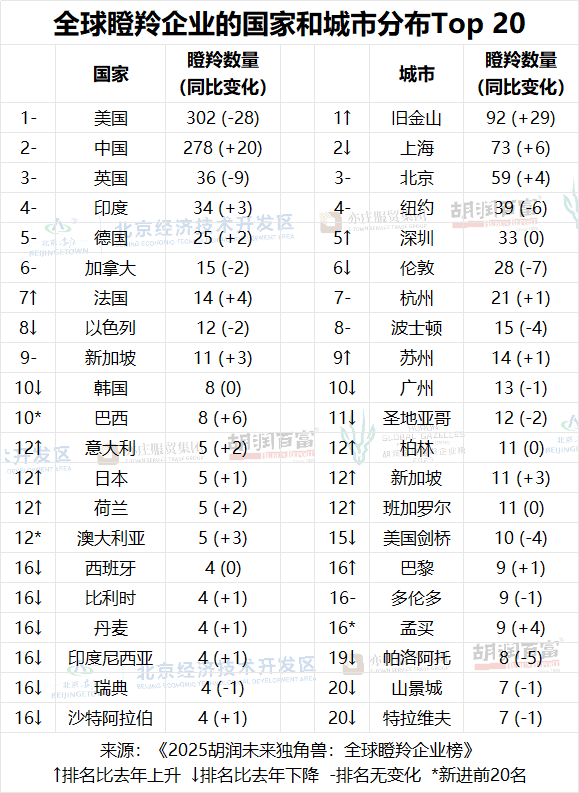
Core Insights - The HuRun Research Institute released the "2025 HuRun Future Unicorn: Global Gazelle Enterprises List," identifying high-growth companies likely to reach a billion-dollar valuation by the end of 2028 [1] - The list includes 819 gazelle companies, with the US and China leading with 302 and 278 companies respectively, accounting for 71% of the total [1] - 146 companies upgraded to unicorn status, while 42 companies were downgraded, primarily in the biotech, fintech, media, entertainment, and agri-tech sectors [1] Group 1: Company Performance - Among the 146 upgraded companies, 71 became unicorns, with notable mentions including Sierra (AI, valued at 71 billion RMB) and Abridge (AI, valued at 38 billion RMB) [1] - 33 companies went public, with the highest valued being the tea brand Gu Ming from Hangzhou, valued at 55 billion RMB [1] Group 2: Geographic Distribution - The top countries for gazelle companies are the US (302, down by 28) and China (278, up by 20) [2] - Major cities contributing to gazelle company numbers include San Francisco (92, up by 29) and Shanghai (73, up by 6) [2]
胡润研究院最新报告:中国占胡润全球瞪羚总数的34%
Zheng Quan Shi Bao Wang· 2026-01-20 10:01
Group 1 - The HuRun Research Institute released the "2025 HuRun Future Unicorn: Global Gazelle Enterprises List," identifying 819 high-growth companies likely to reach a billion-dollar valuation within three years, marking a 19% increase from 688 two years ago [1] - China ranks second with 278 gazelle companies, an increase of 20 from the previous year, representing 34% of the global total [1] - Among the new entrants, 206 are first-time appearances, with 29 in fintech, 28 in artificial intelligence, and 15 each in SaaS and robotics, with the US contributing 64 and China 55 [1] Group 2 - Since 2019, the number of HuRun gazelles in China has nearly quadrupled from 70 to 278, with 55 new faces and 26 upgrades in the past year [2] - Artificial intelligence is transforming various industries, with 71 gazelle companies leveraging AI for efficiency, innovation, and growth [2] - In healthcare, AI aids in diagnostics and personalized medicine, while in finance, it is used for fraud detection and risk management; retail benefits from AI-driven personalization, and manufacturing utilizes AI for automation and quality control [2]
联易融科技-W(09959)1月20日斥资95万港元回购40万股
智通财经网· 2026-01-20 09:47
Group 1 - The company, Lianyi Rong Technology-W (09959), announced a share buyback plan [1] - The company will spend HKD 950,000 to repurchase 400,000 shares [1] - The buyback is scheduled to take place on January 20, 2026 [1]
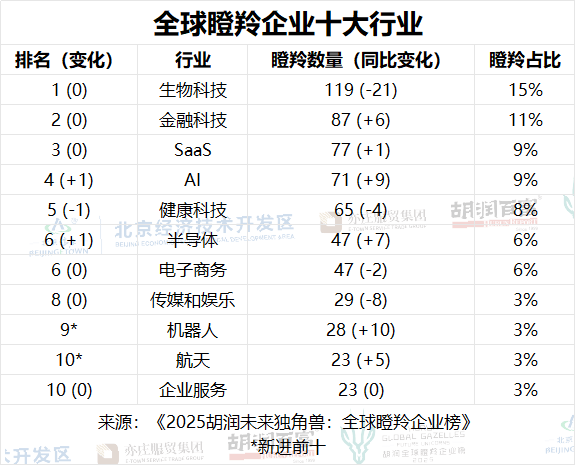
2025胡润未来独角兽瞪羚企业榜单:中国以278家位居第二
证券时报· 2026-01-20 09:43
Core Insights - The article discusses the release of the "2025 Hurun Future Unicorn: Global Gazelle Enterprises List," which identifies high-growth companies likely to achieve a billion-dollar valuation by the end of 2028 [2][4]. Industry Overview - The healthcare sector leads with the highest number of gazelle enterprises, totaling 187, including 119 in biotechnology and 65 in health technology [4][5]. - The list aims to assist these companies in finding investors and partners, encouraging founders to expand their horizons and accelerate growth [4]. Industry Rankings - The top industries for gazelle enterprises are as follows: 1. Biotechnology: 119 (-21 from last year) [5] 2. Fintech: 87 (+6) [5] 3. SaaS: 77 (+1) [5] 4. AI: 71 (+9) [5] 5. Health Technology: 65 (-4) [5] 6. E-commerce: 47 (-2) [5] 7. Media and Entertainment: 29 (-8) [5] 8. Robotics: 28 (+10) [5] 9. Aerospace: 23 (+5) [5] 10. Enterprise Services: 23 (no change) [5] Geographic Distribution - The United States leads with 302 gazelle enterprises, although this is a decrease of 28 from the previous year. China follows with 278, an increase of 20 [8][10]. - The top cities for gazelle enterprises are: 1. San Francisco: 92 [9] 2. Shanghai: 73 [9] 3. Beijing: 59 [9] Emerging Trends - AI is transforming various industries, with 35% of gazelle enterprises driven by AI technologies. The fastest-growing sectors include robotics, AI, semiconductors, fintech, and aerospace [6][11]. - The integration of generative AI, machine learning, and other technologies is creating unprecedented opportunities for innovative startups [11].

腾讯控股:4Q广告预期稳健增长,AI小程序加码布局-20260120
HTSC· 2026-01-20 07:25
Investment Rating - The report maintains a "Buy" rating for Tencent with a target price of 792 HKD [6][5][28] Core Insights - Tencent is expected to achieve a revenue growth of 13% year-on-year in Q4 2025, with adjusted net profit increasing by 16% to 643 billion RMB. The revenue growth is driven by gaming, advertising, and fintech, with expected increases of 16%, 20%, and 9% respectively [1][5][24] - Key catalysts for Tencent in the medium term include the launch of multiple new games, improvements in advertising efficiency due to AI, and the introduction of AI tools for mini-program development on WeChat [1][3][4] Summary by Sections Gaming Business - Tencent's gaming revenue is projected to grow by 16% in Q4, with the new game "Counter-Strike: Future" expected to generate 3.5 to 7 billion RMB in its first year. The game fills a gap in the PVE shooting genre and has already attracted over 10 million players shortly after launch [2][12][16] Advertising Business - Advertising revenue is anticipated to increase by 20% in Q4, driven by budget increases from long-tail advertisers and efficiency gains from AI. WeChat's advertising capabilities are evolving, with new features enhancing social commerce [4][19] Fintech and AI Mini-Programs - Fintech revenue is expected to grow by 9%, supported by a robust performance in social retail. AI mini-programs are projected to expand significantly in 2026, with a 108% increase in monetization scale and a 75% rise in eCPM in 2025 [3][19] Financial Forecast and Valuation - Revenue forecasts for Tencent have been slightly adjusted downwards for 2025-2027, with expected adjusted net profits of 263.1 billion, 299.4 billion, and 342.5 billion RMB respectively. The target price corresponds to a PE ratio of 21.6 for 2026 [5][24][28]