
3D打印

Search documents
连板股追踪丨A股今日共79只个股涨停 中水渔业7连板
Di Yi Cai Jing· 2025-11-24 07:34
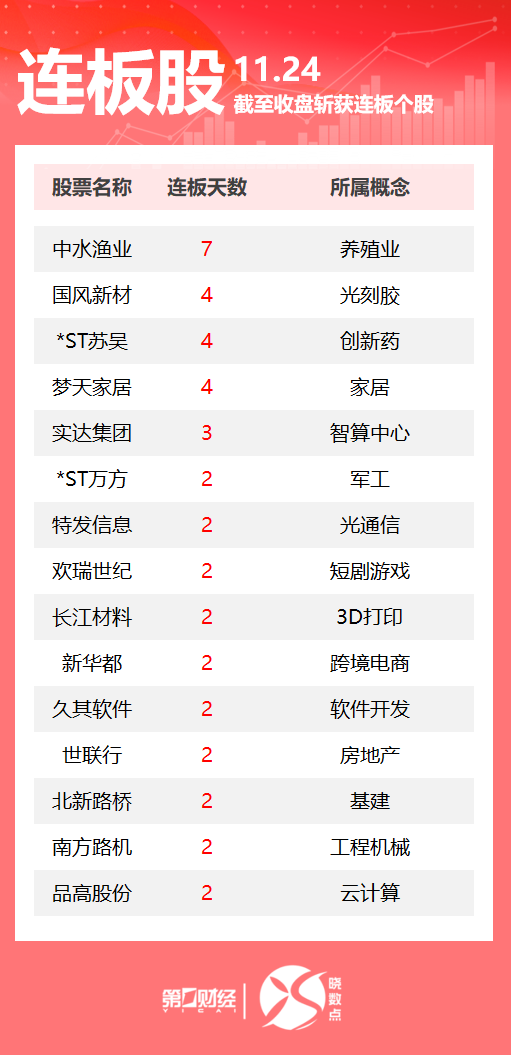
Core Insights - The A-share market saw a total of 79 stocks hitting the daily limit up on November 24, with notable performances in various sectors, particularly aquaculture, photolithography, and 3D printing [1][2]. Group 1: Stock Performance - Guofeng New Materials achieved a four-day consecutive limit up in the photolithography sector [1][2]. - Changjiang Materials, associated with 3D printing, recorded a two-day consecutive limit up [1][2]. - The aquaculture sector, specifically Shuiyu Industry, experienced a remarkable seven-day consecutive limit up [1][2]. Group 2: Conceptual Breakdown of Stocks - The following stocks have notable consecutive limit up days: - Sansi Mingchu: 7 days, related to aquaculture [2]. - Guofeng New Materials: 4 days, related to photolithography [2]. - *ST Suwu: 4 days, related to innovative pharmaceuticals [2]. - Meng Tian Home: 4 days, related to home furnishings [2]. - Shida Group: 3 days, related to intelligent computing centers [2]. - Other stocks with 2 days of consecutive limit up include *ST Wanfang (automotive), Te Fa Information (optical communication), and Changjiang Materials (3D printing) [2].


3D打印板块午后持续走高,金橙子午后涨停
Mei Ri Jing Ji Xin Wen· 2025-11-24 05:40
Group 1 - The 3D printing sector experienced a significant rise in the afternoon trading session on November 24, with notable stocks such as Jin Chengzi hitting the daily limit up [1] - Changjiang Materials previously reached its limit up, indicating strong market interest and performance in the sector [1] - Other companies in the 3D printing space, including Jialian Technology, Bolite, and Yinhui Technology, also saw increases in their stock prices, reflecting a broader positive trend in the industry [1]


拓竹几近完成新一轮融资,大厂参投,估值或达100亿美金|36氪独家
3 6 Ke· 2025-11-24 03:43
Core Viewpoint - The 3D printing company拓竹 is nearing the completion of a new financing round with Tencent participating, potentially valuing the company at $10 billion, although both companies have denied the accuracy of this information [1][2]. Company Overview -拓竹 is recognized as one of the most prominent unicorns in the primary market, with projected revenue of approximately 5.5 to 6 billion RMB and a net profit nearing 2 billion RMB for the previous year [2]. - The company has reportedly shipped over 1.2 million units, achieving a global market share of 29% [2]. Market Dynamics - The global 3D printing market is expected to reach a size of $24.61 billion (approximately 170 billion RMB) by 2024, with an annual growth rate of 18.5% from 2024 to 2034, indicating a rapid development phase for the industry [2]. - The competitive landscape has intensified, with nearly all mainstream 3D printer manufacturers launching their high-speed models in response to拓竹's innovations [5]. Technological Advancements -拓竹 has addressed key pain points in 3D printing, such as slow speed and complex operation, by integrating features like automatic leveling and a fully enclosed structure, significantly enhancing user experience [2][3]. - The introduction of multi-color printing has increased its penetration rate, creating a "technology window" of two years where拓竹 has rapidly advanced without significant competition [3]. Competitive Landscape - The entry of DJI, a former employer of拓竹's founder, into the 3D printing market through investment in智能派 highlights the growing competition, as DJI aims to leverage its manufacturing capabilities and software integration [6]. - The competition is shifting from hardware specifications to software stability, cloud services, and user-friendly ecosystems, marking a new focus in the industry [6].
3D打印概念再度走强 长江材料2连板
Xin Lang Cai Jing· 2025-11-24 02:45
Group 1 - The 3D printing sector is experiencing a resurgence, with companies like Changjiang Materials achieving consecutive gains, and Jin Chengzi rising over 10% [1] - Other companies in the sector, including Haizheng Biomedical Materials, Jialian Technology, Yinhui Technology, and Jinyun Laser, are also seeing upward movement in their stock prices [1] - The catalyst for this growth is the significant update to Google's Nano Banana image generation model, which has introduced Nano Banana Pro [1] Group 2 - The original Nano Banana model, launched by Google in late August, utilizes the Gemini 2.5 Flash model to transform photos of people or anime into lifelike "3D printed figurines" [1] - This capability has led to a rapid global breakout effect, enhancing interest and investment in the 3D printing industry [1]
中国最好的一批消费品牌是怎么诞生的?
3 6 Ke· 2025-11-24 01:18
刚刚过去的一个季度里,瑞幸的门店总数达到29214 家,这个数字是 2020 年退市时的6倍。五年时间里,它从每卖一杯亏 掉5.6 元,到如今单杯稳定获利1.2 元[1]。粉单市场上,它的股价从最低不到 1 美元一路反弹,不断逼近退市前 129 亿美元 的总市值峰点。 这些标志性的数字,构成了瑞幸重生的叙事。 这是近十年来中国商业史上最具代表性的"困境反转"案例。它修正了资本市场对于"中概股退市必死"的刻板印象,演绎了 一段投资机构逆势支持企业的佳话,更用一场起死回生告诉人们: 中国消费市场是一个庞大的存在,只要持续做好自己的产品,就可以活得比所有人以为的更有韧性。 2021年,生椰拿铁的上市宣布了瑞幸的"卷土重来"——单月销量突破 2000 万杯,相当于每秒钟卖出 7 杯,券后价格常年 9.9 元就能实现盈利。瑞幸又回到了最朴素的商业常识里:好产品是前面的1,其他能力是后面的0。规模只是产品的结果, 份额只是品牌的具象。 事实上,IDG资本从一开始就非常看好瑞幸,但一直没有找到合适的入局机会。公司投资团队判断瑞幸本身的品牌、门店 网络、数字化系统等都是良性健康的,只是在前期试图用大量补贴,在短期急速培养消费 ...

智能派获大疆投资的更多细节:三年内年营收要超50亿|早起看早期
36氪· 2025-11-24 00:05
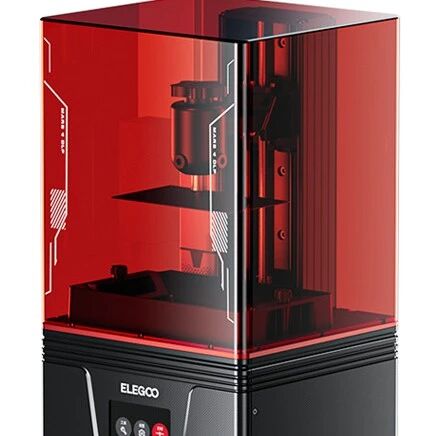
Core Viewpoint - Shenzhen Intelligent Technology Co., Ltd. (ELEGOO) has completed a new round of strategic financing worth hundreds of millions of RMB, with DJI as the investor. The company has achieved a compound annual growth rate (CAGR) of over 40% in the past three years and is projected to reach total revenue of 1.6 billion RMB in 2024, with an expected growth of 30% to 50% in 2025, potentially exceeding 2.5 billion RMB [6][10]. Company Overview - Founded in 2015, Intelligent Technology focuses on the research, production, and sales of consumer-grade 3D printers and laser engraving machines. The company's core goal is to lower the creative threshold for global users by providing high cost-performance and intelligent products [7][9]. - The company leverages China's integrated supply chain advantages and mature e-commerce operations to enter the market with a cost-performance strategy [7]. Product Lines - Intelligent Technology's core product lines include both light-curing (LCD/SLA) and fused deposition modeling (FDM) technologies, maintaining a leading position in global consumer LCD 3D printer shipments for several consecutive years [7][8]. - The Mars series, launched in 2019, was among the first in the global market to offer devices priced at $300 with 2K printing precision. The upcoming Mars 5 Ultra, set to launch in June 2024, features a partitioned exposure function to enhance printing efficiency and quality, winning the Red Dot Product Design Award [7][8]. Market Strategy - The light-curing technology has been an effective strategy for Intelligent Technology's early market entry and rapid growth. Despite consumer concerns about the odor from resin, the high precision of light-curing 3D printers has led to applications in dental medical fields [8]. - The FDM series, particularly the OrangeStorm Giga, represents the company's foray into industrial-grade 3D printing, successfully crowdfunding over $3 million on Kickstarter [8]. Software and Ecosystem - The company is also expanding its product matrix with laser engraving machines and is committed to providing integrated solutions. In November 2024, it will launch its first self-developed slicing software, SatelLite, designed specifically for light-curing 3D printing [9]. - In 2025, Intelligent Technology plans to introduce the Matrix APP for remote device management and launch the Nexprint 3D model platform, along with a $1 million support fund for original designs, completing its 3D printing ecosystem [9]. Global Expansion - Intelligent Technology has diversified its sales platforms, including independent sites and Amazon, with products sold in over 150 countries and regions, achieving cumulative shipments of over one million units [9]. - The company entered the cross-border e-commerce sector in 2015, capitalizing on the growth window for consumer-grade 3D printers overseas, becoming the leading brand in global consumer LCD 3D printer shipments [9]. Competitive Landscape - The 3D printing market has become increasingly competitive, transitioning from a blue ocean to a red ocean, with the market expanding from billions to trillions. With DJI's strategic investment, Intelligent Technology is expected to gain more resources and experience support for global expansion, technology integration, and supply chain optimization [10].
大疆入局 3D打印行业“硝烟”再起
Nan Fang Du Shi Bao· 2025-11-23 23:11
Core Viewpoint - DJI's investment in a 3D printing company, Shenzhen Smart派科技有限公司, is perceived as a strategic move that may threaten its former employee,拓竹科技, indicating a competitive shift in the 3D printing industry [2][3]. Company Overview -拓竹科技, founded in 2020, has rapidly become a leader in the global consumer 3D printing market within five years [2]. - The core team of拓竹科技 consists of former DJI employees, including founder陶冶, who previously managed DJI's Mavic product line [3]. Investment and Competition - DJI's investment in Smart派科技 is based on its belief in the growth potential of consumer-grade 3D printing technology [2]. - The competitive landscape is evolving, with DJI and影石Insta360 intensifying their rivalry in the hardware sector, particularly in the 3D printing and imaging device markets [5][6]. Industry Dynamics - The competition among DJI,影石, and拓竹科技 reflects a broader trend in Shenzhen's hardware industry, transitioning from a single dominant player to a multi-competitive environment [6]. - Future competition will likely focus on supply chain efficiency, global channel capabilities, brand building, and organizational management rather than just product specifications and pricing [6].

中国无人机厂商亮相迪拜航展;易点天下与阿里云达成AI漫剧出海框架合作协议|36氪出海·要闻回顾
36氪· 2025-11-23 15:41
Core Insights - The article highlights the increasing international presence of Chinese companies in various sectors, particularly in drone technology, electric vehicles, AI, and 3D printing, showcasing significant partnerships and market expansions. Group 1: Drone Technology - Chinese drone manufacturers showcased their products at the Dubai Airshow, with companies like United Aircraft Group demonstrating delivery drones capable of carrying 5 kg and adapting to high-temperature environments [4] - EHang completed the first urban air mobility flight in Qatar, reducing travel time from 30 minutes to 8 minutes, marking a significant milestone for eVTOL technology in the Middle East [4] Group 2: AI and Digital Solutions - Epoint and Alibaba Cloud announced a framework cooperation agreement for AI comic series, aiming to create a comprehensive solution for overseas expansion in this emerging market [4] - Alibaba International Station launched AI Mode to automate cross-border e-commerce procurement processes for SMEs, enhancing decision-making and operational efficiency [5][6] Group 3: Electric Vehicles - Didi's 99 platform in Brazil expanded its electric vehicle services to five major cities, with over 30,000 electric and hybrid vehicles registered, significantly reducing carbon emissions [7] - NIO's Firefly right-hand drive model began mass production, with the first batch set for Singapore, indicating rapid global market penetration [8] Group 4: Market Expansion and Financing - Blue Dot Touch completed over 100 million C-round financing to enhance global market expansion, focusing on robotics sensor hardware [10] - Elegoo announced a strategic financing round, with a global shipment exceeding one million units, indicating strong growth in the 3D printing market [11] Group 5: Emerging Markets - Southeast Asia, Africa, and the Middle East are identified as key growth markets for Chinese companies over the next three years, with optimism in sectors like construction, healthcare, and IT [13] - China has become the largest trading partner in the Gulf region, surpassing the combined trade of the US, UK, and Eurozone, with trade expected to grow significantly by 2028 [13]

东南亚多国调研精要,小米多模型构建AI端侧生态,3D打印高增
SINOLINK SECURITIES· 2025-11-23 11:39
Investment Rating - The report does not explicitly provide an investment rating for the industry Core Insights - The research highlights the significant generational differences in consumer behavior and production capabilities across Thailand, Vietnam, and Cambodia, with Thailand resembling a "miniature" version of the Western consumer market, Vietnam in a rapid growth phase, and Cambodia reflecting characteristics of less developed nations [1] - The report emphasizes the potential for investment in Southeast Asia, particularly in consumer goods and technology-driven sectors, as companies leverage local production capabilities and growing consumer markets [1][2] Summary by Sections 1. Industry Insights - Thailand is compared to a "miniature" Western market, showcasing a mature consumer culture and a well-developed service industry, making it a reference point for companies looking to expand into Western markets [1] - Vietnam is characterized as a rapidly developing economy, with a GDP projected to reach approximately 62.69 trillion VND (around 4,700 USD) in 2024, indicating a significant consumer market potential [1] - Cambodia is noted for its low average income and high income disparity, with consumer spending primarily focused on essential goods, suggesting a slower penetration of discretionary spending [1] 2. Segment Tracking - Xiaomi Group is exploring the future of smart home technology with its Xiaomi Miloco initiative, aiming to enhance user interaction and privacy through advanced AI models [9][10] - The pet food sector saw significant growth during the Double Eleven shopping festival, with sales for the brand Guibao exceeding 1 billion RMB, reflecting a trend towards premium pet products [11][12] - The AI and 3D printing industry is experiencing high demand, with companies like Tuozhu achieving record sales during major shopping events, indicating strong market potential [21][22] 3. Macro Consumption Data - In October, the Consumer Price Index (CPI) showed a year-on-year increase of 0.2%, with service sector prices rising, indicating a recovery in consumer spending [35] - The Producer Price Index (PPI) decreased by 2.1% year-on-year, but showed signs of improvement in the month-on-month trend, suggesting a potential stabilization in production costs [45] - Online sales data from major platforms indicated a decline in the home appliance sector, with specific brands like Ecovacs and Roborock showing positive growth despite overall market challenges [50]

AI送上“助攻” 消费级3D打印技术应用场景拓宽
Zheng Quan Ri Bao· 2025-11-22 01:35
Core Insights - DJI has invested 5% in Shenzhen Smart Pie Technology Co., a 3D printing company, indicating confidence in the growth potential of consumer-grade 3D printing technology and aligning with DJI's innovation strategy [1] - The global 3D printing market is projected to reach $115 billion by 2030, with a compound annual growth rate (CAGR) of approximately 30% over the next five years, while China's 3D printing market is expected to reach 41.5 billion yuan in 2024 [2] - The demand for consumer-grade 3D printing is driven by lower costs in supply chains and the rise of IP economy, which allows consumers to access a variety of creative 3D models at minimal costs [2] Industry Trends - The 3D printing industry is experiencing rapid growth, with applications spanning aerospace, construction, and consumer goods, particularly in the consumer segment [2] - The integration of generative AI in 3D design is lowering the barriers for users to create and optimize 3D models, enhancing the accessibility of 3D printing technology [2] - Companies in the A-share market are actively investing in the consumer-grade 3D printing sector, with Hunan Huashu High-Tech Co. focusing on industrial-grade additive manufacturing equipment [3] - Shenzhen Jepu Te Optoelectronics Co. is advancing in the consumer-grade laser technology, with expectations for mass production and collaboration with multiple clients [3] Technological Advancements - The limitations of traditional manufacturing processes are becoming apparent as consumer electronics trend towards lightweight, high-performance, and complex structures [4] - Metal 3D printing is emerging as a solution in the 3C field due to its advantages in lightweight materials, high precision, and customized production capabilities [4]