农产品种植与销售

Search documents
探访“中国小杂粮之乡”甘肃环县:土货“触网”提身价
Zhong Guo Xin Wen Wang· 2025-11-03 07:32
Core Viewpoint - The article highlights the transformation of Gansu's Huancheng County, known as "China's Small Grain Town," where local farmers are leveraging e-commerce and modern processing techniques to enhance the value of small grains like buckwheat and millet, significantly improving their economic conditions [2][4]. Group 1: Industry Overview - Huancheng County has a stable planting area of 500,000 acres for small grains, benefiting from unique climatic conditions that enhance the nutritional value of crops [2]. - The increasing living standards and dietary improvements among consumers have positioned small grains as important components of modern green health foods [2]. Group 2: Entrepreneurial Success Stories - Sun Chunling, a local entrepreneur, transitioned from selling buckwheat pancakes to becoming a "grain anchor" by selling high-quality local buckwheat online, leading to the establishment of a modern processing factory by 2024 [2]. - Her factory operates 14 machines and offers over 30 varieties of small grains, processing more than 300 tons of buckwheat annually and supporting over 600 villagers [2][4]. Group 3: Community Impact - The local government supports villagers interested in e-commerce by providing live-streaming equipment and guidance, which has led to significant economic improvements for many families [4]. - For instance, a farmer who previously faced economic difficulties has improved their situation by selling small grains and agricultural products online [4].

贵南淳豆坊有限公司成立 注册资本20万人民币
Sou Hu Cai Jing· 2025-11-01 05:31
Core Insights - A new company named Guinan Chundoufang Co., Ltd. has been established with a registered capital of 200,000 RMB [1] Company Overview - The legal representative of the company is Yang Ping [1] - The business scope includes licensed projects such as soybean product manufacturing, grain processing food production, and seasoning production, which require approval from relevant authorities before operation [1] - General projects include various agricultural activities such as legume planting, oilseed planting, grain planting, fresh vegetable wholesale and retail, edible agricultural product wholesale, cocoa bean planting, tuber planting, spice crop planting, and sales of edible agricultural products [1]
【逐梦乡村】我是新农人
Jing Ji Ri Bao· 2025-11-01 02:28
Core Insights - The article highlights the transformative impact of "new farmers" in rural areas, emphasizing their role in revitalizing local economies and communities through innovative agricultural practices and sustainable development [1][13]. Group 1: New Farmers and Their Impact - "New farmers" are actively working to inject vitality into rural areas, leading to improved agricultural practices and community development [1]. - The introduction of new agricultural products, such as medicinal roses and bass fish, has created new economic opportunities for local villagers [3][4]. - The collaboration between local farmers and external resources has resulted in significant increases in production and income, fostering a sense of hope and community engagement [3][5]. Group 2: Community Development Initiatives - The work teams have implemented various infrastructure projects, including roads, bridges, and recreational facilities, enhancing the quality of life for residents [4]. - The establishment of e-commerce platforms has facilitated the sale of local products, generating over 80,000 yuan in revenue for the community [4]. - Educational initiatives, such as partnerships with Shenzhen's education system, have brought thousands of students to the area for practical learning experiences, further promoting local tourism [4][5]. Group 3: Sustainable Practices and Future Plans - The focus on cultivating local talent and ensuring transparency in project management is crucial for the sustainability of development efforts [5][6]. - The introduction of new crops, like the golden passion fruit, is expected to significantly boost local income and employment opportunities [7]. - The planning of cultural events, such as a music festival, aims to further enhance community engagement and attract tourism [7]. Group 4: Personal Stories of Return and Innovation - The narrative of individuals like Lu Dingqi and Dai Hongping illustrates the potential for personal and community transformation through entrepreneurship and cultural heritage [8][9]. - The establishment of a youth entrepreneurship association aims to support local startups and enhance community resources [10]. - The recognition of local beauty and culture has led to a renewed appreciation among residents, fostering a sense of pride and identity [11][12].
益阳市资阳区轩竹农业有限公司成立 注册资本10万人民币
Sou Hu Cai Jing· 2025-10-26 14:58
Group 1 - A new company named Yiyang Ziyang District Xuanzhu Agricultural Co., Ltd. has been established with a registered capital of 100,000 RMB [1] - The legal representative of the company is Lu Liangkun [1] - The company's business scope includes tea product production, food sales, and various agricultural activities such as tea planting and sales of agricultural products [1] Group 2 - The company is authorized to engage in food sales, subject to approval from relevant authorities [1] - Additional activities include technical services, consulting, and training, excluding those requiring special licenses [1] - The company also plans to engage in the wholesale and retail of edible agricultural products, as well as grain and vegetable planting and sales [1]
青海海东高原特色农产品推介会在江苏无锡举办
Zhong Guo Jing Ji Wang· 2025-10-16 09:07
Core Insights - The event aimed to promote highland specialty agricultural products from Haidong City, focusing on "highland, green, selenium-rich, and organic" characteristics to enhance agricultural exchange and cooperation between Haidong and Wuxi [1][2] Group 1: Agricultural Products and Development - Haidong City is recognized as an agricultural core area in Qinghai Province, known for its unique highland climate and selenium-rich soil, producing high-quality specialty agricultural products [1] - The city has developed 18 geographical indication products, including purple garlic and potatoes, which are well-received in the market [1] - Haidong has over 310,000 acres of highland cool-season vegetable cultivation, accounting for about half of Qinghai's total, with 284 varieties established [2] Group 2: Market Expansion and Sales Channels - The city has established various bases for cool-season vegetables, including one 10,000-acre base and 29 customs-certified export vegetable bases, with an export volume accounting for 54.3% of Qinghai's total [2] - The agricultural department is actively expanding sales channels through various initiatives, including participation in trade fairs and establishing connections with supermarkets and schools [3] - The event facilitated discussions between local producers and numerous buyers from Wuxi, leading to multiple cooperation intentions in areas such as direct supply of cool-season vegetables and agency sales of selenium-rich products [3] Group 3: Future Cooperation and Strategic Goals - The promotional event not only opened the eastern market for Haidong's specialty products but also established a new platform for agricultural cooperation between the two regions [3] - Haidong City plans to deepen cooperation with Wuxi and other areas through industry connections and brand building to promote more highland products nationwide, supporting rural revitalization strategies [3]

玉渊谭天:美国或失1600万吨大豆订单
财联社· 2025-10-14 06:21
Group 1 - The core issue is the significant decline in U.S. soybean exports to China, with a forecasted loss of 14 to 16 million tons if China does not resume purchases by mid-November [3][4] - From January to September 2023, the number of U.S. grain transport ships docking at Chinese ports decreased by 56%, dropping from 72 to 32 vessels, with no U.S. ships docking since July [3] - In 2024, U.S. soybean exports are projected to reach $24.58 billion, accounting for 14% of total U.S. agricultural exports, with over half of this amount, $12.64 billion, coming from China [3] Group 2 - The U.S. is actively seeking new buyers in Africa and Asia to mitigate the impact of reduced Chinese demand, as indicated by U.S. Treasury Secretary's communication regarding falling soybean prices [4] - Since May 2023, China has ceased purchasing U.S. soybeans, leading to a significant drop in export volumes, with only 5.9 million tons exported to China from January to July [3]
玉渊谭天丨美国或失1600万吨大豆订单
Yang Shi Xin Wen· 2025-10-14 05:54
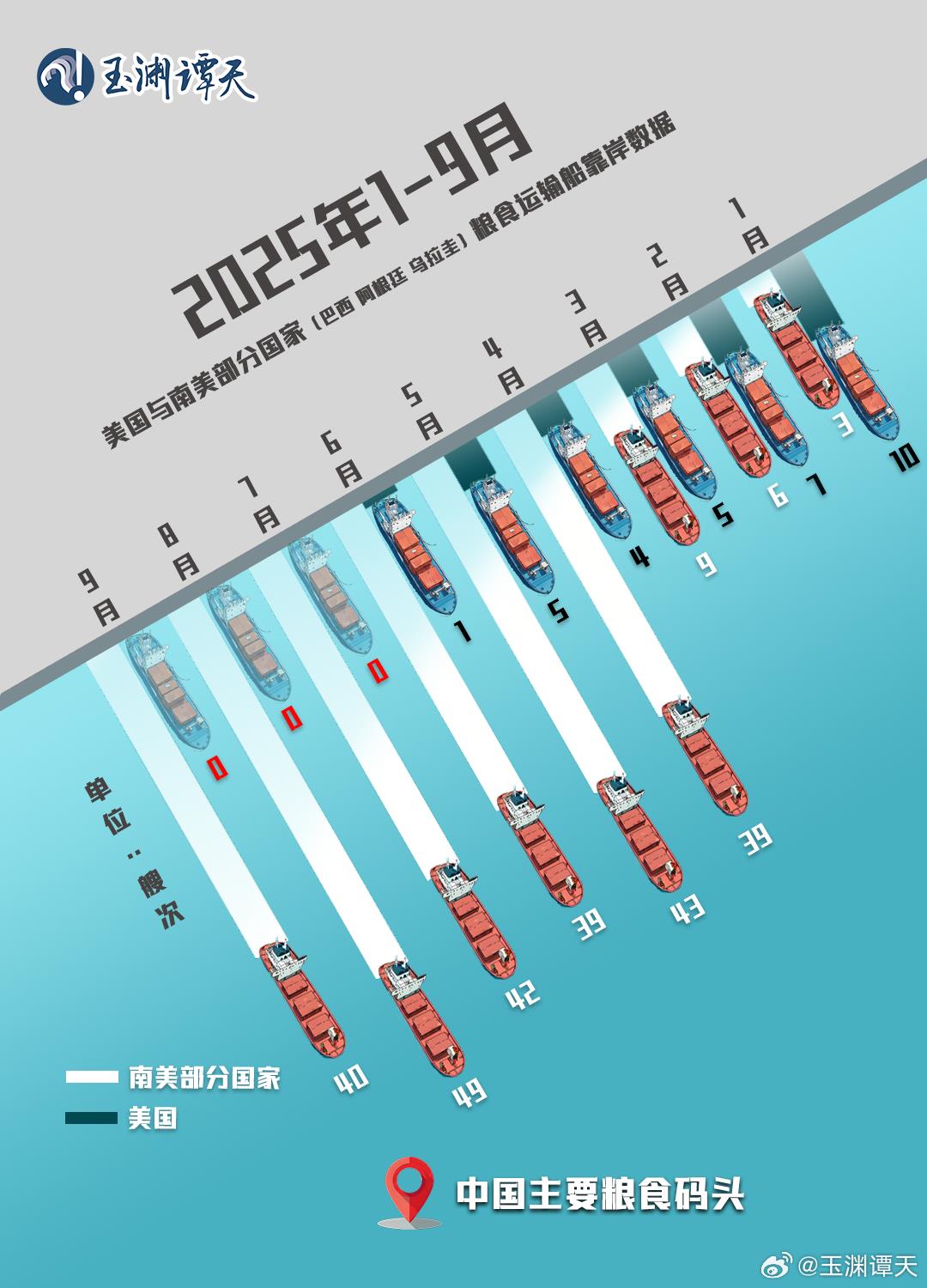
Group 1 - The number of U.S. grain transport ships docking at major Chinese grain terminals has decreased by 56% from January to September, dropping from 72 to 32 vessels, with no U.S. ships docking since July [2] - Since May, an average of over 40 grain transport ships from South American countries such as Argentina, Brazil, and Uruguay have been docking monthly at the terminal, with 90% of these shipments consisting of soybeans [2] - Soybeans are crucial for U.S. agricultural exports, with projected exports valued at $24.58 billion in 2024, accounting for 14% of total U.S. agricultural exports, and China purchasing over half of this amount, valued at $12.64 billion [2] Group 2 - In 2024, the U.S. is expected to export nearly 27 million tons of soybeans to China, but from January to July this year, exports were only 5.9 million tons, as China ceased purchases of U.S. soybeans since May [2] - A market research firm predicts that if China does not return to the U.S. market by mid-November, the potential loss of soybean orders could reach 14 to 16 million tons, equating to losing half of the market [2] - The U.S. is actively seeking new buyers in Africa and Asia, with U.S. Treasury Secretary Becerra noting that soybean prices have further declined, giving China more leverage in negotiations [3]
玉渊谭天:美国或失1600万吨大豆订单
Xin Lang Cai Jing· 2025-10-14 05:54
Core Viewpoint - The number of U.S. grain transport ships docking at major Chinese grain terminals has significantly decreased, with a 56% drop from 72 ships to 32 ships in the first nine months of the year, primarily due to a complete halt in shipments since July [1] Group 1: U.S. Grain Exports - The decline in U.S. grain transport ships is attributed to a cessation of soybean purchases by China since May, which is critical as soybeans account for a significant portion of U.S. agricultural exports [1] - In 2024, U.S. soybean exports are projected to reach $24.58 billion, making it the top agricultural export and representing 14% of total U.S. agricultural exports [1] - China is a major buyer, purchasing over half of U.S. soybeans valued at $12.64 billion, with nearly 27 million tons exported to China in 2024 [1] Group 2: Impact of China's Purchasing Decisions - From January to July this year, U.S. soybean exports to China were only 5.9 million tons, indicating a significant drop in trade volume [1] - A market research firm predicts that if China does not resume purchases by mid-November, the U.S. could lose soybean orders to China amounting to 14 to 16 million tons [1] - The loss of the Chinese market equates to losing half of the U.S. soybean export market, highlighting the critical nature of this trade relationship [1]
美国农民要巨亏450亿?特朗普找印度接盘,中方送给美方一句忠告
Sou Hu Cai Jing· 2025-10-13 03:12
Core Viewpoint - The ongoing U.S.-China trade conflict is significantly impacting American farmers, with potential losses estimated at $45 billion, compounded by a government shutdown due to bipartisan disagreements on a temporary funding bill [1][3]. Group 1: Economic Impact - American farmers are facing increasing complaints due to reduced purchases of U.S. agricultural products by China, leading to escalating potential losses [3][5]. - The government shutdown, which began on October 1, is expected to severely weaken the government's ability to coordinate domestic and foreign trade matters, raising concerns about the progress of U.S.-China trade negotiations [5][9]. Group 2: Government Response - The Trump administration is exploring three main strategies to address the situation: direct financial subsidies to farmers, seeking alternative markets for U.S. agricultural exports, and pursuing face-to-face negotiations with China [9][10]. - The effectiveness of the first two strategies is questioned, as previous subsidy plans have already incurred significant costs, and finding alternative markets is challenging due to existing competition [9][10]. Group 3: Negotiation Dynamics - The U.S. government is pushing for increased Chinese purchases of American agricultural products, but China has not yet made concessions and has redirected some orders to South American countries [7][10]. - China's expectations for negotiations emphasize the need for equality and mutual benefit, indicating that U.S. compliance with Chinese rules and market arrangements is essential for achieving stable and beneficial trade relations [10][12].
美国大豆堆积如山,中方一单未下,特朗普发现不妙,错过最佳时机
Sou Hu Cai Jing· 2025-09-30 08:40
Core Viewpoint - The U.S. soybean industry is facing an unprecedented sales crisis, primarily due to the absence of orders from China, which has historically been a major buyer [1][3]. Group 1: Market Dynamics - China accounted for a significant portion of U.S. soybean exports, with 6.5 million tons of contracts signed at the same time last year, while this year the order volume is zero [3]. - The speed of market shift is alarming, with China importing 66 million tons of soybeans from Brazil in the first eight months of this year, representing 75% of Brazil's total exports [3]. - U.S. soybean exports have plummeted by over 60% year-on-year due to China's imposition of a 23% punitive tariff on U.S. soybeans, making U.S. prices nearly $100 per ton higher than South American soybeans [3]. Group 2: Economic Impact on Farmers - The cost of planting soybeans is $450 per acre, while market prices only cover $300, leading to significant financial strain on farmers [5]. - Brazilian port expansions and Argentina's cancellation of soybean export taxes are expected to further enhance price competitiveness against U.S. soybeans [5]. Group 3: Structural Weaknesses - The soybean market is highly seasonal, and missing the sales window forces farmers to sell at lower prices [7]. - China's shift towards diversified supply sources has reduced its dependency on U.S. soybeans from 85% to 80%, while U.S. soybean exports still rely 60% on China [9]. - The U.S. government is facing internal divisions regarding trade negotiations, with agricultural leaders advocating for urgent talks while trade representatives maintain a hardline stance [7]. Group 4: Political Ramifications - The upcoming midterm elections are causing concern among Republican lawmakers in agricultural states, as each unsold shipment of soybeans could translate to a loss of votes [9]. - The Trump administration's $12 billion agricultural subsidy is viewed as insufficient, covering only 30% of farmers' losses [7].