咖啡种植与加工

Search documents
零关税,让更多非洲产品丰富中国市场(经济聚焦)
Ren Min Ri Bao· 2025-12-02 22:33
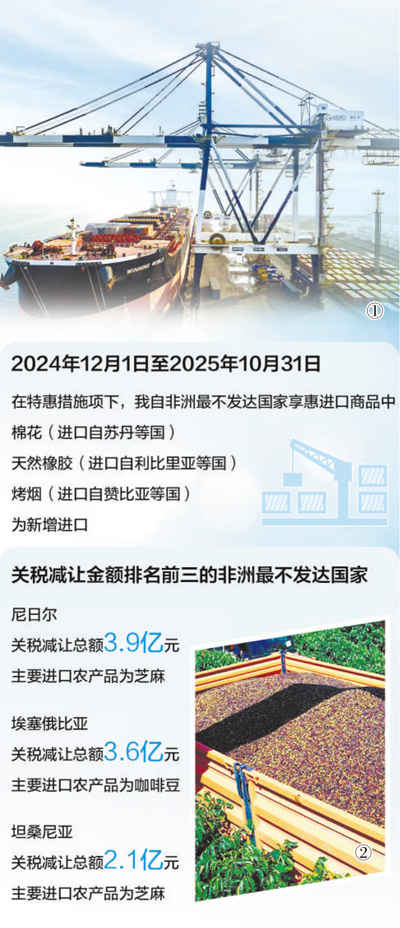
Group 1: Trade Policy Impact - From December 1, 2024, China will implement a zero tariff policy on 100% of products from the least developed countries that have diplomatic relations with China, aiming to enhance mutual development [6] - The zero tariff policy is expected to boost trade vitality between China and Africa, particularly benefiting African industries and enriching consumer choices in China [6] Group 2: Coffee Industry Growth - Ethiopia's coffee exports to China have been growing at an annual rate of 27%, with over 34,000 tons exported in the 2024/2025 fiscal year, generating over $218 million in revenue [7] - The zero tariff policy has significantly increased the competitiveness of Ethiopian coffee in the Chinese market, leading to a substantial rise in export volumes [7][8] - Ethiopian coffee producers plan to increase production to meet the growing demand from China, driven by the favorable tariff conditions [7] Group 3: Sesame Supply Chain Efficiency - Sesame, as Africa's largest agricultural export to China, is being imported more efficiently through direct sourcing channels, enhancing the supply chain from Mozambique to China [9] - The company has expanded its direct sourcing network, importing 1,120 tons of white sesame from Niger, with the first batch arriving in May [9][10] - Efficient logistics and a paperless customs process have streamlined the importation of sesame, reducing costs and improving delivery times [10] Group 4: Rubber Import and Production - The implementation of the zero tariff policy has allowed companies like Triangle Tire to import natural rubber from Liberia without tariffs, saving approximately 300,000 yuan [11] - The reduction in tariff costs enables companies to invest more in R&D, leading to the development of new tire products suitable for electric vehicles and extreme conditions [12] - In the first ten months of the year, Shandong province's imports from Africa reached 87.645 billion yuan, a 50.3% increase year-on-year, with natural and synthetic rubber imports also seeing significant growth [12]


云南波旁咖啡庄园有限公司成立 注册资本100万人民币
Sou Hu Cai Jing· 2025-11-15 16:15
Core Viewpoint - Yunnan Bourbon Coffee Plantation Co., Ltd. has been established with a registered capital of 1 million RMB, focusing on various food and beverage production and sales activities [1] Company Overview - The legal representative of the company is Zheng Xiankun [1] - The company is involved in licensed projects such as beverage production, catering services, food sales, and food production [1] - General projects include coffee bean planting, agricultural product sales, and manufacturing of food and beverage production equipment [1] Business Activities - The company is authorized to engage in food import and export, as well as technology services, development, consulting, and transfer [1] - Additional activities include wholesale and retail of edible agricultural products, initial processing of agricultural products, and the cultivation of nuts and rubber products [1]
云南普洱咖啡香产业旺
Jing Ji Ri Bao· 2025-10-14 22:16
Core Insights - The coffee industry in Pu'er, Yunnan, is transitioning from low-priced raw material exports to high-value specialty coffee production, driven by a new generation of educated coffee farmers returning to their roots [1][2][3] - The total output value of the Pu'er coffee industry reached 8.508 billion yuan last year, indicating significant economic impact [3] Group 1: Industry Development - Pu'er coffee cultivation area has reached 679,000 acres, making it a core coffee production area in China [1] - The city is implementing quality improvement measures, including the transformation of low-yield coffee farms and the establishment of a comprehensive service system for the coffee industry [1][3] - The proportion of specialty coffee beans produced in Pu'er has increased to 36.3% [1] Group 2: Market Expansion - Pu'er coffee has gained recognition among domestic and international consumers, with exports to Europe reaching 1,000 tons this year [2] - The city is promoting a new model that combines coffee culture with tourism, creating experiences for visitors to engage with coffee production [2] - Over 20 coffee estates have been established as part of the "coffee estate economy" in the region, enhancing the local tourism brand [2] Group 3: Financial Support - Agricultural Bank of China has launched the "Rural Revitalization·Coffee Loan" series to support the coffee industry, with a total of 721 million yuan disbursed by the end of August this year [3] - The focus is on enhancing the entire coffee industry chain, including cultivation, processing, and sales, to achieve higher quality and efficiency [3]
美加征关税冲击巴西咖啡业
Xin Hua She· 2025-10-03 22:10
Core Insights - Brazil is the world's largest coffee producer and exporter, with the southeastern state of Minas Gerais accounting for over half of the country's coffee production [1] - The U.S. has imposed a 40% tariff on Brazilian coffee imports since August, leading many Brazilian exporters to halt U.S. orders and seek new markets [1][2] - Approximately one-third of unroasted coffee in the U.S. comes from Brazil, with imports expected to reach 8.14 million bags in 2024, representing 33% of total U.S. coffee consumption [1] Group 1: Impact of Tariffs - The U.S. tariffs on Brazilian coffee are expected to have a more significant negative impact on American roasters and brands, as they rely heavily on Brazilian imports [2] - Brazilian coffee producers are exploring alternative markets, particularly in China, which has a growing demand for high-quality coffee [2] Group 2: Market Dynamics - Many Brazilian coffee cooperatives have reported a lack of orders for the U.S. market, with most shipments made before the tariffs took effect [2] - Despite the tariffs, demand from Europe and Australia remains strong, alleviating inventory pressure for Brazilian exporters [2] - The coffee bean storage life is up to three years, allowing exporters to wait for better market conditions [2] Group 3: Price Implications - The primary impact of the tariffs has been an increase in coffee prices, prompting calls for dialogue and negotiation between the U.S. and Brazil [2]
云南云锦无量咖啡有限公司成立 注册资本200万人民币
Sou Hu Cai Jing· 2025-09-26 10:50
Core Points - Yunnan Yunjin Wuliang Coffee Co., Ltd. has been established with a registered capital of 2 million RMB [1] - The legal representative of the company is Zhang Chong [1] Business Scope - The company is involved in food sales, food production, and catering services, which require approval from relevant authorities before operation [1] - General business activities include coffee bean planting, tea planting, retail of edible agricultural products, primary agricultural product acquisition, and sales of agricultural by-products [1] - Additional activities encompass initial processing of edible agricultural products, supply chain management services, internet sales (excluding licensed goods), tourism project planning and consulting, leisure sightseeing activities, and landscaping engineering construction [1] - The company also engages in fertilizer sales, research and development of bio-organic fertilizers, and various technical services including development, consulting, and technology transfer [1] - The company is authorized to conduct road cargo transportation with ordinary freight vehicles of 4.5 tons or less, excluding network freight and hazardous goods [1] - Labor services are also part of the business scope, excluding labor dispatch [1]
“君研咖啡”系列报告之一:全球咖啡现货市场扫描
Guo Tai Jun An Qi Huo· 2025-09-24 05:15
Group 1: General Information - The report is "Global Coffee Spot Market Scan - One of the 'Junyan Coffee' Series Reports", dated September 24, 2025, with analysts Zhou Xiaoqiu, Yin Kaiyi, and Li Junyu [1] Group 2: Report Core View - The global coffee production is highly concentrated, while consumption is relatively more dispersed. The end - of - period inventory - to - consumption ratio remains low. China's coffee market is growing rapidly, but its share in the global market is still small [2][3][28] Group 3: Natural Attributes of Coffee Beans 3.1 Natural Attributes of Coffee Trees - Coffee trees belong to the Rubiaceae family. They start bearing fruit in 3 years and enter the prime - bearing period in 4 - 5 years. Commercially, they are usually replanted every 20 - 30 years. In Yunnan, China, the flowering period is from February to July, and the coffee fruits mature from October to December [5] 3.2 Different Coffee Tree Planting Conditions and Yields - There are three main types of coffee beans: Arabica (70 - 75% of global production), Robusta (20 - 25%), and Liberica (2 - 3%). They have different requirements for altitude, temperature, precipitation, and light, and vary in pest resistance, main producing areas, commercial uses, and yields [8][9] 3.3 Coffee Tree Planting Regions - Global coffee tree planting is mainly concentrated in the "coffee belt" between the Tropic of Cancer and the Tropic of Capricorn, where the climate is suitable for coffee tree growth [10] 3.4 Coffee Bean Processing and Consumption Forms - Coffee processing involves multiple steps. Coffee products are mainly divided into freshly - ground, instant, and ready - to - drink types, with freshly - ground coffee growing rapidly [12] Group 4: Global Coffee Market Overview 4.1 Global Coffee Production - USDA predicts that the global coffee production in 25/26 will be 10.72 million tons, with the top 5 producers accounting for 73.49%. Production has increased for three consecutive years, with a 2.46% year - on - year increase in 25/26 [15] 4.2 Global Coffee Consumption - The global coffee consumption is relatively more dispersed than production. USDA predicts that the global consumption in 25/26 will be 10.16 million tons, with the top 5 consumers accounting for 59.92%. Consumption is expected to increase by 1.71% year - on - year in 25/26 [19] 4.3 Global Coffee Trade - Over 80% of coffee production is for export, and exports are highly concentrated. USDA predicts that the global coffee export in 25/26 will be 8.91 million tons. The top 5 exporters account for 65.18%. The import concentration is relatively more dispersed [23][25] 4.4 Global Coffee Supply - Demand Balance - The global coffee end - of - period inventory - to - consumption ratio remains low. USDA predicts that in 25/26, production will be 10.72 million tons, consumption 10.16 million tons, and the end - of - period inventory 1.37 million tons [28] Group 5: Chinese Coffee Market Overview 5.1 Chinese Coffee Production - USDA predicts that China's coffee production in 25/26 will be 114,000 tons, accounting for 1.06% of the global total. 98% of China's coffee is produced in Yunnan, mainly in Pu'er, Baoshan, Xishuangbanna, and Dehong [31] 5.2 Chinese Coffee Consumption - China's coffee consumption market is growing rapidly, and the industry concentration is increasing. However, its share in global coffee consumption is still low. USDA predicts that China's apparent coffee consumption in 25/26 will be 350,000 tons, accounting for 3.45% of the global total [34]
通讯丨美国关税冲击下巴西咖啡产业寻新机
Xin Hua Wang· 2025-09-19 03:02
Core Insights - The article discusses the impact of U.S. tariffs on Brazilian coffee exports, highlighting the search for new market opportunities by Brazilian coffee producers due to a 40% tariff imposed on coffee imports from Brazil [1][2] Group 1: Tariff Impact - The U.S. has imposed a 40% tariff on Brazilian coffee, leading many exporters to halt U.S. orders and seek alternative markets [1] - Approximately one-third of unroasted coffee in the U.S. comes from Brazil, with 8.14 million bags expected to be imported in 2024, representing 33% of total U.S. coffee consumption [2] Group 2: Market Opportunities - Brazilian coffee producers are looking to expand into markets like China, which has a growing demand for high-quality coffee [2] - Despite the tariff, European and Australian markets continue to show strong demand, allowing Brazilian exporters to manage inventory without significant pressure [2] Group 3: Price Effects - The primary effect of the tariffs has been an increase in coffee prices, prompting producers to hope for a resolution through dialogue and to explore new market avenues [2]
金融支持咖啡产业链的普洱实践
Jin Rong Shi Bao· 2025-08-21 04:44
Core Insights - The article highlights the unique coffee culture of ethnic minorities in Pu'er, Yunnan, where coffee cultivation is integrated into traditional lifestyles, creating a cultural phenomenon alongside economic development [1] Group 1: Ethnic Minority Coffee Culture - The Wa ethnic group in Ximeng County creatively uses coffee byproducts to produce "coffee silk," which is incorporated into traditional weaving, enhancing the cultural heritage and generating economic value [2] - The Lahu ethnic group incorporates coffee into their traditional belief system, using it in rituals and promoting organic farming practices, resulting in higher market prices for their coffee [3] Group 2: Financial Support for Coffee Industry - The People's Bank of China in Pu'er has initiated financial services tailored to the coffee industry, establishing a comprehensive financial support model to meet the diverse needs of coffee enterprises [4] - Innovative financing solutions, such as "Coffee Loans," have been developed to address the lack of collateral and liquidity among coffee producers, significantly increasing the loan balance for the coffee industry [5] Group 3: Economic Impact and Growth - By the end of 2024, Pu'er had 679,000 acres of coffee plantations, accounting for 52.51% of the national total, with a coffee production of approximately 51,600 tons, representing 34.63% of the national output [8] - The coffee industry in Pu'er has seen a remarkable increase in comprehensive output value, reaching 8.508 billion yuan, with a growth of 3.06 times over three years, benefiting local farmers significantly [8] Group 4: Cultural and Economic Synergy - The interaction between culture, industry, and finance in Pu'er presents a new development model for ethnic minority regions, where cultural uniqueness enhances competitive advantage and financial tools convert cultural value into economic benefits [9]
美关税影响哥斯达黎加咖啡出口 当地企业开拓其他海外市场
Yang Shi Xin Wen Ke Hu Duan· 2025-08-17 07:38
Group 1 - Costa Rica produces high-quality coffee, with approximately 85% of its production intended for export, historically with the United States as the largest export destination [1] - Starting from August 7, the U.S. imposed a 15% tariff on Costa Rican coffee, which has raised concerns in the local coffee industry [1][3] - The Tarrazú Valley, known as the "golden coffee region" of Costa Rica, contributes about one-third of the country's total coffee exports [1] Group 2 - The Tarrazú Coffee Cooperative, which includes nearly 5,000 coffee farmers and producers, manages the entire process from harvesting to export [3] - The cooperative has stated that the increase in tariffs from zero to 15% will severely impact exports to the U.S., prompting efforts to diversify into European and Asian markets [3][5] - The cooperative's representative emphasized the need to seek new markets, indicating a shift in focus beyond the U.S. market [5] Group 3 - In 2024, 46% of Costa Rica's products are expected to be exported to the U.S., and the new tariffs could affect production and employment across various sectors [7] - Costa Rica primarily exports medical devices, bananas, pineapples, coffee, cassava, and other food products, and the tariffs may diminish the country's export competitiveness [8]
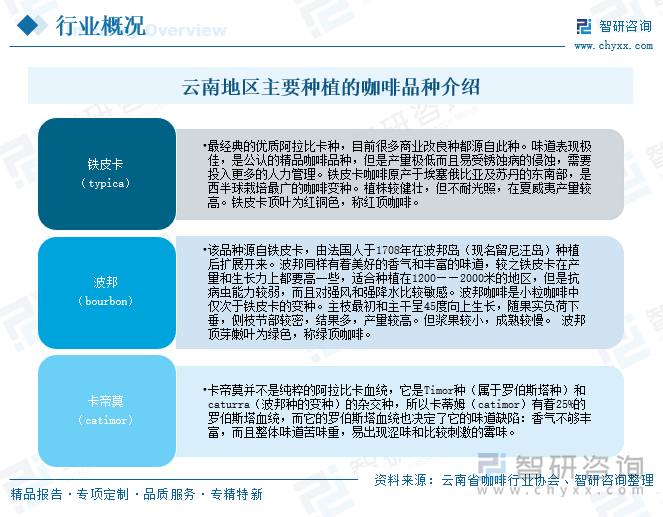
研判2025!云南咖啡产区分布、发展历程、产业链、市场政策、生产现状、竞争格局及发展趋势分析:种植规模持续扩大[图]
Chan Ye Xin Xi Wang· 2025-08-14 01:33
Overview - Yunnan is the largest coffee production base in China, with significant support from the provincial government, making the coffee industry a key sector for agricultural and rural economic development [1][14] - In 2023, the coffee planting area in Yunnan reached 76,400 hectares, with a harvest area of 67,800 hectares and a production volume of 143,400 tons, projected to increase to 150,200 tons in 2024 [1][14] Development History - The history of coffee cultivation in Yunnan began in 1904, with the first coffee seedling planted in Dali, and significant development occurred after 1951 with the introduction of coffee seedlings [5] - The industry saw a shift towards the Catimor variety around 2000, which is suitable for instant coffee production, but faced challenges leading to a focus on quality improvement and brand building in recent years [5][26] Industry Chain - The coffee industry chain in Yunnan includes upstream activities such as coffee planting and raw bean trading, midstream processing including initial and deep processing, and downstream sales through various channels [8] Market Policies - Recent policies from the Yunnan provincial government aim to promote high-quality development in the coffee industry, including action plans for specific regions and financial support for coffee cooperatives [11][13] Current Status - The coffee industry in Yunnan has rapidly developed, becoming a distinctive advantage for economic growth and farmer income, with a significant increase in planting and production areas [14] Competitive Landscape - The coffee market in Yunnan has seen the emergence of influential brands, with notable companies recognized in various coffee competitions, indicating a growing competitive environment [16][17] Development Trends - The trend towards enhancing coffee quality is expected to continue, with a decrease in the proportion of the Catimor variety and an increase in the cultivation of higher-quality varieties like Geisha and Typica [26]