
宏观经济

Search documents
从泰勒规则说起:美联储是否面临信誉危机?
伍治坚证据主义· 2025-09-11 02:13
Core Viewpoint - The article discusses the divergence between the Federal Reserve's actions and the Taylor Rule, highlighting the implications of this deviation on inflation and economic stability in the U.S. [2][3] Group 1: Taylor Rule and Federal Reserve Actions - The Taylor Rule suggests that the Federal Reserve should raise interest rates when inflation is high or the economy is overheating, and lower rates during economic downturns. However, post-pandemic, the Fed deviated significantly from this rule, with inflation reaching 9% while the Fed only raised rates to 5.5%, creating a gap of 5-6 percentage points [2][3]. Group 2: Economic Conditions and Risks - Despite the Fed's deviation from the Taylor Rule, inflation has decreased without a recession, attributed to the Fed's strong reputation as an "inflation fighter." However, this credibility is not infinite, and future inflation may not be managed as easily if the Fed's reputation is compromised [3][4]. - Current macroeconomic indicators show weak growth, with GDP averaging 1.4% in the first half of the year and a decline of 0.5% in Q1, followed by a rebound to 3.3% in Q2. However, consumer spending remains weak, and the labor market is showing signs of decline [4][5]. Group 3: Policy Challenges - The U.S. faces challenges from tariffs and immigration policies that are expected to increase inflation and hinder growth. Historical precedents suggest that high tariffs can lead to economic downturns, similar to the Smoot-Hawley Tariff of 1930 [4][5]. - The tightening of immigration policies is leading to labor shortages, which in turn raises wages and inflation without improving productivity. This combination of tariffs and immigration restrictions is creating a self-inflicted stagflation scenario [5]. Group 4: Market Dynamics and Economic Vulnerability - The stock market's performance is heavily reliant on the wealthiest households, which contribute significantly to consumer spending. A downturn in the stock market could expose vulnerabilities in the broader economy, particularly among middle and lower-income consumers [5][6]. - The article concludes that the U.S. economy is at risk of entering a "policy-induced stagflation trap," driven by tariffs, immigration restrictions, and diminishing fiscal space, alongside the erosion of the Fed's credibility and independence [6].


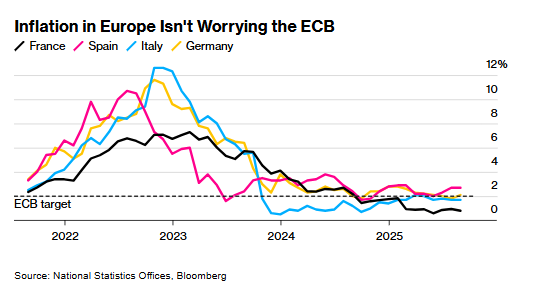
欧元区物价走势现分化!德国通胀意外加速 突破央行2%目标上限
Zhi Tong Cai Jing· 2025-08-29 13:10
Group 1 - Germany's inflation rate rose to 2.1% in August, exceeding economists' expectations of 2%, driven by rising food costs and a slowdown in energy price declines [1][3] - Other major Eurozone countries reported lower-than-expected inflation rates, with France at 0.8%, Italy at 1.7%, and Spain at 2.7% [1] - The European Central Bank (ECB) is expected to maintain its interest rates at 2% in the upcoming meeting, as officials believe inflation risks are "generally balanced" [3] Group 2 - The ECB's survey indicated that consumer inflation expectations remained stable for the next 12 months, with only a slight increase for the next three years [3] - Germany's central bank anticipates inflation rates to exceed 2% in the coming months, primarily due to base effects, but considers this increase to be "temporary" [3] - Despite the rise in inflation, Germany's economy is still recovering slowly after two years of contraction, putting pressure on Chancellor Merz [3] Group 3 - Germany's unemployment rate remains stable at 6.3%, with a slight decrease of 9,000 in seasonally adjusted unemployment figures, despite the number of unemployed surpassing 3 million [4]
日本6月实质薪资连续第六个月下降,引发经济复苏担忧
Sou Hu Cai Jing· 2025-08-06 00:28
Group 1 - Japan's real wages fell for the sixth consecutive month in June, raising concerns about the consumption-driven recovery of the world's fourth-largest economy, with a year-on-year decline of 1.3% after adjusting for inflation [1] - The core inflation rate in Japan has exceeded the Bank of Japan's target, potentially providing room for interest rate hikes, although geopolitical and tariff factors are increasing economic risks [1] - Despite a 3% year-on-year increase in special payments in June due to summer bonuses, it has not kept pace with rising inflation, indicating broader pressures on consumer spending [1] Group 2 - Nominal overall cash earnings increased by 2.5% in June, reaching 511,210 yen, marking the largest increase in four months, and surpassing the revised 1.4% increase in May [1] - Basic wages rose by 2.1%, while overtime pay increased by 0.9%, highlighting the importance of wage trends in maintaining consumer momentum [1]
IMF提高2025—2026年拉美增长预期
Shang Wu Bu Wang Zhan· 2025-08-01 15:42
Core Viewpoint - The International Monetary Fund (IMF) has revised its economic growth forecasts for Latin America, projecting a growth of 2.2% in 2025 and 2.4% in 2026, indicating a slight improvement compared to previous estimates [1] Summary by Relevant Categories Economic Growth Projections - Latin America's economic growth is expected to reach 2.2% in 2025, an increase of 0.2 percentage points from April's forecast, and 2.4% in 2026 [1] - Brazil's growth is projected at 2.3% for 2025, up by 0.3 percentage points, and 2.1% for 2026, an increase of 0.1 percentage points [1] - Mexico is expected to grow by 0.2% in 2025, an increase of 0.5 percentage points, and maintain a growth of 1.4% in 2026 [1] - Argentina's growth forecast remains at 5.5% for 2025 and 4.5% for 2026, unchanged from April [1] Comparative Performance - Despite the upward revision, Latin America's growth continues to lag behind other emerging markets and developing countries, which are projected to grow by 4.1% in 2025 and 4% in 2026 [1]
欧元区二季度经济环比增长0.1%
Xin Hua She· 2025-07-30 12:33
Group 1 - The Eurozone GDP grew by 0.1% quarter-on-quarter in Q2, while the EU GDP grew by 0.2% [1] - Year-on-year, the Eurozone GDP increased by 1.4% in Q2, and the EU GDP rose by 1.5% [1] - In Q1, the Eurozone GDP grew by 1.5% year-on-year, and the EU GDP increased by 1.6% [1] Group 2 - Germany, the largest economy in the EU, saw a GDP contraction of 0.1% in Q2, while France and Spain experienced growth of 0.3% and 0.7% respectively [1] - Italy's GDP also contracted by 0.1%, and Ireland's GDP shrank by 1% in Q2 [1] - The final GDP figures for Q1 showed a quarter-on-quarter growth of 0.6% for the Eurozone and 0.5% for the EU [1] Group 3 - Analysts indicate that the recent trade agreement between the US and EU may weaken EU export competitiveness due to high tariffs [1] - Increased investment from the EU to the US and the relocation of some production from Europe to the US could negatively impact local industry development and employment in the EU [1] - These factors are likely to drag down the economic growth prospects for the EU [1]
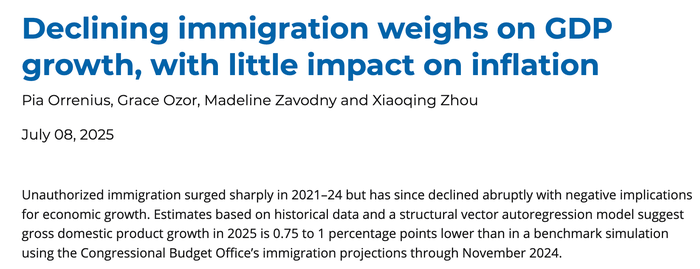
美达拉斯联储:移民限制将在今年打击美国经济
news flash· 2025-07-09 00:08
Core Insights - The Dallas Federal Reserve's report indicates that a significant reduction in immigration across the southern border, coupled with the Trump administration's intensified deportation efforts, could lead to a decrease of approximately 0.8 percentage points in the U.S. GDP growth rate by 2025 [1] Economic Impact - The primary factor contributing to the anticipated GDP decline is the reduction in cross-border migration rather than deportations, accounting for 93% of the expected GDP drop [1] - In a scenario of "mass deportation," where 1 million individuals are removed annually until the end of 2027, the annual GDP growth rate could decrease by nearly 0.9 percentage points by the end of 2025 and by 1.5 percentage points by the end of 2027 [1] Research Limitations - Researchers acknowledge that their findings are "highly uncertain" due to the limited historical data available [1]
高债务实质是“老年病”——拉长时间看国家由盛转衰
李迅雷金融与投资· 2025-06-08 07:36
Group 1 - The article discusses the high levels of government debt in developed countries, with Japan exceeding 250% and the US around 125%, while emerging economies maintain lower debt levels, such as ASEAN countries at approximately 30-40% [1] - It raises the question of whether economic development leads to increased debt levels and the potential for countries to collapse under high debt burdens [1] - The article suggests that the phenomenon of high debt is akin to an "aging disease" affecting economies, indicating a slow decline in economic vitality [30] Group 2 - The article highlights that global public debt is projected to reach 95.1% of GDP, potentially rising to 99.6% by 2030, with significant increases following crises such as the 2008 financial crisis [7][10] - It notes that developed countries have higher average macro leverage ratios compared to developing countries, with developed nations at 255% and developing nations at 217% as of Q3 2024 [7][10] - The article emphasizes that the rapid increase in government debt is driven by factors such as economic stagnation, demographic changes, and the need for increased military spending [10][32] Group 3 - The article discusses the implications of aging populations on economic structures, with rising dependency ratios leading to increased fiscal pressures and healthcare costs [30][32] - It points out that the global average life expectancy has risen significantly, which correlates with higher incidences of age-related diseases, further straining healthcare systems [4][5] - The article suggests that the economic decline of nations may mirror the aging process, where the vitality of economies diminishes over time, similar to biological aging [20][30] Group 4 - The article compares the life cycles of nations to those of individuals and corporations, noting that while nations can endure for long periods, they also experience phases of growth and decline [20][21] - It highlights historical examples of once-dominant nations that have since declined, such as Spain and the UK, drawing parallels to current economic trends in developed countries [22][24] - The article concludes that the current global economic landscape is characterized by high debt levels and aging populations, which may lead to prolonged periods of economic stagnation [30][32]

受多重因素影响,印尼推出约15亿美元“夏季经济刺激计划”
Huan Qiu Shi Bao· 2025-06-04 23:01
Group 1 - Indonesia's government has launched an economic stimulus plan worth 24.44 trillion Indonesian rupiah (approximately $1.5 billion) aimed at boosting consumption and economic growth during the school holiday period from June to July [1] - The stimulus plan includes five key policies: transportation discounts, social assistance, wage subsidies, and toll road incentives, with the goal of maintaining a 5% economic growth rate in the second quarter [1] - Economic challenges are evident, with GDP growth projected at 4.87% in Q1 2025, down from 5.04% in Q4 2023 and 5.02% in Q4 2024, alongside rising unemployment and declining consumer purchasing power [2] Group 2 - The summer economic stimulus plan has sparked discussions domestically, reflecting the government's confidence in achieving the 5% growth target, and emphasizing a long-term strategy to expand domestic demand as a growth engine [3] - The plan aims to enhance the overall investment attractiveness of the Southeast Asian region, showcasing economic resilience, consumer vitality, and industrial upgrades [3] - However, the plan faces challenges due to poor inter-departmental coordination, with several relevant departments unaware of the policy, potentially undermining its effectiveness [3]
34年来首次!日本这一全球地位被德国超越
Mei Ri Jing Ji Xin Wen· 2025-05-27 02:16
Group 1 - Japan's net foreign assets reached 533.05 trillion yen by the end of 2024, marking a 12.9% increase from the previous year and a record high for six consecutive years [1] - Japan has fallen to the second position as the world's largest net creditor nation, overtaken by Germany, which has net foreign assets of 569.65 billion yen [1] Group 2 - Japan's GDP experienced a quarter-on-quarter decline of 0.2% and an annualized decrease of 0.7% in Q1 2025, marking the first negative growth in a year [3][4] - The decline in Japan's economy is attributed to weak consumer spending and poor export performance [4] Group 3 - Personal consumption, which accounts for over half of Japan's economy, showed nearly zero growth in Q1, primarily due to rising prices affecting consumer capacity and willingness [5] - Exports of goods and services fell by 0.6%, while imports increased by 2.9%, indicating a negative impact on economic growth from trade dynamics [6] Group 4 - The Japanese government has allocated 388 billion yen from its reserve fund to address the economic challenges posed by U.S. tariff measures, with specific allocations for energy subsidies and local government support [8]

德专家:美贸易政策是德国经济面临的最大不确定性
news flash· 2025-04-30 10:44
Core Points - Germany's GDP showed a slight recovery of 0.2% in the first quarter of this year according to preliminary data from the Federal Statistical Office [1] - Economic experts have warned that the outlook for Germany's economic recovery remains grim, with the possibility of a recession re-emerging in the summer [1]