
寿险

Search documents
野村东方国际:日本央行加息的背景、展望及影响
野村· 2025-12-22 15:47
Investment Rating - The report indicates a positive outlook for the Japanese economy, suggesting a shift from extreme monetary easing to a neutral interest rate, with expectations of further policy adjustments in the future [1][4][7]. Core Insights - Japan's economy is gradually recovering, with inflation nearing the 2% target, prompting the Bank of Japan to end its ultra-loose monetary policy [1][4]. - The market has largely priced in the December interest rate hike, and the yen depreciated post-hike, but concerns about the Bank of Japan lagging behind have been alleviated [1][4]. - The government's proactive fiscal expansion policy, while increasing debt pressure, is deemed manageable without triggering systemic shocks [1][4][6]. - The likelihood of significant market disruption from the interest rate hike is low due to effective communication from the Bank of Japan and the distinct nature of this rate hike compared to previous instances [1][5]. Summary by Sections Economic Recovery and Monetary Policy - Japan's potential economic growth is expected to remain above 0.5%, supported by fiscal stimulus measures projected to boost GDP by approximately 0.3% in the first half of 2026 [2][4]. - Core inflation is anticipated to gradually rise back to near 2%, despite a potential temporary dip below this threshold in early 2026 [2][4][7]. Market Reactions and Financial Institutions - The banking sector has outperformed the Tokyo Stock Exchange index, benefiting from improved core profitability and low credit costs, despite facing unrealized losses from rising bond yields [2][21]. - Japanese financial institutions are expected to manage risks effectively, reducing the likelihood of systemic risks despite holding significant amounts of government bonds [6][19]. Fiscal Policy and Debt Management - The new government's fiscal policy is characterized as "active but responsible," focusing on balancing economic growth with debt sustainability [18][15]. - Short-term interest payment pressures are manageable, but long-term risks are significant, with projections indicating that new interest payments could match current social security expenditures by 2034 [16][13]. Global Market Implications - The interest rate hike by the Bank of Japan is expected to have a controlled impact on both the domestic financial system and global markets, with particular attention on the divergence between Japan's monetary policy and anticipated U.S. rate cuts in 2026 [23][24]. - The potential for Japanese institutions to sell U.S. Treasuries and repatriate funds is limited due to varying investment strategies among different types of institutions [11][12].
“三春服务 赋能一线”农银人寿积极开展春享暖意客户服务活动
Jin Rong Jie Zi Xun· 2025-12-22 04:09
Core Viewpoint - The company is launching the "Spring Enjoyment Warmth" health management service plan to enhance customer health value-added services and support business growth for 2025 and 2026 [1][3]. Group 1: Service Plan Details - The "Spring Enjoyment Warmth" service plan consists of three progressive levels: "Spring Enjoyment," "Spring Warmth," and "Spring Intention" [3]. - From January 1 to March 31, 2026, the company will provide health value-added services to different customer groups based on premium standards [3]. - "Spring Enjoyment" targets customers aged 55 and above, offering 24/7 telemedicine services for those with a premium of 10,000 yuan or more [3]. - "Spring Warmth" is for customers with a premium between 30,000 yuan and 200,000 yuan, providing telemedicine and outpatient green channel services [3]. - "Spring Intention" is for customers with a premium of 200,000 yuan or more, offering comprehensive services including telemedicine, outpatient green channel, medical accompaniment, critical illness green channel, emergency services, and post-hospitalization care [3]. Group 2: Market Context and Customer Feedback - The competition in the life insurance industry has shifted from product and channel differentiation to enhancing customer service experience [3]. - Customers increasingly desire value-added services that provide warmth and depth throughout their life cycle, which is essential for building trust and confidence [3]. - Previous telemedicine services for elderly customers received positive feedback, with nearly 300,000 elderly clients covered and 9,154 uses recorded by November 2025 [4]. - The new health service initiative reflects the company's commitment to a customer-centric approach, aiming to address real-life medical consultation challenges [4].


国寿平安太保泰康太平人保等八家寿险巨头投资收益率比拼,哪家公司更厉害?
Xin Lang Cai Jing· 2025-12-17 14:19
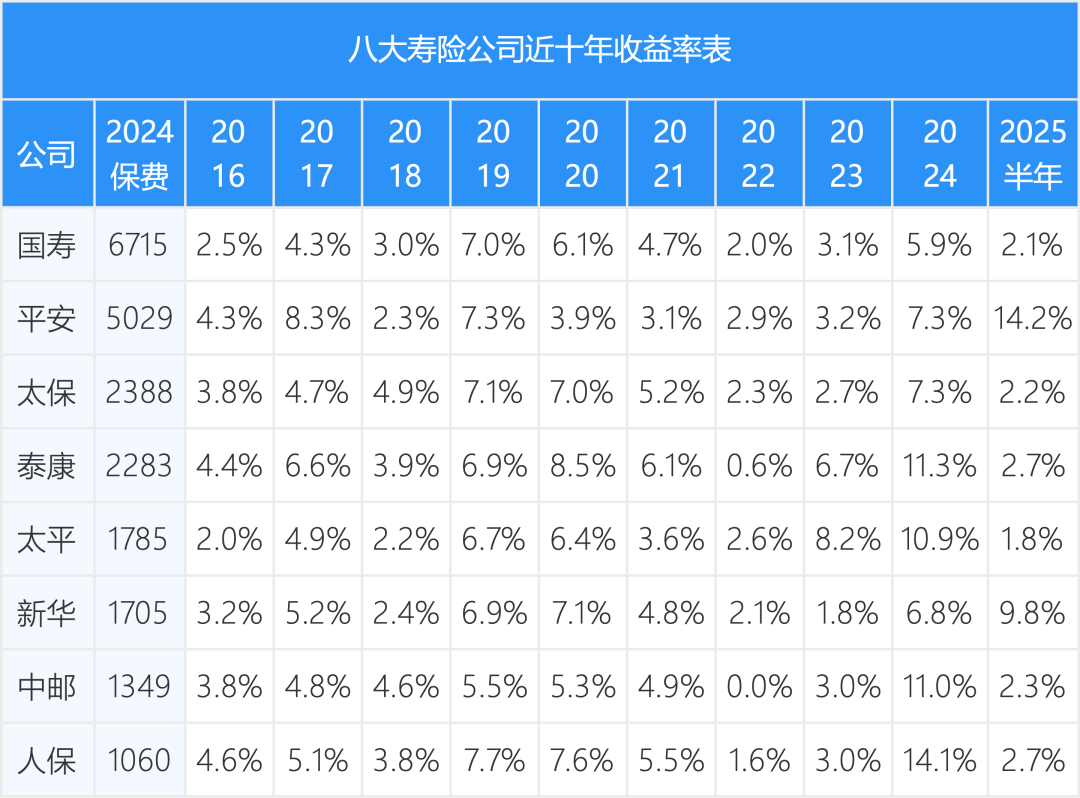
Core Insights - Investment is a core capability for life insurance companies, especially in the era of participating insurance [1][16] - There are significant differences in investment capabilities among major life insurance companies [1][16] - The analysis focuses on eight major life insurance giants with over 100 billion in premiums, which have consistently reported their investment returns for the past ten years [1][16] Investment Returns Overview - The eight major life insurance companies have shown varying investment returns over the past decade, with data presented for each company from 2014 to 2025 [1][16] - The companies included are: China Life, Ping An, Taikang, China Pacific, Taiping, Xinhua, Zhongrong, and PICC [1][16] - The investment returns for these companies are calculated as actual investment returns from 2014-2021 and comprehensive investment returns from 2022-2025 [1][16] Ten-Year Investment Yield Rankings - The top three companies in terms of cumulative investment returns over nine and a half years are Taikang Life (74.5%), Ping An Life (72.6%), and PICC (71.0%) [5][20] - The annualized returns for these companies are 6.0%, 5.9%, and 5.8% respectively [5][20] - There is a notable difference of over 20 percentage points in cumulative investment returns among the companies [20] Performance Consistency - Over the past decade, no company has consistently ranked first or last; five companies have ranked first at some point, and five have ranked last [6][21] - Ping An and PICC have each ranked first three times, while Taikang has ranked first twice [6][21] - The average rankings indicate that Taikang, PICC, and Ping An generally perform better [7][24] Head-to-Head Comparisons - In one-on-one comparisons, Taikang and PICC have the highest win rates against other companies [10][25] - The win-loss records show Taikang winning against Ping An 6:4, and against PICC 7:3, among others [10][25] - China Life has the lowest win rate, winning only 20 out of 100 matchups against the other companies [10][25] Investment Scale Impact - There is a significant difference in investment returns between PICC and China Life, which may be attributed to China Life's larger investment scale [14][29] - PICC has outperformed China Life in eight out of ten years [14][29]



寿险公司权益投资的"拉平收益率"
13个精算师· 2025-12-16 09:32
到今年二季度末,已经有32家寿险公司将HTM债券都转成了AFS债券,其中有28家公 司今年公布的投资收益率仍然是I 3 9下的口径,这包括老七家中的五家公司(只有国寿 和太保寿还没有转)。另外国华和合众今年已经不再公布偿付能力报告了。 今年三季度是债券市场的熊市,10年期到30年期国债和地方债收益率大约上升了2 0到3 6 b p。绝大多数公司的债券久期(不含久期很短的非标投资)都在10年到20年之间,债 券投资的仓位占可投资资产的比例通常在45%到75%之间,对于已经没有HTM债券的公 司来说,三季度债券价格下跌将给公司整体带来- 1. 4%到- 3.0%的投资收益率,公司的 净投资收益率通常在0 . 7%左右,二者相加在一起的贡献在- 0 . 6%到- 2 . 4%之间,那么公 司权益投资带来的收益率贡献(不含已经归属于净资产收益率中的股票和基金分红)等 于 三 季 度 的 综 合 收 益 率 减 去 0.6% 到 2.4% 之 间 的 某 个 数 , 通 常 我 们 会 选 1 . 5% 为 最 佳 估 计,然后再参考20 24年综合收益率及其他相关信息加以微调,最后的误差应该在0 . 5% 之内。当然 ...

券商晨会精华 | 国内首款脑机接口半侵入式产品将提交注册 脑机临床和商业化进展加速
智通财经网· 2025-12-09 00:44
Market Overview - The market opened high and closed with significant gains, with the Shanghai and Shenzhen stock exchanges recording a total turnover of 2.04 trillion yuan, an increase of 310.9 billion yuan compared to the previous trading day, marking a return to over 2 trillion yuan after 20 trading days [1] - The Shanghai Composite Index rose by 0.54%, the Shenzhen Component Index increased by 1.39%, and the ChiNext Index surged by 2.6% [1] Brain-Computer Interface Industry - CITIC Securities reported that the first domestic semi-invasive brain-computer interface product will be submitted for registration, indicating accelerated clinical and commercialization progress [2] - It is anticipated that government support for the brain-computer interface industry will continue, leading to increased investment opportunities as clinical and commercial implementations speed up [2] - The valuation of listed companies related to brain-computer interfaces has risen this year, which is expected to stimulate financing in the primary market and lead to a reconstruction of valuations for related companies [2] Life Insurance Industry Trends - CICC identified five key trends in the life insurance industry to watch for by 2026: 1. Continued rapid growth of new business, embracing "deposit migration" and a "new era of health insurance" 2. Further reduction in the rigid costs of new business, enhancing the persuasive power of new business value 3. Diversification of new business product structures, with significant optimization in the business structures of quality companies 4. An upward migration of customer tiers within the industry, prompting upgrades in operational models and talent 5. A concentration of competition among companies with strong life insurance operational capabilities [3] Securities Industry Outlook - Guojin Securities noted that with regulatory guidance, the operations of securities companies are expected to become more resilient, allowing quality brokers to further increase their leverage limits and improve ROE levels [4] - The current price-to-book (PB) ratio for the sector is only 1.36 times, and the sector has underperformed the Shanghai Composite Index by 15 percentage points since the beginning of the year [4] - Historical profit growth and the performance of the sector suggest that stock prices and valuations are significantly lagging behind performance, indicating potential for valuation recovery [4]



中金:2026年寿险行业将再入黄金发展期,保险业投资重回给予成长能力估值溢价
Zhi Tong Cai Jing· 2025-12-08 06:14
Group 1: Life Insurance Industry Outlook - The life insurance industry is expected to enter a new growth cycle by 2026, with a more positive trend in liabilities and a shift in investment logic from "seeking revaluation of existing business" to "valuing growth potential" [1] - Five key trends are identified for the life insurance sector: 1) Continued rapid growth of new business, embracing "deposit migration" and a "new era of health insurance"; 2) Decrease in rigid costs of new business, enhancing the value proposition; 3) Diversification of new business product structures and optimization of quality companies' business structures; 4) Upward migration of customer tiers and optimization of operational models and talent; 5) Concentration of competition among companies with strong life insurance operational capabilities [1] Group 2: Property Insurance Sector Insights - The property insurance sector is projected to see slow growth in auto insurance premiums, with leading companies optimizing their business structures to improve underwriting profitability; new energy vehicle insurance is gradually moving towards profitability [2] - Non-auto insurance growth is expected to decelerate under low inflation, while health insurance is anticipated to become a significant growth driver; after the "reporting and operation integration," large companies' non-auto underwriting profitability is likely to rise [2] Group 3: Hong Kong Life Insurance Market - Hong Kong life insurance companies, such as AIA, have faced declines due to foreign concerns about Chinese assets and doubts about the mainland insurance industry's prospects; however, by 2026, a shift in foreign attitudes and a return to a golden development period for the mainland insurance industry may enhance the growth trends and business structures of these Hong Kong firms, making their mainland operations a key investment highlight [3]
员工被举报接受高档宴请、KTV有偿陪侍,每次花费10万元不等,官方通报:立案调查,3人已停职
Mei Ri Jing Ji Xin Wen· 2025-12-06 01:30
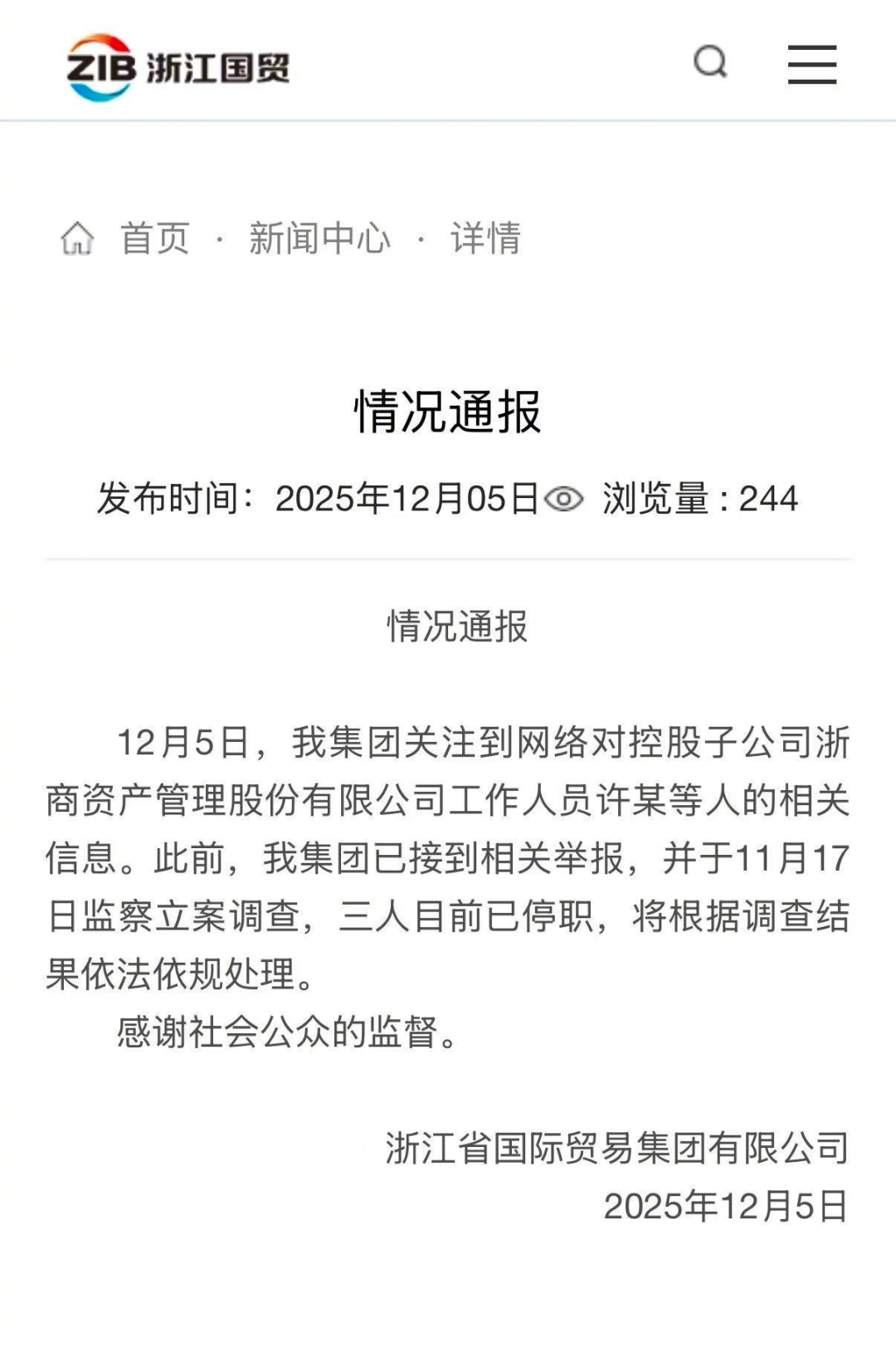
Core Viewpoint - Zhejiang International Trade Group Co., Ltd. has initiated an investigation into allegations of misconduct involving employees of its subsidiary, Zhejiang Merchants Asset Management Co., Ltd. [1][5] Group 1: Allegations and Investigation - Allegations surfaced on social media regarding misconduct by several management personnel at Zhejiang Merchants Asset, including accepting lavish banquets and paid companionship at KTV [5] - The group has confirmed that three employees, including Xu, have been suspended pending the outcome of the investigation, which was initiated after receiving reports on November 17 [1][5] - The reported misconduct includes extravagant hospitality expenses, with claims of over 500,000 yuan spent on receptions, including high-end liquor and entertainment [5] Group 2: Company Background - Zhejiang International Trade Group is a large state-owned enterprise established in 2008, with over 300 subsidiaries and more than 27,000 employees, ranking among China's top 500 enterprises [6] - The financial services segment of the group holds 12 financial and quasi-financial business licenses, with a focus on asset management and bad debt recovery, having acquired over 686.9 billion yuan in bad debt principal by the end of 2024 [6] - Zhejiang Merchants Asset, established in 2013, is a key player in the financial services sector, specializing in the acquisition and disposal of non-performing assets, investment banking services, and fund management [8]
上市寿险公司实际投资收益率与假设偏差比较:2010-2024年行业累积总投资收益率偏差-0.38%,综合投资收益率偏差0.66%
13个精算师· 2025-12-03 11:05
Core Insights - The long-term investment return assumption is a crucial parameter affecting the intrinsic value of life insurance companies, reflecting their expectations regarding capital market conditions and investment strategies. In 2024, most life insurance companies have lowered their long-term investment return assumption from 4.5% to 4.0% [9][11]. Investment Returns Analysis - From 2010 to 2024, listed life insurance companies had a total investment return that exceeded the long-term investment return assumption in only 5 out of 15 years, with the remaining 10 years showing negative deviations. The cumulative total investment return deviation for the industry is -0.38% [3][6][37]. - As of the first three quarters of 2025, the total investment return for the year is approximately 3.5%, slightly below the long-term investment return assumption of 4.0%. A strong performance in the fourth quarter could make 2025 the first year since 2020 to exceed the long-term investment return assumption [3][13]. Company-Specific Performance - In 2024, China Life's total investment return was 4.02%, while its comprehensive investment return was 5.94%, both exceeding the long-term investment return assumption of 4.0% [17][18]. - Ping An Life's total investment return for 2024 was 3.32%, with a comprehensive investment return of 7.25%, also above the long-term assumption [19][21]. - For 2024, Taikang Life's total investment return was 3.03%, while its comprehensive investment return was 7.33%, surpassing the long-term assumption [22][23]. - New China Life reported a total investment return of 3.56% and a comprehensive investment return of 6.84% for 2024, both exceeding the long-term assumption [24][25]. - PICC Life's total investment return was 3.70%, with a comprehensive investment return of 14.1%, significantly above the long-term assumption [28][29]. - AIA's estimated long-term investment return assumption for 2024 is 3.4%, which is below the 4.0% threshold, indicating a cautious outlook [30][33]. Summary of Deviations - The average deviation of total investment returns from long-term assumptions for the industry is -0.38%, while the average deviation for comprehensive investment returns is 0.66%. Companies like PICC Life and AIA show better performance with positive deviations [37][38].
东方嘉富人寿迎“80后”女董事长!总经理空悬3个月
Sou Hu Cai Jing· 2025-12-03 07:10
作者 | 刘银平 编辑 | 付影 来源 | 独角金融 在东方嘉富人寿官宣董事长人选近两年后,何欣的董事长任职资格在11月26日终获监管核准,意味着这 位"80后"女将正式走马上任。不过公司总经理一职仍然空悬,8月份,前总经理张希凡因个人原因辞 职,正式任职不到8个月。副总经理刘大勇被任命为临时负责人,代履总经理职务至今。 自2022年大股东浙江东方增持之后成为单一最大股东以来,东方嘉富人寿经历了更名及高层人员大调 整,如今领导班子仍处于边调整、边补位阶段。 与频繁人事更迭相伴的是公司长期面临的盈利挑战。在成立的前12年,东方嘉富人寿仅有一年略微盈 利,其他11年均为亏损状态,累计亏损超15亿元。2024年以来,在保费收入大幅增长的驱动下,实现扭 亏为盈。在调整后的新领导班子带领下,这一良好的业绩能否持续? 东方嘉富人寿的前任董事长为金朝萍,出生于1975年7月,为浙江东方金融控股集团股份有限公司(简 称"浙江东方",600120.SH)体系内老将,2019年4月出任东方嘉富人寿董事长,彼时公司成立6年多, 一直到2024年1月10日因工作调动卸任。执掌东方嘉富人寿时间4年多,但业绩并不理想,2019-2023 ...

2025年寿险公司净资产的运营变化
13个精算师· 2025-12-01 09:48
Core Viewpoint - The life insurance industry appears to be thriving with reported profits of 460 billion RMB in the first three quarters of the year, but a deeper analysis reveals a concerning decline in net assets under the CGAAP standards, indicating underlying financial pressures [1][2]. Summary by Sections 1. Changes in Net Assets under CGAAP - Despite a reported increase of 222 billion RMB in net assets for companies that disclosed third-quarter results, most life insurance companies experienced a decline in net assets under the old CGAAP standards, primarily due to rising long-term interest rates and poor performance in equity investments [2][3]. - The average return of high-dividend stocks, heavily weighted in the life insurance sector, fell significantly, with only a few companies outperforming the 18% return of the CSI 300 index in the third quarter [2][3]. 2. Implementation of New Accounting Standards (IFRS 17) - Several established life insurance companies have adopted the IFRS 17 accounting standards, leading to higher reported profits compared to the old CGAAP standards. This shift has resulted in changes in liability assessment curves that positively impact comprehensive income [3][4]. - The transition to IFRS 17 allows for the exclusion of certain losses from financial statements, enhancing the reported profitability of companies that have adopted the new standards [4][5]. 3. Net Asset Operational Changes - The operational change in net assets for the life insurance sector was negative 99 million RMB, with only 20 companies reporting positive growth. The "old seven" companies saw a 4% increase, while foreign and small domestic companies experienced declines of 16% and 11%, respectively [10][11]. - The banking-affiliated companies faced the most significant decline in net assets, with a drop of 24%, attributed to their high leverage ratios and the reclassification of HTM assets to AFS [11][12]. 4. Factors Influencing Net Asset Changes - The average yield curve for interest rates increased by 25 basis points, leading to a decline in the market value of existing AFS bonds, estimated to be a loss of 200 to 300 billion RMB for the industry [14][15]. - If the asset and liability assessment curves had remained unchanged, the net assets of the companies could have increased by 500 to 600 billion RMB, primarily driven by excess returns from equity investments [15][16]. 5. Future Implications of IFRS 17 - Starting in 2026, all insurance companies in China will implement IFRS 17, which is expected to provide better alignment between asset and liability assessment curves, potentially offering a protective effect on net assets, especially for traditional insurance products [19][21]. - The focus on duration matching will become increasingly important under the new standards, as it will significantly influence the net assets and solvency of companies in the future [18][19].

