
高技术制造

Search documents
锐财经丨工业经济持续向优向新发展
Ren Min Ri Bao Hai Wai Ban· 2026-01-26 03:07
Group 1: Industrial Growth and Performance - In 2025, the industrial added value of large-scale industries increased by 5.9% compared to the previous year, showing a faster growth rate, up by 0.1 percentage points [2] - The mining, manufacturing, and electricity, heat, gas, and water production and supply industries saw added value growth of 5.6%, 6.4%, and 2.3% respectively [2] - Among 41 major industrial categories, 36 experienced growth, resulting in a growth coverage of 87.8% [2] Group 2: Export Performance - Large-scale industrial enterprises achieved an export delivery value of 15.8 trillion yuan, a 2.2% increase from the previous year, demonstrating strong resilience [2] - The equipment manufacturing sector showed significant export performance, with railway, shipbuilding, aerospace, and specialized equipment exports increasing by 24.2%, 10.2%, and 7.5% respectively [2] Group 3: Profit Structure Improvement - From January to November 2025, profits of large-scale industrial enterprises continued to grow, with the equipment manufacturing sector's profits increasing by 7.7%, contributing 2.8 percentage points to the overall profit growth of large-scale industrial enterprises [2] Group 4: High-tech Manufacturing Growth - In 2025, the added value of high-tech manufacturing increased by 9.4%, the highest growth rate since 2022, contributing 26.1% to the overall industrial growth [5] - Specific industries such as integrated circuit manufacturing, aircraft manufacturing, and biopharmaceuticals saw added value growth rates of 26.7%, 24.8%, and 12.1% respectively [5] Group 5: Digital Product Manufacturing - The added value of the digital product manufacturing industry grew by 9.3% in 2025, contributing 20.3% to the overall industrial growth [7] - Production of communication products like mobile communication base station equipment and 5G smartphones increased by 13.5% and 12.5% respectively [7] Group 6: Technological Innovation and Product Development - Companies are focusing on technological and industrial innovation, with examples like the AI-powered unmanned bulldozer deployed in complex mining environments [4] - New technologies such as perovskite materials and quantum computing are advancing rapidly, with successful prototypes being developed [4] Group 7: Consumer Supply and Market Trends - The industrial sector is adapting to new consumption trends, with a focus on optimizing product supply and enhancing brand development [8] - The integration of 5G, industrial internet, and other technologies into various sectors is expected to support the digital transformation of the economy [8]
3.9万亿元研发经费投入厚蓄硬核实力
Jing Ji Ri Bao· 2026-01-26 02:43
Group 1 - The core point of the article highlights China's significant investment in R&D, reaching 39,262 billion yuan, with an R&D intensity of 2.8%, marking a new milestone in the country's technological development and surpassing the OECD average for the first time [1] - Continuous increase in R&D investment is attributed to the synergy of policy guidance, market drive, and active participation from enterprises [1] - The top-level design has established a solid institutional foundation for technological innovation, with systematic measures empowering high-level technological self-reliance and strength as a strategic support for modernization [1] Group 2 - China's innovation indicators are improving, with the country ranking in the top ten globally for innovation index and surpassing 5 million effective invention patents, while leading the world in PCT international patent applications for six consecutive years [2] - The speed of industrial upgrading is accelerating, with the added value of equipment manufacturing and high-tech manufacturing industries expected to reach 36.8% and 17.1% of the total industrial added value by 2025 [2] - Key breakthroughs have been achieved in fields such as artificial intelligence, quantum computing, and new energy, with the number of AI companies exceeding 6,000 and the core industry scale projected to surpass 1.2 trillion yuan by 2025 [2] Group 3 - Despite notable achievements, there is still room for improvement in the structure and efficiency of R&D funding, particularly in increasing the proportion of basic research [3] - There is a need to promote balanced regional development, as R&D resources are currently concentrated in the eastern regions, requiring policy guidance and collaboration to bridge the gap with central and western regions [3] - Enhancing the mechanism for converting research results into market applications is essential to prevent technological achievements from remaining unused [3]
工业经济持续向优向新发展
Ren Min Ri Bao Hai Wai Ban· 2026-01-26 01:16
Group 1 - The Ministry of Industry and Information Technology announced the 2025 National Key R&D Program for the industrialization of high-tech achievements, highlighting advancements in ultra-high energy density dielectric materials, large-tonnage carbon fiber composite materials, and high-performance sealing components for aerospace hydraulic systems [1] - In 2025, the industrial added value of large-scale industries increased by 5.9% compared to the previous year, with mining, manufacturing, and electricity, heat, gas, and water production and supply sectors growing by 5.6%, 6.4%, and 2.3% respectively [2] - The export delivery value of large-scale industrial enterprises reached 15.8 trillion yuan, a 2.2% increase from the previous year, showcasing resilience, particularly in the equipment manufacturing sector, which saw significant export growth in railways, ships, and aerospace [2] Group 2 - The high-tech manufacturing sector's added value grew by 9.4% in 2025, contributing 26.1% to the overall industrial growth, with notable increases in integrated circuit manufacturing, aircraft manufacturing, and biopharmaceuticals [5] - The digital product manufacturing sector's added value increased by 9.3%, contributing 20.3% to the overall industrial growth, with significant production increases in mobile communication base station equipment and 5G smartphones [6][7] - The Ministry of Industry and Information Technology emphasized the importance of optimizing product supply to support consumption upgrades and enhance consumer vitality, focusing on smart, green, and integrated development in the consumer goods industry [7]
新华社:透视“十四五”收官之年工业和信息化发展成效
Xin Hua She· 2026-01-26 01:14
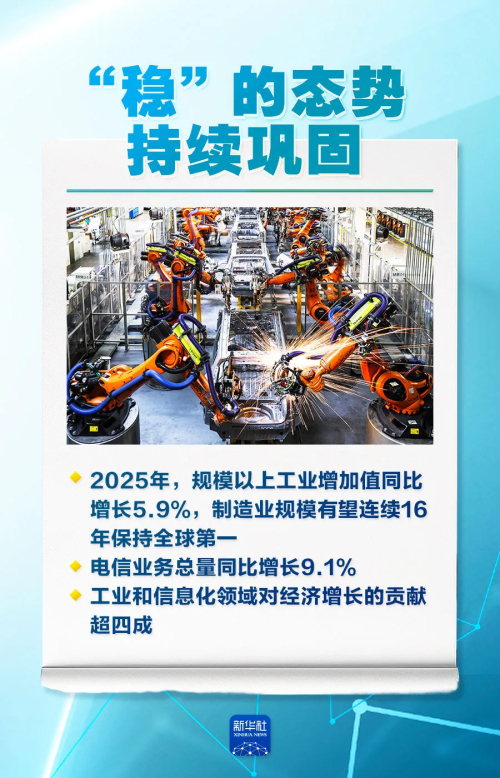
Core Insights - The industrial economy in China is showing steady growth, with a year-on-year increase of 5.9% in industrial added value for large-scale enterprises, and the manufacturing sector maintaining its position as the world's largest for 16 consecutive years [2][8] - The contribution of the industrial and information technology sectors to economic growth exceeds 40%, indicating their critical role in the national economy [2][7] Group 1: Industrial Growth and Achievements - The added value of equipment manufacturing and high-tech manufacturing increased by 9.2% and 9.4% year-on-year, respectively [9] - Over 35,000 basic-level, 8,200 advanced-level, 500 excellent-level, and 15 leading-level smart factories have been established [9] - More than 8,000 national green factories have been cultivated, contributing to energy and water consumption reduction in large-scale industrial units [9] Group 2: Innovation and New Technologies - Significant advancements in technology include over 300 key technology reserves from the first phase of 6G trials, and a year-on-year increase of 26.7% and 23.9% in the added value of integrated circuits and electronic materials, respectively [10] - The production of industrial robots increased by 28%, and new energy vehicle sales reached 16.49 million units, marking a year-on-year growth of 28.2% [10] - The application of artificial intelligence in manufacturing has expanded significantly, with the scale of intelligent computing power reaching 1590 EFLOPS [4] Group 3: Support for Small and Medium Enterprises - A total of 17,600 specialized and innovative "little giant" enterprises and over 140,000 specialized and innovative small and medium enterprises have been cultivated [3][13] - The added value of specialized and innovative "little giant" enterprises in large-scale industries is expected to grow by 6.9% year-on-year [3] Group 4: Future Directions and Policies - The focus for the upcoming year includes stabilizing growth, enhancing innovation, promoting integration, optimizing governance, and preventing risks, with a strong push for new industrialization [6] - The industrial and information technology sectors will continue to support the transformation and upgrading of traditional industries through initiatives like "5G + industrial internet" [5]

工业经济持续向优向新发展(锐财经)
Ren Min Ri Bao Hai Wai Ban· 2026-01-25 22:49
Core Insights - The Ministry of Industry and Information Technology announced the 2025 National Key R&D Program for the industrialization of high-tech achievements, highlighting advancements in ultra-high energy density dielectric materials, large-tonnage carbon fiber composite materials, and high-performance sealing components for aerospace hydraulic systems [2] - In 2025, China's industrial production is expected to remain stable and improve, with significant growth in equipment manufacturing and high-tech manufacturing sectors, reflecting a shift towards high-quality industrial development [3][4] Industrial Growth - In 2025, the industrial added value of large-scale industries is projected to grow by 5.9% year-on-year, with mining, manufacturing, and electricity, heat, gas, and water production and supply sectors increasing by 5.6%, 6.4%, and 2.3% respectively [3] - Among 41 major industrial categories, 36 are expected to see growth, resulting in a growth coverage of 87.8% [3] - The export delivery value of large-scale industrial enterprises is anticipated to reach 15.8 trillion yuan, a 2.2% increase from the previous year, showcasing resilience in the face of external uncertainties [3] Profit Structure Improvement - From January to November 2025, profits of large-scale industrial enterprises are expected to grow, with the equipment manufacturing sector's profits increasing by 7.7%, contributing 2.8 percentage points to the overall profit growth of large-scale industries [3] Technological Innovation - The high-tech manufacturing sector's added value is projected to increase by 9.4% year-on-year, contributing 26.1% to the overall industrial growth, with significant growth in integrated circuit manufacturing (26.7%), aircraft manufacturing (24.8%), and electronic materials (23.9%) [6] - Innovations in AI and autonomous machinery, such as the deployment of the AI electric unmanned bulldozer in complex mining environments, demonstrate the industry's shift towards automation and efficiency [5] Digital Product Manufacturing - The added value of the digital product manufacturing sector is expected to grow by 9.3%, contributing 20.3% to the overall industrial growth, with notable increases in the production of mobile communication base station equipment (13.5%) and 5G smartphones (12.5%) [7] - The integration of new technologies like 5G, industrial internet, and robotics is expected to create vast market opportunities for rapid industrialization of new products [7][8]
理响中国丨“稳、进、新、韧”何以成就?一图解读2025年国民经济大数据
Yang Guang Wang· 2026-01-23 10:11
2025年,国民经济运行顶压前行、向新向优,高质量发展取得新成效,经济社会发展主要目标任务圆满实 现,"十四五"胜利收官。如何看待2025年经济运行的"稳、进、新、韧"?"十五五"开局之年,中国经济如 何再上台阶?央广网约请相关领域专家深入解读。 稳住了发展的底盘 巩固了发展的根基 国内生产总值首次跃上140万亿元新台阶 城镇调查失业率平均值是5.2%,就业保持总体稳定 货物贸易再创新高,外汇储备余额超过3.3万亿美元 经济量现 向优向好的发展势头 规模以上高技术制造业增加值占规模以上工业增加 值比重升到了17.1% 最终消费支出对经济增长贡献率超过了5成 货物进出口总额比上年增长3.8% 居民人均可支配收入实际增长5.0% 新质管之力 下断发展壮大 研发经费投入强度达2.8%,首次超过OECD国家平 均水平 我国创新指数排名首次进入全球前十 规模以上数字产品制造业增加值比上年增长9.3% 新能源汽车国内新车销量占比超过50% s - July 1 "量的跨越" "质的提升" 2025年中国经济的运行情况 世韧ツ "精" 雷诺" 出新" 对世界经济增长的贡献率预计达到30%左右 高技术产品出口额比上年增长13 ...

29座城市GDP超万亿
Di Yi Cai Jing Zi Xun· 2026-01-23 05:45
2026.01.23 本文字数:1515,阅读时长大约2分钟 作者 |第一财经 林靖 浙江省城市科学研究会副理事长汤海孺分析,温州本身就颇具特点,有很好的外部资源,温州人不仅仅 遍布全国各地,还走到了世界各地,资金、信息等资源丰富。近年来,温州通过做大平台等方式,也在 努力运用好这些资源优势。 汤海孺对第一财经表示,近年来温州在传统产业焕新、新兴产业培育等方面下了大力气,创造了良好的 条件。而重视科技发展与高校建设,把科技力量、高校做大做强之后,也能更加有效地支撑当地产业的 发展。同时,这些年浙江高铁等交通基础设施也持续完善,使得杭州的科教资源能够更有效地为温州产 业提升服务,助力当地经济的发展。 继温州和大连跻身GDP万亿城市行列后,当前GDP万亿城市已经增至29个,包括4个直辖市(北京、上 海、天津、重庆),11个省会城市(广州、成都、武汉、杭州、南京、长沙、郑州、合肥、福州、济 南、西安),4个计划单列市(深圳、宁波、青岛、大连),以及10个普通地级市(苏州、无锡、南 通、常州、佛山、东莞、泉州、烟台、唐山、温州)。 从经济总量看,上海、北京超过5万亿,深渝穗三市在3万亿以上,苏州、成都、杭州、武汉超过 ...
2025年中国经济的韧性、温度与担当
Qi Huo Ri Bao Wang· 2026-01-23 01:33
Economic Overview - In 2025, China's GDP reached 140.19 trillion yuan, achieving a year-on-year growth of 5.0%, successfully meeting annual expectations [3] - The growth occurred amidst global economic challenges, with major economies like the US, Eurozone, and Japan experiencing lower growth rates [3] - China's service sector contributed 61.4% to economic growth, highlighting the ongoing optimization of the industrial structure [3] Structural Optimization - New productive forces are becoming the core driver of China's economic growth, with significant increases in value-added from equipment manufacturing (9.2%) and high-tech manufacturing (9.4%) [4] - The digital economy is thriving, with online retail sales of physical goods growing by 5.2%, accounting for 26.1% of total retail sales [4] - High-tech product exports increased by 13.2%, indicating a successful transition from "Made in China" to "Created in China" [4] Policy Coordination - The Chinese government has implemented proactive macroeconomic policies to stimulate market vitality, including a moderately loose monetary policy [5][6] - Despite a 3.8% decline in fixed asset investment, investment in high-tech industries and livelihood sectors remained stable [5] Living Standards - In 2025, the per capita disposable income reached 43,377 yuan, reflecting a nominal growth of 5.0%, which aligns with economic growth [7] - The average urban unemployment rate was 5.2%, indicating stable employment conditions [7] - The Engel coefficient decreased to 29.3%, suggesting an improvement in living standards [7] Domestic and External Demand - Retail sales of consumer goods reached 50.12 trillion yuan, growing by 3.7%, with service retail showing robust growth [8] - Total import and export volume was 45.47 trillion yuan, with exports growing by 6.1% and imports by 0.5% [8] - Private enterprises accounted for 57.3% of total trade, reflecting a diversification in trade [8] Global Positioning - China's economic performance in 2025 is significant amid global economic disparities, providing a stabilizing force in international trade [10] - The country is committed to high-level opening up and reform, enhancing its competitive edge and creating new growth opportunities for global enterprises [10] Future Outlook - Despite external shocks and internal challenges, China's economic fundamentals remain strong, with ongoing technological innovation driving industrial upgrades [11] - The manufacturing PMI rose to 50.1, indicating a return to expansion, suggesting a buildup of internal economic momentum [11] - China's economy is positioned as a reliable stabilizer in the global landscape, contributing to global growth amidst uncertainties [11]

中经评论:经济发展新旧动能加快转换
Jing Ji Ri Bao· 2026-01-23 00:09
Group 1 - The core viewpoint emphasizes that the transition from old to new economic drivers is a complex process characterized by coexistence and mutual stimulation, leading to profound adjustments in industrial layout, employment structure, and regional economic patterns [1][5]. - By 2025, China's economy is projected to exceed 140 trillion yuan, showcasing resilience and a significant transformation towards a more advanced economic structure [1]. - High-tech manufacturing is expected to account for 17.1% of the industrial added value, with equipment manufacturing reaching 36.8%, both significantly outpacing the average industrial growth rate [1]. Group 2 - The consumer market is shifting from goods consumption to service consumption, with service retail expected to grow by 5.5% in 2025, outpacing goods retail growth by 1.7 percentage points [2]. - Investment in fixed assets is anticipated to decline by 3.8% in 2025, yet the investment structure is optimizing, focusing on technological innovation and upgrading industries [2]. - New consumption trends are emerging, with a focus on green and intelligent durable goods, driven by policies encouraging the replacement of old products [2]. Group 3 - The acceleration of the transition from old to new economic drivers is driven by policy guidance, market demand, and technological innovation, supported by China's large-scale market and complete industrial system [3]. - Future characteristics of this transition include integration across industries, enhanced resilience through diverse economic structures, and increased openness to global markets [4].
经济发展新旧动能加快转换
Jing Ji Ri Bao· 2026-01-22 21:59
Group 1 - The core viewpoint emphasizes that the transition from old to new economic drivers is a complex process characterized by coexistence and mutual stimulation, leading to profound adjustments in industrial layout, employment structure, and regional economic patterns [1][4] - By 2025, China's economy is projected to exceed 140 trillion yuan, showcasing resilience and a significant transformation towards a more advanced economic structure [1] - The high-tech manufacturing sector is expected to account for 17.1% of the industrial added value, with equipment manufacturing reaching 36.8%, both significantly outpacing the average industrial growth rate [1] Group 2 - The consumer market is shifting from goods consumption to service consumption, with service retail expected to grow by 5.5%, outpacing goods retail by 1.7 percentage points [2] - Investment in fixed assets is anticipated to decline by 3.8% in 2025, influenced by a decrease in real estate investment, yet the investment structure is optimizing towards technology innovation and industrial upgrades [2] - The transition is driven by policy guidance, market demand, and technological innovation, with China's large-scale market providing ample application scenarios and a complete industrial system fostering innovation [3] Group 3 - Future characteristics of the transition include integration across industries, resilience in economic structure, and a higher level of openness to global markets, which will introduce external resources for new economic drivers [4] - The process of transitioning will not be a simple linear replacement but rather a complex interplay of old and new, with emerging industries experiencing growth opportunities while traditional sectors face transformation challenges [4]