集成电路圆片

Search documents
29座万亿城市新格局:东北首现万亿之城,沪京并肩5万亿
2 1 Shi Ji Jing Ji Bao Dao· 2026-02-07 01:57
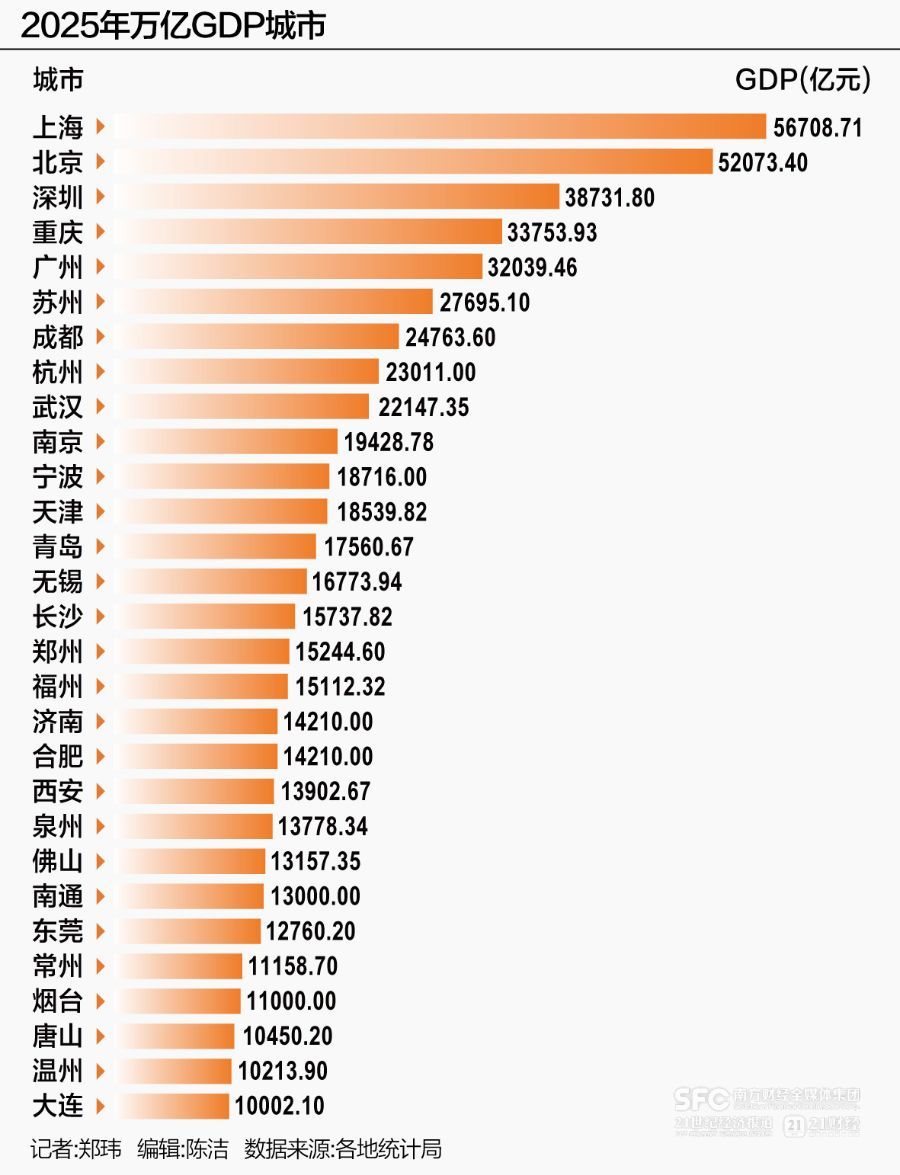
Core Insights - The economic landscape of Chinese cities is undergoing a transformation as Wenzhou and Dalian join the "trillion-yuan club," with Beijing and Shanghai also surpassing the 5 trillion yuan GDP mark, indicating a reshaping of the urban economic hierarchy [1][13][15] - The competition among these trillion-yuan cities is shifting from mere economic scale to a focus on quality of life, innovation ecosystems, and sustainable development [1][14] Economic Growth and Structure - By 2025, 29 cities in China are projected to have a GDP exceeding 1 trillion yuan, with Wenzhou and Dalian being the latest additions, while Shanghai and Beijing reach the 5 trillion yuan threshold [15][20] - Among these cities, 22 are expected to have GDP growth rates exceeding 5%, with Tangshan, Hefei, Yantai, and Wenzhou achieving over 6% [15][16] - The economic structure of these cities varies, with Shanghai and Beijing's growth driven by the tertiary sector, while Wenzhou and Dalian rely on robust industrial growth [16][21] Industrial Performance - In 2025, Beijing's GDP is projected to reach 52,073.4 billion yuan, with a 5.4% year-on-year growth, primarily driven by the information technology and financial sectors [18][19] - Shanghai's GDP is expected to hit 44,958.7 billion yuan, with a 6.0% growth rate, also supported by the service sector [19] - Wenzhou's industrial output is anticipated to grow by 10.3%, with significant contributions from the automotive and electrical industries [21][22] - Dalian's industrial output is projected to increase by 11.7%, with notable growth in the equipment manufacturing sector [22] Future Industry Focus - Many of these cities are now targeting artificial intelligence as a key industry for future development, with plans to integrate AI into various sectors [23][24] - Wenzhou aims to establish itself as a leader in AI innovation, while Dalian focuses on enhancing its digital economy and AI applications in traditional industries [24][25] - The emphasis on AI is seen as a means to drive technological advancement and improve overall economic quality [25][26] Urban Development Trends - The competition among cities is expected to evolve beyond GDP figures to include factors like technological innovation, cultural strength, and livability [26] - The development model is shifting from single-center cities to collaborative urban clusters, enhancing regional synergies and economic dynamism [26]
东北首现万亿GDP之城
21世纪经济报道· 2026-02-06 14:52
Core Insights - The article discusses the expansion of China's trillion-yuan cities, with 29 cities projected to reach this milestone by 2025, including Wenzhou and Dalian, which are new entrants to the trillion-yuan club [1][2][9] - The growth of these cities is characterized by varying economic structures, with leading cities like Shanghai and Beijing focusing on the tertiary sector, while new entrants like Wenzhou and Dalian rely on robust industrial growth [1][8][9] Group 1: Economic Growth and Structure - By 2025, 22 of the 29 trillion-yuan cities are expected to have GDP growth rates exceeding 5%, with Tangshan, Hefei, Yantai, and Wenzhou achieving over 6% [1][2] - Beijing's GDP is projected to surpass 5 trillion yuan for the first time, reaching 52,073.4 billion yuan with a growth rate of 5.4%, driven by significant contributions from the information technology and financial sectors [7][8] - Shanghai's GDP is also expected to grow, with the tertiary sector's value added reaching 44,958.7 billion yuan, growing at 6.0%, supported by strong performance in information technology services [8][9] Group 2: Industrial Performance - Wenzhou's GDP is projected to reach 10,213.9 billion yuan, growing by 6.1%, with significant contributions from the automotive and electrical industries, which saw increases of 19.0% and 13.6% respectively [9][11] - Dalian's GDP is expected to hit 10,002.1 billion yuan, with a growth rate of 5.7%, and notable growth in high-tech manufacturing, particularly in the computer and pharmaceutical sectors [10][11] Group 3: Future Industry Focus - Cities are increasingly focusing on artificial intelligence and high-tech industries as key areas for future development, with Shanghai and Beijing leading the charge in sectors like smart vehicles and advanced manufacturing [13][14] - Wenzhou aims to establish itself as a leader in AI innovation, targeting a revenue of 22 billion yuan from core AI industries [14] - Dalian plans to enhance its digital economy and AI capabilities, focusing on smart manufacturing and software engineering [14][16] Group 4: Urban Development Trends - The competition among cities is shifting from mere GDP growth to a more comprehensive evaluation that includes technological innovation, cultural strength, and livability [16][17] - The development model is evolving from single-center cities to collaborative urban clusters, exemplified by the Yangtze River Delta and the Guangdong-Hong Kong-Macau Greater Bay Area [16][17]

“万亿版图”重新洗牌,哪些城市要爆发
2 1 Shi Ji Jing Ji Bao Dao· 2026-02-06 13:20
Core Insights - In 2025, 29 cities in China will achieve a GDP of over 1 trillion yuan, with Wenzhou and Dalian being the latest additions to this group [1][9] - The expansion of the "trillion GDP cities" indicates a shift towards high-quality development, focusing on technology innovation and ecological livability rather than just scale [2][15] Economic Growth - 22 of the 29 trillion GDP cities will have a GDP growth rate exceeding 5%, with Tangshan, Hefei, Yantai, and Wenzhou surpassing 6% [1] - Beijing and Shanghai will both exceed 5 trillion yuan in GDP, with Beijing reaching 52,073.4 billion yuan and Shanghai 44,958.7 billion yuan in 2025 [5][7][8] Sector Contributions - The tertiary sector will lead growth in Beijing and Shanghai, with their respective growth rates at 5.8% and 6.0%, outpacing overall GDP growth [7][8] - Wenzhou and Dalian will rely on their secondary industries, with Wenzhou's industrial output growing by 10.3% and Dalian's by 11.7% [10][11] Industrial Focus - Wenzhou's industrial growth is driven by automotive and electrical industries, while Dalian focuses on heavy industry and high-tech manufacturing [10][11] - Both cities are adopting different paths to achieve their trillion GDP status, with Wenzhou leveraging its private economy and Dalian building on its industrial base [11] Future Industry Trends - Cities are increasingly focusing on artificial intelligence (AI) as a key industry for future development, with Shanghai and Beijing outlining plans for AI integration in various sectors [12][14] - The emphasis on AI reflects a broader trend towards enhancing technological capabilities and fostering high-quality economic growth [15] Urban Development Dynamics - The competition among cities is shifting from mere GDP comparisons to a multidimensional assessment that includes innovation capacity and quality of life [15] - The development model is evolving from single-center cities to collaborative urban clusters, enhancing regional synergies and growth potential [15]
2025年山东新能源汽车产量超过110万辆
Xin Lang Cai Jing· 2026-01-27 08:49
Core Viewpoint - Shandong Province is advancing structural adjustments in key industries by 2025, with significant projects in petrochemicals and new energy being implemented [1] Group 1: Industry Developments - The major projects such as Qilu Petrochemical's major projects and the Shandong Times New Energy Battery Base are progressing smoothly [1] - The first phase of Yulong Petrochemical is achieving stable production [1] Group 2: High-tech Product Growth - High-tech product output is experiencing substantial growth, with integrated circuit wafers increasing by 19.2%, lithium batteries by 103.1%, and industrial robots by 26.6% [1] - The production of new energy vehicles has surpassed 1.1 million units [1]
高技术制造业引领经济增长,湖北2025年GDP站稳6万亿元台阶
Chang Jiang Ri Bao· 2026-01-24 00:56
Economic Overview - In 2025, Hubei Province achieved a GDP of 62,660.90 billion yuan, growing by 5.5% year-on-year at constant prices [1] - The primary industry added value was 5,380.66 billion yuan, growing by 3.5%; the secondary industry added value was 21,865.90 billion yuan, growing by 5.1%; and the tertiary industry added value was 35,414.34 billion yuan, growing by 6.0% [1] Growth Drivers - High-tech manufacturing led economic growth with an added value increase of 15.5%, contributing 35.6% to the growth of industrial enterprises above designated size [2] - Key products in high-tech sectors saw significant production increases: new energy vehicles (33.3%), complete computers (46.0%), integrated circuit wafers (21.9%), lithium-ion batteries (18.8%), and smartphones (16.5%) [2] - Domestic and foreign demand worked in tandem, with total retail sales of consumer goods growing by 2.7% and online retail sales increasing by 9.6% [2] Employment and Income - In 2025, urban employment increased by 939,100, and per capita disposable income reached 38,881 yuan, growing by 5.2% [2] - The Consumer Price Index (CPI) rose by 0.1% year-on-year, indicating stable inflation [2] Future Outlook - The provincial statistics bureau emphasized the need for steady progress, quality improvement, and expansion of domestic demand to achieve effective qualitative and reasonable quantitative growth in the upcoming "15th Five-Year Plan" [3]
2025年福建GDP破6万亿元 民营经济支撑作用凸显
Zhong Guo Xin Wen Wang· 2026-01-23 17:26
Economic Overview - In 2025, Fujian Province's GDP is projected to reach 60,199.45 billion RMB, reflecting a 5% increase from the previous year at constant prices [1] - The primary industry value added is expected to be 3,354.37 billion RMB, growing by 3.6%; the secondary industry value added is projected at 25,497.34 billion RMB, with a growth of 5.1%; and the tertiary industry value added is anticipated to be 31,347.74 billion RMB, also increasing by 5.1% [1] High-Quality Development - The economic operation in Fujian Province is described as generally stable with progress, indicating stronger resilience and higher quality development [1] - Despite the positive outlook, uncertainties in the external environment and insufficient effective demand are noted as challenges that need to be addressed for sustained economic recovery [1] High-Tech Manufacturing Growth - The value added of high-tech manufacturing above designated size is expected to grow by 14.6%, with specific sectors such as aerospace and equipment manufacturing increasing by 22.9% and electronic and communication equipment manufacturing by 16% [1] - The digital transformation is accelerating, with the value added of digital product manufacturing above designated size projected to increase by 10.9% [1] - Production outputs for key products are expected to rise significantly, including liquid crystal display modules (25.7%), integrated circuit wafers (21.5%), semiconductor discrete devices (19.8%), and electronic components (9.5%) [1] Private Sector Contribution - In 2025, the value added of private industrial enterprises above designated size is projected to grow by 7.2%, surpassing the growth rate of the overall industrial sector by 0.7 percentage points, accounting for 62.8% of the total industrial value added [2] - The private sector is expected to contribute 69.9% to the growth of the industrial sector [2] Consumer Market Dynamics - Policies such as trade-in programs are expected to stimulate consumer potential, with retail sales of household appliances and audio-visual equipment projected to increase by 23.1% and new energy vehicle sales by 27% [2] - The equipment manufacturing sector is anticipated to strengthen its leading role due to increased efforts in equipment upgrades and renovations [2]
湖北去年GDP总量6.26万亿,新能源汽车产销两旺
Di Yi Cai Jing· 2026-01-23 11:26
Economic Performance - Hubei's GDP reached 62,660.90 billion yuan in 2025, growing by 5.5%, which is 0.5 percentage points higher than the national average [1] - The industrial added value increased by 6.9%, and the service industry revenue grew by 11.4%, both exceeding the national growth rates [1] Industrial Growth - High-tech manufacturing led the growth with an added value increase of 15.5%, contributing 35.6% to the industrial growth [1] - Production of new energy vehicles, computers, integrated circuit wafers, lithium-ion batteries, and smartphones grew by 33.3%, 46.0%, 21.9%, 18.8%, and 16.5% respectively [1] Investment Trends - The number of investment projects exceeding 100 million yuan increased by 8.8%, with manufacturing investment growing by 7.4%, surpassing the national rate of 6.8% [2] - Automotive manufacturing investment surged by 30.6%, while real estate development investment declined by 7.3% [2] Retail and Consumption - Hubei's total retail sales of consumer goods reached 27,938.62 billion yuan in 2025, with a year-on-year growth of 2.7% [2] - Retail sales of new energy vehicles increased by 14.4%, driven by the "self-care economy" and emotional consumption [2] Trade Performance - Hubei's total import and export volume was 8,340.1 billion yuan, growing by 18.2% [2] - High-tech product exports rose by 25.9%, accounting for 19.7% of total exports [2] Financial Sector - By the end of 2025, Hubei's financial institutions had a total deposit balance of 101,824.24 billion yuan, an increase of 8.3% year-on-year [3] - The loan balance reached 93,844.52 billion yuan, growing by 7.7% [3]
东北首个万亿城市诞生
Zhong Guo Jing Ying Bao· 2026-01-23 09:37
Economic Overview - Dalian's GDP reached 10,002.1 billion yuan in 2025, marking a 5.7% year-on-year growth, making it the first city in Northeast China to surpass a trillion yuan in GDP [1] - The primary industry added value was 665.4 billion yuan, growing by 3.6%; the secondary industry added value was 3,532.5 billion yuan, increasing by 7.7%; and the tertiary industry added value was 5,804.2 billion yuan, rising by 4.8% [1] Industrial Performance - The industrial added value of Dalian's large-scale enterprises grew by 11.7% year-on-year, an increase of 4.1 percentage points from the previous year [2] - State-owned enterprises saw a 14.6% increase in added value, while shareholding enterprises grew by 15.7% [2] - Key sectors such as mining, manufacturing, and utilities showed significant growth, with mining increasing by 72.7%, manufacturing by 12.1%, and utilities by 6.5% [2] - High-tech manufacturing grew by 13.9%, with notable increases in computer and office equipment manufacturing (78.2%) and pharmaceutical manufacturing (30.9%) [2] Investment Trends - Manufacturing investment increased by 2.8%, while infrastructure investment decreased by 11.9% [2] - Industrial enterprise technology renovation investment rose by 14.5%, and equipment purchase investment grew by 9.2% [2] - Private investment saw a decline of 14.1% [2] Consumer Market - Dalian's total retail sales of consumer goods reached 2,180.8 billion yuan in 2025, with a year-on-year growth of 2.1% [3] - Retail sales of household appliances and audio-visual equipment surged by 109.7%, while smart phone sales increased by 90.6% [4] Economic Characteristics - Dalian's economic operation is characterized by stability and progress, with a focus on high-quality development [5] - The proportion of productive services in the service industry reached 56%, indicating improved development quality [5] - Real estate investment's share dropped to 18.8%, while manufacturing and industrial technology renovation investments showed positive growth [5] Technological Advancements - Dalian is focusing on high-end, intelligent, and green development, with significant achievements in technology localization and digital transformation [6] - The establishment of smart factories and industrial internet platforms has been prioritized, with 183 smart factories and 43 provincial-level industrial internet platforms created [6]
29城GDP超万亿:大连成东北首个GDP万亿城市
Di Yi Cai Jing· 2026-01-23 06:02
Core Insights - Dalian has become the first city in Northeast China to surpass a GDP of 1 trillion yuan, achieving a total GDP of 1,002.1 billion yuan in 2025, reflecting a year-on-year growth of 5.7% at constant prices [1] Economic Performance - The primary industry in Dalian contributed an added value of 66.54 billion yuan, growing by 3.6% year-on-year [1] - The secondary industry saw an added value of 353.25 billion yuan, with a growth rate of 7.7% [1] - The tertiary industry achieved an added value of 580.42 billion yuan, marking a growth of 4.8% [1] Industrial Growth - In the previous year, Dalian's industrial output value increased by 11.7% year-on-year, which is an improvement of 4.1 percentage points compared to the previous year [1] - Key industries such as petrochemicals grew by 8.9%, while equipment manufacturing surged by 15.4%, with the railway and shipbuilding sector experiencing a remarkable growth of 57.5% and the automotive industry growing by 19.5% [1] - High-tech manufacturing also saw a growth of 13.9%, with computer and office equipment manufacturing skyrocketing by 78.2% and pharmaceutical manufacturing increasing by 30.9% [1] Product Output - Dalian reported significant increases in product output, with chemical raw materials, integrated circuit wafers, and liquid crystal displays growing by 26.1%, 19.1%, and 3.0% respectively [1] Additional Information - Wenzhou, located in Zhejiang Province, has also joined the "GDP trillion club" alongside Dalian [1]
29座城市GDP超万亿
Di Yi Cai Jing Zi Xun· 2026-01-23 05:45
Group 1 - Dalian's GDP is projected to reach 100.21 billion yuan by 2025, with a growth rate of 5.7% compared to the previous year [2] - The primary industry in Dalian is expected to contribute 66.54 billion yuan, growing by 3.6%, while the secondary industry is projected to add 353.25 billion yuan, growing by 7.7%, and the tertiary industry is expected to reach 580.42 billion yuan, growing by 4.8% [2] - Dalian's industrial output value increased by 11.7% year-on-year, with significant growth in key sectors such as petrochemicals (8.9%) and equipment manufacturing (15.4%), particularly in the railway and shipbuilding sector (57.5%) and automotive industry (19.5%) [2] Group 2 - Wenzhou is also set to surpass a GDP of 1 trillion yuan by 2025, leveraging its external resources and strong community connections [3] - The city has focused on revitalizing traditional industries and nurturing emerging sectors, supported by advancements in technology and higher education [4] - The improvement of transportation infrastructure in Zhejiang has enhanced the effectiveness of educational resources in supporting Wenzhou's economic development [4] Group 3 - The number of cities with a GDP exceeding 1 trillion yuan has increased to 29, including major municipalities and provincial capitals [4] - Shanghai's GDP is projected to reach 5670.87 billion yuan in 2025, with a growth rate of 5.4%, maintaining its position as a global economic center [4] - Beijing's GDP is expected to hit 5207.34 billion yuan in 2025, with significant contributions from the information technology and financial sectors [5]