Mobile Phones

Search documents
X @TechCrunch
TechCrunch· 2026-01-27 15:17
Samsung’s TriFold phone will cost $2,899 in the US https://t.co/8tXzbNpAX4 ...
X @Bloomberg
Bloomberg· 2026-01-27 14:04
Samsung's TriFold is launching in the US on January 30th for an eye-watering $2,899, making it one of the most expensive phones to date. https://t.co/GTM9wnyPHF ...
iPhone降价,破纪录了
3 6 Ke· 2026-01-26 23:59
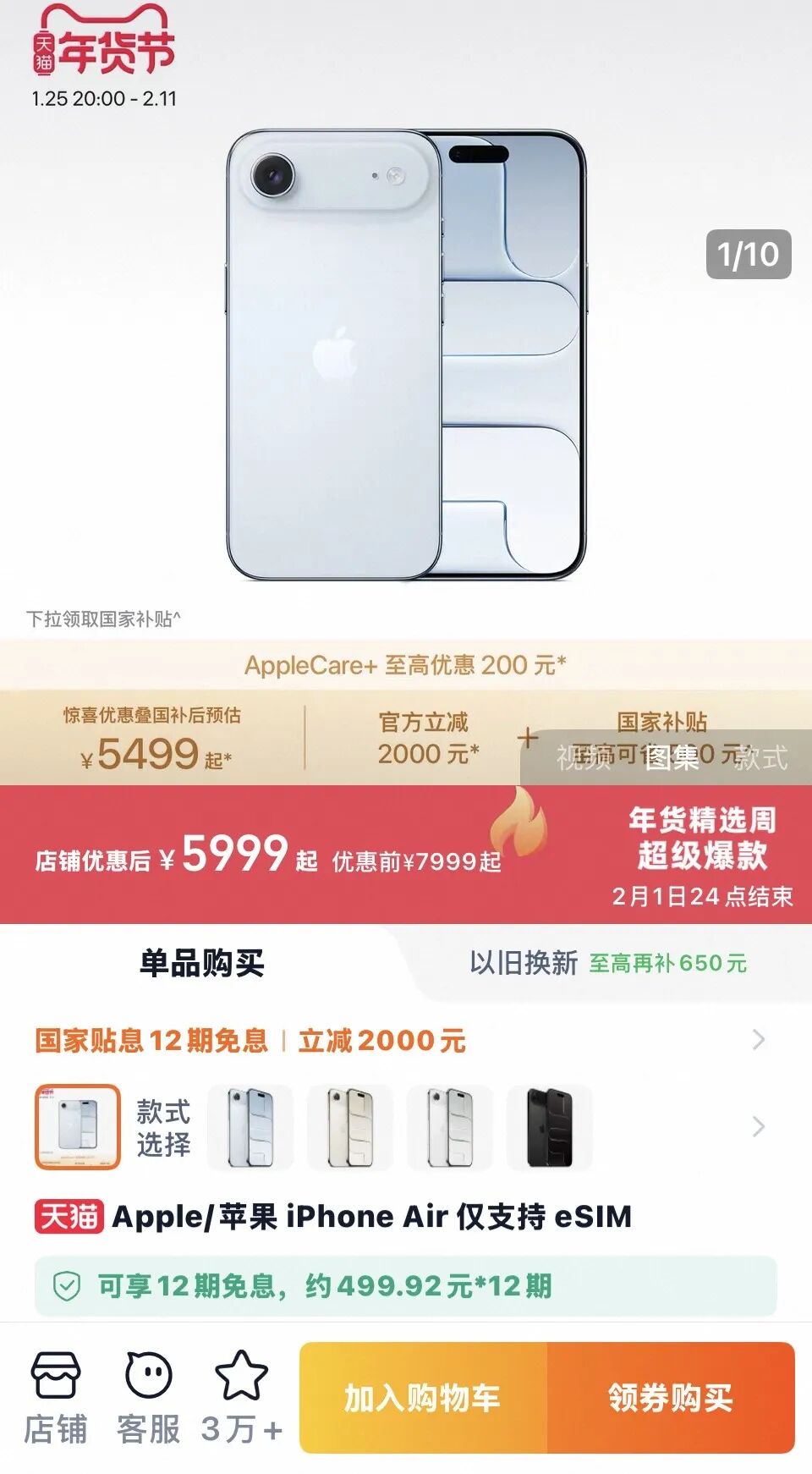
Core Viewpoint - The iPhone Air, released only three months ago, has become a focal point due to a significant price drop, with a reduction of 2000 yuan, bringing the starting price to 5499 yuan after regional subsidies [1][3]. Group 1: Market Performance and Consumer Response - The iPhone Air's market performance has been disappointing, leading to the dismantling of several production lines by Apple suppliers [3][9]. - The device has not resonated with the majority of consumers, as its lightweight design appeals to a niche market rather than the broader audience [4][10]. - The iPhone Air's initial sales were overshadowed by the iPhone 17 series, which dominated sales rankings during the same period [4][8]. Group 2: Product Features and Consumer Expectations - To achieve its slim profile of 5.6 mm and weight of 165 grams, the iPhone Air compromised on key features, including a smaller battery capacity of 3149 mAh and a single camera setup [5][7]. - Consumers are increasingly unwilling to pay flagship prices for devices that lack high-end specifications, leading to a perception of the iPhone Air as a "downgraded" option [8][9]. - The high initial price of 7999 yuan, which is comparable to other flagship models with superior specifications, has further hindered its appeal [8][9]. Group 3: Industry Trends and Competitor Actions - The smartphone market is witnessing a shift, with many manufacturers, including Xiaomi and OPPO, canceling lightweight model projects in response to consumer feedback [9][10]. - Competitors are adopting a more balanced approach, offering lightweight models with better specifications at lower price points, which has proven more successful in the market [13][19]. - The iPhone Air's lack of success does not indicate a failure in the lightweight category, as the industry continues to explore innovations in design and functionality [20][21].


商务部:2025年汽车、手机等以旧换新产品销售额2.61万亿元
Sou Hu Cai Jing· 2026-01-26 14:13
Core Insights - The total retail sales of consumer goods in 2025 are projected to exceed 50 trillion yuan, reaching 50.1 trillion yuan, with a growth rate of 3.7% and a contribution rate of consumption to economic growth at 52%, an increase of 5 percentage points [3] Group 1: Consumer Goods Market - The implementation of the "old for new" policy in consumer goods has led to sales of related products such as automobiles, home appliances, and mobile phones reaching 2.61 trillion yuan, benefiting 366 million people [3] - Retail sales of household appliances and audio-visual equipment are expected to reach 1.17 trillion yuan in 2025, with a year-on-year growth of 11%, while retail sales of communication equipment are projected to reach 1 trillion yuan, with a year-on-year growth of 20.9% [3] - The market scale for home appliances and mobile phones is expected to surpass 1 trillion yuan each in 2025, setting a historical record [3] Group 2: Service Consumption - The retail sales of services are projected to grow by 5.5% in 2025, with sectors such as cultural and recreational services, tourism consulting and leasing, and transportation services maintaining double-digit growth [3] - Initiatives to enhance service consumption quality and benefit the public are being implemented [3] Group 3: Innovative Consumption Scenarios - Pilot projects for international consumption environment construction are being launched, along with optimization of the departure tax refund policy, leading to nearly a doubling of sales for goods eligible for departure tax refunds [3]

传音控股遭LG专利诉讼,市值蒸发千亿、净利暴跌45%
Sou Hu Cai Jing· 2026-01-26 11:21
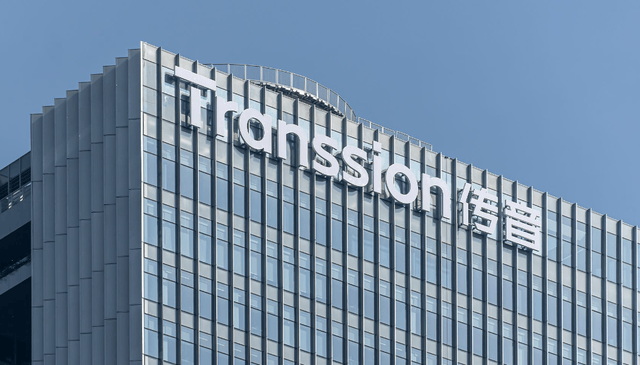
从"手机界的隐形冠军"到被镁光灯反复审视的"出海标杆",宁波富豪竺兆江和他的传音控股 (688036.SH)正迎来创业二十载以来最严峻的时刻。 如果说市场竞争是外伤,那么上游供应链的暴涨则是直击命门的内伤。 2025年进入AI服务器爆发期,存储芯片迎来了罕见的"超级牛市"。据Counterpoint数据显示,2025年第 四季度,DRAM和NAND闪存价格涨幅高达40%-50%,且这种涨势在2026年一季度并无放缓迹象。对于 主打中低端市场的传音而言,存储芯片占据其手机成本的15%至25%,涨价潮导致其2025年9月末毛利 率降至19.47%,创近五年新低。 2026年1月21日,LG在印度正式对传音发起4/5G专利诉讼,为传音本就动荡的全球化版图再添阴霾。仅 仅两天前,传音在资本市场的表现同样令人唏嘘:截至1月19日,其股价徘徊在64.99元/股,市值相较 巅峰期已蒸发超过千亿元。 而在港交所递交二次上市申请的冷遇,更是直接撕开了这家昔日黑马的"增长焦虑"。 传音的崛起曾是商业教科书式的"降维打击"。2006年,竺兆江避开国内手机市场的惨烈内卷,深入手机 普及率仅6%的非洲大陆。通过四卡四待、深肤色美颜算法 ...

刚刚,罗永浩大量资产被冻结!
Xin Lang Cai Jing· 2026-01-23 22:15
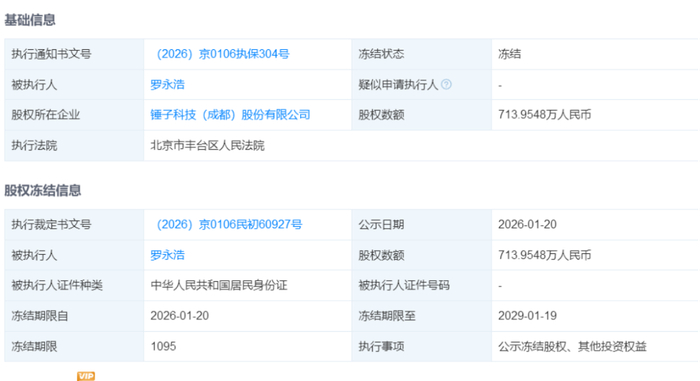
Core Viewpoint - The recent freezing of 7.14 million shares owned by Luo Yonghao has brought him back into the spotlight, highlighting the ongoing struggles of Smartisan Technology and Luo's debt repayment journey [2][8][29] Group 1: Company Overview - Smartisan Technology, founded by Luo Yonghao in 2012, aimed to create high-quality smartphones but faced challenges in the competitive mobile industry, leading to its decline [3][4] - The company was acquired by ByteDance in early 2019, marking the end of Luo's smartphone ambitions [5] - Despite the company's downfall, Luo has managed to repay over 800 million yuan of his 1.3 billion yuan debt through various means, including live streaming and asset liquidation [6][7] Group 2: Recent Developments - Luo's 7.14 million shares in Smartisan Technology have been frozen for three years by the Beijing Fengtai District People's Court, impacting his ability to access these assets [8][9] - This share freeze is part of ongoing legal issues faced by Smartisan Technology, which still carries multiple legal risks, including lawsuits and financial obligations [17][21] Group 3: Debt and Legal Issues - Luo's debt repayment journey, referred to as "Zhen Huan Chuan," continues as he faces unresolved debts and legal disputes, despite claiming to have cleared his personal debts [21][22] - The freezing of shares is a judicial measure related to the company's debt issues rather than Luo's personal financial obligations [21][22] - Luo's history of debt and legal challenges reflects a broader narrative of his controversial public persona and ongoing struggles within the business landscape [28][29]
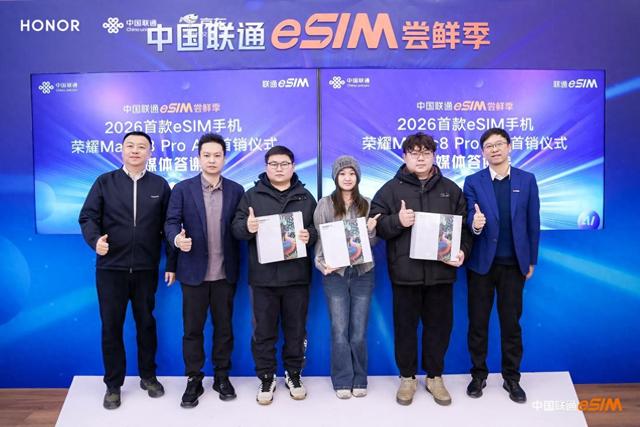
2026首款eSIM手机荣耀Magic8 Pro Air上市
Huan Qiu Wang· 2026-01-23 12:35
Core Viewpoint - The launch of the Honor Magic8 Pro Air eSIM phone marks a significant milestone in the collaboration between China Unicom, Honor, and JD.com, indicating a new phase in the eSIM market in China [1][3][7]. Group 1: Strategic Collaboration - China Unicom, Honor, and JD.com have established a strong partnership, which is expected to enhance the development of the domestic eSIM mobile market [3]. - The unveiling of the eSIM phone symbolizes the deepening of strategic cooperation among the three companies, highlighting the importance of ecosystem partners in the commercialization of eSIM technology [7]. Group 2: Product Features and Offerings - The Honor Magic8 Pro Air eSIM phone features a leading configuration of "two physical SIM cards + two eSIM cards," combined with a lightweight design and a large-capacity battery [5]. - To enhance user experience with eSIM, China Unicom has introduced the upgraded "e Supplement" policy, which includes immediate billing for calls, 200GB of nationwide data for a year, and convenient online services for international business travelers [5]. Group 3: Future Outlook - The collaboration is seen as a catalyst for accelerating the transition to a user-centered, all-scenario smart experience era [7]. - China Unicom aims to continue deepening partnerships to promote eSIM technology, making it accessible to more households and paving the way for a smarter, more convenient digital lifestyle [8].


重构“生态野心”:解码荣耀全球化下半场的护城河
Feng Huang Wang· 2026-01-23 06:18
Core Insights - Honor has successfully transformed from a Chinese market brand to a global technology enterprise, achieving a global shipment of over 71 million units in 2025, with overseas sales increasing by 47% and surpassing 50% of total shipments for the first time [1] - The company has established a clear product roadmap focusing on the mid-to-high-end market, particularly in the $300-$499 price range, which has become a significant portion of its overseas shipments [2] - Honor's technological advancements, including the "Qinghai Lake battery" technology and AI capabilities, have created a competitive edge in user experience and positioned the company for future growth in human-machine interaction [3] Product Strategy - Honor's market resilience is rooted in its commitment to creating an irreplaceable experience barrier in the mid-to-high-end market, particularly in overseas expansion [2] - The company has adopted a comprehensive strategy combining product, channel, and marketing to penetrate various regions, such as leveraging partnerships with carriers in Latin America and the Middle East [2] Globalization Strategy - Honor's overseas business now accounts for over 50% of its total revenue, marking a strategic shift where globalization is a core pillar of growth rather than an optional market [4] - The company has structured its global strategy to focus on high-end breakthroughs in Europe, stable output in Latin America and the Middle East, and future growth in Southeast Asia through local manufacturing [4] Challenges and Future Outlook - Despite its successes, Honor faces challenges such as uncertainties in the global semiconductor supply chain, slowing growth in key markets, and the difficulty of transitioning from a hardware to an ecosystem company [5] - The company aims to expand in emerging markets while deepening user value in established high-end markets through AI services and ecosystem development [5] - The future success of Honor will depend on maintaining organizational vitality during rapid growth, solidifying local roots amid globalization, and balancing technological ideals with commercial realities [6]
华为折叠屏国内份额超70%,坐等苹果入局
Guan Cha Zhe Wang· 2026-01-22 09:16
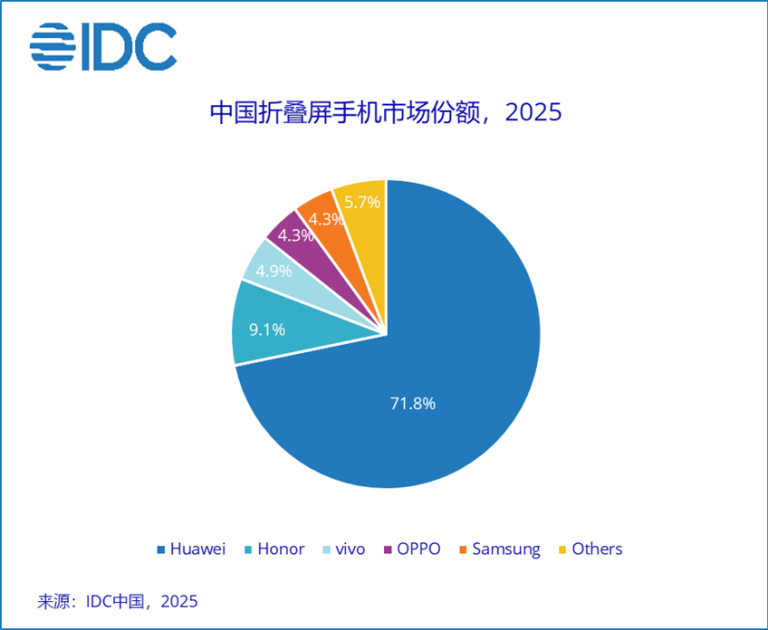
Core Insights - The Chinese foldable smartphone market is projected to see a shipment of approximately 10.01 million units in 2025, reflecting a year-on-year growth of 9.2%, contrasting with a slight decline of 0.6% in the overall smartphone market [1] - Huawei leads the market with a significant share of 71.8%, while other brands like Honor, Vivo, and OPPO have much smaller shares, indicating Huawei's dominant position [1][3] - Despite the emergence of competitive products from other manufacturers, Huawei's comprehensive product lineup and brand strength have solidified its market leadership [4][6] Market Dynamics - The foldable smartphone segment has reached a bottleneck since 2019, with manufacturers struggling to drive sales through hardware improvements alone, leading to a decline in the overall market in Q4 of the previous year [3][4] - Brand strength is increasingly influencing consumer preferences in the high-end market, with Huawei's focus on balanced capabilities and innovative designs contributing to its market share growth of over 20 percentage points in 2025 [4] - The foldable smartphone market still represents only 3.5% of total smartphone shipments in China, prompting some manufacturers to reconsider their strategies in this niche segment [4][6] Technological Innovations - Manufacturers are exploring soft-hard collaboration as a breakthrough direction, with Huawei's MateX7 focusing on AI integration rather than just hardware enhancements [6] - Other brands like OPPO and Vivo are also attempting to bridge compatibility with Apple ecosystems, indicating a trend towards cross-platform functionality [6] Future Outlook - The anticipated entry of Apple's foldable smartphone, expected to be released in the fall of 2026, is generating significant market interest, particularly regarding its potential to enhance hardware and software integration [7][8] - The overall smartphone market in China may face challenges in 2026 due to rising storage costs, which could lead to a noticeable decline in shipments [8]

华为折叠屏国内份额超70%,苹果今年能带来惊喜吗?
Guan Cha Zhe Wang· 2026-01-22 09:12
Core Insights - The Chinese foldable smartphone market is projected to see a shipment of approximately 10.01 million units in 2025, marking a year-on-year growth of 9.2%, contrasting with a slight decline of 0.6% in the overall smartphone market [1] - Huawei leads the market with a significant share of 71.8%, while other brands like Honor, Vivo, and OPPO have much smaller shares, with Xiaomi dropping out of the top five [1][3] - The foldable smartphone segment is experiencing a bottleneck phase, with hardware improvements no longer sufficient to drive significant sales growth, leading to a decline in market performance [3][4] Market Dynamics - Huawei's dominance is attributed to its comprehensive product lineup, including various foldable designs and a focus on balanced capabilities rather than just lightweight models [4] - Other manufacturers have introduced innovative products, such as OPPO's Find N5 and Vivo's lightweight foldable, but these have not significantly challenged Huawei's market position [3][4] - The foldable smartphone market only accounts for 3.5% of total smartphone shipments in China, leading some companies like Xiaomi to reconsider their strategies in this niche [4][6] Technological Innovations - Manufacturers are focusing on soft-hard collaboration to enhance user experience, with Huawei's MateX7 introducing AI capabilities to improve functionality [6] - Competitors like OPPO and Vivo are also exploring compatibility with Apple ecosystems to attract users [6] - The anticipated entry of Apple's foldable phone, expected in 2026, is generating significant market interest, with expectations for superior hardware and software integration [7][9] Future Outlook - The smartphone market is expected to face cost pressures due to rising storage prices, potentially leading to a noticeable decline in shipments in 2026 [9] - The success of Apple's foldable device and its impact on the market remains a key point of interest for industry stakeholders [9]