纺织服装

Search documents
政策解读|“人工智能+制造”怎么干
Ren Min Ri Bao· 2026-01-09 00:43
"人工智能技术与制造业应用双向赋能,要一端抓技术供给,推动智能产业化;一端抓赋能应用, 加快产业智能化,整体壮大产业生态,促进人工智能科技创新与产业创新深度融合。"工业和信息化部 科技司有关负责人表示,实施意见围绕创新筑基、赋智升级、产品突破、主体培育、生态壮大、安全护 航、国际合作等7个重点任务,细化21项具体措施,加快制造业智能化、绿色化、融合化发展。 人民日报记者 刘温馨 人工智能与实体经济深度融合,深刻改变制造业生产模式和经济形态,驱动产业加速升级。1月7 日,工业和信息化部等8部门发布《"人工智能+制造"专项行动实施意见》,为加快推进人工智能技术在 制造业融合应用明确目标举措。 21项具体措施推动人工智能在制造业融合应用 "十五五"规划建议提出,"全面实施'人工智能+'行动""抢占人工智能产业应用制高点,全方位赋能 千行百业"。 打造人工智能发展和赋能应用主力军,既要鼓励龙头企业、央企国企等先行先试,提供规模化应用 场景,研发应用工业智能体,探索人工智能赋能制造业新模式;同时也应深入实施中小企业数字化赋能 专项行动,支持中小企业开展数字化、智能化改造,加快中小企业人工智能应用复制推广。实施意见还 鼓 ...
2027年人工智能关键核心技术安全可靠供给 “人工智能+制造”怎么干
Ren Min Ri Bao· 2026-01-09 00:43
实施意见明确:到2027年,我国人工智能关键核心技术实现安全可靠供给,产业规模和赋能水平稳居世 界前列。推动3—5个通用大模型在制造业深度应用,推出1000个高水平工业智能体,打造100个工业领 域高质量数据集,推广500个典型应用场景。培育2—3家具有全球影响力的生态主导型企业和一批专精 特新中小企业,打造一批"懂智能、熟行业"的赋能应用服务商,选树1000家标杆企业。建成全球领先的 开源开放生态,安全治理能力全面提升,为人工智能发展贡献中国方案。 "手把手"为制造业企业提供转型升级指南 纺织车间需要空调风机进行温湿度调控、空气净化及通风换气,传统产品依赖人工调控,精度低、故障 难预判。"我们依托浪潮云洲工业大模型,在传统风机上加装多类传感器,采集、训练数据,研发出数 智风机。"山东金信空调集团董事长吴子才介绍,数智风机能根据实时工况优化风量等相关参数,精准 控制车间温湿度,设备检修周期缩短40%。 "人工智能+制造"怎么干 人工智能与实体经济深度融合,深刻改变制造业生产模式和经济形态,驱动产业加速升级。1月7日,工 业和信息化部等8部门发布《"人工智能+制造"专项行动实施意见》,为加快推进人工智能技术在制 ...
“人工智能+制造”怎么干(政策解读)
Ren Min Ri Bao· 2026-01-09 00:17
人工智能与实体经济深度融合,深刻改变制造业生产模式和经济形态,驱动产业加速升级。1月7日,工 业和信息化部等8部门发布《"人工智能+制造"专项行动实施意见》,为加快推进人工智能技术在制造业 融合应用明确目标举措。 21项具体措施推动人工智能在制造业融合应用 "十五五"规划建议提出,"全面实施'人工智能+'行动""抢占人工智能产业应用制高点,全方位赋能千行 百业"。 "人工智能技术与制造业应用双向赋能,要一端抓技术供给,推动智能产业化;一端抓赋能应用,加快 产业智能化,整体壮大产业生态,促进人工智能科技创新与产业创新深度融合。"工业和信息化部科技 司有关负责人表示,实施意见围绕创新筑基、赋智升级、产品突破、主体培育、生态壮大、安全护航、 国际合作等7个重点任务,细化21项具体措施,加快制造业智能化、绿色化、融合化发展。 实施意见明确:到2027年,我国人工智能关键核心技术实现安全可靠供给,产业规模和赋能水平稳居世 界前列。推动3—5个通用大模型在制造业深度应用,推出1000个高水平工业智能体,打造100个工业领 域高质量数据集,推广500个典型应用场景。培育2—3家具有全球影响力的生态主导型企业和一批专精 特新 ...
到二〇二七年人工智能关键核心技术安全可靠供给 “人工智能+制造”怎么干(政策解读)
Ren Min Ri Bao· 2026-01-08 22:50
针对使用人工智能进行研发设计、生产制造、经营管理及开展延伸服务的企业,实施意见还提供附件 《制造业企业人工智能应用指南》,从开展智能化评估和规划、提升智能化基础能力、构建高质量数据 集、合理规划布局算力资源、开展模型选型与调优、模型部署与集成、做好人工智能应用安全防护等方 面给出详尽指南,"手把手"为企业智能化转型升级提供实施路径和方法指引。 人工智能与实体经济深度融合,深刻改变制造业生产模式和经济形态,驱动产业加速升级。1月7日,工 业和信息化部等8部门发布《"人工智能+制造"专项行动实施意见》,为加快推进人工智能技术在制造业 融合应用明确目标举措。 21项具体措施推动人工智能在制造业融合应用 "十五五"规划建议提出,"全面实施'人工智能+'行动""抢占人工智能产业应用制高点,全方位赋能千行 百业"。 "人工智能技术与制造业应用双向赋能,要一端抓技术供给,推动智能产业化;一端抓赋能应用,加快 产业智能化,整体壮大产业生态,促进人工智能科技创新与产业创新深度融合。"工业和信息化部科技 司有关负责人表示,实施意见围绕创新筑基、赋智升级、产品突破、主体培育、生态壮大、安全护航、 国际合作等7个重点任务,细化21项 ...
申洲国际(02313.HK):1月8日南向资金增持25.02万股
Sou Hu Cai Jing· 2026-01-08 19:23
Group 1 - The core point of the article highlights that southbound funds have increased their holdings in Shenzhou International (02313.HK) by 250,200 shares on January 8, with a total net increase of 2,575,200 shares over the past five trading days [1] - Over the last 20 trading days, southbound funds have increased their holdings on 13 occasions, resulting in a cumulative net increase of 6,013,500 shares [1] - As of now, southbound funds hold 108 million shares of Shenzhou International, accounting for 7.16% of the company's total issued ordinary shares [1] Group 2 - Shenzhou International Group Holdings Limited primarily engages in the production and sale of knitted apparel products, operating as an investment holding company [1] - The company's main business involves manufacturing knitted products for clients through a combination of Original Equipment Manufacturing (OEM) and Original Design Manufacturing (ODM) [1] - The product categories include sportswear, casual wear, underwear, and other knitted products, with operations conducted in both domestic and international markets [1]


山东省济宁市市场监管局公布2025年第2批市级产品质量监督抽查结果
Zhong Guo Zhi Liang Xin Wen Wang· 2026-01-08 08:50
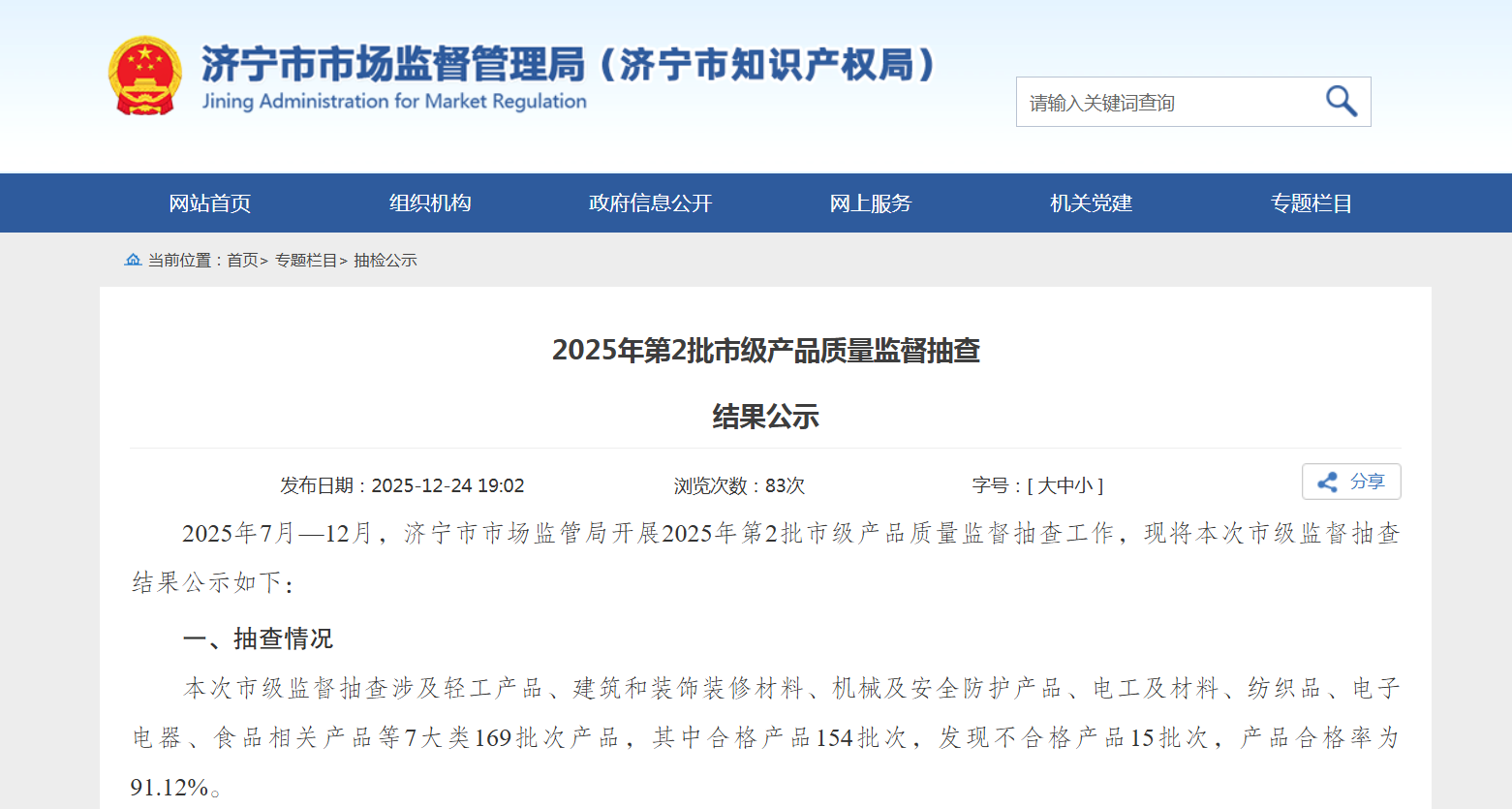
Summary of Key Points Core Viewpoint The Jining Market Supervision Administration in Shandong Province has released the results of the second batch of product quality supervision and spot checks for 2025, indicating a product pass rate of 91.12% across various categories. Group 1: Overall Inspection Results - A total of 169 batches of products were inspected, with 154 batches passing and 15 batches failing, resulting in a compliance rate of 91.12% [2]. Group 2: Specific Product Categories - **Plastic Shopping Bags**: Out of 3 batches inspected, 1 batch was found non-compliant, leading to a non-compliance rate of 33.33% [3]. - **Chlor-alkali Products**: All 6 batches of high-purity hydrochloric acid and by-product hydrochloric acid were compliant [4]. - **Industrial Formaldehyde**: All 2 batches inspected were compliant [5]. - **Industrial Methanol**: All 3 batches inspected were compliant [6]. - **Sodium Hypochlorite**: All 2 batches inspected were compliant [7]. - **Benzene Products**: Both batches of crude benzene and coke benzene products were compliant [8][9]. - **Industrial Hydrogen Peroxide**: The single batch inspected was compliant [10]. - **Lead-acid Batteries**: All 11 batches inspected were compliant [11]. - **Household and Similar Use Plugs and Sockets**: All 5 batches inspected were compliant [12]. - **Food Contact Paper Packaging and Containers**: All 4 batches inspected were compliant [13]. - **Food Contact Plastic Packaging Containers and Tools**: All 4 batches inspected were compliant [14]. - **Composite Film Bags**: All 7 batches inspected were compliant [15]. - **Non-composite Film Bags**: All 3 batches inspected were compliant [16]. - **Melamine Plastic Tableware**: All 2 batches inspected were compliant [17]. - **Construction Steel**: All 30 batches inspected were compliant [18]. - **Waterproof Membranes**: All 5 batches inspected were compliant [19]. - **Ceramic Tiles**: All 6 batches inspected were compliant [20]. - **Automotive Lubricants**: All 11 batches inspected were compliant [21]. - **Coal Products**: All 10 batches inspected were compliant [22]. - **Textiles**: Out of 50 batches inspected, 14 batches were found non-compliant, resulting in a non-compliance rate of 28% [23].
鄂尔多斯股价涨5.22%,易方达基金旗下1只基金位居十大流通股东,持有1106.38万股浮盈赚取885.11万元
Xin Lang Cai Jing· 2026-01-08 06:11
Group 1 - The stock price of Ordos has increased by 5.22% on January 8, reaching 16.13 CNY per share, with a trading volume of 427 million CNY and a turnover rate of 1.43%, resulting in a total market capitalization of 45.144 billion CNY. The stock has risen for three consecutive days, with a cumulative increase of 24.03% during this period [1] - Ordos Resources Co., Ltd. is located in the Dongsheng District of Ordos City, Inner Mongolia, established on October 15, 1995, and listed on April 26, 2001. The company's main business includes cashmere clothing, power metallurgy, and chemicals. The revenue composition is as follows: silicon iron 37.05%, PVC resin 18.59%, clothing 13.60%, caustic soda 7.78%, others 7.65%, coal 5.87%, silicon manganese alloy 3.76%, fertilizer 2.81%, calcium carbide 2.55%, and polysilicon 0.34% [1] Group 2 - Among the top ten circulating shareholders of Ordos, E Fund's fund holds a significant position. The E Fund CSI Dividend ETF (515180) increased its holdings by 786,200 shares in the third quarter, totaling 11.0638 million shares, which accounts for 0.4% of the circulating shares. The estimated floating profit today is approximately 8.8511 million CNY, with a total floating profit of 32.8596 million CNY during the three-day increase [2] - The E Fund CSI Dividend ETF (515180) was established on November 26, 2019, with a current scale of 9.051 billion CNY. Year-to-date returns are 1.63%, ranking 4819 out of 5493 in its category; the one-year return is 8.29%, ranking 3913 out of 4197; and since inception, the return is 80.45% [2]

股市必读:鲁 泰A(000726)1月7日董秘有最新回复
Sou Hu Cai Jing· 2026-01-07 19:05
Group 1 - The stock price of Lutai A (000726) closed at 7.17 yuan on January 7, 2026, with a decrease of 0.14% and a turnover rate of 1.36%, totaling a trading volume of 80,400 hands and a transaction amount of 57.82 million yuan [1] - The company has not yet applied for the exemption of import duties for its investment in Hainan, and will proceed with the application based on business needs [1] - The company is closely monitoring the long-term trend of the RMB appreciation, as it has a high export revenue, and will take reasonable measures to mitigate the impact of exchange rate fluctuations on its operating performance [1] Group 2 - On January 7, the net inflow of main funds was 1.3781 million yuan, indicating a positive short-term attitude from major investors towards the stock [2] - The net outflow of speculative funds was 3.2287 million yuan, while retail investors saw a net inflow of 1.8505 million yuan [3]

再现“A吃A”!苏美达拟收购蓝科高新16.92%股份,实现对其控股
Zheng Quan Shi Bao Wang· 2026-01-07 12:53
Core Viewpoint - Sumida plans to acquire 60 million shares of Lanke High-tech from its controlling shareholder, Guoji Group, at a price of 6.71 yuan per share, totaling 403 million yuan, which will increase Sumida's stake in Lanke High-tech to 21.72%, making it a subsidiary [1] Group 1: Company Overview - Sumida, established in 1978, is a key member of Guoji Group and has developed into a diversified international enterprise with significant market scale and brand influence [1] - As of the end of 2024, Sumida has 13 subsidiaries, 37 overseas members, and 28 wholly-owned or controlling factories, covering over 160 countries and regions [1] - In 2024, Sumida achieved a revenue of 117.17 billion yuan and a total import-export volume of 12.9 billion USD, ranking 97th in the 2023 Fortune China 500 list [1] Group 2: Financial Performance - In the first three quarters of 2025, Sumida reported a revenue of 87.42 billion yuan, a year-on-year increase of 0.52%, and a net profit attributable to shareholders of 1.104 billion yuan, up 10% year-on-year [2] - The company's shipbuilding and shipping business showed strong profitability, while the textile and apparel business grew steadily, and the ecological and environmental protection business remained stable [2] Group 3: Strategic Initiatives - Sumida is actively investing in strategic emerging industries such as new energy and high-end energy equipment through both internal cultivation and external mergers and acquisitions [2] - Lanke High-tech, originating from a key national research institute, specializes in the R&D, design, manufacturing, and inspection of oil and petrochemical energy equipment and new energy equipment [2] - As of September 2025, Lanke High-tech has contributed over 1,190 technological achievements to the country, including 3 national invention awards and 4 national science and technology progress awards [2] Group 4: Market Position and Growth - In the first three quarters of 2025, Lanke High-tech achieved a revenue of 589 million yuan, a year-on-year increase of 18.02%, and a net profit attributable to shareholders of 33.31 million yuan [3] - The demand for traditional oil and gas chemical equipment products has improved due to sustained investment in downstream industries, leading to increased order delivery [3] - Lanke High-tech's strategic focus on new energy, energy conservation, and deep-sea equipment has shown significant results, contributing positively to revenue [3]


部署工业互联网和AI融合赋能,工信部“点名”这些重点行业
2 1 Shi Ji Jing Ji Bao Dao· 2026-01-07 12:32
Core Insights - The Ministry of Industry and Information Technology has issued the "Action Plan for the Integration of Industrial Internet and Artificial Intelligence" to enhance the integration of AI and industrial internet by 2028 [1][5] - By 2025, over 340 influential industrial internet platforms are expected to connect more than 100 million devices and serve nearly 4 million enterprises, covering all 41 major industrial categories [1][2] Infrastructure - The new industrial network will expand to meet the high throughput, low latency, high reliability, and low jitter communication needs of AI applications, with plans to upgrade at least 50,000 enterprises [2][5] - The action plan emphasizes the need for intelligent upgrades of industrial networks and the development of a "model pool" for industrial AI applications [5][6] Data Support - A comprehensive system for industrial data aggregation, governance, circulation, and sharing will be established, focusing on 20 key industries to create high-quality data sets [2][6] - The plan encourages collaboration among industrial internet companies and data service providers to enhance data management and create high-quality industry data sets [6][8] Application Integration - The action plan aims to promote the transformation of application models, encouraging enterprises to leverage industrial internet for data flow between consumption and production, and to adopt intelligent analysis based on AI [6][7] - A focus on cultivating intelligent solution providers for key industry chain segments and typical scenarios is outlined to facilitate collaborative upgrades among enterprises of all sizes [2][6] Industry Ecosystem - The plan includes actions to strengthen the cultivation of key enterprises and encourage the development of intelligent system integration capabilities among industrial internet and AI companies [8] - It promotes innovation in technology products, including industrial communication chips and sensors, and aims to enhance public service capabilities for industry data sets and industrial model evaluations [8]