
啤酒

Search documents
食品饮料周报(26年第5周):酒底部信号增多,关注春节旺季动销表现
Guoxin Securities· 2026-02-03 04:25
Investment Rating - The report maintains an "Outperform the Market" rating for the food and beverage sector [4][5][10]. Core Views - The food and beverage sector is expected to perform well in 2026, with a focus on four main investment themes: cost advantages, efficiency improvements, innovation-driven growth, and opportunities for recovery in distressed segments [3][10][14]. - The report highlights the increasing signals of a bottoming out in the liquor market, particularly for baijiu, and emphasizes the importance of sales performance during the Spring Festival [2][10]. - The report suggests a diversified approach to investment, recommending leading companies in various sub-sectors, including dairy, beverages, snacks, and restaurant supply chains [2][3][10]. Summary by Relevant Sections Liquor - Baijiu prices are stable with an upward trend, and the report emphasizes monitoring sales during the Spring Festival. Key recommendations include Kweichow Moutai, Shanxi Fenjiu, and Luzhou Laojiao, with a focus on their market positioning and growth potential [2][10][11]. - The report anticipates a continued decline in production for smaller liquor companies, while larger firms are expected to manage inventory effectively [10][11]. Beer - The beer industry is experiencing healthy inventory levels, with expectations for demand recovery. Recommendations include Yanjing Beer and China Resources Beer, focusing on their growth potential and market strategies [11][12]. Snacks - The report identifies strong growth potential in the konjac snack segment, recommending leading companies like Weidong and Yanjinpuzi for their innovative product offerings and competitive advantages [12][17]. Dairy - The dairy sector is advised to focus on leading companies like Yili, with expectations for steady demand recovery and improved profitability in 2026. The report notes the importance of managing inventory and product innovation [14][15]. Beverages - The beverage sector is characterized by a focus on inventory reduction during the off-season, with key recommendations for companies like Nongfu Spring and Dongpeng Beverage, which are expected to benefit from market expansion and product innovation [15][16].




食品饮料周报(26年第5周):白酒底部信号增多,关注春节旺季动销表现-20260203
Guoxin Securities· 2026-02-03 02:37
Investment Rating - The report maintains an "Outperform the Market" rating for the food and beverage sector [4][5]. Core Views - The food and beverage sector is expected to perform well in 2026, with a focus on four main investment themes: cost advantages, efficiency improvements, innovation-driven growth, and opportunities for recovery in distressed segments [3][10]. - The report highlights the increasing bottom signals in the liquor market, particularly for baijiu, and emphasizes the importance of sales performance during the Spring Festival [2][10]. Summary by Relevant Sections Liquor - Baijiu prices, particularly for Moutai, are stable with a slight increase, and attention is drawn to the sales rhythm during the Spring Festival. The report recommends Moutai, Shanxi Fenjiu, and Luzhou Laojiao as top picks, while also suggesting to monitor other brands like Gujing Gongjiu and Wuliangye [2][10]. - The report anticipates a continued trend of small liquor companies exiting the market, with a projected production decline of 12.1% for baijiu in 2025 [10]. Beer - The beer industry is experiencing healthy inventory levels, with expectations for demand recovery. The report recommends Yanjing Beer and China Resources Beer as key players to watch [11][10]. Snacks - The report emphasizes the importance of strong alpha stocks in the snack sector, particularly focusing on konjac snacks, with companies like Weilong and Yanjinpuzi showing strong product innovation and competitive advantages [12][10]. Food Supply Chain - The food supply chain is entering a peak season for stocking and sales, with a focus on pre-prepared dishes. The report recommends leading companies like Yihai International and Haitian Flavoring, as well as companies that are expanding their channels like Qianwei Yangchun [13][14]. Dairy Products - The report suggests a cautious outlook for dairy companies due to competitive pressures, but highlights the potential for recovery in 2026, particularly for leading companies like Yili [14][10]. Beverages - The beverage sector is currently in a de-stocking phase, with stable preparations for the Spring Festival. The report continues to recommend companies like Nongfu Spring and Dongpeng Beverage, which are accelerating their national expansion [15][10].

未知机构:招商食品啤酒板块观点更新及跟踪20260202当前行业股息-20260203
未知机构· 2026-02-03 02:25
Industry and Company Analysis Summary Industry Overview - The beer industry is currently experiencing a high dividend yield, with leading companies increasing their dividends, providing support for stock prices. The focus is on the recovery of service consumption and inflation expectations driving volume and price growth in 2026 [1][2] - The industry is expected to see a recovery in volume and price due to improved service consumption and inflation expectations [1] Key Companies and Insights China Resources Beer (华润啤酒) - Recognized for its leading position and ongoing premiumization strategy [1] - Projected to achieve a small single-digit volume growth in 2025, with stable pricing and a slight decline in H2 compared to H1. Full-year profit is expected to grow by a high single to double-digit percentage [2] - Anticipated revenue and profit for 2025 are 39.1 billion and 5.8 billion respectively, not accounting for impairments [2] - Dividend payout ratio is expected to gradually increase to 70-80% [2] Chongqing Brewery (重啤) - Q4 trends are better than the same period last year, primarily due to strict inventory control in 2025. The company expects stable or slightly increased sales for the year [2] - Notable growth in U.S. and Xinjiang markets, with double-digit growth for brands like Carlsberg and Fenghua Xueyue [2] Yanjing Beer (燕京) - The company forecasts a slight decline in net profit for Q4, with a year-on-year growth rate of -3% to +44% [3] - Plans to launch a new product, A10, to enhance its product matrix in 2026 [3] - Expected stable cost per ton and potential for operational efficiency improvements [3] Financial Metrics - China Resources Beer has a dividend yield of 4.0% for A shares and 5.5% for H shares [2] - Chongqing Brewery's Q4 performance is expected to show a slight increase in sales, with a focus on inventory management [2] - Yanjing's Q4 revenue is projected to grow by 7%, with an annual profit of 1.2 billion [3] Risks - Potential risks include cost fluctuations, slower-than-expected recovery in demand from the restaurant sector, and increased competition [4]




双A共鸣 质感共生!奥古特观赛团直击2026澳网巅峰时刻
Zheng Quan Ri Bao Wang· 2026-02-02 12:15
Core Insights - The 2026 Australian Open concluded with significant social media engagement, highlighting the partnership between Qingdao Beer’s brand, Aogute, and the Australian Open, emphasizing a shared pursuit of quality and elegance [1] Group 1: Event Highlights - The Australian Open is a prestigious event in the tennis world, attracting numerous fans, especially from China due to the emergence of Chinese players [2] - Aogute organized a special viewing group that included a tennis exhibition match featuring four national champions, showcasing the sport's charm and excitement [2] - The climax of the event was the live viewing of the Australian Open 2026 finals at Rod Laver Arena, where thousands of spectators experienced the thrill of top-level tennis [3] Group 2: Brand Collaboration - Aogute's design and branding resonate with the Australian Open's identity, creating a harmonious partnership that enhances the experience for tennis fans [4] - As the official partner of the Australian Open in China, Aogute aims to bring the excitement of the tournament to Chinese consumers through various events and promotions [4] - Aogute plans to host the Aogute Cup Tennis Carnival in six cities in China in 2025, further engaging the growing tennis population, which has exceeded 25 million in the country [4]
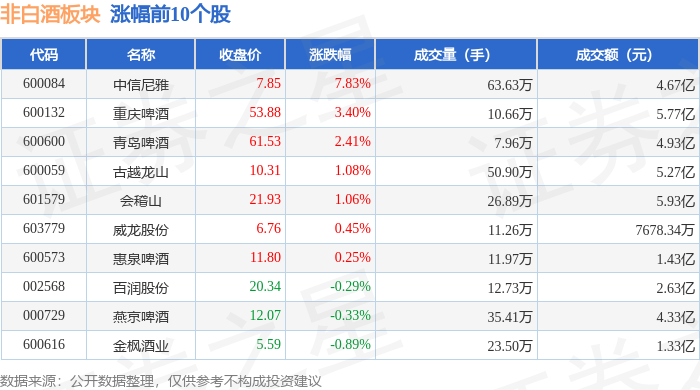
非白酒板块2月2日涨0.96%,中信尼雅领涨,主力资金净流出5108.94万元
Zheng Xing Xing Ye Ri Bao· 2026-02-02 09:15
Group 1 - The non-white liquor sector increased by 0.96% compared to the previous trading day, with CITIC Niyah leading the gains [1] - The Shanghai Composite Index closed at 4015.75, down 2.48%, while the Shenzhen Component Index closed at 13824.35, down 2.69% [1] - Key stocks in the non-white liquor sector showed varied performance, with CITIC Niyah closing at 7.85, up 7.83%, and Chongqing Beer at 53.88, up 3.40% [1] Group 2 - The non-white liquor sector experienced a net outflow of 51.09 million yuan from institutional investors, while retail investors saw a net outflow of 7.08 million yuan [2] - The main capital flow data indicates that Kuaijishan had a net inflow of 22.89 million yuan from institutional investors, while CITIC Niyah had a net outflow of 4.01 million yuan [3] - Retail investors showed a significant net outflow in several stocks, including Baorun Co., which had a net outflow of 22.42 million yuan [3]


燕京啤酒:截至2026年1月30日公司股东总户数47607户
Zheng Quan Ri Bao Wang· 2026-02-02 09:10
Core Viewpoint - Yanjing Beer (000729) reported that as of January 30, 2026, the total number of shareholders is 47,607 [1] Summary by Relevant Categories Company Information - Yanjing Beer has a total of 47,607 shareholders as of the specified date [1]
中证恒生沪港通AH股精明指数调整:赛力斯获纳入,成份股格局优化
Sou Hu Cai Jing· 2026-02-02 04:52
Group 1 - The core announcement is the semi-annual review results of the China Securities Index Co., Ltd. and Hang Seng Index Company regarding the CSI Hang Seng Stock Connect AH Index as of December 31, 2025 [1] - The adjustments involve the inclusion and exclusion of constituent stocks to better reflect the market performance and structural changes of listed companies in both regions [3] - The total number of constituent stocks in the index remains unchanged at 50 [6] Group 2 - Two new constituent stocks are added: SANY Heavy Industry Co., Ltd. (600031.SH, 06031) and Seres Group Co., Ltd. (601127.SH, 09927) [4] - The stocks being removed from the index are China Eastern Airlines Corporation Limited (600115.SH, 00670) and Tsingtao Brewery Group Co., Ltd. (600600.SH, 00168) [4] - The inclusion of Seres, a representative company in the new energy vehicle sector, highlights its increasing activity and influence in the A+H share market, reflecting the index's focus on emerging high-growth industries [6] Group 3 - The specific share categories (A-shares or H-shares) for the newly included companies will be finalized by March 2026, ensuring the representativeness and investability of the index [8] - The update of the index constituents is a routine reflection of market dynamics, optimizing the industry structure to better represent vibrant and potential listed companies under the Stock Connect mechanism [10]




食品饮料行业周报:茅台批价底部验证,大众品推荐顺周期-20260202
CMS· 2026-02-02 03:05
Investment Rating - The report recommends a positive investment outlook for the liquor sector, particularly for Kweichow Moutai, Wuliangye, and Shanxi Fenjiu, while suggesting a cautious approach towards Yingjia and Luzhou Laojiao [9][18]. Core Insights - The report indicates that Kweichow Moutai's sales volume and price have exceeded expectations, with a traditional channel delivery progress of 25%, maintaining zero inventory in channels. The demand side shows a double-digit growth year-on-year, supporting the price stability at 1499 RMB [1][18]. - The liquor industry is experiencing a bifurcation in brand performance, with Kweichow Moutai and Wuliangye showing positive sales trends, while other brands like Gujing and Yingjia are facing declines [9][18]. - The report highlights the importance of the upcoming Spring Festival for sales, with a tight supply-demand relationship expected to support prices, although a slight decline post-festival is anticipated [1][18]. Summary by Sections Core Company Tracking - Kweichow Moutai's payment progress is at 36%, with a delivery rate of approximately 20%, expected to increase to over 25%. The sales performance is strong, with a growth rate exceeding 10% year-on-year [2][11]. - Wuliangye's payment progress is at 60%, with a sales growth of 30% year-on-year, indicating a stable market condition similar to the previous year [3][14]. - Other brands like Fenjiu and Gujing are experiencing varied performance, with Fenjiu showing a slowdown in growth while Gujing's sales of certain products have declined significantly [2][3][14]. Investment Recommendations - The report suggests a bottom-fishing strategy for Kweichow Moutai, Wuliangye, and Shanxi Fenjiu, while also recommending attention to Yingjia and Luzhou Laojiao for potential rebounds [9][18]. - It identifies four main lines for consumer goods: recovery in the restaurant chain, raw milk cycle turning point, high valuation and performance alignment, and bottom-fishing for companies like China Resources Beverage and Qiaqia Food [9][18]. Industry Valuation - The report provides a valuation table for key companies, indicating Kweichow Moutai's market cap at 17544 million RMB with a PE ratio of 20, while Wuliangye has a market cap of 4076 million RMB with a PE ratio of 17 [20].


中国必选消费品1月需求报告:基础需求回暖,享乐型消费承压
Haitong Securities International· 2026-02-02 00:41
Investment Rating - The report rates multiple companies in the consumer staples sector as "Outperform," including Guizhou Moutai, Wuliangye, and Yili [1]. Core Insights - The consumer staples industry in January 2026 shows a recovery in basic demand while hedonic consumption remains under pressure, indicating a divergence in performance across different segments [3][29]. - Among the eight key consumer industries tracked, four are experiencing positive growth (condiments, frozen food, soft drinks, and catering), while four are facing declines (high-end and above Baijiu, mass-market Baijiu, dairy products, and beer) [29]. Summary by Segment Baijiu (High-end and Above) - In January, the revenue for high-end Baijiu reached 47 billion yuan, a year-on-year decline of 14.0%. The price pressure is significant, with expectations of over a 10% price drop throughout the year due to high inventory levels [11]. Baijiu (Mass-market and Below) - The mass-market Baijiu segment generated 22.9 billion yuan in January, down 3.0% year-on-year. Despite the decline, the segment shows resilience due to rigid demand and adaptability to consumption scenarios [13]. Beer - The beer industry reported revenues of 17 billion yuan in January, a decrease of 7.1% year-on-year. The demand was affected by adverse weather and the delayed Spring Festival, leading to a cautious inventory approach by distributors [15]. Condiments - The condiment sector achieved revenues of 46.9 billion yuan in January, reflecting a year-on-year growth of 3.5%. The recovery in the catering channel and increased demand from small and medium-sized businesses are key drivers [17]. Dairy Products - The dairy sector's revenue was 43.5 billion yuan in January, down 3.3% year-on-year. The demand remains under pressure, but a potential recovery is anticipated in the coming months due to low base effects [19]. Frozen Food - The frozen food segment saw revenues of 14.99 billion yuan in January, with a year-on-year increase of 8%. The demand is supported by pre-Spring Festival stocking and favorable weather conditions [21]. Soft Drinks - The soft drink industry generated 96.2 billion yuan in January, with a modest growth of 1.1% year-on-year. Increased promotional activities indicate heightened market competition [24]. Catering - The catering sector reported revenues of 16.2 billion yuan in January, up 2.5% year-on-year. The demand is gradually improving, particularly in small and medium-sized restaurants [26].


食品饮料行业:金星啤酒“中式风味精酿”带来的启示
GF SECURITIES· 2026-02-01 05:31
Investment Rating - The industry investment rating is "Buy" [2] Core Insights - The report highlights that Jin Xing Beer has successfully transitioned to the "Chinese-style craft beer" segment, achieving rapid revenue and net profit growth, with craft beer products accounting for 78.1% of total revenue by Q3 2025, and overall gross margin increasing from 27.3% in 2023 to 47.0% [6][24] - The report emphasizes the unique characteristics of the Chinese craft beer market, where local companies dominate and flavor-driven products lead growth, contrasting with the Western craft beer narrative [6][24] - Jin Xing Beer serves as a case study for the industry's shift from supply-side monopolies to demand-side growth, indicating a competitive landscape where smaller breweries explore new opportunities while larger firms make strategic decisions [6][24] Summary by Sections Section 1: Company Overview - Jin Xing Beer, located in Henan, has over 40 years of history and is the eighth largest beer company in China by retail sales as of 2024, with a significant focus on craft beer [15] - The company reported a revenue of 1.11 billion CNY and a net profit of 310 million CNY for Q3 2025, marking a year-on-year increase of 191% and 1096% respectively [15] Section 2: Insights from Jin Xing's "Chinese-style Craft Beer" - The report discusses the evolution of craft beer in China, noting that its growth is correlated with the maturity of industrial lager, reflecting a global trend where craft beer emerges as a compensatory consumption pattern in highly concentrated markets [6][24] - Jin Xing's approach to craft beer emphasizes flavor innovation, leveraging local ingredients and traditional practices, which aligns with consumer preferences for unique and personalized drinking experiences [6][24] Section 3: Financial Analysis of Leading Beer Companies - The report compares Jin Xing Beer with major beer companies, highlighting differences in scale, pricing, and profitability, with Jin Xing achieving higher prices per ton despite its smaller size [6][24] - Financial metrics indicate that Jin Xing's craft beer segment has a significant impact on its overall financial performance, showcasing the potential for growth in the craft beer market [6][24] Section 4: Investment Recommendations - The report suggests focusing on companies that are adapting to the demand-side changes in the beer industry, recommending Jin Xing Beer, Yanjing Beer, Chongqing Beer, and major players like China Resources Beer and Tsingtao Brewery for their strong dividend yields and potential for EPS growth in the craft beer segment [6][24]