
保险业

Search documents
上海:支持保险机构创新适用于低空航空器测试试飞等的低空特色险
Bei Jing Shang Bao· 2026-01-04 08:56
Core Viewpoint - The Shanghai Municipal Economic and Information Technology Commission has issued measures to accelerate the construction of an advanced manufacturing cluster for low-altitude economy in the Yangtze River Delta region, emphasizing support for innovative insurance products tailored for low-altitude aircraft testing, commercial applications, and consumer use [1] Group 1 - The measures aim to promote the aggregation of low-altitude insurance institutions [1] - The initiative is part of a broader strategy to enhance the low-altitude economy in the Yangtze River Delta [1]
联合研究|组合推荐:长江研究2026年1月金股推荐
Changjiang Securities· 2026-01-04 08:46
Market Overview - The market is expected to experience style differentiation as it approaches the Spring Festival, maintaining a structural trend under narrow fluctuations[4] - Key focus areas include the release of December and annual economic data in late January and a concentrated period of earnings forecasts[4] Investment Strategy - The strategy emphasizes three main lines: 1. High-growth and high-elasticity sectors, including AI hardware (e.g., optical modules), energy storage, lithium batteries, and non-ferrous metals[4] 2. Market hot tracks such as commercial aerospace, robotics, and cultural tourism[4] 3. Low-position large financial sectors, focusing on high-certainty performance in brokerage, insurance, and banks with dividend expectations[4] Recommended Stocks - **Metals**: Yun Aluminum Co., Ltd. (000807.SZ) with a projected EPS of 1.87 in 2025 and a PE of 17.6[28] - **Chemicals**: Yara International (000893.SZ) with a projected EPS of 2.06 in 2025 and a PE of 23.3[28] - **New Energy**: Slin Smart Drive (301550.SZ) with a projected EPS of 1.32 in 2025 and a PE of 105.0[28] - **Machinery**: Hengli Hydraulic (601100.SH) with a projected EPS of 2.19 in 2025 and a PE of 50.2[28] - **Aerospace**: AVIC Xi'an Aircraft Industry Group (000768.SZ) with a projected EPS of 0.42 in 2025 and a PE of 60.3[28] - **Banking**: Jiangsu Bank (600919.SH) with a projected EPS of 1.76 in 2025 and a PE of 5.9[28] - **Non-Banking**: New China Life Insurance (601336.SH) with a projected EPS of 11.82 in 2025 and a PE of 5.9[28] - **Social Services**: Jin Jiang International (600754.SH) with a projected EPS of 0.89 in 2025 and a PE of 28.3[28] - **Electronics**: Dongshan Precision (002384.SZ) with a projected EPS of 0.77 in 2025 and a PE of 109.8[28] - **Telecommunications**: Zhongji Xuchuang (300308.SZ) with a projected EPS of 9.47 in 2025 and a PE of 64.4[28] Risk Factors - Economic recovery may fall short of expectations, leading to slow growth or stagnation[34] - Significant changes in individual stock fundamentals could adversely affect performance[34]



上海:支持保险机构创新适用于低空航空器测试试飞、商业应用及消费的低空特色险,促进低空保险机构集聚
Mei Ri Jing Ji Xin Wen· 2026-01-04 08:10
Core Viewpoint - The Shanghai Municipal Government has issued measures to accelerate the construction of a low-altitude economy and advanced manufacturing cluster in the Yangtze River Delta, emphasizing increased financial support for related industries [1] Financial Support Measures - The government will enhance financial support by encouraging insurance institutions to innovate low-altitude specialty insurance products suitable for testing, commercial applications, and consumer use [1] - Banks are guided to increase loans and financing lease support for low-altitude enterprise production line investment projects [1] - A subsidy of up to 20 million yuan will be provided for bank loans and financing lease projects [1]
上海:支持保险机构创新适用于低空航空器测试试飞、商业应用及消费的低空特色险
Zheng Quan Shi Bao Wang· 2026-01-04 08:10
Core Viewpoint - The Shanghai Municipal Economic and Information Technology Commission has issued measures to accelerate the construction of a low-altitude economy and advanced manufacturing cluster in the Yangtze River Delta, emphasizing increased financial support for the sector [1] Financial Support Measures - The measures include promoting innovative insurance products tailored for low-altitude aircraft testing, commercial applications, and consumer use, aimed at fostering the concentration of low-altitude insurance institutions [1] - Banks are encouraged to enhance support for loans and financing leases for low-altitude enterprise production line investment projects [1] - A subsidy of up to 20 million yuan will be provided for bank loans and financing lease projects [1]
信用债市场周度回顾260104:赎回新规落地,3-5年修复窗口打开-20260104
GUOTAI HAITONG SECURITIES· 2026-01-04 05:20
Group 1 - The report highlights a significant reduction in credit bond issuance towards the end of the year, with a net repayment of 635 billion yuan, contrasting with a net financing of 482 billion yuan in the previous week [6][8]. - The primary active maturities remain in the short to medium term, with a focus on 3-year bonds as potential riding opportunities following the implementation of new redemption regulations [1][6]. - The report indicates a low trading volume in the secondary market, with total transactions amounting to 3964.25 billion yuan, a sharp decline from 9679.95 billion yuan in the previous week [6][9]. Group 2 - The issuance of short-term financing bonds totaled 380.8 billion yuan, while 942.8 billion yuan matured, indicating a significant outflow [6][7]. - The report notes that the majority of issuers are rated AA+, accounting for 39.44% of the total, with the construction sector being the largest contributor at 43.66% [6][7]. - The yield on 3-year AAA medium-term notes increased by 3.15 basis points to 1.89%, reflecting a general upward trend in medium to long-term yields [9][10].

保险业2025年前11个月保费收入同比增长7.6% 人身险公司实现较高增速
Huan Qiu Wang· 2026-01-03 01:41
Group 1 - The insurance industry achieved a total premium income of 57,629 billion yuan in the first 11 months of 2025, representing a year-on-year growth of 7.6% [1] - Life insurance companies generated premium income of 41,472 billion yuan, with a year-on-year increase of 9.1%, while property insurance companies reported premium income of 16,157 billion yuan, growing by 3.9% [1] - The growth in life insurance premium income is attributed to the continuous decline in interest rates and the expiration of bank wealth management products, leading to increased consumer interest in insurance products that offer both guaranteed and floating returns [3] Group 2 - Health insurance and accident insurance within property insurance companies saw significant premium income growth, with health insurance premiums reaching 2,187 billion yuan (up 11.4%) and accident insurance premiums at 546 billion yuan (up 11.3%) [3] - Life insurance companies reported a premium income of 33,874 billion yuan from life insurance (up 11.5%) and 188 billion yuan from unit-linked insurance products (up 16.7%) [3] - The demand for short-term health insurance is strong, and property insurance companies have successfully increased health insurance premium income through participation in public welfare insurance and mid-range medical insurance [4] Group 3 - The growth in life insurance premium income is primarily driven by the sales of savings-type products, while unit-linked insurance products have become more attractive due to favorable settlement interest rates amid a declining interest rate environment [4] - The insurance industry is experiencing a transformation towards floating return products, with a shift from single protection to a model that combines diversified protection and long-term savings [4] - Analysts indicate that floating return products are becoming a trend in the insurance market, as they have lower rigid cost structures and can alleviate pressure from interest rate spreads [4]


养老金融新格局:个人养老金“提质”成关键
Xin Lang Cai Jing· 2026-01-02 19:32
Core Insights - The implementation of the "Guiding Opinions" by nine departments, including the People's Bank of China, aims to support the development of the pension system in China, particularly the third pillar, which is expected to see significant growth by 2025 [1][2] Group 1: First Pillar Developments - The first pillar of the pension system, basic pension insurance, has made significant progress in 2025, with a nationwide adjustment of pensions by 2%, benefiting approximately 150 million retirees [2] Group 2: Second Pillar Developments - The second pillar, enterprise annuities, has seen an investment operation scale exceeding 7.7 trillion yuan, with investment returns surpassing 756 billion yuan during the 14th Five-Year Plan period [2] Group 3: Third Pillar Developments - The third pillar, personal pension accounts, has experienced explosive growth, with over 150 million accounts opened by the end of 2025, and a product catalog featuring 1,274 options across various categories [3][4] - Despite the rapid growth in account openings, there is a prevalent issue of low contribution amounts and a lack of sustained investment, attributed to insufficient public awareness and the appeal of different product types [4][5] Group 4: Challenges and Recommendations - The third pillar faces structural challenges, including the need for improved service orientation from banks, which should shift focus from mere account opening to ongoing customer engagement and education [6][8] - Recommendations include enhancing tax incentives for low-income groups, implementing a "pay-as-you-go" mechanism for personal pension contributions, and encouraging enterprises to integrate personal pensions into employee benefits [7][8]
绿色金融质变:价值创造赋能产业转型
Xin Lang Cai Jing· 2026-01-02 19:32
Core Viewpoint - A profound transformation focused on low-carbon pathways and development missions is underway in China, marking a new stage in green development where it becomes a core engine for higher quality and sustainable growth rather than a constraint on economic growth [1] Development History of Green Finance - The development of green finance in China has evolved significantly since its inception in 1995, when environmental protection was first integrated into the credit framework [2] - The "Two Mountains Theory" proposed by Xi Jinping in 2005 established a core mission for green finance, emphasizing the value of ecological civilization [2] - In 2007, the linkage between bank lending and environmental protection was formalized, marking the beginning of a structured approach to green finance [2] - The establishment of a green finance system was officially recognized in the 2015 State Council document, positioning it as a key driver for ecological civilization [2][3] Current Status and Future Directions - By the end of Q3 2025, the balance of green loans in China reached 43.51 trillion yuan, with major applications in infrastructure upgrades, energy transition, and ecological protection, accounting for 74.97% [4] - The green loan scale has grown from less than 10 trillion yuan in 2016 to 36.6 trillion yuan by the end of 2024, indicating rapid expansion [4] - The "14th Five-Year Plan" emphasizes the need for further development of green finance standards and innovative products to support low-carbon and sustainable sectors [6] Role of Green Finance in Industry - Green finance is seen as a catalyst for traditional industries' transition to greener practices, enabling banks to guide high-emission sectors towards strategic new industries [6][7] - Financial institutions are increasingly linking interest rates to companies' emission reductions, incentivizing green transformations [7] - The rise of green industries is attracting more investment, with a focus on sectors like energy storage, wind, and solar power, aiming for both economic and social benefits [8] Integration with Technology and ESG - The integration of green finance with technology finance is emphasized, particularly in sectors like renewable energy, where financial services are not only green but also technologically innovative [8] - Companies are adopting ESG scoring across their entire asset base, ensuring that green financial products maintain a significant proportion of related assets to prevent "greenwashing" [8]
长期护理保险扩面提标
Jing Ji Ri Bao· 2026-01-01 22:13
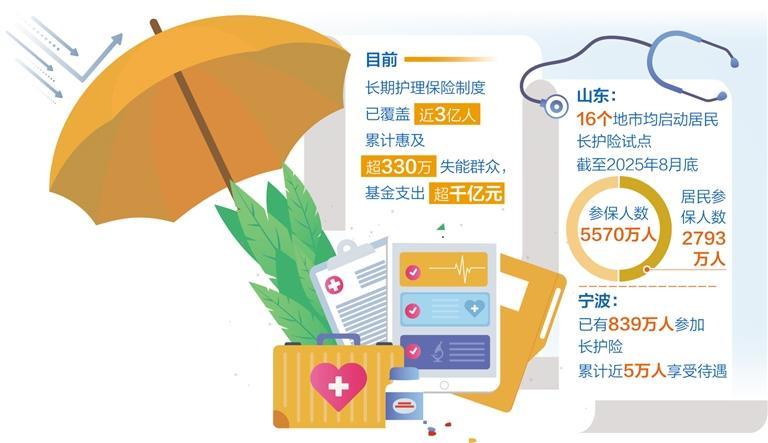
中央经济工作会议提出,实施康复护理扩容提升工程,推行长期护理保险制度,加强对困难群体的关爱帮 扶。长护险被称作继"养老、医疗、失业、工伤、生育"五大社会保险之后的"第六险"。从国外的实践以及国 内试点情况来看,建立长期护理保险制度,能够减轻失能失智人员家庭的生活照护压力,分担医疗护理的高 额费用,从而大幅度减轻个人或家庭的经济负担,有利于促进养老服务产业的发展。 试点范围持续扩大 在近日举行的2025年全国长期护理保险高质量发展大会上,国家医保局局长章轲介绍,长期护理保险制度已 覆盖近3亿人,累计惠及超330万失能群众,基金支出超千亿元。 服务待遇水平提升 长护险试点以来,各地因经济发展水平差异导致信息不对称、标准不统一、监管不到位等问题发生,制约着 这项制度从"点上突破"向"面上推广"跨越。 国家医保局秉持顶层设计、统筹规划、试点先行、平稳推进的基本原则,于2022年初启动长期护理标准研 究,明确标准体系需符合法律法规与专业要求,覆盖全业务范围、科学协调且动态完善,最终初步构建起包 含基础共性、管理工作、公共服务、评价监督四大子体系、23项标准的层次分明、功能完备的长护险信息业 务标准体系。 在山东,16个 ...
险企积极开展中期分红
Jing Ji Ri Bao· 2026-01-01 22:04
Group 1 - The core viewpoint of the articles highlights the strong capital strength and operational confidence of the insurance industry, as evidenced by the mid-term dividend distributions totaling approximately 29.336 billion yuan from four major A-share listed insurance companies [1] - China Ping An has the largest dividend distribution amounting to 17.202 billion yuan, while the overall mid-term dividend scale has increased by 8.8% compared to 2024, indicating robust financial performance [1] - The dividends are supported by stable investment performance, with insurance companies optimizing asset allocation to achieve a rebound in total investment returns, providing sufficient cash flow for dividends [1] Group 2 - The insurance industry's overall strength has been enhanced, with total assets reaching 40.40 trillion yuan, a year-on-year increase of 15.42% as of the end of Q3 2025 [2] - Insurance companies have adjusted their investment strategies, leading to a significant increase in investment returns, with the balance of insurance funds invested in the equity market rising substantially [2] - The optimization of liability structures within insurance companies has strengthened their risk resistance and dividend stability, transitioning from traditional life insurance products to dividend-type products [2] Group 3 - Recent policies, including the "New National Guidelines," have provided clear direction and institutional support for insurance companies to enhance dividend stability and frequency, making mid-term dividends a strategic priority [3] - The policies have not only stimulated the amount of single dividends but also encouraged more frequent distributions, thereby improving the timing structure of dividends [3] - Future recommendations include establishing a transparent and predictable long-term dividend framework and exploring a combination of cash dividends and stock buybacks to enhance shareholder value [3]



