航空航天

Search documents
多重利好提振!航空航天ETF天弘(159241)近20日净流入近3.5亿元
Mei Ri Jing Ji Xin Wen· 2026-02-03 01:24
Group 1 - The aerospace sector experienced a slight decline, with the Tianhong Aerospace ETF (159241) closing down 1.65% on February 2, and several component stocks, including AVIC Technology, dropping over 5% [1] - The Tianhong Aerospace ETF has seen a net inflow of 344 million yuan over the last 20 trading days, with a total fund size of 951 million yuan as of January 30, 2026 [1] - The ETF focuses on military aerospace, covering a full industry chain including fighter jets, transport aircraft, helicopters, and missiles, aligning with the "integrated aerospace" strategic direction [1] Group 2 - The commercial aerospace, large aircraft, and aviation engine sectors are expected to maintain high growth momentum, driven by China's "Tiangong Kaiwu" plan and SpaceX's satellite network [2] - The aerospace industry is transitioning from policy-driven growth to long-term strategic leadership, with a significant increase in rocket launch frequency [2] - Investment opportunities are emerging in high-end equipment manufacturing, satellite internet, and domestic production within the aerospace sector under the national strategy for becoming a space power [2]
特朗普突发!直线拉升!
Zhong Guo Ji Jin Bao· 2026-02-02 14:25
Core Viewpoint - Trump is launching a $12 billion strategic critical minerals reserve plan, known as the "Vault Plan," aimed at helping manufacturers mitigate supply shocks and reduce the risk of shortages [3][4]. Group 1: Plan Overview - The Vault Plan will combine $1.67 billion in private capital with a $10 billion loan from the Export-Import Bank of the United States to procure and store critical minerals for manufacturers [3]. - The reserve will focus on strategic minerals such as gallium and cobalt, which are essential for products like iPhones, batteries, and jet engines [4]. - Over a dozen companies, including General Motors, Stellantis, Boeing, Corning, GE Vernova, and Google, are already participating in the initiative [4]. Group 2: Financial Structure - The Ex-Im Bank's board is expected to vote on a 15-year loan, which, if approved, would be the largest single loan in the bank's history, exceeding previous transactions by more than double [4]. - The project has been "oversubscribed," indicating strong investor interest due to the backing of creditworthy manufacturers and the involvement of the U.S. export credit agency [5]. Group 3: Operational Details - Companies can utilize their material reserves but must replenish them after consumption; in case of significant supply disruptions, they can access the entire reserve [6]. - The project allows companies to lower the impact of price volatility in critical materials without needing to establish large inventories themselves [5].




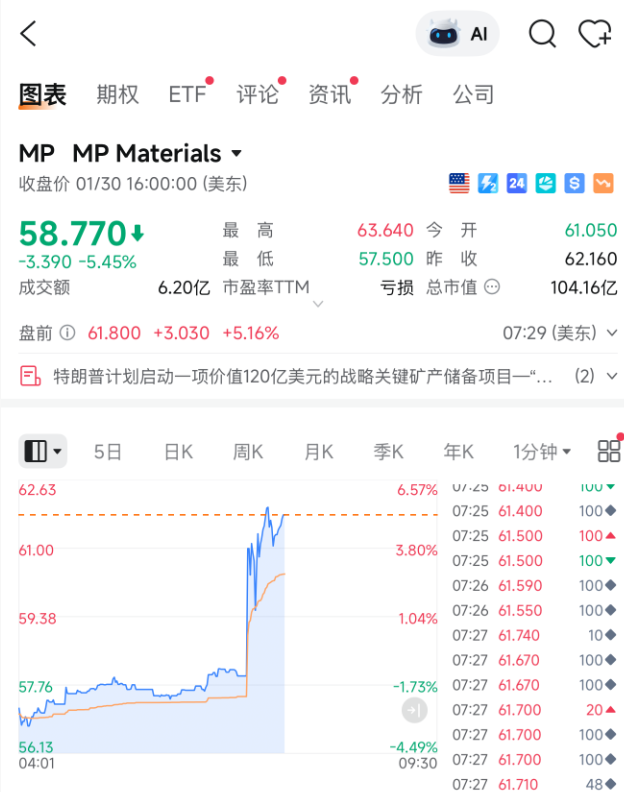
三大股指期货跌幅显著收窄,特朗普豪掷120亿美元启动“金库计划”
Zhi Tong Cai Jing· 2026-02-02 13:29
Market Overview - US stock index futures showed a significant narrowing of declines, with Dow futures down 0.09%, S&P 500 futures down 0.38%, and Nasdaq futures down 0.66% as of the report [1] - European indices performed positively, with Germany's DAX up 0.91%, UK's FTSE 100 up 0.64%, France's CAC40 up 0.60%, and the Euro Stoxx 50 up 0.47% [2][3] - WTI crude oil fell by 4.75% to $62.11 per barrel, while Brent crude oil dropped by 4.52% to $66.19 per barrel [3][4] Key Corporate Developments - Disney reported Q1 revenue and profit exceeding expectations, driven by strong performance in its theme park business, achieving $26 billion in revenue, a 5% year-over-year increase, and a pre-tax profit of $3.7 billion [10] - Tyson Foods also exceeded revenue expectations in Q1, reporting $14.31 billion, a 5.1% year-over-year increase, with adjusted EPS of $0.97, surpassing analyst expectations [10] - Tesla announced the upcoming launch of its third-generation humanoid robot, aiming for an annual production capacity of 1 million units by the end of 2026, although its stock was down 1.64% in pre-market trading [11] - Oracle plans to raise $45 to $50 billion to expand its cloud infrastructure, indicating strong demand from major clients like AMD and Meta [11] - Apple faces supply chain challenges as AI companies aggressively purchase key components, impacting its profit margins and leading to increased costs for chips and storage [12] - Boeing is under scrutiny from the FAA, which stated that the company must take further actions to regain its certification rights, despite having made significant progress [13] Upcoming Economic Data and Events - Key economic data releases include the final January SPGI Manufacturing PMI at 22:45 Beijing time and the January ISM Manufacturing PMI at 23:00 [14][15] - Notable earnings reports are expected from Palantir, NXP, and Teradyne on Tuesday morning, with PepsiCo and Pfizer reporting before the market opens [17]

特朗普拟启动120亿“金库计划”,打响关键矿产战略储备战!
Jin Shi Shu Ju· 2026-02-02 13:15
Core Insights - The U.S. government is launching a strategic critical minerals reserve plan named "Project Vault" with an initial funding of $12 billion to reduce reliance on foreign sources for rare earths and other metals [1][2] - The plan integrates $1.67 billion in private capital with a $10 billion loan from the Export-Import Bank of the United States, aimed at supporting manufacturers in sectors like automotive and technology [1][2] Group 1: Project Overview - "Project Vault" will serve as the first private sector critical minerals reserve plan in the U.S., similar in operation to the existing emergency oil reserve system but focused on minerals like gallium and cobalt [1][2] - The initiative is a significant commitment by the U.S. government to accumulate key industrial minerals, impacting core sectors such as automotive, aerospace, and energy [2] Group 2: Participation and Financing - Over ten companies, including General Motors, Stellantis, Boeing, Corning, GE Vernova, and Alphabet, are participating in the plan, along with commodity traders like Hartree Partners, Traxys North America, and Mercuria Energy Group [2] - The Export-Import Bank's board is set to vote on a record 15-year loan, which is more than double the size of the bank's previous second-largest transaction [2] Group 3: Mechanism and Benefits - The plan provides a way for participating companies to hedge against price volatility of critical raw materials without needing to establish their own reserves [4] - Companies can extract their reserved minerals and must replenish them later; in case of significant supply chain disruptions, they can access the entire reserve [5] - A core mechanism of the plan requires companies to commit to purchasing specific quantities of minerals at fixed prices, which is expected to stabilize market prices [5]
三角防务(300775) - 300775三角防务投资者关系管理信息20260202
2026-02-02 09:08
Group 1: Company Overview - Xi'an Triangle Defense Co., Ltd. is engaged in defense and aerospace sectors, with a focus on expanding its market presence both domestically and internationally [1][2]. - The company reported a revenue of 1.247 billion CNY for the first three quarters of 2025, reflecting a year-on-year decrease of 8.51%, while net profit attributable to shareholders increased by 25.64% to 375 million CNY [2]. Group 2: Business Growth and Opportunities - In November 2025, the company signed a "Gas Turbine Project Development Agreement" and a "Framework Order Agreement" with Siemens Energy, marking a significant step in its business expansion [2][3]. - The company is actively engaging with overseas clients to explore diversified cooperation models and business opportunities [3]. Group 3: Product Development and Market Position - The company has been involved in the research and trial production of engine models over the past decade, with products expected to enter preliminary production soon [3]. - The company aims to increase the revenue share from its gas turbine and engine segments, optimizing its business structure to enhance overall competitiveness [3]. Group 4: Pricing and Project Updates - The company's pricing model is based on a cost-plus approach, ensuring profitability while remaining competitive [3]. - The Aviation Digital Integration Center project has recently commenced, focusing on the assembly of the first cabin section of the C919 aircraft, which will enhance the company's manufacturing capabilities and product value [3].

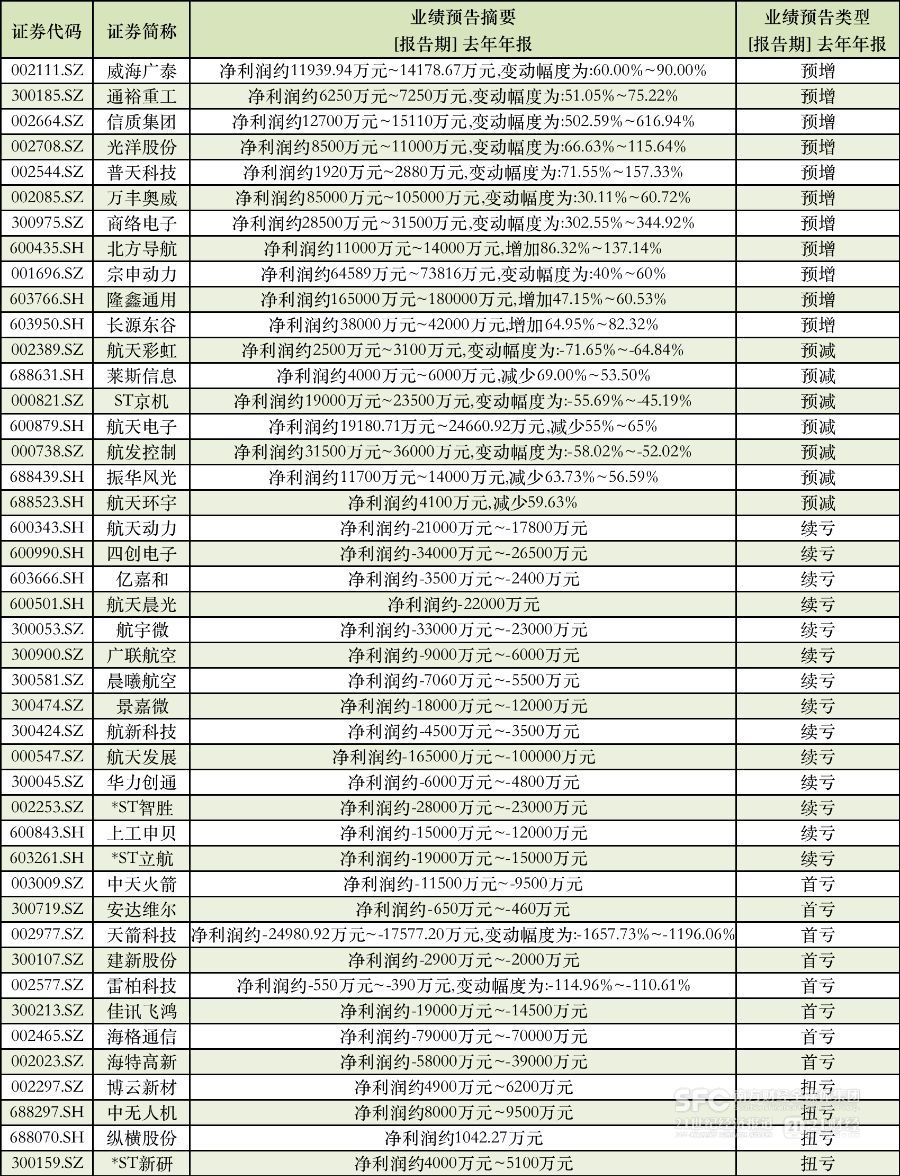
44家低空企业披露业绩预告:万丰奥威等预增,上工申贝等续亏
2 1 Shi Ji Jing Ji Bao Dao· 2026-02-02 07:20
Core Viewpoint - The low-altitude economy sector is showing mixed results for 2025, with 22 companies expected to be profitable while another 22 are projected to incur losses, indicating a significant divergence in performance within the industry [3]. Performance Forecast Summary Profit Growth - 11 companies are expected to report profit increases, with notable projections including: - Xinzhi Group (002664.SZ) and Shangluo Electronics (300975.SZ) anticipating several-fold increases in net profit [4]. - Weihai Guangtai (002111.SZ), Tongyu Heavy Industry (300185.SZ), and Guangyang Co. (002708.SZ) expecting over 50% growth in net profit [4]. - Wan Feng Aowei (002085.SZ) and Zongshen Power (001696.SZ) also forecasted net profit growth [4]. Losses - 22 companies are projected to incur losses, with several notable cases: - Zhongtian Rocket (003009.SZ) and Andavil (300719.SZ) have shifted from profit to loss [7]. - Haige Communication (002465.SZ) is investing heavily in R&D, leading to increased costs and a projected loss [7]. - Companies like Aerospace Power (600343.SH) and Sihua Electronics (600990.SH) are also expected to continue reporting losses [8]. Industry Insights - The low-altitude economy's contribution to overall profits remains limited, with most revenue still coming from aircraft manufacturing and infrastructure construction [3]. - Companies like Wan Feng Aowei are leveraging their low-altitude business to drive profit growth, supported by strong orders in general aviation aircraft manufacturing and strategic acquisitions [5]. - The industry is witnessing a shift towards commercial applications of low-altitude technologies, with companies preparing for a significant commercialization phase in 2026 [9][10]. Strategic Developments - Companies are increasingly focusing on integrating low-altitude infrastructure and management platforms, as seen with Suzhou Keda's strategic investments in civil aviation infrastructure [11]. - The emphasis on R&D and market expansion in emerging fields like low-altitude economy is evident, with companies aiming to enhance their competitive edge through innovative solutions [7][11].


标的指数一度翻红,航空航天ETF天弘(159241)实时换手率居同标的第一,近20日获资金净流入超3.4亿元
2 1 Shi Ji Jing Ji Bao Dao· 2026-02-02 07:00
Group 1 - The three major indices collectively declined, with the CN5082 Aerospace and Aviation Industry Index briefly turning positive before closing down 0.94%. Among its constituent stocks, Hangcai Co. rose over 5%, Beimo High-tech increased over 4%, and Aerospace Development gained over 3% [1] - The Tianhong Aerospace ETF (159241) had a trading volume exceeding 800 million yuan, with a real-time premium rate of 0.03% and a turnover rate of 8.67%, ranking first among similar products. It has seen net inflows for seven consecutive trading days, accumulating a net inflow of 344 million yuan over the past 20 days [1] - The Tianhong Aerospace ETF tracks the National Aerospace Index, which covers the aerospace industry chain, with a combined weight of over 68% in aviation and aerospace equipment. Its top ten holdings include leading state-owned enterprises such as Aero Engine Corporation of China and AVIC Shenyang Aircraft Corporation, providing both stability from core assets and growth potential from smaller market-cap companies [1] Group 2 - CITIC Securities predicts a structural recovery in the global aviation industry by 2026, with international route demand expected to recover to over 95% of 2019 levels. Supply chain issues at Boeing are anticipated to cause delivery delays of new aircraft, with a projected shortfall of 800 aircraft by 2026, leading to upward pressure on ticket prices [2] - China Commercial Aircraft Corporation's C919 is expected to accelerate production, targeting an annual output of 50 aircraft by 2026, which will drive the domestic large aircraft industry chain into a performance realization phase. The localization rate of core components such as avionics systems and engines is expected to exceed 60% [2] - In the military sector, satellite internet is included in the new infrastructure category, with low-orbit satellite constellation networks accelerating. By 2026, over 2,000 satellites are planned for launch domestically, leading to a surge in demand for key components like phased array TR components, with the industry maintaining a growth rate of over 15% [2]
核心技术攻坚驱动商业化进程提速!航空航天ETF(563380)、通用航空ETF(563320)有望助力把握航天产业关键阶段
Mei Ri Jing Ji Xin Wen· 2026-02-02 06:18
Group 1: Industry Developments - The commercial aerospace sector is experiencing multiple favorable catalysts, both domestically and internationally, which are expected to inject new growth expectations into the industry [1] - SpaceX has applied to deploy a constellation of up to 1 million satellites to create a powerful on-orbit data center to support advanced AI development, reflecting a global acceleration in the strategic layout of space information infrastructure [1] - In China, major commercial rocket institutions have identified "winning the primary rocket's maiden flight and recovery battle" as a core task for 2026, indicating a formal push towards reusable technology, which is crucial for global competitiveness [1] Group 2: Investment Opportunities - The aerospace ETF (563380) has seen net inflows for 15 out of the last 20 trading days this year, accumulating 734 million yuan, with average daily trading volume increasing to 181 million yuan, significantly higher than the 2025 average [2] - The aerospace ETF's underlying index focuses on the aerospace sector, with significant allocations in aerospace equipment (61.4%), space equipment (17.8%), and military electronics (17.4%), providing comprehensive coverage of the aerospace industry chain [2] - The general aviation ETF (563320) has also shown improved fund inflow, with continuous increases in the last six trading days [2] Group 3: Fund Management - The fund manager for the aerospace ETFs, Huatai-PB Fund, is one of the first ETF managers in China, with extensive experience in ETF management [3] - The two benchmark products, Huatai-PB CSI 300 ETF (510300) and Huatai-PB A500 ETF (563360), are among the largest in their category, both adopting the lowest fee structure in the market (management fee of 0.15% per year and custody fee of 0.05% per year) to facilitate low-cost investment for investors [3]
核心技术攻坚驱动商业化进程提速!航空航天ETF、通用航空ETF有望助力把握航天产业关键阶段
Xin Lang Cai Jing· 2026-02-02 05:15
Group 1 - The commercial aerospace sector is experiencing multiple favorable catalysts both domestically and internationally, which is expected to inject new growth expectations into the industry [1][5] - SpaceX has applied to deploy a constellation of up to 1 million satellites to create a powerful on-orbit computing center to support advanced AI development, reflecting a global acceleration in the strategic layout of space information infrastructure [1][5] - China's main commercial rocket institutions have identified "winning the primary rocket's maiden flight and recovery battle" as a core task for 2026, indicating a formal push towards reusable technology, which is crucial for global competitiveness [1][5] Group 2 - The reusable launch vehicle is currently the core technological path for reducing launch costs and increasing launch frequency in the global aerospace industry [1][5] - Although Chinese commercial aerospace companies have achieved multiple successful launches, they are still in the stage of catching up and breaking through in the reliable recovery and rapid reuse of first-stage rockets [1][5] - The designation of the "recovery battle" as a core task signifies that state-backed commercial rocket companies are officially launching an offensive in this high-tech barrier area, which may directly impact China's long-term competitiveness in the global commercial rocket market [1][5] Group 3 - The aerospace ETF (563380) has seen net inflows in 15 out of the last 20 trading days this year, accumulating 734 million yuan, with an average daily trading volume rising to 181 million yuan, significantly widening compared to 2025 [2][6] - The fund's scale and shares have both reached new highs since its inception, at 879 million yuan and 713 million shares respectively [2][6] - The aerospace ETF focuses on the aerospace sector, with significant allocations in aerospace equipment (61.4%), space equipment (17.8%), and military electronics (17.4%), providing comprehensive coverage of the aerospace industry chain [2][6] Group 4 - The fund manager of the aerospace ETF (563380) and the general aviation ETF (563320) is Huatai-PB Fund, one of the first ETF managers in China, with extensive ETF management experience [3][7] - Both flagship products, the Huatai-PB CSI 300 ETF (510300) and the Huatai-PB A500 ETF (563360), are among the largest in their category, utilizing the lowest fee structure in the market (management fee of 0.15% per year, custody fee of 0.05% per year) to assist investors in low-cost allocations [3][7]
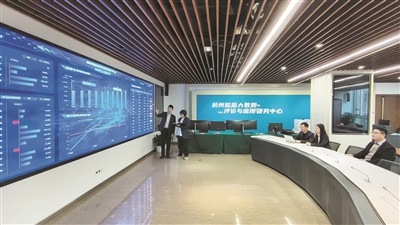
五年跃升41.4% 全市电力消费“量质齐升”
Hang Zhou Ri Bao· 2026-02-02 03:27
Core Insights - Hangzhou's total electricity consumption is projected to reach 114.25 billion kWh by 2025, marking a 6.5% year-on-year increase and a 41.4% increase compared to 2020, positioning it as the second provincial capital city in China to exceed 100 billion kWh in electricity consumption [3][4] Group 1: Electricity Consumption Trends - The electricity consumption structure in Hangzhou is undergoing significant transformation during the 14th Five-Year Plan period, with emerging manufacturing and service industries becoming the main growth drivers [3] - By 2025, the electricity consumption shares of the primary, secondary, and tertiary industries, as well as residential use, are expected to be 0.5%, 42.7%, 35.8%, and 21% respectively, with the tertiary industry's share increasing by 7.8 percentage points since 2020 [3][4] - The secondary industry's electricity consumption remains the highest, but its growth is shifting from high energy consumption to high-tech driven [3] Group 2: Manufacturing and Service Sector Developments - The high-end, intelligent, and green transformation in the manufacturing sector is particularly notable, with manufacturing electricity consumption expected to account for 36.7% of total electricity by 2025, reflecting a 3.1% year-on-year increase [4] - High-end manufacturing sectors such as computer communication, pharmaceutical manufacturing, and aerospace are experiencing double-digit growth in electricity consumption, while the electric vehicle manufacturing sector is projected to grow by 17.1% [4] - The productive service sector's electricity consumption is expected to account for 18.6% of total consumption, with a year-on-year growth of 10.4% and a 78.6% increase since 2020 [4] Group 3: Emerging Sectors and Innovations - The internet data service sector, driven by artificial intelligence, is witnessing explosive growth, with electricity consumption increasing by 159.6% year-on-year and 25.5 times since 2020 [4] - The consumption of electricity in the consumer service sector is projected to account for 17% of total consumption, with a year-on-year increase of 9.8% and an 84.2% increase since 2020 [4] - The charging and swapping service sector for electric vehicles is expected to see a 41.5% year-on-year increase in electricity consumption by 2025, with a staggering 650% increase since 2020 [5] Group 4: Infrastructure and Future Outlook - By 2025, Hangzhou is expected to have built 5,011 charging stations, with total charging volume reaching 2.077 billion kWh, a 49.7% year-on-year increase [5] - The changes in electricity consumption patterns will provide robust data support and practical guidance for Hangzhou's new energy system construction and the development of advanced manufacturing clusters during the 15th Five-Year Plan period [5]