
锂电池

Search documents
“双万亿”第三城,新目标定了
Mei Ri Jing Ji Xin Wen· 2026-01-20 01:40
Group 1: Core Insights - Guangzhou has become the third city in China to achieve a "double trillion" status in consumption and foreign trade during the 14th Five-Year Plan period, following Beijing and Shanghai [1][2] - By 2025, Guangzhou's airport is expected to handle over 83 million passengers, ranking among the top ten globally, while its port is projected to handle nearly 700 million tons of cargo, placing it in the top six worldwide [1] - The city aims to establish six advanced manufacturing clusters with outputs exceeding 100 billion yuan and ten service sectors with added value surpassing 100 billion yuan during the same period [1] Group 2: Economic Indicators - As of 2024, only seven cities in China have reached a consumption level of over one trillion yuan, including Guangzhou, which highlights the significance of its economic status [2] - The report indicates that Guangzhou's foreign trade volume also exceeds one trillion yuan, making it one of only seven cities to achieve this milestone [2] Group 3: Strategic Development - Guangzhou's government has outlined plans to enhance its role as a global supply chain innovation center, aiming to strengthen its core urban functions [3][4] - The city is leveraging its geographical advantages, including proximity to the Pearl River Delta manufacturing hub and its status as a major transportation and trade center, to transition from a trade hub to a supply chain management center [4] Group 4: Future Goals - The city has set ambitious goals for the 15th Five-Year Plan, focusing on increasing its visibility and resource allocation capabilities within the global resource network [3] - The government has previously articulated a vision to develop Guangzhou into a world-class city with both historical charm and modern vitality, as outlined in its urban planning documents [3]

五部门联合部署开展零碳工厂建设,逐步拓展至传统高载能行业
Huan Qiu Wang· 2026-01-20 00:54
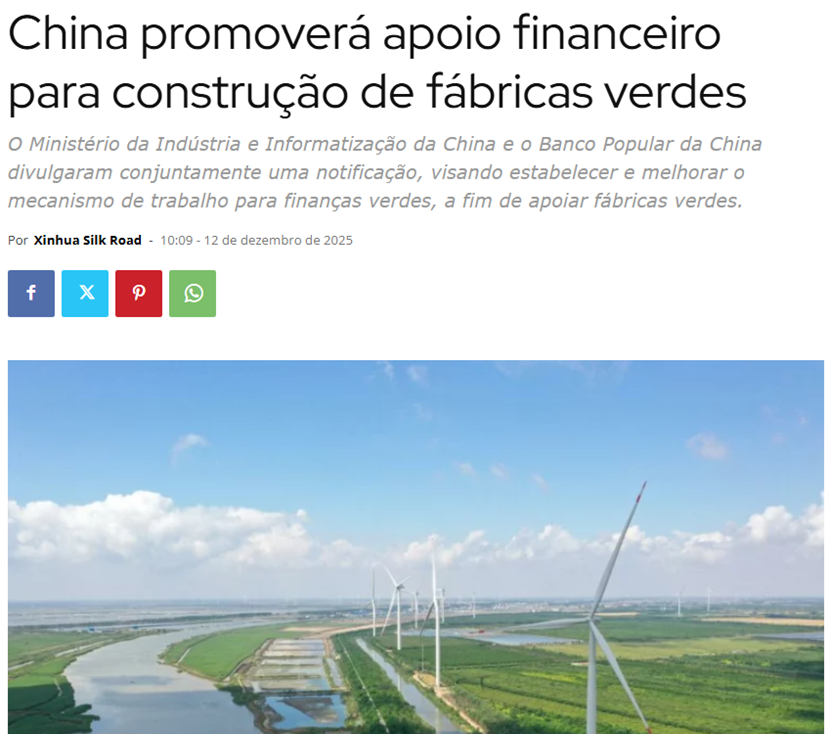
Group 1 - The Ministry of Industry and Information Technology, along with four other departments, has launched a plan to develop zero-carbon factories, aiming to cultivate a number of such factories in industries like automotive, lithium batteries, photovoltaics, and electronics by 2027, and to expand this initiative to traditional high-energy-consuming industries such as steel, non-ferrous metals, and petrochemicals by 2030 [1][4] - China's green factories play a significant role in green manufacturing, with their output accounting for over 20% of the national manufacturing output. Currently, approximately 6,430 national-level green factories have been cultivated in China [1] Group 2 - The Ministry of Industry and Information Technology and the Bank of China have jointly issued a notice to establish and improve the green finance work mechanism, encouraging financial institutions to develop financial products that support green manufacturing and increase investments in energy conservation, low-carbon development, water resource protection, environmental protection, and resource utilization in green factories [4] - The Minister of Industry and Information Technology, Li Lecheng, stated that during the 14th Five-Year Plan period, the focus will be on achieving new industrialization to promote high-quality development, advancing the intelligent, green, and integrated development of manufacturing, and maintaining a reasonable proportion of the manufacturing sector. A key priority will be to rejuvenate traditional industries, with initiatives like the "Artificial Intelligence+" action plan to explore the creation of zero-carbon factories and zero-carbon parks [4]
容百科技千亿订单闹剧重创股价 单季预盈3000万产业转型存变数
Chang Jiang Shang Bao· 2026-01-19 23:57
Core Viewpoint - The controversy surrounding the estimated 120 billion yuan contract by Rongbai Technology has led to an investigation by the China Securities Regulatory Commission (CSRC) for misleading statements, raising concerns about the company's ability to fulfill its commitments [2][4][10]. Group 1: Contract Details and Investigation - Rongbai Technology announced a procurement cooperation agreement with CATL, estimating a total sales amount exceeding 120 billion yuan for supplying 3.05 million tons of lithium iron phosphate cathode materials over six years [2][4]. - The CSRC has initiated an investigation due to the alleged misleading nature of the contract announcement, which lacked the chairman's signature [8][9]. - The company clarified that the 120 billion yuan figure was an estimate and that the actual sales amount would depend on future orders and raw material prices, indicating a lack of precision in the original announcement [5][7]. Group 2: Market Reaction and Financial Impact - Following the announcement and subsequent investigation, Rongbai Technology's stock price dropped by 11.16%, resulting in a market value loss of approximately 3 billion yuan [3][9]. - The company's projected revenue for 2024 is 15.088 billion yuan, making the estimated 120 billion yuan contract amount nearly eight times its expected revenue [5]. Group 3: Production Capacity and Financial Health - Rongbai Technology is in the process of acquiring stakes in Guizhou Xinren to enhance its production capacity, but current capacity is insufficient to meet the projected demand of 305 million tons over six years [10]. - The company plans to invest approximately 8.7 billion yuan over the next three years to expand production capacity, with expected capital expenditures of 3.6 billion yuan, 3.3 billion yuan, and 1.8 billion yuan for the years 2026, 2027, and 2028, respectively [10]. - As of September 2025, the company reported sufficient liquidity, with cash and financial assets totaling 4.591 billion yuan and unused bank credit of 8.438 billion yuan [10]. Group 4: Industry Challenges and Future Outlook - The lithium iron phosphate industry is currently characterized by intense competition, and Rongbai Technology's transition to this sector may face significant challenges [12]. - The company has experienced substantial declines in net profit in 2023 and 2024, with a projected loss of 190 million to 150 million yuan for the full year of 2025, although a slight profit is expected in the fourth quarter [13]. - Rongbai Technology has established long-term partnerships with major clients such as CATL and BYD, raising questions about its future commitment to the lithium iron phosphate market [14].

五部门:2026年起将遴选一批标杆零碳工厂
Zhong Guo Zheng Quan Bao· 2026-01-19 23:57
1月19日消息,工业和信息化部、国家发展改革委、生态环境部、国务院国资委、国家能源局近日联合 印发《关于开展零碳工厂建设工作的指导意见》,深挖工业和信息化领域节能降碳潜力,带动重点行业 领域减碳增效和绿色低碳转型。其中,提出2026年起,遴选一批零碳工厂,做好标杆引领。 《指导意见》主要目标为:实施分阶段梯度培育,优先选择脱碳需求迫切、能源消费以电力为主、脱碳 难度相对较小的行业先行探索,逐步完善相关规划设计、能源供应、工艺技术、管理运营和商业模式, 待条件成熟后再向碳排放量强度高、脱碳难度大的行业逐步推进。2026年起,遴选一批零碳工厂,做好 标杆引领。到2027年,在汽车、锂电池、光伏、电子电器、轻工、机械、算力设施等行业领域,培育建 设一批零碳工厂。到2030年,逐步拓展至钢铁、有色金属、石化化工、建材、纺织等行业领域,探索传 统高载能产业脱碳新路径。 零碳工厂建设是指通过技术创新、结构调整和管理优化等减排措施,实现厂区内二氧化碳排放的持续降 低、逐步趋向于近零的过程。工业和信息化部节能与综合利用司有关负责人提出,零碳工厂不是绝对 的"零"二氧化碳排放,而是在当前技术经济条件允许下,实现应减尽减并持续改 ...
今年起将遴选一批标杆零碳工厂
Xin Lang Cai Jing· 2026-01-19 22:18
Core Viewpoint - The Ministry of Industry and Information Technology, along with four other departments, has issued guidelines for the construction of zero-carbon factories, aiming to enhance energy efficiency and carbon reduction in key industrial sectors, with a target to select a batch of zero-carbon factories starting in 2026 [1] Group 1: Zero-Carbon Factory Construction - Zero-carbon factory construction involves reducing carbon dioxide emissions through technological innovation, structural adjustments, and management optimization, aiming for near-zero emissions within factory premises [1] - The guidelines emphasize the importance of pilot zero-carbon factories in fostering new productive forces and balancing high-quality development with environmental protection, supporting carbon peak and carbon neutrality goals [1] Group 2: Implementation Timeline and Industry Focus - By 2027, the initiative aims to cultivate zero-carbon factories in sectors such as automotive, lithium batteries, photovoltaics, electronics, light industry, machinery, and computing facilities [1] - By 2030, the construction of zero-carbon factories will expand to include traditional high-energy-consuming industries like steel, non-ferrous metals, petrochemicals, building materials, and textiles, exploring new decarbonization pathways [1] Group 3: Construction Pathways - The guidelines outline pathways for zero-carbon factory construction, including establishing a carbon emission accounting system to identify and quantify emissions and removals [2] - Factories are encouraged to build industrial green microgrids and enhance the application of new-generation information technology [2] - Carbon emissions reductions can be offset through mechanisms such as cross-border carbon trading [2]
2026年起我国将遴选一批标杆零碳工厂
Xin Lang Cai Jing· 2026-01-19 22:17
Core Viewpoint - The Ministry of Industry and Information Technology, along with four other departments, has issued guidelines to promote the construction of zero-carbon factories, aiming to enhance energy efficiency and facilitate green transformation in key industries [1] Group 1: Zero-Carbon Factory Development - Starting in 2026, a selection of zero-carbon factories will be identified to serve as benchmarks [1] - The guidelines outline a phased approach to cultivate zero-carbon factories, with a target to establish them in sectors such as automotive, lithium batteries, photovoltaics, electronics, light industry, machinery, and computing facilities by 2027 [1] - By 2030, the initiative aims to expand zero-carbon factory construction to include industries like steel, non-ferrous metals, petrochemicals, building materials, and textiles, exploring new pathways for decarbonization in traditional high-energy-consuming industries [1]
我国今年起将遴选一批零碳工厂
Ren Min Ri Bao· 2026-01-19 22:08
Core Viewpoint - The Ministry of Industry and Information Technology, along with four other departments, has issued guidelines to promote the construction of zero-carbon factories, aiming to enhance energy efficiency and facilitate green low-carbon transformation in key industries [1][2]. Group 1: Zero-Carbon Factory Concept - Zero-carbon factories represent a new model for high-quality development, focusing on systematic emission reduction through technological innovation, structural adjustments, and management optimization [1]. - The term "zero-carbon" does not imply absolute zero CO2 emissions but rather aims for the lowest possible emissions under current technological and economic conditions, with continuous improvement [1]. Group 2: Implementation Phases - The implementation of the guidelines will occur in phases, prioritizing industries with urgent decarbonization needs, primarily those relying on electricity, and where decarbonization is relatively easier [1]. - A gradual approach will be taken to develop relevant planning, energy supply, process technology, management operations, and business models before expanding to industries with higher carbon intensity and greater decarbonization challenges [1]. Group 3: Timeline and Industry Focus - By 2026, a selection of zero-carbon factories will be identified to serve as benchmarks [2]. - By 2027, efforts will focus on industries such as automotive, lithium batteries, photovoltaics, electronics, light industry, machinery, and computing facilities to establish a batch of zero-carbon factories [2]. - By 2030, the initiative will expand to include traditional high-energy-consuming industries like steel, non-ferrous metals, petrochemicals, building materials, and textiles, exploring new decarbonization pathways [2].
2026年起将遴选一批标杆零碳工厂
Zhong Guo Zheng Quan Bao· 2026-01-19 21:11
Core Viewpoint - The Chinese government has issued guidelines for the construction of zero-carbon factories, aiming to enhance energy efficiency and promote green transformation in key industries by 2026 [1][2]. Group 1: Objectives and Implementation - The main goal is to implement a phased approach to cultivate zero-carbon factories, starting with industries that have urgent decarbonization needs and primarily rely on electricity [1]. - By 2026, a selection of zero-carbon factories will be identified to serve as benchmarks, with a broader rollout planned for various industries by 2030 [1][2]. Group 2: Construction Pathways - The construction of zero-carbon factories involves several key measures, including establishing a carbon emission accounting management system, enhancing energy efficiency, and promoting the use of renewable energy [2][3]. - Specific strategies include improving the energy structure, conducting carbon footprint analysis for key products, and advancing digitalization for precise energy and carbon management [2]. Group 3: Energy Structure Transformation - The guidelines encourage factories to achieve zero-carbon energy supplies, including electricity, heat, hydrogen, and fuels, while promoting the development of distributed renewable energy sources [3]. - The government will support the establishment of industrial green microgrids and integrated projects for clean hydrogen applications [3].
五部门: 2026年起将遴选一批标杆零碳工厂
Zhong Guo Zheng Quan Bao· 2026-01-19 21:09
Core Viewpoint - The Chinese government has issued guidelines for the construction of zero-carbon factories, aiming to enhance energy efficiency and promote green transformation in key industries by 2026 [1][2]. Group 1: Objectives and Implementation - The guidelines prioritize industries with urgent decarbonization needs and primarily electric energy consumption for initial exploration [1]. - By 2026, a selection of zero-carbon factories will be established as benchmarks, with a broader rollout planned for various sectors by 2030 [1][2]. - The phased approach includes focusing on industries like automotive, lithium batteries, photovoltaics, electronics, light industry, machinery, and computing facilities by 2027, and expanding to steel, non-ferrous metals, petrochemicals, building materials, and textiles by 2030 [1]. Group 2: Construction Pathways - The construction of zero-carbon factories involves a comprehensive approach, including carbon emission accounting, energy structure transformation, and management optimization [2]. - Key strategies include enhancing renewable energy utilization, improving energy efficiency, conducting carbon footprint analysis, and advancing digitalization for precise energy and carbon management [2][3]. - The guidelines encourage the development of green microgrids and integrated projects for renewable energy applications, such as distributed photovoltaics and wind power [3]. Group 3: Future Actions - The Ministry of Industry and Information Technology will coordinate the implementation of the guidelines and develop universal requirements and industry-specific construction guidelines [3]. - There will be a focus on establishing greenhouse gas emission accounting standards and disclosure requirements for enterprises and products [3].
五部门联合部署零碳工厂建设 分阶推进工业绿色低碳转型
Zheng Quan Shi Bao· 2026-01-19 18:07
Core Viewpoint - The release of the "Guiding Opinions on the Construction of Zero Carbon Factories" aims to enhance energy conservation and carbon reduction in the industrial and information sectors, promoting green and low-carbon transformation while fostering new productive forces. Group 1: Overall Requirements and Goals - The "Guiding Opinions" outlines overall requirements, stage goals, and implementation paths for zero carbon factory construction, focusing on energy conservation and carbon reduction potential in key industries [1] - A phased cultivation strategy is proposed, with a selection of zero carbon factories starting in 2026, expanding to various industries by 2030, including steel, non-ferrous metals, petrochemicals, and textiles [1] Group 2: Importance and Challenges - The establishment of zero carbon factories is crucial for achieving carbon peak and carbon neutrality, balancing high-quality development with environmental protection [2] - There are significant differences in understanding and implementation across regions and industries, with challenges such as inconsistent evaluation requirements and weak carbon emission accounting foundations [2] Group 3: Principles and Construction Paths - The construction of zero carbon factories will follow principles such as tailored strategies, systematic advancement, innovation-driven approaches, and transparency [3] - Six major construction paths are defined, including improving carbon emission accounting, accelerating green energy transitions, and promoting carbon footprint analysis and data management [3] Group 4: Source Reduction and Energy Supply - The "Guiding Opinions" encourages factories to achieve zero carbon energy supply while ensuring energy security, promoting the use of distributed renewable energy sources like solar and wind [3] - Factories are encouraged to develop industrial green microgrids and integrate various energy sources for efficient utilization [3]