电动自行车

Search documents
小牛电动(NIU.US)涨5% 机构:电动自行车新国标实施日临近 龙头企业弹性值得期待
Zhi Tong Cai Jing· 2025-08-06 03:07
周二,小牛电动(NIU.US)涨5%,报3.75美元。距离9月1日电动自行车新国标在生产端正式实施,仅剩1 个月不到。长江证券表示,新国标正式落地符合市场预期,针对非经营性用途的电动自行车,不再强制 加装北斗定位模块,这有利于降低成本和车价,进而提升消费需求。同时,生产过渡期延长,预计2025 年电动自行车市场或以"老车"销售为主,"新车"销售或在四季度后逐步起量。叠加以旧换新政策延续, 龙头企业弹性值得期待。 ...

李迅雷:以旧换新换什么乘数效应更大
Di Yi Cai Jing· 2025-08-06 02:00
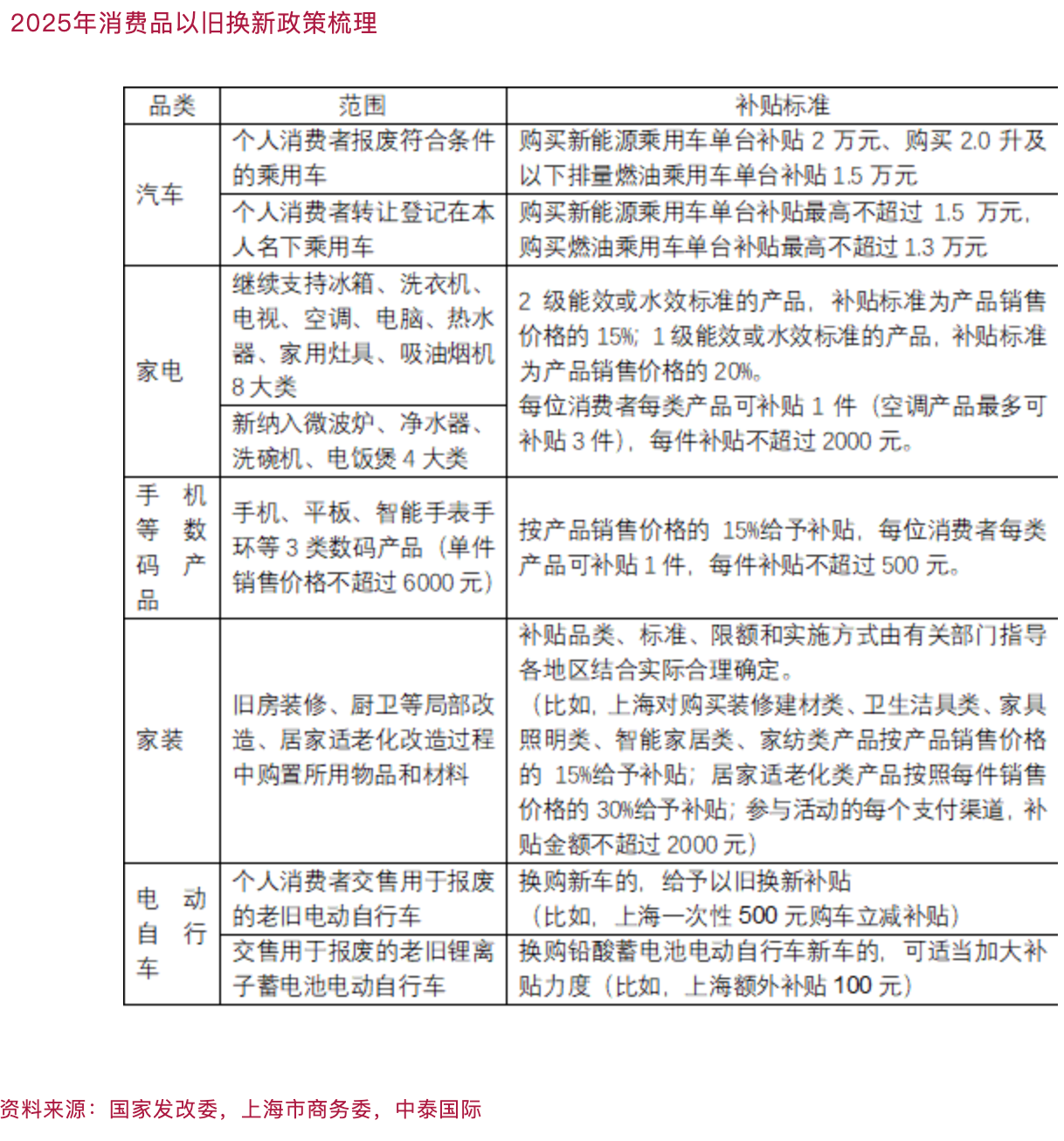
Core Insights - The article discusses the expansion of the "trade-in for new" policy in China, which will begin in 2024, aiming to stimulate consumption across various categories, including essential goods and services [1][19] - The policy is supported by a significant financial commitment, with 150 billion yuan allocated in 2024 and an increase to 300 billion yuan in 2025, targeting a wide range of consumer goods [1][2] - The expected impact of the policy includes a projected sales boost exceeding 1.3 trillion yuan in 2024, driven by sectors such as automobiles, home appliances, and electric bicycles [1][4] Policy Implementation - The "trade-in for new" policy will cover five major categories in 2025, including the replacement of vehicles and digital products [2] - Specific subsidy standards have been established, such as 20,000 yuan for new energy vehicles and 15,000 yuan for certain fuel vehicles [3] Financial Impact - In the first half of the year, central subsidies of 162 billion yuan led to sales exceeding 1.6 trillion yuan, with a total subsidy of over 180 billion yuan when including local funding [4][5] - The estimated maximum subsidy across categories could reach 233.4 billion yuan, indicating a potential for higher financial support than previously allocated [6] Consumption Growth - The "trade-in for new" policy has contributed to a 5% increase in retail sales, with significant growth in categories such as home appliances and communication equipment [8][11] - The contribution of final consumption to economic growth reached 52% in the first half of the year, highlighting the foundational role of consumption in economic development [11] Optimization Suggestions - Recommendations include expanding the scope of the trade-in policy to include essential goods and services, which could benefit a broader demographic [19][20] - The article suggests that the policy should consider the indirect effects on overall consumption, as initial purchases may lead to additional spending in related sectors [20]

上海7月电动自行车火灾39起 因电池故障或热失控超半数
Xin Jing Bao· 2025-08-05 15:04
Summary of Key Points Core Viewpoint - In July 2023, Shanghai experienced a significant decrease in electric bicycle fires, with a total of 39 incidents reported, marking a reduction of 22 incidents or 36.1% compared to the previous year [1]. Fire Incident Breakdown - Among the 39 fire incidents, 21 were caused by battery failures or thermal runaway [1]. - The brands involved in these battery-related fires included: - Yadea: 5 incidents - Aida: 3 incidents - Phoenix, Tailin, and New Dazhou: 2 incidents each - Jebao Wang, Jielin, Saige, and Yongjiu: 1 incident each [1]. - Battery brands implicated in the fires included: - Yadea original: 3 incidents - Tianneng: 2 incidents - Chaoli, Chaowei, Zhuoneng, Sanyuan, and Yongjiu original: 1 incident each [1]. Electrical Faults - 16 incidents were attributed to electrical faults in the vehicle's wiring [1]. - Brands involved in these electrical fault fires included: - Bubufa, New Dazhou, and Phoenix: 2 incidents each - Jin Jian, Aima, Jin Jian, Green Bright, Green Energy, Xiao Dao, Xin Huan Power, and Aida: 1 incident each [1]. Charging Line Issues - 2 incidents were caused by charging line faults, with both incidents occurring in the food delivery industry, involving one rider from Meituan and one from Ele.me [1].
上海7月电动自行车火灾39起,因电池故障或热失控超半数
Xin Jing Bao· 2025-08-05 14:43
Summary of Key Points Core Viewpoint - In July 2023, Shanghai experienced a significant decrease in electric bicycle fires, with a total of 39 incidents reported, marking a reduction of 22 incidents or 36.1% compared to the previous year [1] Group 1: Fire Incidents - Out of the 39 fire incidents, 21 were caused by battery failures or thermal runaway [1] - The brands involved in battery-related fires included Yadea (5 incidents), Aida (3 incidents), and others such as Phoenix, Tailin, and New Dazhou, each with 2 incidents [1] - Battery brands implicated in these fires included Yadea original (3 incidents) and Tianneng (2 incidents), among others [1] Group 2: Electrical Faults - 16 incidents were attributed to electrical faults in the vehicle's wiring [1] - Brands involved in wiring-related fires included Bubu Fa, New Dazhou, and Phoenix, each with 2 incidents, while others like Jinjian and Aima had 1 incident each [1] Group 3: Charging Issues - 2 incidents were caused by charging line faults, with both incidents occurring in the food delivery industry [1] - The involved delivery services included Meituan and Ele.me, with one incident linked to each service [1]
李迅雷:以旧换新,换什么乘数效应更大|立方大家谈
Sou Hu Cai Jing· 2025-08-05 14:37
Group 1 - The core viewpoint of the articles is that the "old-for-new" policy is expected to significantly boost consumer spending in various sectors, particularly in automobiles, home appliances, and digital products, with substantial government support through subsidies [1][2][3] - In 2024, the government will implement a consumption upgrade program with a budget of 150 billion yuan, increasing to 300 billion yuan in 2025, aimed at stimulating sales in categories such as automobiles, home appliances, and home renovations [1][2] - The estimated sales driven by the "old-for-new" policy in 2024 is projected to exceed 1.3 trillion yuan, with the central government's funding of 162 billion yuan in the first half of the year leading to over 1.6 trillion yuan in sales [1][2][3] Group 2 - The 2025 "old-for-new" policy will expand to include five major categories, with specific subsidy standards for automobiles, home appliances, digital products, home renovations, and electric bicycles [2][3] - The estimated subsidy amounts for various categories in 2025 include up to 20,000 yuan for new energy vehicles and 1,500 to 2,000 yuan for home appliances, with a total estimated subsidy cap of 233.4 billion yuan [2][3][6] - The policy is expected to have a multiplier effect on consumer spending, contributing to a 5% increase in retail sales of consumer goods in the first half of the year, with significant growth in categories such as home appliances and communication equipment [7][9] Group 3 - The contribution of final consumption to economic growth reached 52% in the first half of the year, indicating the foundational role of consumption in economic development [9][10] - The "old-for-new" policy's impact on retail sales is estimated to contribute between 0.74% and 0.96% to the total retail sales growth, suggesting a modest multiplier effect [10] - The total number of individuals benefiting from the subsidies is estimated at 280 million, indicating a significant reach of the policy, although the actual number of unique beneficiaries may be lower [17] Group 4 - Recommendations for optimizing the "old-for-new" policy include expanding the subsidy scale and diversifying the categories of supported products to include essential goods and services, thereby benefiting a broader demographic [18][19] - The policy is seen as having both direct and indirect effects on overall consumption, as the savings from subsidies may lead to increased spending in other areas [19] - The articles suggest that the current subsidy structure may favor higher-income groups, and adjustments could enhance the policy's equity and accessibility [17][18]
以旧换新:换什么乘数效应更大?
Hu Xiu· 2025-08-05 13:57
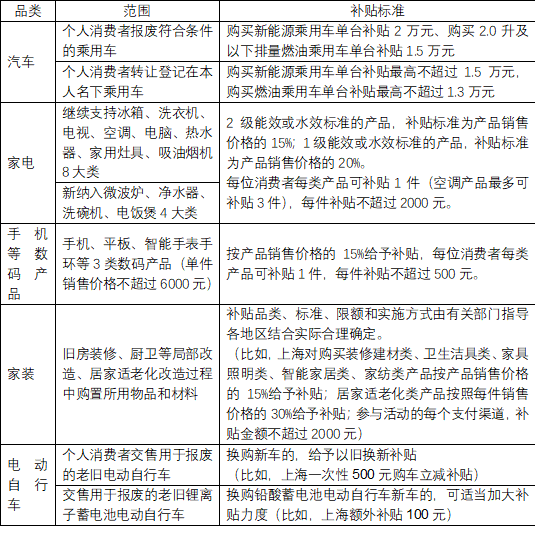
Group 1 - The core viewpoint of the article is that the "old-for-new" policy for consumer goods will be implemented starting in 2024, with a funding support of 150 billion yuan from long-term special government bonds, increasing to 300 billion yuan in 2025, which is expected to significantly boost sales in various sectors [1][4][26] - The policy is projected to drive sales exceeding 1.3 trillion yuan in 2024 for categories such as automobiles, home appliances, home decoration, and electric bicycles, with central funding of 162 billion yuan in the first half of the year leading to over 1.6 trillion yuan in sales [1][7] - The article discusses the specific categories and subsidy amounts for the "old-for-new" policy in 2025, which includes automobiles, home appliances, digital products, home decoration, and electric bicycles [4][6][9] Group 2 - The estimated sales driven by subsidies in 2024 include 920 billion yuan for automobiles, 270 billion yuan for home appliances, and approximately 40 billion yuan for electric bicycles, totaling around 1.3 trillion yuan [9][18] - The contribution of final consumption to economic growth reached 52% in the first half of the year, indicating the foundational role of consumption in economic development, with the "old-for-new" policy playing a positive role in optimizing economic structure [18][20] - The article suggests that the multiplier effect of the "old-for-new" policy on retail sales is relatively modest, contributing approximately 0.74% to 0.96% to the total retail sales growth of 1.3% in the first half of the year [18][20] Group 3 - Recommendations for optimizing the "old-for-new" policy include expanding the subsidy scale to maintain stable consumption growth in the fourth quarter and adjusting subsidy standards in response to rapid fund usage [26][27] - The article proposes broadening the categories of items eligible for the "old-for-new" program to include essential goods and services, which would benefit a larger population, particularly lower-income groups [28] - It emphasizes the indirect effects of the "old-for-new" policy on overall consumption, suggesting that initial subsidies can lead to increased spending in other areas, thereby enhancing the overall economic impact [28][29]
以旧换新:换什么乘数效应更大
李迅雷金融与投资· 2025-08-05 13:20
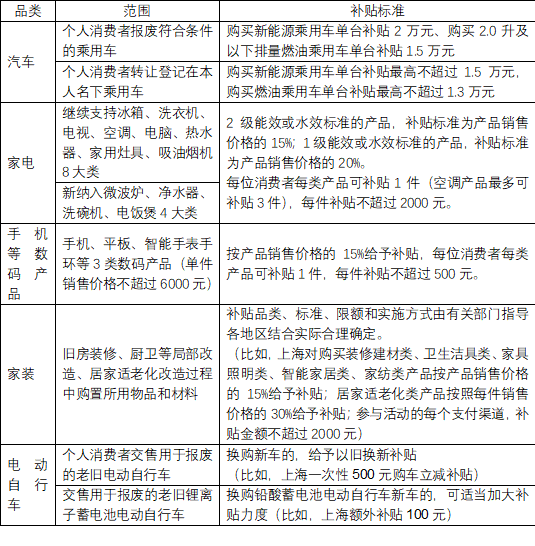
Core Viewpoint - The article discusses the implementation of a "trade-in for new" policy starting in 2024, supported by special government bonds, aimed at boosting consumer spending in various sectors, including automobiles and home appliances [1][2]. Group 1: Policy Implementation and Financial Support - The "trade-in for new" policy will begin in 2024 with a funding of 150 billion yuan, increasing to 300 billion yuan in 2025, with an expanded range of supported consumer goods [1][3]. - The policy is expected to drive sales exceeding 1.3 trillion yuan in sectors such as automobiles, home appliances, and electric bicycles [1][6]. Group 2: Subsidy Details and Categories - The 2025 policy will cover five major categories, including the scrapping of high-emission vehicles and the purchase of new digital products [3][4]. - Subsidy standards vary by category, with electric vehicles receiving up to 20,000 yuan per unit, while home appliances can receive up to 20% of the sales price as a subsidy [4][5]. Group 3: Sales Impact and Estimates - In the first half of 2023, central subsidies of 162 billion yuan led to sales exceeding 1.6 trillion yuan, indicating a strong multiplier effect from the subsidies [6][13]. - The estimated net increase in sales due to the trade-in policy for various categories shows that lower-priced items, such as home appliances and electric bicycles, have a more significant impact on sales growth [20][22]. Group 4: Recommendations for Policy Optimization - Suggestions include expanding the subsidy scale to maintain consumer spending growth and adjusting policies to ensure broader access to benefits, particularly for lower-income groups [23][24]. - The article emphasizes the need for a systemic approach to the trade-in policy, highlighting its indirect benefits on overall consumption beyond the targeted categories [25].

新国标落地在即!电动自行车经销商抢抓销售窗口期
Zhong Guo Jing Ying Bao· 2025-08-05 00:10
中经记者 夏治斌 石英婧 上海报道 "现在这些(非新国标)车型,8月31日之后就不能在店里摆放销售了,但会有缓冲时间供上牌。"7月30 日,在上海市普陀区的一家电动自行车门店,销售人员指着店内的电动自行车向《中国经营报》记者直 言,"这些天,好多人来换车。国家大力支持换车,现在还有国补。" 相关数据显示,当前我国电动自行车社会保有量约3.8亿辆,相当于每4个人就拥有1辆电动自行车。电 动自行车是人们日常短途出行的重要交通工具,与人们生活息息相关。 电动自行车的质量、安全性能等问题一直是外界关注的重点。2024年年底,新版强制性国家标准《电动 自行车安全技术规范》(GB 17761—2024)正式发布,共设定了两个实施时间,其中生产环节实施时 间是2025年9月1日,销售环节实施时间是2025年12月1日。 对于即将实施的电动自行车的新国标,世纪证券研报指出,随着新国标实施,大量不符合标准的存量车 辆需更新换代,加之各地"以旧换新"补贴政策推动,将刺激市场需求。 新国标进入"倒计时" 7月24日,工业和信息化部举行"电动自行车相关标准政策"新闻发布会,介绍新版电动自行车强制性国 家标准及《关于强化电动自行车强制 ...

以旧换新政策带来多重效应(延伸阅读)
Ren Min Ri Bao· 2025-08-04 21:56
Group 1 - The core viewpoint of the articles highlights the significant impact of the "trade-in for new" policy on consumer behavior and market dynamics, with an expansion in the range of products eligible for trade-in, including traditional appliances and new categories like smartphones and tablets [1][2] - The policy has resulted in over 66 million consumers purchasing more than 109 million units of 12 categories of home appliances, and over 69 million consumers buying more than 74 million digital products, indicating a strong consumer response [1] - The sales revenue driven by the trade-in policy reached 2.9 trillion yuan, benefiting approximately 400 million people through subsidy incentives, showcasing the policy's effectiveness in stimulating consumption [1] Group 2 - The trade-in policy has contributed to a greener consumption model, with the penetration rate of new energy vehicles reaching 50.2% in the first half of the year, reflecting a shift towards sustainable consumption practices [2] - The recycling of resources has improved, with 1.955 million scrapped vehicles recovered in the first quarter, marking a 58.6% increase, and 482,500 old appliances dismantled by enterprises under the supply and marketing cooperative, also up by 58% [2] - The Ministry of Commerce plans to organize more trade-in activities to further enhance the effectiveness of the consumption promotion initiatives [3]
电动自行车“新国标”9月1日起实施 雅迪爱玛台铃绿源已获新版标准CCC证书
Ren Min Ri Bao Hai Wai Ban· 2025-08-03 02:36
Core Viewpoint - The implementation of the new national standard for electric bicycles will significantly enhance safety features, reduce fire risks, and improve overall vehicle performance, ultimately benefiting consumers and the industry [1][3][5]. Group 1: New National Standard Overview - The new national standard, GB 17761-2024, will officially take effect on September 1, 2025, following extensive technical discussions and public feedback [3]. - The standard includes over 200 revised technical indicators aimed at improving the safety and quality of electric bicycles [3]. Group 2: Key Improvements - Fire hazard reduction: The new standard optimizes fire resistance technology, limiting the plastic weight ratio to below 5.5% of the total vehicle weight, which helps slow down fire spread and reduce toxic gas emissions during a fire [3][4]. - Traffic accident risk reduction: The standard imposes strict limits on the maximum motor speed and enhances braking performance, reducing the maximum braking distance by approximately 50% [3][4]. - Prevention of illegal modifications: Enhanced technical indicators for battery packs and controllers will raise the barriers for illegal modifications, promoting compliance with safety standards [4]. Group 3: Consumer Benefits - Improved usability: The weight limit for lead-acid battery models has been increased from 55 kg to 63 kg, allowing for a range of 60 to 70 km, thus reducing charging frequency [5]. - Enhanced safety features: The standard encourages the installation of rearview mirrors and turn signals, improving overall riding safety [5]. - Clear product information: The standard mandates the labeling of recommended service life on product certificates, helping consumers make informed decisions [4][5]. Group 4: Market Readiness - The Ministry of Industry and Information Technology and other departments are working to ensure a smooth transition to the new standard, including accelerating the development and production of new models [5]. - Four companies, including Yadea and Aima, have already obtained 14 new CCC certificates under the revised standard [5]. Group 5: Certification and Compliance - Electric bicycles must display the CCC mark to indicate compliance with the new national standard, ensuring consumer confidence in product safety [6]. - Consumers can verify the authenticity of product certificates and CCC certifications through a dedicated online platform [6].