可再生能源

Search documents
摩洛哥可再生能源领域吸引外资居阿拉伯国家第二位
Shang Wu Bu Wang Zhan· 2025-11-25 05:59
Core Insights - Morocco ranks second among Arab countries in attracting foreign direct investment in the renewable energy sector, following Egypt, with a share of 45.9% [1] - From 2003 to 2024, Morocco attracted $38.1 billion in foreign investment in renewable energy, accounting for 11% of the total foreign investment in this sector across Arab countries [1] - The country has implemented 55 key projects in renewable energy, creating 12,267 jobs [1] Energy Production - Morocco's projected electricity generation for 2025 is 43 billion kilowatt-hours, ranking ninth among Arab countries [1] - Despite thermal power (oil, natural gas, and coal) being the primary source of energy, accounting for 28.7 billion kilowatt-hours, renewable energy has gained significant importance [1] - Wind power generation is notable at 9.2 billion kilowatt-hours, solar power at 3.7 billion kilowatt-hours, and hydropower at 1.2 billion kilowatt-hours [1] Energy Access and Consumption - Morocco has achieved 100% coverage in energy service accessibility, joining 12 other Arab countries in ensuring universal electricity access [1] - The annual electricity consumption in Morocco is 39.2 billion kilowatt-hours, also ranking ninth among Arab countries [1] - It is projected that electricity consumption will increase to 44.3 billion kilowatt-hours by 2030, with per capita electricity consumption at a moderate level of 1,100 kilowatt-hours per person, significantly lower than the Arab average of 8,600 kilowatt-hours per person [1]
新华时评:践诺于行,共同应对气候治理“行动赤字”
Xin Hua She· 2025-11-25 02:47
Core Points - The COP30 conference in Belem, Brazil, concluded with a political document titled "Global Mobilization for Unity and Cooperation to Address Climate Change Challenges," emphasizing the commitment to green and low-carbon transformation [1] - The urgency of climate governance is highlighted by the increasing frequency of extreme weather events, while the global community faces an "action deficit" in climate initiatives [1] - The conference reached a consensus on climate adaptation funding, particularly for developing countries severely impacted by climate change [1] Group 1: Climate Governance and International Cooperation - The conference underscored the importance of multilateralism and financial support as essential strategies to effectively address climate challenges [1] - Despite rising unilateralism and geopolitical tensions, COP30 demonstrated that international consensus can still be achieved under the framework of the UN Climate Change Convention [1] Group 2: China's Role in Climate Action - China emphasizes that addressing climate change should not compromise development and livelihoods, particularly for developing countries [2] - As a major developing country, China has taken practical measures to fulfill its responsibilities in global climate governance, advocating for cooperation in addressing climate challenges [2] - China has set ambitious targets for its national contributions by 2035, covering all greenhouse gases and introducing absolute reduction targets [2] Group 3: Low-Carbon Technology and Support for Developing Countries - China is a significant contributor to low-carbon technology, exporting wind, solar, and new energy vehicles to over 200 countries, providing 70% of wind power equipment and 80% of solar components globally [3] - Since 2016, China has mobilized over 177 billion RMB in project funding to support developing countries in enhancing their climate change response capabilities [3] - The closure of COP30 marks the beginning of a new phase in climate governance, with a call for practical actions to address the climate crisis [3]
新华时评丨践诺于行,共同应对气候治理“行动赤字”
Xin Hua She· 2025-11-24 12:53
Core Viewpoint - The COP30 conference in Brazil marked a significant step in global climate governance, emphasizing the need for multilateralism, financial support, and just transitions to address the "action deficit" in climate change efforts [1][2][4] Group 1: Climate Governance and International Cooperation - The COP30 conference resulted in the political document "Global Mobilization and Collaborative Response to Climate Change Challenges," showcasing a commitment to green and low-carbon transformation [1] - Despite challenges such as rising unilateralism and geopolitical tensions, COP30 demonstrated that international consensus can still be achieved under the framework of the UN Climate Change Convention [1][2] Group 2: Financial Support for Developing Countries - The UN Environment Programme's 2025 Adaptation Gap Report highlights an increasing funding gap for climate adaptation in developing countries, threatening lives and economic stability [2] - COP30 reached a consensus on providing support for developing countries severely impacted by climate change, emphasizing the need to fulfill financial commitments [2] Group 3: China's Role in Climate Action - China has set ambitious targets for its 2035 Nationally Determined Contributions, covering all greenhouse gases and introducing absolute reduction targets, reflecting its commitment as a responsible major country [3] - China has established the world's most comprehensive carbon reduction policy system and the largest renewable energy system, contributing significantly to global emissions reduction [3] - As a major contributor to low-carbon technology, China exports renewable energy products globally, significantly reducing costs for wind and solar power [3] Group 4: Future Directions in Climate Governance - The conclusion of COP30 is seen as the beginning of a new phase in climate governance, with a call for practical actions to address the climate crisis and protect the planet [4]
国际能源署发布报告显示:能源服务需求将持续上涨
Jing Ji Ri Bao· 2025-11-24 03:08
Group 1 - The International Energy Agency (IEA) emphasizes that global demand for energy services, particularly electricity, will continue to grow significantly in the coming decades, driven by various sectors including transportation, heating, cooling, and data services related to artificial intelligence [1][2] - Electricity currently accounts for only 20% of global final energy consumption but supports over 40% of the global economy, indicating its critical role in both industrial and digital economies [1][2] - The report highlights that global electricity demand growth will outpace overall energy consumption growth, with electricity supply and electrification investments already comprising 50% of total global energy investments [1][2] Group 2 - The report identifies that the core of energy security in the electricity era lies in the development of grid infrastructure, energy storage facilities, and flexible resource allocation, which are currently lagging in many countries [2] - Renewable energy, particularly solar power, is projected to lead the growth in energy consumption, with 80% of this growth occurring in regions with high solar irradiance by 2035 [2] - The nuclear power sector is expected to recover, with a forecasted increase of at least one-third in global nuclear capacity by 2035, following a 20-year stagnation [2] Group 3 - The report predicts an increase in final investment decisions for new liquefied natural gas (LNG) projects by 2025, with approximately 300 billion cubic meters of new LNG export capacity expected to come online by 2030, resulting in a 50% increase in global LNG supply [3] - Despite anticipated growth in natural gas demand, the significant increase in LNG capacity may lead to an oversupply in the market [3] - Oil and gas are expected to continue playing a crucial role in the energy transition, with demand for these resources not peaking until 2050 under current policy conditions [3]
高盛:碳经济学大会心得:利用人工智能数据中心加速能源需求的‘全方位‘方法
Goldman Sachs· 2025-11-24 01:46
Investment Rating - The report indicates a positive sentiment towards traditional oil and gas sectors, with investors showing increased acceptance of major European oil companies' stocks [27] Core Insights - The demand for energy driven by artificial intelligence and data centers is significantly increasing, posing challenges to existing power infrastructure and necessitating new energy supplies to support digital transformation [1][3] - Natural gas has re-emerged as a key transitional fuel, while oil demand is expected to continue growing until 2040, despite strong renewable energy development [5][12] - The U.S. Inflation Reduction Act positively impacts clean technology development, with Texas emerging as a clean technology hub [6] - European electricity demand, which stagnated for 15 years, has recently begun to grow at an annual rate of 2-3%, driven by electrification, declining electric vehicle costs, and the rise of data centers [9][10] Summary by Sections Energy Demand and Supply - Artificial intelligence and data centers are projected to significantly increase future energy demand, necessitating substantial investments in energy infrastructure [3][4] - Global oil supply is under pressure due to a lack of major discoveries over the past decade, while U.S. shale oil growth is slowing [12] - Renewable energy is expected to meet base load consumption growth over the next decade, but its intermittent nature will increase the demand for battery storage [13] Regulatory Impact - The U.S. Inflation Reduction Act and the EU Emissions Trading System (EUETS) are crucial in shaping the development of clean technologies [6][21] - The report highlights the importance of regulatory changes in fostering clean technology advancements and the potential impacts of border adjustment mechanisms [6] Market Trends - There is a notable shift in investor sentiment towards utility stocks and data center themes, with significant buying activity observed [28] - The renewable energy market is experiencing a new cycle of returns, with internal rates of return reaching 78% [20] Infrastructure Challenges - Aging electricity grids in Europe and the U.S. require modernization to meet future demands, with significant capital investments anticipated [18] - The expansion of data centers is expected to lead to a substantial increase in electricity consumption in Europe, with projections of a 10-15% rise in demand from 2029 to 2035 [22] Future Energy Landscape - Nuclear energy is positioned to play a critical role in the future energy structure, although large-scale applications will take time due to long construction cycles [29][30] - The report emphasizes the ongoing importance of fossil fuels in certain regions, particularly in the context of energy security and supply challenges [5][21]
国际能源署发布报告显示—— 能源服务需求将持续上涨
Jing Ji Ri Bao· 2025-11-23 23:12
近日,国际能源署发布《2025年世界能源展望》报告强调,未来几十年,全球对能源服务特别是电力需 求将持续增长,包括交通、供暖、制冷、照明及其他家庭与工业用途的能源需求将快速上升,同时,数 据和人工智能相关服务需要的能源供应也将大幅上扬。 电力是当代工业和数字经济的命脉,目前,电力仅占全球终端能源消费的20%,但支撑起全球经济总量 40%以上领域,也是大多数家庭的核心能源保障。在可预见的时间内,全球电力需求增速将远高于能源 消费总量增速。这在当前全球能源投资中已有明显体现,对电力供应与终端电气化投资已占全球能源投 资总量的50%。 国际能源署多年来的分析持续凸显电力在全球经济中日益重要的地位。国际能源署署长法提赫·比罗尔 指出,与过去10年的趋势不同,电力消费增长不再局限于新兴经济体和发展中经济体。数据中心和人工 智能带来的电力需求迅猛增长,同样大幅推升了全球发达经济体的用电量。2025年全球数据中心投资预 计将达5800亿美元,已超过全球石油供应投资的5400亿美元,体现出全球经济形态的深刻变革。 报告指出,伴随着国际能源市场变革和国际政治格局动荡,在油气供应等传统能源安全风险之外,其他 关键矿产资源领域的脆 ...
国际能源署发布报告显示——能源服务需求将持续上涨
Sou Hu Cai Jing· 2025-11-23 22:52
报告显示,以光伏为首的可再生能源增速领先其他主要能源,到2035年,全球80%的能源消费增长将发 生在太阳辐照优质区域。同时,全球核电产业加速复苏,经历20多年停滞后,预测在2035年前,全球核 电装机容量至少能够实现三分之一的增长。同时,对传统大型核电站和小型模块化反应堆等新型设计的 投资将保持双线增长。 近日,国际能源署发布《2025年世界能源展望》报告强调,未来几十年,全球对能源服务特别是电力需 求将持续增长,包括交通、供暖、制冷、照明及其他家庭与工业用途的能源需求将快速上升,同时,数 据和人工智能相关服务需要的能源供应也将大幅上扬。 电力是当代工业和数字经济的命脉,目前,电力仅占全球终端能源消费的20%,但支撑起全球经济总量 40%以上领域,也是大多数家庭的核心能源保障。在可预见的时间内,全球电力需求增速将远高于能源 消费总量增速。这在当前全球能源投资中已有明显体现,对电力供应与终端电气化投资已占全球能源投 资总量的50%。 国际能源署多年来的分析持续凸显电力在全球经济中日益重要的地位。国际能源署署长法提赫·比罗尔 指出,与过去10年的趋势不同,电力消费增长不再局限于新兴经济体和发展中经济体。数据中心 ...
外媒看中国|“共同追求更可持续的未来”——国际舆论积极评价中国引领全球气候治理
Ren Min Ri Bao· 2025-11-22 00:21
Core Viewpoint - The international community is highly focused on the outcomes of COP30, with expectations that China's leadership in global climate governance will significantly influence the next decade of climate action [3][10]. Group 1: China's Climate Commitments - China has made significant progress in implementing its 2030 Nationally Determined Contributions (NDCs) and has announced a new target for 2035, which includes absolute reduction goals for all greenhouse gases [3][8]. - The new NDCs aim for a 7%-10% reduction in net greenhouse gas emissions from peak levels by 2035, with non-fossil energy consumption reaching over 30% of total energy consumption [8][11]. Group 2: Global Leadership in Renewable Energy - China is recognized as the world's largest and fastest-growing renewable energy system, solidifying its position as a global clean energy powerhouse [6][9]. - The country has established the largest and most complete new energy industrial chain, providing a significant portion of the world's photovoltaic components and wind power equipment [6][9]. Group 3: International Cooperation and Influence - China is actively collaborating with African nations on renewable energy projects, supporting their energy transitions through investments in solar, wind, hydro, and biomass energy [6][9]. - The establishment of the Climate Change South-South Cooperation Fund reflects China's commitment to enhancing international climate cooperation [10]. Group 4: Economic and Environmental Synergy - China's approach to sustainable development emphasizes the balance between economic growth and environmental protection, serving as a model for other countries seeking sustainable development [10][11]. - The country’s efforts in reducing energy transition costs are positioning it as a key ally for developing nations aiming to achieve climate goals without sacrificing economic growth [11].

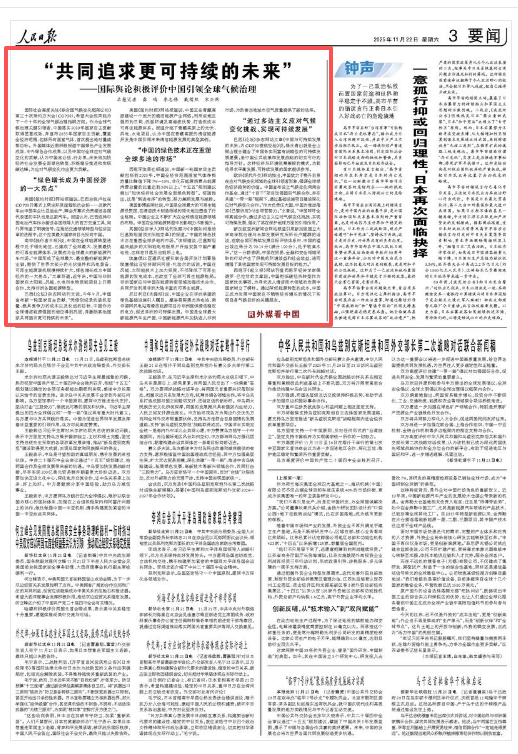
“共同追求更可持续的未来”(外媒看中国)——国际舆论积极评价中国引领全球气候治理
Ren Min Ri Bao· 2025-11-21 21:54
Core Viewpoint - The international community is closely watching the COP30 conference, with expectations that its outcomes will guide global climate governance for the next decade. China has made significant progress in implementing its 2030 Nationally Determined Contributions (NDCs) and has announced its 2035 NDCs, which include absolute reduction targets for all greenhouse gases [1][4]. Group 1: China's Role in Global Climate Governance - China is recognized as a key leader in global climate governance, with foreign media highlighting its achievements in green industry development and international cooperation on climate change [1]. - The country has established the world's largest and fastest-growing renewable energy system, becoming the largest market for new energy vehicles [2][4]. - China's new round of NDCs aims for a 7%-10% reduction in greenhouse gas emissions by 2035, with non-fossil energy consumption reaching over 30% of total energy consumption [4][6]. Group 2: Renewable Energy Development - China is developing a vast clean energy industry network in the Tibetan Plateau, leveraging its unique environmental conditions to create a low-cost renewable energy system [3]. - The country has formed the largest and most complete new energy industrial chain globally, providing a significant portion of the world's photovoltaic components and wind power equipment [2][4]. - Chinese enterprises are expanding their presence in the global clean energy sector, influencing the energy transition worldwide [4][5]. Group 3: International Cooperation and Investment - China is actively collaborating with African nations on renewable energy projects, supporting their energy transitions through investments in solar, wind, hydro, and biomass energy [2][5]. - The establishment of the South-South Cooperation Fund for climate change reflects China's commitment to enhancing international climate cooperation [7]. - China's actions in trade, finance, and security have generated positive environmental and social benefits, enhancing the capacity of other countries to achieve sustainable development goals [7][8].
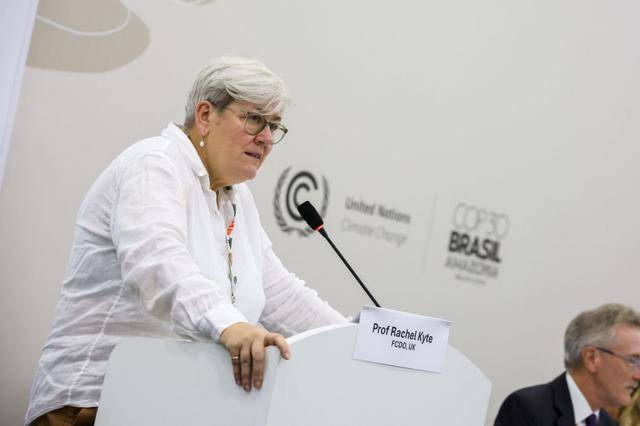
英国气候特使:中英深化气候能源合作有四个重点方向
Sou Hu Cai Jing· 2025-11-21 18:44
Core Viewpoint - The cooperation in climate and energy sectors can stabilize geopolitical situations and drive global progress, even amidst complex geopolitical environments [12] Group 1: UK Climate Diplomacy - The UK has returned to the forefront of global climate diplomacy with the appointment of Rachel Kyte as the UK climate envoy, a role previously abolished by the last government [2] - The UK delegation at COP30 is focusing on climate financing, particularly in supporting developing countries to adapt to and mitigate climate change [3] - The UK has initiated a proposal with 83 parties to the Paris Agreement, including the EU, to develop a "fossil fuel exit roadmap" [3] Group 2: Climate Goals and Challenges - Significant progress has been made in addressing climate change, with the Paris Agreement being the most effective global framework, shifting the temperature trajectory from over 4°C to 2.6°C [4] - The UK's net-zero economy is projected to grow by 10% between 2023 and 2024, while China's clean energy sectors are becoming crucial economic pillars [4] - The current trajectory is off course for the 1.5°C target, with increasing costs of delayed transitions manifesting in damaged infrastructure and productivity losses [4][5] Group 3: Financing and Cooperation - Climate financing remains a contentious issue in negotiations, with a need to move beyond binary debates on funding sources to a more diversified "all sources model" [7] - The urgency of climate action is emphasized, linking it to economic security and resilience, and the necessity of strategic use of multilateral platforms like G20 and COP [8] - The UK and China have significant opportunities for collaboration in green finance, carbon market development, electricity market reform, and nature-based solutions [10][11] Group 4: Complementary Strengths - The UK excels in market design, regulatory innovation, and financial architecture, while China leads in the scale and speed of renewable energy deployment [11] - The UK has successfully closed its last coal-fired power station, demonstrating a commitment to clean energy through clear policy signals and market reforms [11] - Both countries share the responsibility of aiding developing nations in energy transitions, promoting inclusivity and resilience in global transformations [11]