房地产业

Search documents
北京万通新发展集团股份有限公司股票交易风险提示公告
Shang Hai Zheng Quan Bao· 2025-08-12 20:03
登录新浪财经APP 搜索【信披】查看更多考评等级 证券代码:600246 证券简称:万通发展 公告编号:2025-068 北京万通新发展集团股份有限公司 股票交易风险提示公告 本公司董事会及全体董事保证本公告内容不存在任何虚假记载、误导性陈述或者重大遗漏,并对其内容 的真实性、准确性和完整性承担法律责任。 北京万通新发展集团股份有限公司(以下简称"公司")股票于2025年8月8日、8月11日连续两个交易日 内收盘价格涨幅偏离值累计达到 20%,根据《上海证券交易所交易规则》的有关规定,属于股票交易 异常波动的情形。具体内容详见公司于2025年8月12日披露的《股票交易异常波动公告》(公告编号: 2025-066)。 2025年8月12日,公司股票再次涨停。鉴于公司股价短期内涨幅较大,敬请广大投资者注意投资风险。 现对股票交易风险提示如下: 一、二级市场交易风险 公司股票于2025年8月8日、8月11日连续两个交易日内收盘价格涨幅偏离值累计达到 20%,属于股票交 易异常波动的情形。2025年8月12日收盘,公司股票再次涨停。截至2025年8月12日,公司市净率为 3.55。根据中证指数有限公司发布的中证行业分 ...

央行、银保监会:用好用足各项金融政策 主动靠前服务实体经济
Xin Hua Wang· 2025-08-12 06:27
中国人民银行网站4月20日消息,4月19日,人民银行、银保监会联合召开金融支持实体经济座谈 会,抓好近期各项金融政策的落地工作,加大疫情防控和经济社会发展金融支持,保障物流畅通和促进 产业链供应链循环。 会议指出,要用好用足各项金融政策,主动靠前服务实体经济。各金融机构要重点围绕接触型服务 业、小微受困主体、货运物流、投资消费等重点支持领域,强化对重点消费、新市民和有效投资的金融 服务,及时在信贷资源配置、内部考核、转移定价等方面出台配套措施。要充分发挥多项结构性货币政 策工具的效能,做好政银企对接,及早释放政策红利。要平衡好支持疫情防控、支持实体经济与防范风 险的关系,提升政策可持续性和宣传落地效果。 会议强调,金融机构要坚持房子是用来住的、不是用来炒的定位,因城施策落实好差别化住房信贷 政策,更好满足购房者合理住房需求。要执行好房地产金融宏观审慎管理制度,区分项目风险与企业集 团风险,不盲目抽贷、断贷、压贷,保持房地产融资平稳有序。要按照市场化、法治化原则,做好重点 房地产企业风险处置项目并购的金融服务。要及时优化信贷政策,灵活调整受疫情影响人群个人住房贷 款还款计划。 【纠错】 【责任编辑:刘睿祎】 会 ...
人民银行研究局:我国经济增长底气足韧性强 促消费和投资增长大有可为
Xin Hua Wang· 2025-08-12 06:26
Group 1 - The article emphasizes that China's economic growth is robust, resilient, and has significant potential, with considerable opportunities for promoting consumption and investment growth [1] - Recommendations include accelerating new infrastructure construction, enhancing traditional infrastructure, leveraging market entities in infrastructure investment, promoting stable development in the real estate market, and expanding effective investment in manufacturing [1] - For the real estate market, the article suggests supporting rigid and improved housing demand while optimizing supply, increasing affordable rental housing, and implementing differentiated housing credit policies [1] Group 2 - The article identifies green consumption as a new growth point for China's economy, advocating for a unified green product labeling system and encouraging local governments to provide tax incentives for financial institutions issuing green consumption credit [2] - It calls for strengthening foundational arrangements for green finance, including mandatory environmental information disclosure and establishing a unified domestic green bond disclosure system [2] - The article proposes implementing a green bond certification subsidy system to encourage the development of the green bond market and improve the capabilities of third-party certification institutions [2] Group 3 - The establishment of a reliable and efficient carbon pricing system is recommended, along with expanding the carbon market to include more industries and developing various financial products linked to carbon emissions [3] - The article advocates for the innovation of green finance and transition finance products, including carbon-neutral bonds and sustainable development-linked bonds, utilizing diverse financial tools to support green low-carbon economic activities [3] - It encourages the development of private equity and venture capital products to address high leverage and insufficient collateral issues faced by high-carbon enterprises [3]
新华时评·年中经济观察丨以“好房子”建设激发房地产市场新活力
Xin Hua Wang· 2025-08-12 06:24
Core Viewpoint - The real estate market is showing signs of stabilization, with "good houses" playing a crucial role in revitalizing the market and meeting the public's demand for improved living conditions [1][2]. Group 1: Market Performance - In the first half of the year, the real estate market experienced fluctuations but is moving towards stabilization, with active transactions in commodity housing [1]. - The demand for high-quality housing is becoming a key driver for market growth, as consumers seek better living conditions and housing standards [1]. Group 2: Policy and Standards - The implementation of the national standard "Residential Project Specifications" on May 1 has accelerated the establishment of "good house" standards [1]. - Various regions, including Beijing, Jiangsu, and Zhejiang, are promoting housing quality improvements through technical guidelines and model projects [1][2]. Group 3: Industry Transformation - Building "good houses" presents both challenges and opportunities for the real estate industry, necessitating collaboration among government, real estate companies, and other stakeholders [2]. - There is a need for increased policy support in areas such as land, finance, and fiscal measures to enhance the effective supply of "good houses" [2].
央行:稳健的货币政策更加精准有力
Xin Hua Wang· 2025-08-12 06:14
Core Viewpoint - The People's Bank of China (PBOC) emphasizes a stable and proactive approach to monetary policy and financial regulation to support economic recovery and manage risks in the financial system [1][2]. Monetary Policy - The PBOC will continue to implement a prudent monetary policy, ensuring that the growth rate of money supply and social financing aligns with nominal economic growth [2]. - The central bank aims to enhance the transmission mechanism of monetary policy and support domestic demand while optimizing the economic structure [2]. - There is a focus on reducing actual loan interest rates and financing costs for enterprises and personal consumption through market-oriented interest rate reforms [2]. Financial Regulation - The PBOC plans to strengthen financial regulation by enhancing risk control and ensuring all financial activities are subject to oversight [3]. - Key legislative efforts will include revising important financial laws to improve the regulatory framework and prevent systemic financial risks [3]. - The PBOC will implement measures to monitor and manage risks associated with financial institutions and local government financing platforms [4]. Risk Management - The PBOC will adopt a categorized approach to address local government debt risks and enhance the mechanisms for debt resolution [4]. - Specific measures will be taken to support the real estate market, including differentiated housing credit policies and financial support for real estate companies [4]. - The central bank will intensify efforts to combat illegal financial activities and enhance public financial literacy [4]. Financial Market Stability - The PBOC aims to maintain stable financial market operations by implementing policies to boost investor confidence and manage risks in capital markets [5]. - Measures will be taken to monitor and prevent risks associated with large real estate companies and local government bonds [5]. - The PBOC will ensure the stability of the RMB exchange rate and manage cross-border capital flows to prevent market volatility [5].
2025年1-4月全国国有及国有控股企业经济运行情况
Xin Hua Wang· 2025-08-12 05:54
Revenue - In the first four months, the total operating revenue of state-owned enterprises remained flat compared to the previous year, amounting to 262,755.0 billion yuan [1] Profit - The total profit of state-owned enterprises in the first four months decreased by 1.7% year-on-year, totaling 13,491.4 billion yuan [2] Tax Payable - The tax payable by state-owned enterprises in the first four months was 20,380.0 billion yuan, reflecting a slight increase of 0.1% year-on-year [3] Debt Ratio - As of the end of April, the asset-liability ratio of state-owned enterprises was 65.1%, which represents an increase of 0.2 percentage points compared to the previous year [4]
超53%行业裁员潮预示美国经济衰退临界点
Sou Hu Cai Jing· 2025-08-12 01:33
Core Insights - Moody's latest analysis indicates that the U.S. is at a critical juncture of economic recession, with 53% of industries initiating layoffs, except for the healthcare sector which continues to see job growth [1] - The employment market has contracted significantly for three consecutive months, with July 2025 non-farm payrolls adding only 73,000 jobs, falling short of market expectations by 37,000 jobs [4] - A systemic weakening of economic indicators suggests an imminent recession risk, with notable consumer weakness and a manufacturing PMI below the growth threshold for six months [4] Employment Trends - The July 2025 non-farm payrolls were revised downwards, with May and June figures adjusted to 19,000 and 14,000 respectively, totaling a downward revision of 258,000 jobs [4] - 215 out of 400 industry classifications have experienced job reductions, marking the fourth time since 1970 that this ratio has exceeded 50% [4] Economic Indicators - Retail sales in July showed a minimal increase of 0.1%, while real consumer spending, adjusted for inflation, exhibited negative growth [4] - The manufacturing sector is under pressure, with a PMI of 48.3, the lowest since February 2024, and new orders dropping to 46.1 [4] - The housing market is also struggling, with 30-year mortgage rates rising to 7.25%, leading to existing home sales falling to an annualized rate of 3.87 million, the lowest since the beginning of 2025 [4] Policy and Structural Issues - The Federal Reserve's tight monetary policy, with a federal funds rate of 5.25%-5.5% amid a 3.2% inflation rate, limits policy flexibility [5] - Historical policy missteps, such as the steel and aluminum tariffs and immigration reform, have led to increased manufacturing costs and reduced labor supply, contributing to a 9.3% year-over-year increase in service sector wages [5] - Corporate profit margins have contracted to 7.8%, the lowest level since 2008, indicating significant economic strain [5] Future Outlook - The upcoming three quarters will be critical in determining the depth and breadth of the recession cycle, with traditional monetary policy tools nearing ineffectiveness [5]



房地产:北京定向松绑五环外限购
Hengtai Securities· 2025-08-11 14:35
Investment Rating - The report maintains an "Outperform" rating for the real estate sector [1] Core Insights - The second-hand housing market is under increasing pressure, with Beijing's second-hand housing transaction area at 266,900 square meters, a week-on-week decrease of 1.14%, nearing levels seen in May 2024. Shanghai's second-hand housing transaction area is 366,500 square meters, close to levels in October 2024 [5][10] - The targeted easing of purchase restrictions outside the Fifth Ring Road in Beijing is expected to help reduce inventory in that area, signaling a positive outlook. Continuous monitoring of policy developments in Shanghai and Shenzhen is advised [5] - In the new housing market, developers are expected to increase supply towards the end of August to prepare for the "Golden September." High-quality products in core areas are likely to see stable sales, benefiting brands like China Resources Land, Binjiang Group, and Jianfa International Group [5] - The real estate sector outperformed the market indices, with the Shanghai Composite Index rising by 2.11%, the CSI 300 Index by 1.23%, and the real estate sector by 2.16%, outperforming the Shanghai Composite by 0.05 percentage points and the CSI 300 by 0.93 percentage points [10] Market Performance - The report highlights that the real estate sector has shown resilience, with key A-share real estate stocks such as Heimu Dan, *ST Rongkong, and Yatong shares leading in gains [10] - In the Hong Kong market, companies like Huayin International Holdings, Shun Tak Holdings, and Hongyang Real Estate also showed significant gains [10] - The report notes that the transaction area for new homes in 30 major cities decreased week-on-week, with a cumulative year-on-year decline of 3.71% [5][39] Policy Changes - Beijing's adjustment to purchase restrictions allows eligible families to buy an unlimited number of properties outside the Fifth Ring Road, which includes both new and second-hand homes [5] Sales Trends - The report indicates that new home sales in 30 major cities have decreased, with a total sales area of 1.2645 million square meters last week, reflecting a year-on-year decline of 3.71%. First-tier cities saw a slight increase in sales, while second-tier cities experienced a more significant decline [5][39] Company Valuations and ETF Performance - The report provides a detailed valuation of key real estate companies, highlighting their market capitalization and expected earnings per share (EPS) for 2025 to 2027 [85] - It also reviews the performance of real estate ETFs, noting weekly returns and net inflows for various funds [88]
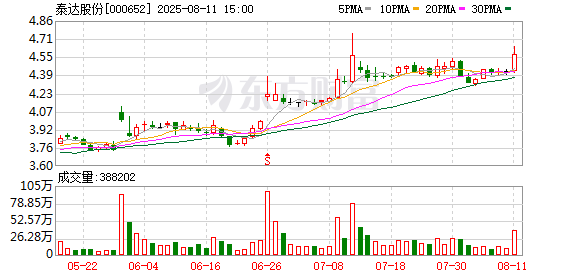
泰达股份:8月11日召开董事会会议
Mei Ri Jing Ji Xin Wen· 2025-08-11 12:50
Group 1 - The company, Teda Co., Ltd. (SZ 000652), announced a temporary board meeting on August 11, 2025, to discuss the appointment of a new chief auditor [2] - For the fiscal year 2024, the company's revenue composition is as follows: wholesale industry accounts for 89.33%, environmental management for 6.82%, construction for 2.8%, real estate for 0.74%, and textile and apparel for 0.29% [2]

万达集团被强执超24亿
21世纪经济报道· 2025-08-11 12:19
天眼查信息显示,近日,大连万达集团股份有限公司新增一则被执行人信息,执行标的24亿余 元,执行法院为北京金融法院等。 | 2024-12-27 · 被执行人 | 被执行人:大连万达集团股份有限公司 | 执行标的:2,406,053,380.00元 | | --- | --- | --- | | 2025-08-07 ● 被执行人 | 被执行人:大连万达集团股份有限公司 | 执行标的: 2,406,053,380.00元 | 大连万达集团股份有限公司现存10条被执行人信息, 被执行总金额超76亿元。 | 被执行人 ② | VIP | | | | | 7天眼查 | | --- | --- | --- | --- | --- | --- | --- | | | 被执行人 10 历史被执行人 22 | | 年份不限 ▼ | Q 点击进行搜索 | | 임 음영 | | | | | 2 被执行总金额:760,632.54万元 | | | | | 序号 | 案号 | 被执行人 | 执行标的(元) = 执行法院 | | 立案日期÷ | 操作 | | 1 | (2025)京74执1380号 | 大连万达集团股份有限公司 | 2 ...