新能源材料

Search documents
【科技自立·产业自强】容百科技:深化研发布局 以更多突破性技术助推能源产业升级
Zheng Quan Shi Bao Wang· 2025-10-06 09:58
Core Insights - Rongbai Technology has significantly increased its patent applications from 602 to 1401 over the past three years, representing a growth rate of 248% [1] - The number of invention patent applications has nearly quadrupled, rising from over 200 to nearly 800 [1] - The company has authorized over 60 invention patents in cutting-edge technology fields, achieving an authorization rate exceeding 95% [1] Patent and Global Expansion - The PCT patent family has surpassed 60 families, covering 15 countries including the US, Japan, and Europe, with over 145 overseas patents [1] - The company is accelerating its global layout in the patent landscape [1] Technological Advancements - Rongbai Technology has made significant breakthroughs in key indicators such as the compaction density, capacity, and rate performance of cathode materials, achieving a cycle life exceeding 10,000 times [1] - The products maintain high discharge capacity even in extreme low-temperature environments of -30°C, reaching advanced industry performance levels [1] - The cost of cathode materials is expected to decrease by 20%-30% compared to current lithium batteries, further accelerating the commercialization of sodium batteries [1] Innovations in Battery Materials - The patented method for preparing lithium sulfide significantly enhances material purity and preparation efficiency, providing critical material support for the industrialization of solid-state batteries [1] - The patent for a composite cathode material and its preparation method optimizes structure design and material systems, significantly improving battery energy density and cycle performance to meet market demands for high-performance batteries [1] Commitment to R&D - Rongbai Technology continues to increase its investment in independent research and development, leading the ongoing breakthroughs in global new energy material technology [1]

2025贵州省上市公司发展报告
Sou Hu Cai Jing· 2025-10-06 06:15
Core Insights - The report outlines the development status of listed companies in Guizhou Province, highlighting the need for structural optimization and industrial upgrading as key factors for future growth [1][5]. Group 1: Company Quantity and Progress - As of April 30, 2025, Guizhou Province has 38 listed companies, with 35 on A-shares and 3 overseas [18]. - The number of A-share companies represents only 0.65% of the national total, ranking Guizhou 25th among provinces, which is lower than its GDP ranking of 22nd [23][25]. - The listing speed of Guizhou companies has lagged behind both its historical average and the overall A-share market [1]. Group 2: Regional Distribution - The distribution of A-share companies is concentrated, with 65.71% (23 companies) located in Guiyang, while other cities have significantly fewer [2]. - Only 20.45% of the 88 districts and counties in Guizhou have listed companies, indicating untapped potential in county-level capital markets [2]. Group 3: Market Value and Industry Structure - Kweichow Moutai dominates the market with a valuation of 1,943.34 billion yuan, accounting for 87.78% of the total market value of A-share companies in Guizhou [2]. - The average market value of the remaining 34 companies is only 8.61 billion yuan, with over 70% classified as small-cap companies [2]. Group 4: Industry Distribution - Guizhou's listed companies span 10 industries, with the highest representation in industrial (9 companies) and raw materials (7 companies) sectors [3]. - Despite the tourism sector's significant revenue of 1.46 trillion yuan in 2024, no nationally influential tourism-related listed companies have emerged [3]. Group 5: Operational and Development Capabilities - In 2024, the total revenue of Guizhou's A-share companies was 335.20 billion yuan, with Kweichow Moutai contributing over 50% of the revenue and 92.17% of the net profit [4]. - The average R&D expenditure across listed companies was 6.39 million yuan, below the national average of 7.57 million yuan [4]. Group 6: Capital Operations - In 2024, Guizhou had no new IPOs and only two companies raised 1.75 billion yuan through refinancing, indicating low capital market activity [4]. - The province's bond financing totaled 948.37 billion yuan, representing only 0.33% of the national total [4]. Group 7: Opportunities for Development - The growth of the tourism industry and the "Four Modernizations" strategy present opportunities for capitalizing on local resources and developing new listed entities [5]. - The potential for creating a diversified listing structure exists if Kweichow Moutai leverages its market position to invest in sectors like consumer goods and tourism [5].


展商预告丨泰和科技 将携最新产品亮相CINE2025固态电池及钠电展,展位号:B14!
起点锂电· 2025-10-04 09:13
Group 1 - The CINE Solid-State Battery Exhibition and CINE Sodium Battery Exhibition is the first professional exhibition focusing on the entire industry chain of new battery technologies, scheduled for November 6-8, 2025, in Guangzhou, with over 200 exhibitors and 20,000 professional attendees expected [2] - The event will feature a new battery technology forum with nine specialized sessions and the prestigious Solid-State Battery Golden Ding Award ceremony [2] - Taihe Technology will showcase its latest products at the CINE Solid-State Battery Exhibition, with booth number B14 [3] Group 2 - Shandong Taihe Technology Co., Ltd. has over 20 years of experience in the research and production of fine chemicals, recently achieving success in the R&D and partial industrialization of lithium and sodium battery cathode materials, including lithium iron phosphate and sodium iron pyrophosphate [8] - The company also develops anode materials such as hard carbon and silicon-carbon anodes, as well as various electrolytes and electrolyte additives [8] - Taihe Technology's product range includes solid-state electrolytes and raw materials, such as high-purity lithium sulfide and sulfide solid electrolyte powders [8]

节前调研,机构扎堆去哪儿?
Shang Hai Zheng Quan Bao· 2025-10-02 12:09
Group 1 - Institutional research is actively seeking quality investment opportunities ahead of the National Day holiday, with around 200 listed companies receiving investor inquiries from September 22 to September 28, particularly in the technology and high-end manufacturing sectors [1] - Companies' fourth-quarter operational plans, order status, production capacity, and overseas expansion are key focus areas for institutional investors, indicating a positive outlook for several industries [1][4] Group 2 - The electronic, AI, and electrical equipment sectors are receiving significant attention from institutional investors, with companies like Jingzhida being the most favored, hosting nearly 150 institutional inquiries during the specified period [2] - Jingzhida is focusing on its computing chip testing business, emphasizing the integration of computing and storage chips in the AI era, and plans to collaborate closely with downstream clients to provide high-end testing solutions [2] Group 3 - Ant Group and Gaweida have established a strategic partnership aimed at leveraging AI big data services in the banking and fintech sectors, with a projected global fintech market size exceeding $450 billion by 2025 [3] - Companies like Xintai are exploring AI applications in biopharmaceuticals, while Jinggong Technology is advancing its exoskeleton robot development, aiming for mass production of its second-generation model [3] Group 4 - Many companies report a strong order backlog and saturated production capacity, reflecting robust business momentum and industry vitality [4][5] - For instance, ShenNan Circuit is expanding its PCB production capacity through new factories and technological upgrades, while Huatuo Cable is facing capacity constraints despite having ample orders [4][5] Group 5 - Companies like Dangsheng Technology are achieving significant breakthroughs in both production capacity and sales, with plans to increase lithium iron phosphate production capacity to 120,000 tons annually by the second half of 2025 [5] - Mingtai Aluminum is also expanding its overseas production capacity, with plans to invest in a new cold-rolled project to increase capacity by 30,000 to 40,000 tons [5] Group 6 - Huidian Co.'s production base in Thailand is set to enter small-scale production by the second quarter of 2025, with expectations of gradually releasing production capacity and achieving economic scale by the end of 2025 [6]
【科技自立·产业自强】宏源药业:积极推进“第三代”六氟磷酸锂自主技术
Zheng Quan Shi Bao Wang· 2025-10-01 01:15
Core Insights - Hongyuan Pharmaceutical (301246) invests nearly 70 million yuan annually in R&D and collaborates deeply with universities such as Fudan University and Wuhan University, establishing a comprehensive innovation system [1] - The company holds 65 patents, including 57 invention patents, and has received multiple provincial science and technology progress awards for its innovative processes [1] - In the pharmaceutical sector, Hongyuan has built a complete industrial chain covering nitroimidazole antibacterial drugs, becoming a major global supplier with leading market share in core products [1] - In the new energy sector, the company has developed a "rheological reverse reaction method for preparing lithium hexafluorophosphate" in collaboration with Wuhan University, achieving international advanced levels and becoming a supplier for BYD (002594) [1] - Hongyuan is advancing its "third-generation" lithium hexafluorophosphate technology and is scaling up a 6000-ton high-purity crystal project, which is expected to enhance its market share in the electrolyte sector upon production [1]
翟美卿:粤商要勇于“饮头啖汤”,敢于啃“硬骨头”
2 1 Shi Ji Jing Ji Bao Dao· 2025-09-30 04:04
Core Viewpoint - The concept of "chain leader" enterprises emphasizes collaboration and co-creation rather than monopolization, as articulated by Zhai Meiqing, the honorary president of the Guangdong Provincial Chamber of Commerce [1] Group 1: Innovation and Technology - The new generation of Guangdong merchants is encouraged to tackle core technological challenges, likened to being the first to "taste the soup" in business [2] - Xiangjiang Group has developed the world's first industrial production line for lithium carbonate from aluminum hydroxide mother liquor, with an annual capacity exceeding 10,000 tons and a lithium recovery rate over 90%, sufficient to meet the battery needs of 200,000 electric vehicles [2] - The company has achieved significant technological breakthroughs in the new energy materials sector through AI-driven sensor networks that optimize purification processes to meet battery-grade standards [2] Group 2: Strategic Alignment - Innovation must be integrated into national strategies to maintain control over innovation and achieve high-quality development [2] - The role of "chain leader" enterprises includes building platforms, establishing rules, and promoting collaborative innovation across the entire industry chain [2] - The shift from a trial-and-error approach to a focus on independent innovation is essential for navigating the complexities of technological advancement [2]
不停牌!多家A股公司 重大资产重组!
Zheng Quan Shi Bao· 2025-09-29 14:40
Group 1 - Multiple companies are planning significant asset restructuring, including Fulin Precision (300432) and Guolin Technology (300786) [2][4] - Fulin Precision announced a joint investment with CATL to increase capital in its subsidiary Jiangxi Shenghua New Materials, with Fulin investing RMB 1 billion and CATL investing RMB 2.563 billion [2][3] - After the transaction, CATL will hold a 51% stake in Jiangxi Shenghua, while Fulin Precision will hold 47.41% [2] Group 2 - The transaction is expected to enhance Jiangxi Shenghua's capital strength and competitiveness, optimizing its business development in lithium iron phosphate products and energy storage markets [3][4] - Guolin Technology is planning to acquire 91.07% of Xinjiang Kailianjie Petrochemical Co., which will become a subsidiary, using self-funding and bank loans [4][5] - The acquisition of Kailianjie is aligned with Guolin Technology's strategic development in the fine chemical sector, aiming to create synergies with its existing business [5]


不停牌!多家A股公司,重大资产重组!
Zheng Quan Shi Bao· 2025-09-29 14:37
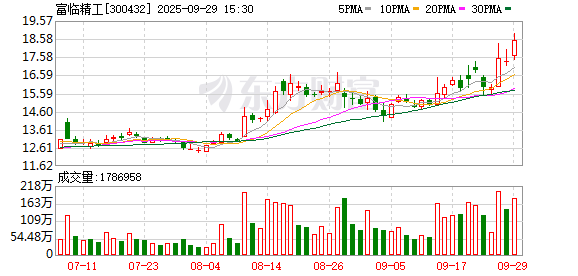
Group 1 - Multiple companies are planning significant asset restructuring, including 富临精工 and 国林科技 [1][3] - 富临精工 announced a joint capital increase in its subsidiary 江西升华 with 宁德时代, involving a total investment of RMB 35.63 billion, where 富临精工 will invest RMB 10 billion and 宁德时代 will invest RMB 25.63 billion [1][2] - After the transaction, 宁德时代 will hold 51% of 江西升华, while 富临精工 will hold 47.41% [1] Group 2 - The transaction is expected to enhance 江西升华's capital strength and competitive advantage in the lithium iron phosphate market, contributing to its profitability and strategic cooperation in the new energy sector [2] - 国林科技 is planning to acquire 91.07% of 新疆凯涟捷石化有限公司 using self-funding and bank loans, which will allow it to gain control over the target company [3][4] - The acquisition of 凯涟捷 will create a synergistic relationship with 国林科技's existing business in fine chemicals, enhancing market competitiveness and operational scale [4]
金圆股份:9月29日召开董事会会议
Mei Ri Jing Ji Xin Wen· 2025-09-29 12:04
Group 1 - The core viewpoint of the news is that Jinyuan Co., Ltd. has held a board meeting to discuss governance system amendments and reported its revenue composition for the first half of 2025, with a significant focus on the environmental protection industry [1][2] - Jinyuan Co., Ltd. reported that 99.41% of its revenue comes from the environmental protection sector, while new energy materials account for 0.39% and other businesses contribute 0.2% [1] - As of the latest update, Jinyuan Co., Ltd. has a market capitalization of 3.9 billion yuan [2] Group 2 - The competitive landscape in the beverage industry is highlighted by the market share decline of Yibao, which dropped nearly 5 percentage points following the launch of Farmer's green bottle [2] - The news indicates that while Farmer's brand gained market share, it is noted that Zong Fuli has benefited the most from this competition [2]

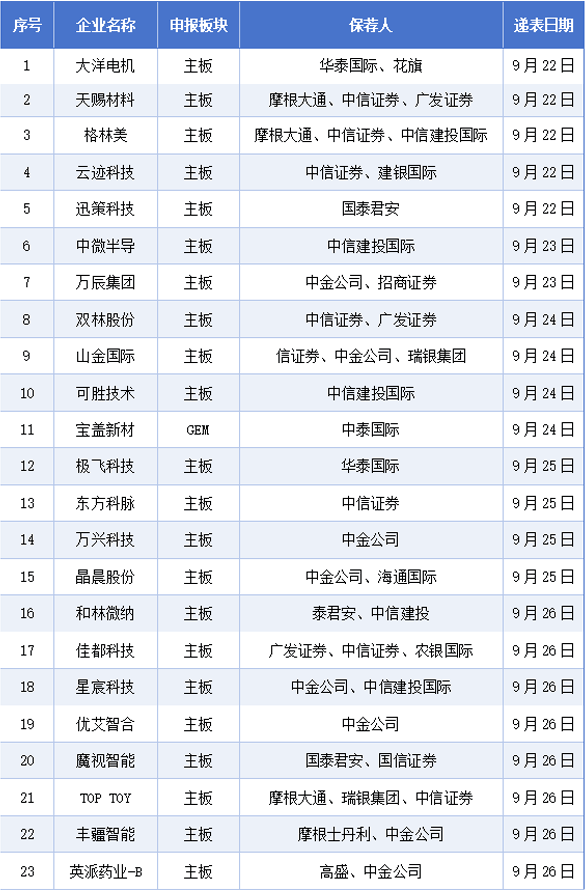
9月21-27日港股IPO观察:25家递表,其中12家企业冲刺A+H
Sou Hu Cai Jing· 2025-09-29 10:29
Summary of Key Points Core Viewpoint The Hong Kong stock market has seen significant activity from September 21 to September 27, with 25 companies submitting prospectuses, 3 companies passing hearings, and 2 new stocks successfully listed. Group 1: Companies Submitting Prospectuses - A total of 25 companies submitted listing applications to the Hong Kong Stock Exchange during the specified period, including major players like 大洋电机, 天赐材料, and 格林美 [2][4][5] - Notably, 12 of these companies have already listed on the A-share market, indicating a trend towards dual listings in both A and H shares [2][4] Group 2: Companies Passing Hearings - Three companies successfully passed hearings: 长风药业, 挚达科技, and 金叶国际 [30] - 长风药业 focuses on biopharmaceuticals for respiratory diseases, with projected revenues of 6.08 billion RMB in 2024 [31] - 挚达科技 is the largest provider of home electric vehicle charging stations globally, with revenues of 5.9 billion RMB in 2024 [32] - 金叶国际 is a long-established electromechanical engineering contractor, specializing in HVAC systems [33] Group 3: Companies in the IPO Process - Five companies are currently in the IPO process, including 长风药业, 紫金黄金国际, 西普尼, 博泰车联, and 奇瑞汽车 [34] - 奇瑞汽车 successfully listed on September 25, with a first-day stock price increase of 13.75% [41][43] Group 4: Financial Performance of Companies - 大洋电机 reported total revenues of approximately 109.3 billion RMB in 2022, with a projected increase to 121.13 billion RMB in 2024 [5] - 天赐材料's revenues were approximately 223.17 billion RMB in 2022, expected to decline to 125.18 billion RMB in 2024 [6] - 格林美's revenues were around 293.92 billion RMB in 2022, projected to reach 332.00 billion RMB in 2024 [7] - 万辰集团, a leading snack and beverage retailer, reported revenues of 5.49 billion RMB in 2022, with a significant increase to 323.29 billion RMB in 2024 [10] Group 5: Market Trends and Insights - The trend of companies seeking dual listings in both A and H shares is becoming more prevalent, reflecting a strategic move to access broader capital markets [2][4] - The overall activity in the Hong Kong IPO market indicates a robust interest from companies looking to capitalize on the favorable market conditions [2][30]