
超市

Search documents
别慌!广东多地提醒:生活必需品供应量足价稳,无须过度囤货
2 1 Shi Ji Jing Ji Bao Dao· 2025-09-23 02:58
Core Viewpoint - The 18th typhoon "Haikashan" has developed into the strongest typhoon globally this year, expected to make landfall in Guangdong, impacting local weather and prompting citizens to stock up on essential supplies [1][3]. Group 1: Typhoon Impact and Response - The Central Meteorological Administration has issued an orange alert for typhoon "Haikashan," which has been classified as a super typhoon for over 40 hours [1]. - Heavy rainfall and strong winds are anticipated in Guangdong, Guangxi, and Hainan, lasting until Friday [1]. - Local governments are urging citizens to purchase essential goods reasonably and avoid excessive stockpiling [3][4]. Group 2: Supply and Demand Management - Guangzhou's business sector reports sufficient inventory of essential goods, with prices stable and supply channels open [4]. - Shenzhen's business sector has increased the supply of essential goods by 2-3 times the usual demand to ensure availability [4][5]. - Zhuhai has implemented a monitoring mechanism for essential goods supply, ensuring smooth circulation and addressing any shortages promptly [6]. - Shantou and Huizhou report stable prices and sufficient inventory of essential goods, with measures in place to prevent price gouging [7][8]. - Dongguan's business sector has prepared for a 7-10 day supply of essential goods, coordinating with major retailers to meet demand [9]. - Jiangmen has activated an emergency plan for essential goods supply, ensuring continuous availability and monitoring for any price manipulation [10].

国光连锁跌2.05%,成交额5892.52万元,主力资金净流出463.09万元
Xin Lang Cai Jing· 2025-09-23 02:00
Company Overview - Guoguang Chain is primarily engaged in the operation of chain supermarkets and department stores, with main business revenue composition being 91.82% from supermarkets, 6.79% from other sources, and 1.39% from department stores [1][2]. Stock Performance - As of September 23, Guoguang Chain's stock price decreased by 2.05% to 16.21 CNY per share, with a total market capitalization of 8.127 billion CNY [1]. - Year-to-date, the stock price has increased by 112.45%, but it has seen a decline of 15.09% over the last five trading days [1]. - The stock has appeared on the "Dragon and Tiger List" 16 times this year, with the most recent appearance on September 5, where it recorded a net buy of -10.41 million CNY [1]. Financial Performance - For the first half of 2025, Guoguang Chain achieved a revenue of 1.448 billion CNY, representing a year-on-year growth of 6.50%, and a net profit attributable to shareholders of 19.8979 million CNY, up by 4.15% [2]. - Since its A-share listing, the company has distributed a total of 66.9033 million CNY in dividends, with 14.8674 million CNY distributed over the past three years [3]. Shareholder Information - As of September 10, the number of shareholders for Guoguang Chain was 38,500, a decrease of 20.69% from the previous period, while the average circulating shares per person increased by 26.08% to 13,034 shares [2].

山姆、胖东来将聚首郑州,中原零售市场必有一战!
2 1 Shi Ji Jing Ji Bao Dao· 2025-09-22 13:09
Core Insights - Zhengzhou will be the only city in China to host both Sam's Club and Pang Donglai, marking a significant development in the retail landscape of the region [2] - The competition between these two retail giants is expected to drive upgrades in the local retail industry [5][6] - Both companies have distinct business models and strategies that cater to different consumer needs [3][4] Company Developments - Sam's Club in Zhengzhou has a total investment of approximately 720 million yuan and will cover an area of about 44.01 acres, with an expected opening in 2026 [2] - Pang Donglai's first store in Zhengzhou is set to open before New Year's Day 2026, marking its expansion outside of Henan after 18 years [2] - Pang Donglai reported a total sales of 16.964 billion yuan in 2024, while Sam's Club's annual sales exceed 100 billion yuan [5] Market Dynamics - The retail market in Henan has shown steady growth, with a total retail sales of consumer goods reaching 2.76 trillion yuan in 2024, a year-on-year increase of 6.1% [5] - Zhengzhou's retail sales surpassed 580 billion yuan, with a per capita disposable income of 48,000 yuan, reflecting a 5.8% increase [5] - The local retail ecosystem includes various established players, such as Da Zhang and Wan De Long, as well as emerging brands like Hua Yu Bai Jia and Tao Xiao Pang [6] Competitive Landscape - Sam's Club operates on a standardized membership model, focusing on providing high value and specific lifestyle solutions, with nearly 9 million members across 52 stores in 28 cities by 2024 [4] - Pang Donglai emphasizes a strong local presence and customer service, with plans to distribute 1.5 billion yuan of net profit to employees by 2025 [3] - The competition is expected to enhance the operational capabilities of other local retailers, as they adapt to the new market dynamics introduced by these two giants [7][8]

两周关闭37家门店,奈雪、Seesaw、天虹持续调整
3 6 Ke· 2025-09-22 12:26
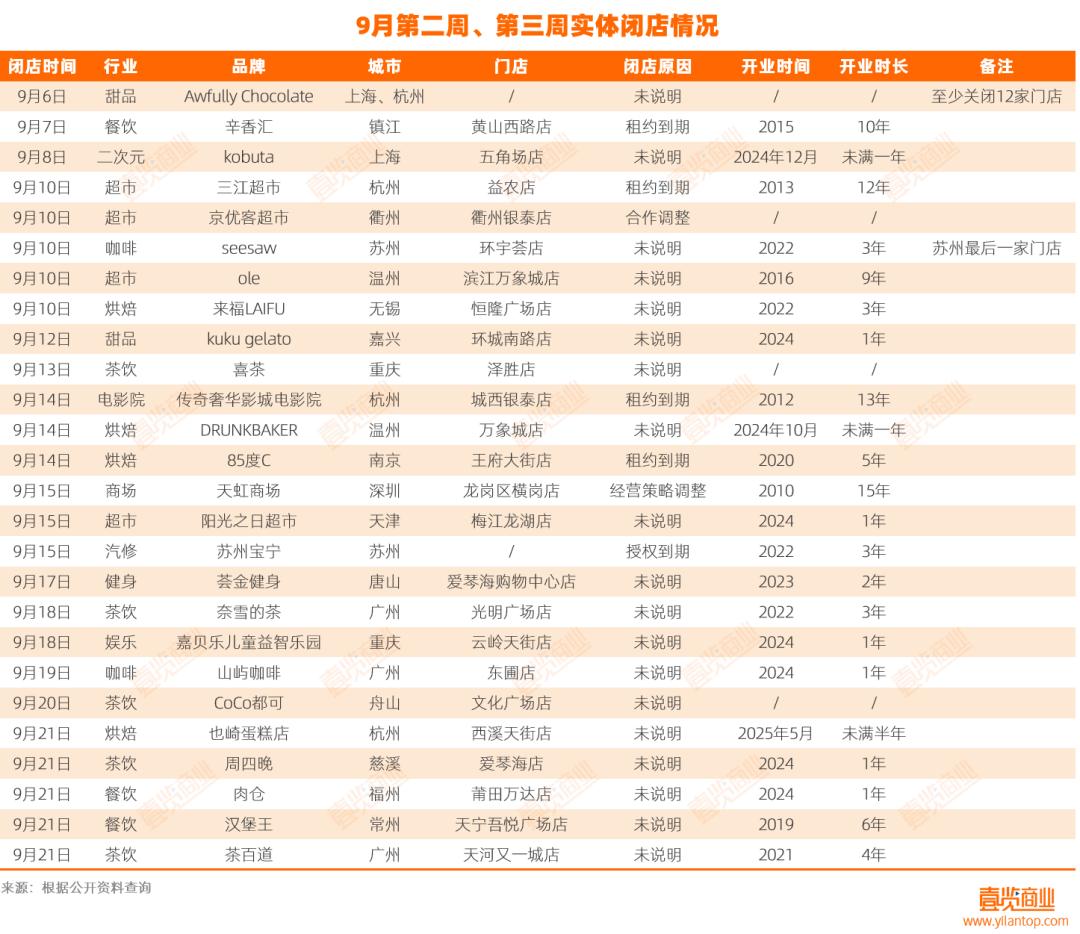
Core Insights - The article highlights a significant wave of store closures across various sectors, particularly in the restaurant industry, indicating a potential shift in market dynamics and consumer preferences [3][4]. Industry Overview - The restaurant sector has seen the highest number of closures, with 27 restaurants shutting down, including 13 dessert shops, 4 bakery stores, 5 tea drink shops, and 2 coffee shops [3]. - Notable tea brands like Heytea, Nayuki, CoCo, and others have closed stores without disclosing reasons, suggesting possible strategic optimization [3]. - Seesaw has exited the Suzhou market after closing its last store there, reducing its total store count from 102 to 46 since January 2024, indicating a significant contraction [3]. Supermarket Sector - Four supermarket stores have also closed, including Sanjiang Supermarket and Ole, which is a premium supermarket under China Resources Vanguard [3][4]. - Despite the growing middle class in China, the overall market size for premium supermarkets remains limited, with the market size for supermarkets and hypermarkets at 3.09 trillion yuan in 2021, and premium supermarkets accounting for only 129.4 billion yuan, or 4.19% of the total [3]. Brand Strategy - China Resources Vanguard employs a multi-brand strategy to target different consumer segments, launching Ole in 2004 for high-end consumers, BLT in 2009 for mid-range products, and Wan Jia City in 2020 for the broader middle market [4]. - This strategy, while aiming for broad coverage, has led to resource dilution and internal competition, contrasting with industry norms where companies focus on a single brand per format [4]. Closure Trends - The closure trend shows a polarization among brands, with established brands like Xinxianghui and Sanjiang Supermarket closing due to lease expirations after over 10 years of operation, reflecting normal market cycles [4]. - Conversely, many new brands face survival challenges, with over one-third of closed brands operating for less than two years, highlighting the rapid rise and fall of niche or trendy brands in the current market environment [4].
宁夏首家“胖改店”开业3天客流量破10万人次
Sou Hu Cai Jing· 2025-09-22 10:44
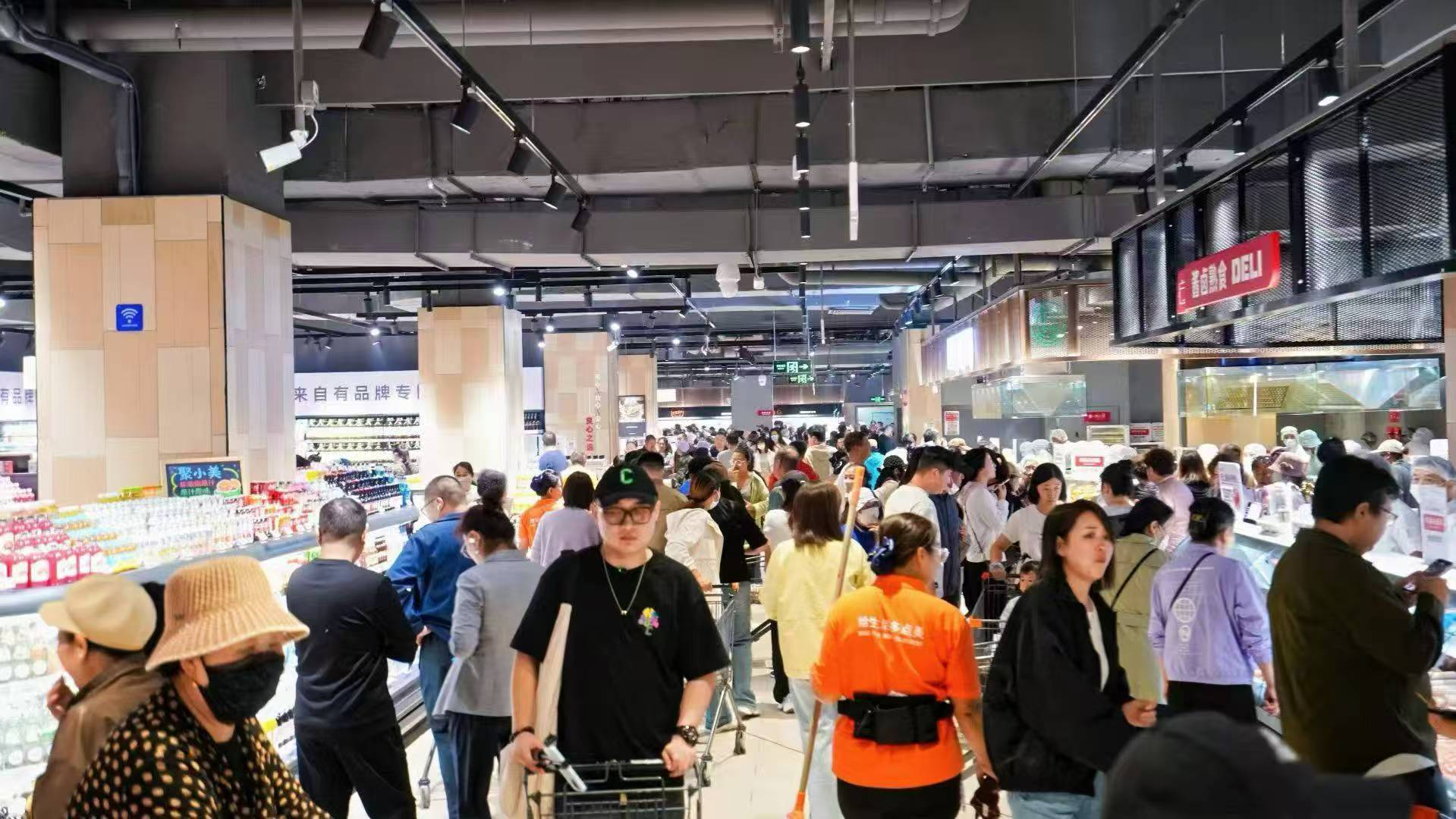
Group 1 - The first "fat reform store" in Ningxia, operated by Yinchuan Xinhua Department Store Group Co., Ltd., opened its Wu Zhong Wanda store, attracting over 100,000 visitors in just three days of operation [1][3] - The success of the store serves as a confidence booster for the physical retail market, indicating that understanding consumer needs and providing quality products and attentive service can activate consumption potential [3][4] - The store focuses on three principles: freshness, affordability, and local taste, rather than a wide range of SKUs, ensuring that every product resonates with customers [3][4] Group 2 - The current retail competition has evolved beyond price and scale battles, entering a new phase driven by both products and services, where supermarkets must become solution providers for community residents [4] - Consumer willingness to visit the store despite adverse weather conditions reflects trust and emotional recognition of the brand, emphasizing the importance of focusing on genuine user needs and refining service details to unlock consumption potential [4]

找了一圈CEO,叶国富还是用了永辉老人
Sou Hu Cai Jing· 2025-09-22 08:51
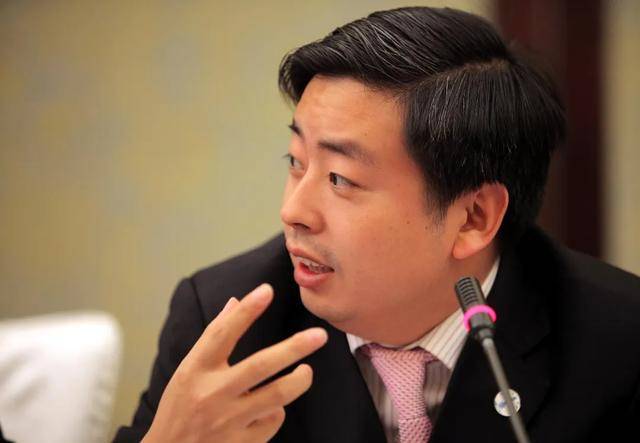
Core Viewpoint - The appointment of Wang Shoucheng as the new CEO of Yonghui Supermarket reflects a strategic move by Ye Guofu, the founder of Miniso, to implement significant reforms within the company, aiming to balance the existing team with the new management from Miniso [2][3]. Group 1: Leadership Changes - Wang Shoucheng, a long-time employee of Yonghui, has been appointed CEO, which is seen as a way to ease tensions between the existing team and the new Miniso management [3]. - Ye Guofu's acquisition of a 29.4% stake in Yonghui and the establishment of a reform leadership group indicate a strong commitment to transforming the company [2][3]. - Wang Shoucheng's familiarity with Yonghui's culture and operations is expected to help stabilize the company during this transition [3]. Group 2: Strategic Reforms - The "naked price direct procurement" strategy introduced by the Miniso team aims to enhance profit margins but disrupts Yonghui's traditional procurement system [2][5]. - Yonghui plans to complete the transformation of 200 stores by September 30, 2025, and exceed 300 stores by the Spring Festival of 2026, focusing on becoming a "national quality supermarket" [5][6]. - Despite some positive sales growth in transformed stores, Yonghui's overall performance remains under pressure due to store closures and supply chain reforms [5][6]. Group 3: Financial Challenges - Yonghui reported a 20.73% year-on-year decline in revenue and a net loss of 241 million yuan in the first half of 2025, with a debt ratio of 88.21% [5][6]. - The company has closed 227 loss-making stores, leading to cumulative losses exceeding 9.5 billion yuan since 2021 [5][6]. - The financial strain is compounded by the high costs associated with the store transformation and the historical burden of past losses [17]. Group 4: Operational Dynamics - Wang Shoucheng's leadership is crucial for integrating the "Pang Donglai model" into Yonghui's operations, which emphasizes supply chain efficiency and product quality [5][11]. - The restructuring of the supply chain aims to reduce the number of suppliers from thousands to a few hundred core partners, which poses risks to Yonghui's traditional profit model [13][14]. - The transformation process is characterized by high costs and risks, as the company navigates the complexities of adapting the Pang Donglai model across diverse regional markets [13][17].

外卖战后,盒马、美团、京东盯上折扣超市
21世纪经济报道· 2025-09-22 06:40
Core Viewpoint - The rise of hard discount supermarkets is becoming a new trend in the retail sector, with major players like Hema, Meituan, and JD entering the market, leading to increased competition against established giants like Aldi [1][2]. Group 1: Market Dynamics - Hard discount supermarkets are characterized by "everyday low prices," focusing on cost efficiency and a limited selection of high-demand products [5][6]. - The global discount retail channel is projected to grow by 8.2% in 2024, while China's penetration rate is only 8%, indicating significant growth potential compared to mature markets like Germany (42%) and Japan (31%) [2][6]. - The compound annual growth rate (CAGR) for China's hard discount sector is expected to reach 5.6% over the next decade, slightly higher than the 5.5% for convenience stores [2]. Group 2: Competitive Landscape - Hema's "Super Box" has opened nearly 300 stores in just over two years, while Aldi has established 76 stores across China, indicating a rapid expansion in the hard discount segment [6][5]. - The competition is not just about pricing; it also involves supply chain efficiency and the ability to cater to local consumer preferences [6][7]. - Major platforms like Hema, JD, and Meituan leverage user data to optimize product offerings, which may give them an edge over traditional retailers [6][7]. Group 3: Supply Chain and Private Labels - Aldi has developed a robust supply chain with a high proportion of private label products, achieving up to 90% of its offerings, while Hema's private label share is around 60% [1][8]. - Private labels are crucial for maintaining higher profit margins, with typical margins around 50% compared to 20% for branded products [8][9]. - Retailers need to enhance their market selling capabilities to successfully develop private labels, as many struggle with consumer recognition and acceptance [9]. Group 4: Future Outlook - The hard discount sector is still in its early stages, primarily focusing on supply chain cost control rather than comprehensive cost reduction across the entire retail process [9]. - The future may see intense competition similar to the "takeout wars," but the regional nature of retail may mitigate overly aggressive competition [9].

中百集团跌2.06%,成交额1.23亿元,主力资金净流出1777.91万元
Xin Lang Cai Jing· 2025-09-22 03:28
Company Overview - Zhongbai Group is a large chain enterprise primarily engaged in commercial retail, including chain supermarkets and comprehensive department stores, with additional involvement in pharmaceuticals, logistics, property management, and import-export trade [1] - The company's main business revenue composition is 91.07% from merchandise sales and 8.93% from other income [1] Stock Performance - As of September 22, Zhongbai Group's stock price decreased by 2.06%, trading at 7.59 CNY per share, with a total market capitalization of 5.03 billion CNY [1] - The stock has experienced a year-to-date decline of 41.97%, with a 3.92% drop over the last five trading days, 4.29% over the last 20 days, and 2.44% over the last 60 days [1] - The company has appeared on the trading leaderboard 18 times this year, with the most recent appearance on April 14, where it recorded a net purchase of 53.38 million CNY [1] Financial Performance - For the first half of 2025, Zhongbai Group reported a revenue of 4.62 billion CNY, a year-on-year decrease of 19.13%, and a net profit attributable to shareholders of -255 million CNY, a decline of 79.50% year-on-year [2] - The company has cumulatively distributed 919 million CNY in dividends since its A-share listing, with no dividends distributed in the past three years [3] Shareholder Information - As of August 31, Zhongbai Group had 99,800 shareholders, a decrease of 2.57% from the previous period, with an average of 6,568 circulating shares per shareholder, an increase of 2.63% [2] Industry Classification - Zhongbai Group belongs to the retail trade sector, specifically in the general retail and supermarket category, and is associated with concepts such as community group buying, duty-free shopping, rural revitalization, state-owned enterprise reform, and new retail [2]

家家悦跌2.09%,成交额1122.55万元,主力资金净流出13.36万元
Xin Lang Cai Jing· 2025-09-22 02:14
Core Viewpoint - The stock price of Jiajiayue has experienced a decline in recent trading sessions, reflecting a negative trend in its market performance and investor sentiment [1][2]. Group 1: Stock Performance - As of September 22, Jiajiayue's stock price fell by 2.09% to 10.78 CNY per share, with a trading volume of 11.2255 million CNY and a turnover rate of 0.16%, resulting in a total market capitalization of 6.881 billion CNY [1]. - Year-to-date, Jiajiayue's stock has decreased by 4.69%, with a 4.94% drop over the last five trading days and a 3.06% decline over the past 20 days, although it has increased by 6.52% over the last 60 days [2]. Group 2: Financial Performance - For the first half of 2025, Jiajiayue reported a revenue of 9.007 billion CNY, representing a year-on-year decrease of 3.79%, while the net profit attributable to shareholders was 183 million CNY, showing a year-on-year increase of 7.82% [2]. - Since its A-share listing, Jiajiayue has distributed a total of 1.488 billion CNY in dividends, with 303 million CNY distributed over the last three years [3]. Group 3: Shareholder Information - As of June 30, 2025, Jiajiayue had 24,400 shareholders, a decrease of 0.45% from the previous period, with an average of 26,192 circulating shares per shareholder, which is an increase of 0.45% [2]. - Among the top ten circulating shareholders, Huaxia Large Cap Select Mixed Fund holds 5.8505 million shares, unchanged from the previous period, while Hong Kong Central Clearing Limited increased its holdings by 1.5847 million shares to 4.5736 million shares [3].

商贸零售行业周报:潮宏基订货会火热举办,优质新品受加盟商欢迎-20250921
KAIYUAN SECURITIES· 2025-09-21 12:30
Investment Rating - The industry investment rating is "Positive" (maintained) [1] Core Views - The retail industry is experiencing a shift towards emotional consumption, with brands that possess differentiated product capabilities and deep consumer insights gaining traction [31] - The report highlights the strong performance of the jewelry sector, particularly in high-end and fashion segments, driven by consumer preferences and innovative marketing strategies [31][39] Summary by Sections Retail Market Overview - The retail index closed at 2384.72 points, down 0.51% for the week, outperforming the Shanghai Composite Index, which fell 1.30% [6][13] - Year-to-date, the retail index has increased by 6.51%, lagging behind the Shanghai Composite Index's 13.97% rise [13][15] Key Industry Dynamics - The report emphasizes the successful autumn ordering meeting of Chao Hong Ji, showcasing strong demand for new products rooted in traditional craftsmanship and innovative designs [25][26] - The jewelry sector, particularly the high-end and fashion categories, is benefiting from emotional consumption trends, with brands like Lao Pu Gold and Chao Hong Ji recommended for investment [31][39] Company Performance Highlights - Lao Pu Gold reported a revenue of 12.354 billion yuan for H1 2025, a 250.9% increase year-on-year, with a net profit of 2.268 billion yuan, up 285.8% [33][36] - Chao Hong Ji achieved a revenue of 4.102 billion yuan in H1 2025, reflecting a 19.5% increase, with a net profit of 331 million yuan, up 44.3% [39][40] - The report also highlights the performance of other companies such as Mao Ge Ping and Ru Ben, which are experiencing significant growth in the cosmetics sector [32][42] Investment Recommendations - The report suggests focusing on high-quality companies in the emotional consumption theme, particularly in the jewelry and cosmetics sectors, with specific recommendations for Lao Pu Gold, Chao Hong Ji, and Mao Ge Ping [7][31][32]
