硬科技

Search documents
港投公司首份年报亮相:总资产超640亿港元,硬科技投资占比超七成 | 公司动态
Sou Hu Cai Jing· 2025-12-04 07:23
港投公司在报告中强调其"资本带动"效应。截至2025年6月30日,公司每投资1港元,可带动超过6港元的市场长期资金跟投。成立两年间,投资组合中已有2 家企业成功在港上市,另有10余家企业已于2025年内提交或计划提交上市申请,其中5家在上市前已成为独角兽企业。 这些被投企业为香港本地经济带来实质贡献:累计租赁楼面面积超过26.8万平方米,创造直接职位超过6,400个,注册知识产权达109项,并举办行业活动164 场。 构建生态圈,强化香港"超级联系人"角色 港投公司积极搭建涵盖"政、产、学、研、投"的生态圈,已与香港城市大学、中文大学、科技大学、理工大学及香港大学开展超过100项协作项目。此外, 通过设立海外合作基地、举办国际峰会等形式,助力香港巩固其"超级联系人"与"超级增值人"的双重角色。 港投公司行政总裁陈家齐表示:港投公司是坚持长期投资、价值投资、责任投资的专业机构投资者。我们秉持全球视野,加强在区域和国际市场上发挥影响 力,贡献国家发展,说好香港故事,助力构筑互利共赢的市场规则和投资格局。同时,我们透过构建港投公司生态圈,汇聚本地及海外公私营界别的资源和 智慧,助力转型、重塑、定义香港产业、经济和金 ...

2025VENTURE50重磅揭晓
投资界· 2025-12-04 07:01
Core Insights - The 2025 VENTURE50 results were announced, highlighting key companies in the sectors of AI, hard technology, and life sciences, with a focus on high-growth enterprises [2][26] - AI companies dominated the selection, accounting for 49% of the total, with a shift from technology validation to commercial implementation driven by policy support and market demand [2] Group 1: Company Categories - The "Fengyun 50" category includes companies that have completed Series B funding or were established before 2022, while the "Xinya 50" category includes those in Series B or earlier and established after 2022 [2] - The selected companies in the AI sector are focusing on embodied intelligence, generative AI, and "AI + vertical scenarios," indicating a trend towards practical applications [2] Group 2: Geographic Distribution - The majority of selected companies are located in first-tier cities such as Shanghai, Beijing, and Shenzhen, which account for 72% of the total, showcasing the concentration of innovation resources and talent [3] - Emerging first-tier cities like Suzhou and Hangzhou are becoming significant innovation hubs, while core cities in central and western China are also seeing notable entries, reflecting a nationwide effort to enhance the quality of the industrial ecosystem [3] Group 3: Selected Companies - Notable companies in the 2025 VENTURE50 include: - Beidou Zhili (BICV) focusing on automotive intelligence and navigation - Megatech specializing in AI and automation technologies - Tianbing Technology, a private liquid rocket developer - Yuyuan Technology, a provider of intelligent robots [4][5][6][7][8][9][10][11][12][13][14][15][16][17][18][19][20][21][22][23][24][25] Group 4: Investment and Growth Metrics - Since its inception in 2006, VENTURE50 has seen over 81,000 companies participate, with cumulative follow-up financing exceeding 351.76 billion RMB, and a follow-up financing rate of 34.64% in the last three years [26] - The initiative aims to connect thousands of tech innovation companies with hundreds of leading investment institutions, facilitating the growth of startups into unicorns and promoting deep integration between industry and capital [26]
港投公司发布首份年报:硬科技领域投资占比高达71%
Jing Ji Guan Cha Wang· 2025-12-04 06:15
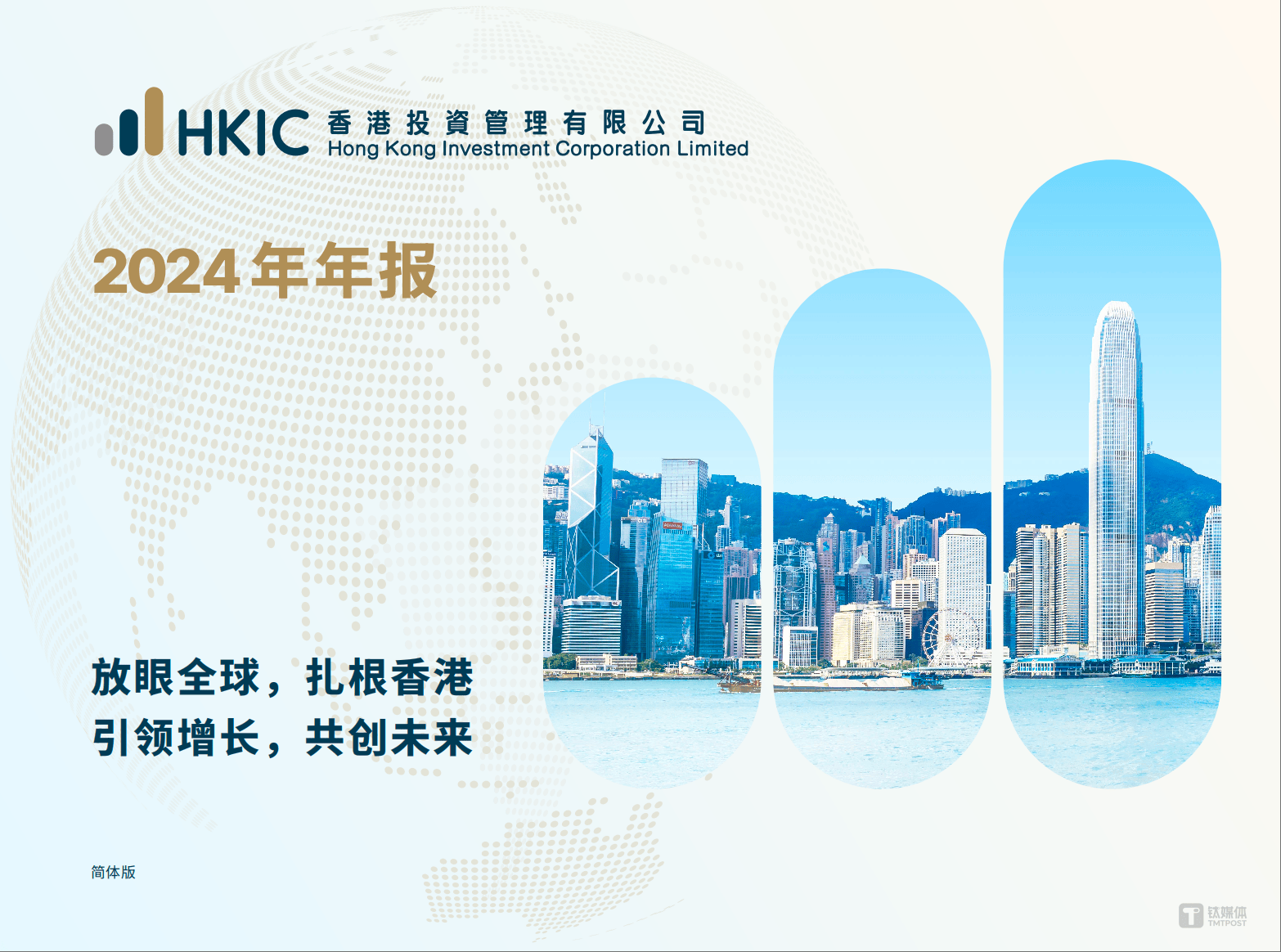
Core Insights - The Hong Kong Investment Company has officially released its first annual report for 2024, marking a significant milestone since its establishment [1] Financial Performance - As of December 31, 2024, the total asset size of the company is HKD 64.007 billion, with less than 20% of the initial capital invested in projects [1] - The company achieved investment income of HKD 2.345 billion and recorded an operating profit of HKD 2.252 billion [1] Investment Allocation - The investment allocation in the hard technology sector is notably high at 71%, while investments in life sciences and new energy/green technology account for 13% and 11% respectively [1]
港投公司发布成立以来第一份年报,硬科技领域投资占比高达71%
Zheng Quan Shi Bao Wang· 2025-12-04 05:33
Core Insights - The Hong Kong Investment Company has officially released its first annual report for 2024, marking a significant milestone since its establishment [1] Financial Performance - As of December 31, 2024, the total asset size of the company is HKD 64.007 billion, with invested project funds accounting for less than one-fifth of the initial capital [1] - The company achieved investment income of HKD 2.345 billion and recorded an operating profit of HKD 2.252 billion [1] Investment Allocation - The investment allocation shows a high concentration in the hard technology sector, which accounts for 71% of the total investments [1] - Investments in life sciences and new energy/green technology represent 13% and 11% respectively [1]
耐心资本观察 | “生态+直投”双轮驱动 复旦系科创基金构建原始创新赋能新范式
Xin Hua Cai Jing· 2025-12-03 15:32
Core Insights - Fudan University is actively building a comprehensive innovation ecosystem, highlighted by the establishment of the Zuqian Innovation Transformation Research Institute and the launch of the Fudan Innovation Investment Fund with an initial target size of $100 million [1][6]. Group 1: Fudan University's Initiatives - The Zuqian Research Institute aims to serve as a core platform for high-quality transformation and industrialization of major scientific achievements, focusing on cultivating top-tier entrepreneurial talent and innovative ecosystems [3][4]. - Fudan's president emphasized the importance of deepening basic research, nurturing innovative talent, promoting interdisciplinary collaboration, and expanding global cooperation to enhance the university's contribution to national and regional development [1][2]. Group 2: Investment Strategies - The newly established Fudan Innovation Investment Fund will focus on early-stage projects in life sciences, artificial intelligence, and new energy materials, aiming to support the commercialization of original technologies from Fudan's core research institutions [6][5]. - The Fudan Overseas Innovation Investment Fund, also launched, has a target size of $100 million and aims to attract international enterprises and talent interested in China's development, facilitating the internationalization of Fudan's research outcomes [7]. Group 3: Strategic Collaborations - Fudan University is forming strategic partnerships with various organizations, including Shanghai Industrial Group and local governments, to enhance the quality and speed of technology transfer and industrialization [7][4]. - The first batch of "Zuqian Partners" includes prominent figures from academia and industry, contributing diverse resources to support the commercialization of scientific achievements [4].
AI重塑了管理假设,组织不一样了
3 6 Ke· 2025-12-02 03:56
Group 1 - The core viewpoint of the articles is that large enterprises are shifting towards a centralized organizational model, where top management directly oversees various functions, especially in competitive industries like electric vehicles and technology [1][5][10] - Centralization is seen as a response to the complexities introduced by AI, which allows for more efficient management and decision-making without relying heavily on middle management [1][6][9] - The traditional hierarchical structure, which relies on middle management to filter information and execute decisions, is being challenged as middle management often becomes a bottleneck rather than a facilitator of efficiency [2][3][4] Group 2 - The emergence of AI tools is enabling top management to manage a larger span of control, simplifying the relationships they need to oversee and allowing for more effective decision-making based on real-time data [6][7] - As AI enhances the capabilities of frontline employees, the need for middle management to oversee and filter work diminishes, leading to a flatter organizational structure [7][10] - The trend indicates that middle management roles that do not add significant value, such as those merely acting as information relays, are likely to be eliminated, leaving only those who can contribute strategically or execute effectively [10][8]
乐见更多科技股上市
Bei Jing Shang Bao· 2025-12-01 16:36
Group 1 - The core viewpoint of the articles highlights the acceleration of hard technology companies' IPOs in China, exemplified by the upcoming IPO of Muxi Co., which follows the successful listing of Moore Threads [1][2] - The "1+6" policy from the Sci-Tech Innovation Board has significantly increased the inclusivity for hard technology companies to go public, supported by a series of systemic policy measures from multiple government departments [1][2] - The average first-day return rate for newly listed stocks this year has reached 253%, with no instances of stock price declines, indicating strong market recognition and providing substantial benefits to investors [1][2] Group 2 - The positive performance of technology stocks post-listing has led to increased interest and investment in technology companies from venture capital and private equity, improving the financing ecosystem for hard technology firms [2] - Newly listed technology stocks are expected to enhance their research and development capabilities and market competitiveness, potentially leading to explosive growth in performance and profitability for both the new stocks and their supply chain partners [2] - The ongoing value reassessment of technology stocks reflects a broader shift in the A-share market towards high-quality development, boosting overall market confidence [3]
吴世春:没投到字节跳动的天使轮,是我的人生遗憾
创业家· 2025-11-28 10:19
Core Insights - The article discusses the challenges and opportunities in early-stage investment in China, emphasizing the need for patience and a long-term vision in the current investment landscape [2][5][6]. Investment Landscape - The current investment environment is characterized by difficulties in fundraising and high costs of customer acquisition, leading to longer exit cycles for investments [3][4]. - Historically, companies like Li Auto and Niu Technologies had shorter IPO timelines, but now the best companies may take up to 12 years to go public [4]. Investment Logic - The author outlines three key investment strategies: 1. **Investing in "Unicorn Tigers"**: Focus on companies that can dominate their market rather than those that merely exist alongside competitors [7][9]. 2. **Investing in "Town Youth"**: Emphasizes the importance of young entrepreneurs from smaller towns who are more likely to adopt a long-term focus and avoid chasing trends [10][11][13]. 3. **Alignment of People, Events, Timing, and Valuation**: Successful investments require the right team, the right business model, favorable market conditions, and reasonable valuations [14]. Current Investment Activity - The company has invested in over 600 enterprises, with around 70 to 80 achieving profitability close to A-share listing standards, indicating a high success rate in their investment strategy [14]. Upcoming Events - A learning event is scheduled in Xi'an, focusing on technology manufacturing and exploring opportunities in various sectors, including robotics, aerospace, and new materials [15][21].

辽宁吹响创投“集结号”:22条举措精准发力,力争2500亿元基金认缴规模
Zheng Quan Shi Bao· 2025-11-27 12:30
Core Viewpoint - Liaoning Province has launched 22 specific measures to promote the high-quality development of private equity investment funds, aiming to enhance the financial support for technological innovation and establish a robust investment ecosystem by 2027 and 2030 [1][2]. Group 1: Development Goals - By the end of 2027, the province aims to form a multi-level, diversified, and full-cycle private equity investment fund system, with a target of exceeding 180 billion yuan in subscribed capital [1]. - By the end of 2030, the subscribed capital for various funds is expected to surpass 250 billion yuan, significantly contributing to the province's high-quality development [1]. Group 2: Investment Focus - The new policy emphasizes not only attracting more capital but also directing it towards the right industries, particularly original and leading technological innovation enterprises in Liaoning [2]. - The initiative encourages the participation of research institutions and innovation platforms in venture capital, promoting corporate venture capital (CVC) development to accelerate core technology breakthroughs and industrial transformation [2]. Group 3: Regional Development - Shenyang and Dalian are designated to leverage their economic and financial advantages to create a nationally influential regional private equity investment institution cluster, aiming for double-digit annual growth in fund subscriptions [3]. - The policy highlights the importance of developing patient capital, supporting insurance institutions to invest in venture capital funds, and optimizing risk factors for eligible insurance companies [3]. Group 4: Industry Alignment - The policy stresses enhancing the connection between private equity investment institutions and key industry clusters, facilitating collaboration between upstream and downstream enterprises [4]. - It aims to utilize educational and research resources to improve the interaction between innovation resources and private equity investment institutions [4]. Group 5: Risk Management - To foster a "willing to invest" environment, the policy reinforces risk tolerance and error-correction mechanisms, optimizing the evaluation system for government investment funds [5]. - It establishes a differentiated management mechanism for venture capital and industrial investment funds, allowing for higher government contribution ratios for venture capital funds [6]. Group 6: Exit Strategies - The policy outlines measures to streamline exit channels for funds, promoting domestic and international listing and acquisition opportunities for invested enterprises [6]. - It encourages the establishment of acquisition funds by government and state-owned funds to broaden market exit channels for private equity investment institutions [6]. Group 7: Market Liquidity - The initiative promotes the development of secondary market funds (S funds), supporting government investment funds in initiating S funds and encouraging various financial institutions to invest [7]. - Overall, the policy aims to create a comprehensive ecosystem for private equity investment funds, ensuring directed investments and clear exit strategies [7].
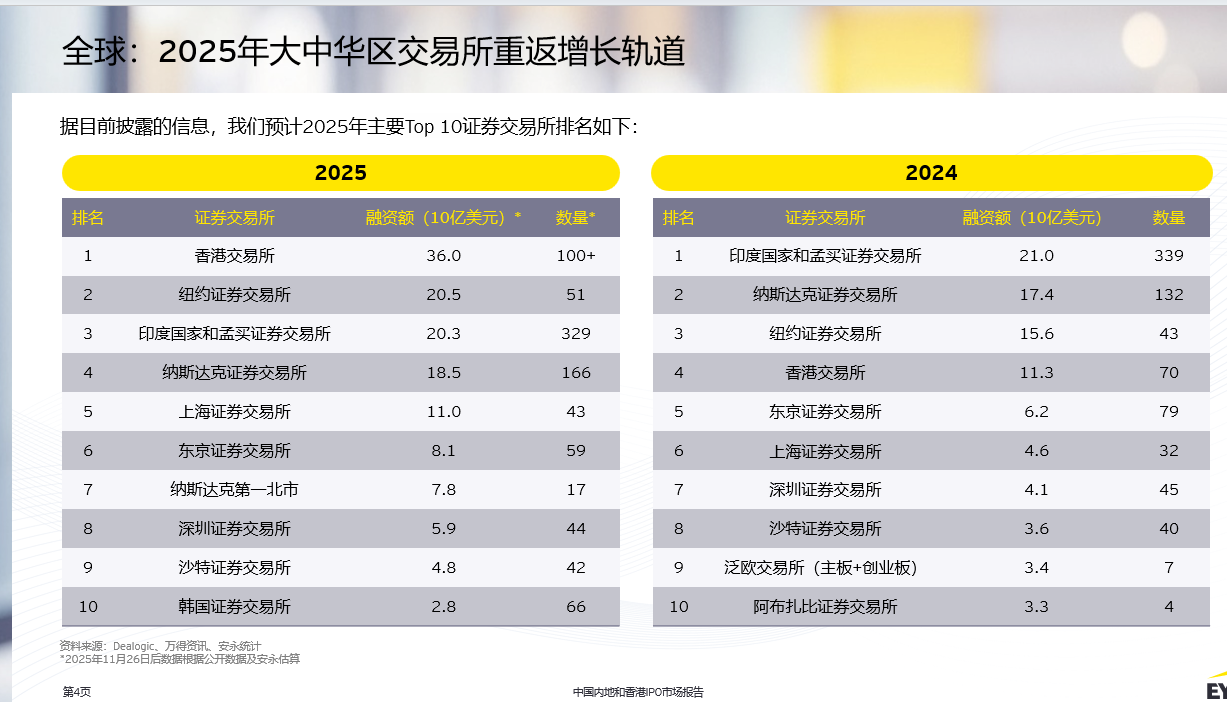
安永:A股和香港市场IPO筹资额占全球1/3
Di Yi Cai Jing· 2025-11-27 11:48
Core Insights - The report by Ernst & Young indicates a growth trend in IPO activities in mainland China and Hong Kong, with A-shares and Hong Kong accounting for 16% of global IPO numbers and 33% of global fundraising amounts in 2025 [1] Group 1: IPO Market Overview - Hong Kong Stock Exchange is projected to lead global exchanges with a fundraising amount of $36 billion in 2025, while Shanghai Stock Exchange ranks fifth with $11 billion [2] - Chinese companies occupy five positions in the global top ten IPOs, with representation across automotive, mining, energy, and advanced manufacturing sectors [2] Group 2: A-share Market Dynamics - The A-share IPO market is expected to see moderate growth in 2025, with approximately 97 companies going public and raising around 100 billion RMB [3] - The average fundraising amount per IPO in A-shares has increased to 1.031 billion RMB, reflecting a 53% year-on-year rise, driven by large IPOs [4] - The automotive sector accounts for about 30% of A-share IPOs, with significant contributions from industrial, technology, and materials sectors [4] Group 3: Hong Kong IPO Landscape - The Hong Kong IPO market is experiencing a strong recovery, with fundraising surpassing 200 billion HKD, marking the second-highest peak in five years [5] - Mainland enterprises dominate the Hong Kong IPO market, contributing 88.5% of the number of listings and 83.5% of the total fundraising [5] - New consumption and hard technology sectors are identified as the dual engines driving IPO activities in Hong Kong [5] Group 4: Future IPO Trends - The IPO issuance in 2026 is expected to transition to a "new normal," focusing on a steady pace rather than a return to rapid expansion, influenced by macroeconomic conditions and the quality of prospective listings [8] - The A-share market is anticipated to gradually restore normal issuance patterns, emphasizing quality and structural optimization, particularly in strategic emerging industries [8] - The Hong Kong IPO market is expected to maintain its momentum, with a focus on A+H listings and the return of Chinese concept stocks [8]