
金属交易

Search documents
业界大佬:全球铜都在流向美国,这是铜多头“一次大好机会”
华尔街见闻· 2025-11-30 12:10
Group 1 - Kostas Bintas, head of metals at Mercuria Energy Group, reiterated a bullish outlook on copper prices, warning of further depletion of copper inventories globally as large amounts of metal flood into the U.S. market [1] - Bintas described the current situation as a "great opportunity" for copper bulls, noting that profitable U.S. arbitrage trading is returning, leading to supply shortages outside the U.S. and driving copper prices higher [2] - He emphasized that from a mathematical perspective, the only answer to the current trends of tight supply and rising prices is that even Chinese buyers will have to pay higher premiums to secure supply [3] Group 2 - Mercuria expects a significant increase in U.S. copper imports in the coming months, predicting that the import rate in Q1 2026 will match the record level of over 500,000 tons seen in Q2 2025 [4] - The copper market has experienced volatility this year, with U.S. copper prices soaring earlier in the year due to tariff threats, leading to a massive flow of metal into the U.S. from other regions [4] - Bintas believes the current market structure, characterized by weak demand and surplus yet rising prices, is a "special dynamic" that could lead to shortages in the Chinese market as metal continues to flow to the U.S. [4] Group 3 - Bintas acknowledged that the bullish outlook is driven by U.S. policy, with the U.S. now being the largest copper consumer globally [5] - Market data shows that New York futures prices are significantly higher than London benchmark prices, leading to a bidding war among Asian buyers [5] - This market polarization has created a "dual-speed" mechanism, where LME and Shanghai copper contracts are primarily supported by Russian and Chinese metals, while metals deliverable to Comex enjoy high premiums [5] Group 4 - Traders have pushed up the premium for deliverable copper, with reports indicating some traders attempting to purchase Chilean copper at premiums exceeding $500 over LME prices [7] - Chile's Codelco has recently proposed a benchmark premium of over $300 per ton to customers in South Korea and China, shocking Asian buyers [7] - Bintas predicts that while Chinese buyers are currently hesitant about high prices, they will eventually accept them, and the market will likely settle above a $200 premium [7]

白银库存仍存在“危机” 伦敦银打开上涨轨道
Jin Tou Wang· 2025-11-28 06:32
Group 1 - The current trading price of London silver is above $53.81, with a recent high of $54.22 and a low of $53.30, indicating a short-term bearish trend [1] - Silver inventory is facing a "crisis," with Shanghai Gold Exchange silver stocks dropping by 58.83 tons to 715.875 tons, the lowest since July 3, 2016 [2] - The London Metal Exchange (LME) has seen a significant decline in metal inventories, leading to liquidity issues in certain metal markets due to cross-border shipping cost concerns and tariff-related arbitrage opportunities [2] Group 2 - The price of London silver is preparing to challenge a key resistance level at $54.35, supported by trading above the EMA50, indicating a short-term bullish trend [3] - Positive signals have emerged in the relative strength index, suggesting potential for increased short-term gains as the market moves out of an overbought state [3] - Silver is increasingly being recognized as a primary metal rather than a secondary to gold, particularly in the photovoltaic sector and in the demand for silver paste in next-generation electric vehicles [2]
LME高管:高度关注在铝领域上市新的中国和印尼品牌
Ge Long Hui A P P· 2025-11-27 01:30
格隆汇11月27日|伦敦金属交易所(LME)高管:未来18个月内,纽约商品交易所溢价高于伦敦金属交易 所的情况或将持续。高度关注在铝领域上市新的中国和印尼品牌。 ...
期铜升至逾一周高位,受库存持续外流至美国支撑【11月25日LME收盘】
Wen Hua Cai Jing· 2025-11-26 00:42
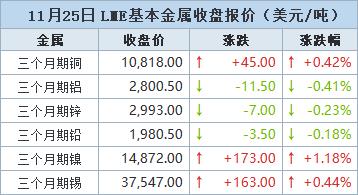
Core Insights - LME copper prices reached a one-week high due to ongoing inventory outflows to the US [1][4] - The three-month copper contract rose by $45, or 0.42%, closing at $10,818 per ton [1][2] - LME copper inventory has decreased by 42% this year, contributing to a tight market [4] Price Movements - Three-month copper: $10,818.00, up $45.00 (0.42%) [2] - Three-month aluminum: $2,800.50, down $11.50 (-0.41%) [2] - Three-month zinc: $2,993.00, down $7.00 (-0.23%) [2] - Three-month lead: $1,980.50, down $3.50 (-0.18%) [2] - Three-month nickel: $14,872.00, up $173.00 (1.18%) [2] - Three-month tin: $37,547.00, up $163.00 (0.44%) [2] Market Dynamics - The outflow of copper inventory to COMEX has created a supply squeeze, raising concerns about potential US import tariffs [4] - The LME spot copper contract premium over the three-month forward rose to $25 per ton, the highest since mid-October [4] - The Yangshan copper premium, an indicator of Chinese copper import demand, fell by 6% to $32, a four-month low [4] Technical Analysis - LME copper has broken through the 21-day moving average resistance, which is now at $10,828 per ton [5] - Copper prices previously reached a historical high of $11,200 per ton due to supply concerns from the Grasberg mine [5] - Other LME metals showed mixed performance, with lead hitting a low not seen since October 20 [5]
LME:2026年中起将停止管理LBMA铂金和钯金价格
Zhi Tong Cai Jing· 2025-11-20 15:22
(责任编辑:张晓波 ) 【免责声明】本文仅代表作者本人观点,与和讯网无关。和讯网站对文中陈述、观点判断保持中立,不对所包含内容 的准确性、可靠性或完整性提供任何明示或暗示的保证。请读者仅作参考,并请自行承担全部责任。邮箱: news_center@staff.hexun.com 智通财经APP获悉,伦敦金属交易所(LME)11月20日宣布,自2026年中起将停止管理伦敦贵金属市 场协会(LBMA)铂金和钯金价格,以专注于其核心基本金属业务。LME已与LBMA共同就此次变更计划 与伦敦铂钯市场(LPPM)参与者展开沟通,并承诺确保在任命新管理机构后实现平稳有序的过渡。 LME首席运营官Jamie Turner在声明中表示:"铂金和钯金拍卖已不再是我们的核心业务,因此我们 认为,将定价功能转移到其他平台符合LME及市场的最佳利益。" ...
LME将停止运营铂金和钯金的拍卖
Ge Long Hui A P P· 2025-11-20 13:50
格隆汇11月20日|伦敦金属交易所(LME)将从明年年中起停止每日两次的铂金和钯金定价拍卖,以 便专注于其核心的基本金属业务。LBMA铂金和钯金拍卖的结果被市场和行业广泛用于合同结算和交 易。拍卖过程本身也为大宗交易提供了一个流动性提升的窗口,有助于大额交易的顺利进行。 LME首席运营官Jamie Turner在声明中表示:"铂金和钯金拍卖已不再是我们的核心业务,因此我们认 为,将定价功能转移到其他平台符合LME及市场的最佳利益。" ...
中经评论:推动全球金属交易格局走向新平衡
Jing Ji Ri Bao· 2025-11-18 00:02
Core Viewpoint - The London Metal Exchange (LME) has decided to suspend all non-USD denominated metal options trading, reflecting the fragility of the current international pricing system dominated by a single currency and market [1][2] Group 1: LME's Decision and Market Impact - The LME's announcement on November 3 indicated that non-USD denominated metal options contracts, such as those in euros and renminbi, lacked liquidity and had higher maintenance costs than benefits, leading to the suspension effective November 10 [1] - Following the announcement, there was a significant market reaction, with Shanghai Futures Exchange's night session metal contracts hitting the upper limit while LME's USD contracts faced rare declines, creating the largest price differential since 1987 [1][3] Group 2: Background and Challenges to the USD System - The decision comes amid unprecedented challenges to the USD system, including a US federal debt exceeding $38 trillion and real yields on US Treasuries failing to cover inflation costs, undermining the attractiveness of USD assets [2] - There is a noticeable trend of foreign central banks diversifying their reserve assets, with increased demand for gold and new multi-lateral payment mechanisms reflecting concerns over the existing clearing system [2] Group 3: Implications for Global Metal Trading - The LME's actions may strengthen the USD's position in the short term but also accelerate the fragmentation of the global metal trading system, increasing exchange rate risks and transaction costs for companies in Europe and Asia [3] - Japanese and German manufacturers, for instance, will face heightened complexity in risk management as they shift to USD contracts, dealing with both metal price and USD exchange rate fluctuations [3] Group 4: Opportunities for Chinese Enterprises - For Chinese companies, the LME's announcement presents both challenges and opportunities, as they may face a shortage of hedging tools and rising costs in the short term [3] - However, China's significant consumption of global copper and control over 55% of electrolytic aluminum capacity provide a natural anchor for renminbi pricing, alongside improvements in financial infrastructure and regional cooperation initiatives like the Belt and Road [3] Group 5: Historical Context and Future Outlook - Historically, attempts to enforce a single currency have often backfired, as seen in the 1960s with the UK's strict foreign exchange controls, which inadvertently facilitated the rise of the USD [4] - The overemphasis on the USD system may lead to strong alternative demands, indicating that the transformation of the global metal trading system will require a new balance deeply connected to the real economy [4]
推动全球金属交易格局走向新平衡
Jing Ji Ri Bao· 2025-11-17 22:23
Core Viewpoint - The London Metal Exchange (LME) has decided to suspend all non-USD denominated metal options trading, reflecting the fragility of the current international pricing system dominated by a single currency and market [1][2]. Group 1: LME's Decision and Market Impact - The LME's announcement on November 3 indicated that non-USD denominated metal options contracts had "long-term lack of liquidity," leading to the suspension effective November 10 [1]. - Following the announcement, there was a significant market reaction, with Shanghai Futures Exchange's metal contracts hitting the limit up, while LME's USD contracts faced a rare limit down, creating the largest price differential since 1987 [1][3]. Group 2: Background and Challenges to the USD System - The USD system is facing unprecedented challenges, with U.S. federal debt surpassing $38 trillion and real yields on U.S. Treasuries failing to cover inflation costs for major holders [2]. - There is a noticeable trend of foreign central banks diversifying their reserve assets, reflecting a decline in confidence in the USD [2]. - The U.S. is also pushing for a "critical minerals alliance" among G7 countries and others, aiming to reinforce the USD's dominance in metal pricing [2]. Group 3: Implications for Global Metal Trading - The LME's actions may strengthen the USD's position in the short term but also accelerate the fragmentation of the global metal trading system [3]. - Companies in Europe and Asia will face increased currency risk and transaction costs due to the loss of non-USD hedging tools [3]. - There are signs of capital shifting towards regional platforms like Shanghai and Dubai, indicating a potential reallocation of global liquidity [3]. Group 4: Opportunities for Chinese Enterprises - The LME's announcement presents both challenges and opportunities for Chinese enterprises, with potential short-term pressures on hedging tools and costs [3]. - China's significant consumption of copper and control over a large share of electrolytic aluminum production positions it to gain more pricing power in the long term [3]. - The development of financial infrastructure and initiatives like the Belt and Road Initiative may enable China to establish a more autonomous pricing system [3]. Group 5: Historical Context and Future Outlook - Historical instances of enforced currency unification have often led to unintended consequences, suggesting that the current overemphasis on the USD may generate strong demand for alternatives [4]. - The transformation of the global metal trading system will require a deep coupling with the real economy to achieve a new balance [4].
人民币遭封杀!英国将中国踢出局,紧要关头全球资本弃美投中
Sou Hu Cai Jing· 2025-11-17 14:15
Core Viewpoint - The article discusses the ongoing financial battle between the US dollar and the Chinese yuan, highlighting how the recent ban on non-dollar metal trading in London may inadvertently strengthen the yuan's position in global metal transactions [1][3]. Group 1: Historical Context - The article draws parallels between the current situation and the decline of the British pound in the 1950s, where attempts to enforce currency dominance through administrative measures backfired, leading to the rise of the dollar as the primary global currency [5][10]. - The dollar's dominance has been built on three pillars: settlement, reserve, and pricing power, with pricing being a significant source of revenue [12][18]. Group 2: Current Developments - The Shanghai Futures Exchange recently reported that yuan-denominated copper futures have reached the highest global position, while the London Metal Exchange (LME) has halted all non-dollar metal options trading, indicating a desperate attempt to maintain dollar dominance [8][10]. - The yuan's share in global metal pricing has surged by 900% over three years, with countries like Russia and those in the Middle East increasingly signing long-term contracts in yuan [8][18]. Group 3: Market Reactions - Following the LME's ban, the Shanghai Futures Exchange saw a significant increase in trading volume, while dollar-denominated transactions on the LME stagnated, indicating a shift in market sentiment towards yuan pricing [23][25]. - The Dubai Commodity Exchange announced plans to launch yuan-denominated copper futures, further solidifying the yuan's position in the market [25][30]. Group 4: Future Implications - The article suggests that the dollar's attempts to maintain its hegemony through financial restrictions may lead to its own decline, as the yuan's real demand in the industrial sector becomes more prominent [32][34]. - The shift towards yuan-denominated transactions is seen as a natural evolution of the global industrial landscape, with the yuan's rise being supported by actual market needs rather than speculative financial maneuvers [36].
LME期铜下滑,因担忧美国12月可能不会降息
Wen Hua Cai Jing· 2025-11-17 09:24
Group 1 - LME copper futures weakened amid a general decline in the base metals market, influenced by hawkish comments from some Federal Reserve officials regarding potential interest rate decisions in December [1] - The main copper contract on the Shanghai Futures Exchange fell by 790 yuan or 0.91% to 86,450 yuan per ton [1] - As of 16:30 Beijing time, LME three-month copper dropped by 0.24% to $10,825.50 per ton, reflecting market pressures from expectations that the Fed may not lower rates [1] Group 2 - Other base metals also experienced declines, with Shanghai aluminum down 1.14% to 21,725 yuan per ton, lead down 1.39% to 17,355 yuan per ton, zinc down 0.33% to 22,465 yuan per ton, nickel down 0.92% to 116,750 yuan per ton, and tin down 1.32% to 290,360 yuan per ton [1] - LME three-month aluminum fell by 0.33% to $2,849 per ton, zinc decreased by 0.23% to $3,013.50 per ton, lead dropped by 0.41% to $2,055.50 per ton, and nickel declined by 0.38% to $14,835 per ton, while tin saw a slight increase of 0.08% to $36,815 per ton [2]