
食品工业

Search documents
精彩抢先看 | 价值与投资——寻找新引擎 传统产业的智造跃迁
Di Yi Cai Jing· 2025-08-21 07:12
Group 1 - The event focuses on exploring new consumption patterns, models, and products in the food industry under the new industry landscape, featuring executives from Haitian Flavoring and Angel Yeast [1][2] - The Shanghai Stock Exchange, in collaboration with Yicai, aims to promote rational, value, and long-term investment principles, enhancing the demonstration effect of state-owned enterprises and companies listed on the Sci-Tech Innovation Board [1] - The food industry is undergoing rapid transformation and upgrading, leveraging digitalization as a key driver, with advancements in technology enabling personalized product innovation and efficiency improvements [1] Group 2 - The program titled "Finding New Engines: Intelligent Manufacturing Leap of Traditional Industries" will feature discussions with industry leaders and investment analysts [2] - The live event will be available for viewing on Yicai's official website and app on August 22, 2025, at 15:00 [2][3]

潮州市:构建特色鲜明、优势突出的现代化产业体系
Zhong Guo Fa Zhan Wang· 2025-08-20 05:47
Economic Performance - Chaozhou's GDP for the first half of the year reached 67.974 billion yuan, with a year-on-year growth of 5.1%, ranking 4th in the province [1] - The industrial added value above designated size increased by 2.9% year-on-year, ranking 12th in the province [1] - Fixed asset investment rose by 2% year-on-year, ranking 2nd in the province [1] Industrial Development - Chaozhou focuses on high-quality industrial development, aiming to transform traditional industries and cultivate emerging ones [1] - The establishment of the Cape Medical Science Park production base signifies a deep integration of "smart manufacturing" and "precision medicine," showcasing new productive forces [2][5] - The city is developing 15 county-level characteristic industrial parks, emphasizing differentiated development in various districts [3] Innovation and Services - The Cape Medical Science Park will enhance the production capacity of nucleic acid diagnostic products, with an annual output capacity of 50 million tests, scalable to 100 million during emergencies [5][6] - Chaozhou has implemented a "full lifecycle service" mechanism to expedite project approvals, reducing approval times by over 63% for various projects [7] - The city has established an online and offline dual-track service system for industrial land applications, facilitating quicker access to land for enterprises [6][7] Events and Economic Activities - The third "Chao Food Fair" attracted 267,000 visitors and generated 15.35 billion yuan in intended orders, setting new records for the event [4] - The intelligent bathroom expo drew 140,000 professional attendees, with intended orders exceeding 2.6 billion yuan [4] - The stainless steel industry conference attracted over 100,000 professional buyers, resulting in intended orders of 3.3 billion yuan [4] Tourism and Cultural Integration - Chaozhou is enhancing its agricultural, cultural, and tourism integration, with projects like a 100 million yuan rural hotel complex boosting local employment and product sales [4]
重走抗战路,一定要去一趟“国际和平城市”潍坊!
Zhong Guo Xin Wen Wang· 2025-08-14 00:21
Core Viewpoint - The article highlights the transformation of Weifang, a city in Shandong, from a site of historical conflict to a symbol of peace, emphasizing the importance of remembering history to cherish peace [1][40]. Group 1: Historical Context - The Weifang area was affected by the Pacific War from 1942 to 1945, leading to the establishment of the Weifang Western Internment Camp by Japan, where over 2,000 Western civilians were detained, including 327 children [3][5]. - The camp was the largest of its kind in China, housing notable figures such as the second U.S. ambassador to China and an Olympic champion [5][11]. Group 2: Community Support - Local Chinese citizens risked their lives to assist the interned Western civilians by providing supplies, donations, and even acting as informants to help them escape [9][11]. Group 3: Memorialization and Education - A museum has been established at the former internment camp site, preserving historical memories and educating visitors about the suffering endured during that time [11][14]. - The museum features a "digital mirror" project that allows visitors to experience the camp's history through virtual reality [14][16]. Group 4: Peace Initiatives - Weifang has been recognized as an "International City of Peace," becoming the second city in China to receive this designation [18]. - The city promotes peace through various initiatives, including international exhibitions, joint sports events, and volunteer programs aimed at educating the youth about the importance of peace [16][18]. Group 5: Economic Development - Weifang's economy is characterized by significant industrial clusters, contributing approximately 10% of Shandong's total output and 1% of the national output, with key industries including advanced manufacturing and modern agriculture [30][32]. - The city has embraced new technologies in agriculture, leading to the establishment of smart greenhouses and digital farms, which have gained national recognition [32][34]. Group 6: Cultural and International Engagement - Weifang hosts various cultural events, such as the International Kite Festival, which fosters international friendships and cultural exchange [24][26]. - The city has established trade relationships with over 200 countries and regions, enhancing its global connectivity through various international events [36][40].


2025“吃货季”食品提质扩需工作启动
Xin Hua Wang· 2025-08-12 05:49
Core Viewpoint - The Ministry of Industry and Information Technology, the Ministry of Commerce, and the State Administration for Market Regulation have launched the 2025 "Foodie Season" initiative to enhance food quality and expand domestic demand, aiming to build a modern food industry system from June to December this year [1]. Group 1: Initiative Overview - The initiative is themed "Digital Upgrade, Characteristic Innovation, and Integrated Development," focusing on the integration of food industry with digital technology, catering, and leisure sectors to create new products, scenarios, and hotspots in food consumption [1]. - The program aims to stimulate market vitality and consumer potential through a series of supply chain connection activities and the deep integration of new information technologies with the food industry [1]. Group 2: Implementation Strategies - The initiative encourages leading e-commerce platforms, social media, and trade circulation enterprises to utilize smart technologies for personalized food recommendations to consumers [1]. - It promotes a seamless shopping experience by integrating online platforms with offline stores [1]. - Food production and sales companies are encouraged to transform production lines and facilities into immersive interactive experience spaces, and to collaborate deeply with cultural and tourism enterprises to explore local food culture and historical stories [1]. Group 3: Digital Transformation and Quality Control - The initiative emphasizes the digital transformation of food production and sales enterprises, establishing strict quality control systems [1]. - It encourages practices such as "Transparent Kitchens and AI Inspections" to enhance food safety and quality [1].
食品企业须长出“数字大脑”
Jing Ji Ri Bao· 2025-08-11 22:05
Core Viewpoint - The digital transformation of the food industry is essential for enhancing competitiveness and meeting consumer demands for safety, personalization, and quality [1][2][3] Group 1: Digital Transformation Goals - The Ministry of Industry and Information Technology and six other departments have issued a plan aiming for an 80% digital management penetration rate among key enterprises by 2027, with a 75% rate for key processes and digital design tools in large-scale enterprises [1] - Currently, the digitalization rates for key processes and design tools stand at 63.3% and 72.8%, respectively, indicating a foundational framework for digital transformation [1] Group 2: Challenges in Digital Transformation - Insufficient internal motivation is a primary barrier, with some labor-intensive enterprises lacking awareness of the value of digital transformation [2] - Coordination issues across the supply chain are significant, as the food industry spans multiple sectors, leading to unbalanced and insufficient collaborative transformation, particularly for small and medium-sized enterprises [2] - There is a notable shortfall in the supply of services and standards for digital transformation, with a need for improved talent development and the availability of key intelligent equipment and software systems [2] Group 3: Innovation through Digital Transformation - Digital transformation is expected to drive comprehensive innovation within food enterprises, enhancing innovation capabilities, optimizing supply levels, and building well-known brands [2] - Technologies such as big data can facilitate product design iterations and the development of personalized products, while IoT can create traceability systems to bolster food safety [2][3] Group 4: Reshaping Business Models - Digital transformation will reshape business models, particularly in supply chain management, by establishing digital management systems for raw materials and enhancing collaborative efficiency across the industry chain [3] - The integration of smart technologies will lead to cost reduction and efficiency improvements, enhancing both product supply and consumer service capabilities [3] Group 5: Strategic Implementation - Precise strategies are necessary for advancing digital transformation, including tailored approaches based on individual enterprise conditions and strengthening resource guarantees [3] - The development of digital service platforms, standardization, and the cultivation of versatile talent are critical for enhancing the self-supply capabilities of essential software and hardware [3] - The role of industrial internet in facilitating data flow across the supply chain is emphasized, promoting collaborative transformation among enterprises of various sizes [3]
印度食品走向世界?
Jing Ji Ri Bao· 2025-08-09 21:56
Group 1 - Indian Prime Minister Modi expressed a vision for every household globally to have Indian food products on their tables, highlighting the government's push for food exports as a key strategy for economic growth [1][2] - The Indian government aims to boost food exports to over $51.9 billion by 2024, with significant investments in food processing and the establishment of around 200 food parks, targeting to become one of the top five food exporters by 2030 [1][2] - The strategy is seen as a way to enhance agricultural and manufacturing sectors, expand international trade, and elevate India's cultural influence globally [2] Group 2 - India's food export ambitions face external threats, particularly from U.S. sanctions against Russia, which could impact India's energy imports and economic stability [4][5] - Ongoing trade negotiations with the U.S. may require India to make concessions in sensitive areas like agriculture and dairy, potentially affecting its food export strategy [5] - Internally, the Indian food industry is struggling with the need for a comprehensive industrial chain to support food exports, as the government's Production Linked Incentive (PLI) scheme has not yielded the expected results [6][7] Group 3 - The PLI scheme, aimed at attracting foreign investment and enhancing manufacturing, has seen a decline in manufacturing's share of GDP, raising concerns about its future [7] - The Indian government has adopted protectionist measures in response to industry challenges, which may hinder the import of food products from other countries, reflecting a lack of self-critique and proactive solutions [7][8] - Addressing fundamental issues such as food safety is crucial for India's goal of becoming a global food exporter, suggesting a need for a more focused approach rather than a broad strategy [8]
约旦工业协会回应美方加税:成衣业受影响,进口汽车价格或将下调
Shang Wu Bu Wang Zhan· 2025-08-09 03:25
Core Viewpoint - The recent decision by the United States to impose a 15% tariff on certain Jordanian exports, which previously enjoyed zero tariffs, significantly impacts the garment industry, particularly knitwear. The food industry, with its local resource base and growth potential, should be prioritized for future development [1] Group 1: Impact on Industries - The garment industry is the most affected sector due to the new 15% tariff on exports to the U.S. [1] - The food industry is highlighted as having local resource advantages and growth potential, suggesting a shift in focus for future investments [1] Group 2: Trade Relations - Jordan primarily imports cars, chemicals, and pharmaceuticals from the U.S. [1] - Future U.S.-Jordan trade negotiations are expected to cover various aspects of imports, which may lead to a decrease in the prices of American cars in the Jordanian market [1]
2025年7月份工业生产者出厂价格环比降幅收窄
Yang Shi Wang· 2025-08-09 02:11
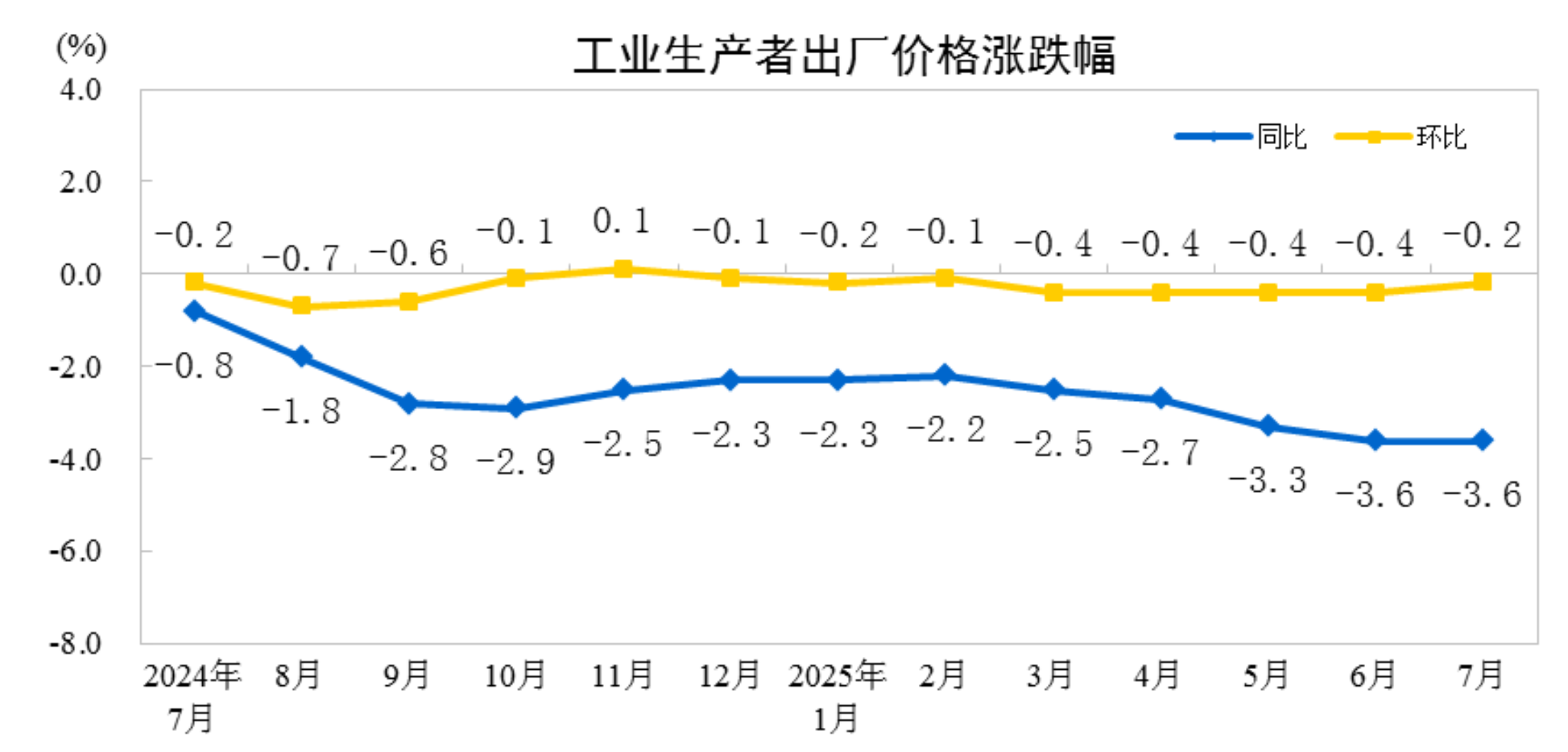
Core Insights - In July 2025, the national industrial producer price index (PPI) decreased by 0.2% month-on-month, while the industrial producer purchase price index (PPPI) fell by 0.3%, with the decline narrowing by 0.2 and 0.4 percentage points compared to the previous month respectively [1] - Year-on-year, the PPI dropped by 3.6%, and the PPPI decreased by 4.5% [1] - For the average from January to July, the PPI declined by 2.9% compared to the same period last year, and the PPPI fell by 3.2% [1] Price Changes in July - In July, the prices of production materials decreased by 4.3%, contributing approximately 3.20 percentage points to the overall decline in the PPI [3] - The mining industry saw a price drop of 14.0%, while raw materials and processing industries experienced declines of 5.4% and 3.1% respectively [3] - Prices of living materials decreased by 1.6%, impacting the overall PPI by about 0.42 percentage points, with food prices down by 1.8% and durable goods prices down by 3.5% [3] Month-on-Month Price Changes - In July, the production materials prices decreased by 0.2%, affecting the overall PPI by approximately 0.17 percentage points [8] - The mining industry prices fell by 0.2%, raw materials prices decreased by 0.1%, and processing industry prices dropped by 0.3% [8] - Living materials prices also decreased by 0.2%, with food prices remaining stable and durable goods prices declining by 0.6% [8] Purchase Price Changes - In the PPPI, fuel and power prices decreased by 10.8%, black metal materials by 8.0%, and chemical raw materials by 6.5% [7] - Agricultural products prices fell by 4.6%, while construction materials and non-metallic materials prices decreased by 3.8% [7] - However, prices for non-ferrous metal materials and wires increased by 2.8% [7]
十部门发布实施方案 拓展农产品消费新空间
Ren Min Ri Bao· 2025-07-31 23:23
Group 1: Core Insights - The article highlights a shift in consumer preferences towards quality, personalization, and functionality in agricultural products, moving away from traditional staples [1] - A joint implementation plan by ten government departments aims to promote agricultural product consumption through 23 specific measures [1] Group 2: Supply Improvement - Agricultural production is the source of agricultural consumption, with a high quality safety monitoring rate of 97.9% in the first half of the year [2] - Since the 14th Five-Year Plan, 36,000 new certifications for green, organic, and specialty agricultural products have been issued, a 70% increase from the end of the 13th Five-Year Plan [2] - The sales revenue of green food is projected to reach 609.78 billion yuan in 2024, supporting the transition to standardized, green, and high-quality agricultural production [2] Group 3: Distribution Enhancement - A modern agricultural product distribution system is essential for reducing losses and improving consumption quality, with a projected 15.8% growth in online agricultural product retail sales in 2024 [3] - China consumes approximately 1 billion tons of fresh agricultural products annually, with cold chain logistics playing a crucial role in maintaining freshness from production to consumption [3] - The Ministry of Agriculture and Rural Affairs is focusing on improving cold chain logistics, with over 98 million cubic meters of new cold storage capacity added, doubling from the end of the 13th Five-Year Plan [3] Group 4: Market Activation - The rise of experiential consumption is evident, with trends such as "village BA" and integrated online-offline shopping experiences gaining popularity [5] - The development of rural leisure tourism is seen as a key strategy for expanding new consumption spaces, with projected revenue from leisure agriculture nearing 900 billion yuan in 2024 [5] - The implementation plan includes initiatives like the "Chinese Farmers' Harvest Festival" to stimulate consumption, with over 3,000 events expected to generate more than 30 billion yuan in agricultural product sales [6]

国内年人均奶类消费量40.5公斤 还不到膳食推荐量的一半
Mei Ri Jing Ji Xin Wen· 2025-07-29 13:21
Core Viewpoint - The Ministry of Agriculture and Rural Affairs, along with ten other departments, has introduced a plan to promote agricultural product consumption, focusing on optimizing supply, innovating circulation, and activating the market through 23 specific measures to adapt to new consumer trends and preferences [1]. Group 1: Nutritional and Health Consumption - There is a shift in consumer demand from "sufficient food" to "nutritious and healthy food," prompting the Ministry to advocate for increased consumption of soybeans and milk to help consumers form a scientific dietary structure [1][2]. - Current data indicates that the average per capita milk consumption in China is 40.5 kg, significantly below the recommended dietary intake of 110-183 kg, and lower than the 80-90 kg levels in Japan and South Korea [2]. - Soybean and soybean product consumption is also below the recommended levels by 59%, indicating substantial growth potential in these areas [2]. Group 2: Public Health and Nutrition Education - The Ministry plans to enhance public services related to nutrition and health by developing and promoting healthy dietary plans, particularly targeting student groups to optimize nutrition in school meals [3]. - There will be a focus on promoting healthy eating habits through campaigns that encourage reduced oil intake, increased consumption of soy and milk, and greater intake of fruits, vegetables, and whole grains [3]. - The Ministry will also create food maps for dairy and beef to integrate agricultural product consumption with cultural and tourism activities [3]. Group 3: Food Industry Upgrading - The Ministry of Industry and Information Technology emphasizes the need to establish a diversified food supply system and enhance the quality of the food industry to drive agricultural product consumption [4]. - The application of biotechnology in the food industry is being promoted to expand agricultural development, including the optimization of production processes for various food products [5]. - The Ministry is also focusing on developing local specialty food industries and promoting deep processing of food products to enhance agricultural product consumption quality [6].