
Nonferrous Metals

Search documents
Volatile Nonferrous Metals And The DBB ETF
Seeking Alpha· 2025-08-19 16:43
Group 1 - The Hecht Commodity Report provides comprehensive coverage of market movements for over 29 different commodities, offering bullish, bearish, and neutral calls along with actionable trading recommendations [1][2] - Copper has experienced significant volatility since early April, reaching new highs and then plunging to around $4.30 per pound on the nearby COMEX futures contract [2] Group 2 - The author of the report actively participates in commodities markets through various instruments such as futures, options, and ETFs, with positions that can change intraday [3]


放量爆发,沪指创2015年以来新高,牛抬头?
Ge Long Hui· 2025-08-18 19:19
Market Performance - The Shanghai Composite Index rose by 0.85%, the Shenzhen Component Index increased by 1.73%, and the ChiNext Index surged by 2.84% at the close [1][3] - Over 4,000 stocks in the two markets experienced gains, with a total trading volume of 2.76 trillion yuan [1] Sector Highlights - The liquid cooling concept stocks saw a strong surge, with an increase of 7.05% by midday, including over 20 stocks hitting the daily limit or rising more than 10% [3] - Major financial stocks, including brokerage and fintech companies, reached new historical highs, with stocks like Zhina Compass and Tonghuashun performing particularly well [3] - The rare earth permanent magnet sector was active, with stocks like Northern Rare Earth hitting the daily limit [3] - The coal industry opened high but closed down by 0.53%, with several stocks, including Electric Power Investment Energy and Jinko Coal Industry, falling over 2% [3] - Other sectors such as non-ferrous metals, gold, fertilizers, and steel experienced notable declines [3] Trading Dynamics - The market showed strong performance in the morning, with the Shanghai Composite Index reaching a new high since 2015, but cautious sentiment led to a pullback in the afternoon [3] - Despite the afternoon retreat, trading volume significantly increased, surpassing 5.196 trillion yuan compared to the previous trading day [3]

镍&不锈钢:动不失时
Zi Jin Tian Feng Qi Huo· 2025-08-14 07:32
1. Report Industry Investment Rating There is no information provided regarding the report's industry investment rating. 2. Core Viewpoints of the Report - The fundamentals of nickel have changed relatively little, but the expectation of oversupply remains. Nickel prices are temporarily fluctuating in line with macro - sentiment. This week, the price of nickel ore has slightly declined, the arrival volume of nickel ore has increased, and domestic port inventories are showing a tendency to accumulate. On the smelting side, the production of refined nickel is running smoothly, the loss of ferronickel plants has narrowed, and the supply remains at a low level [3]. - In the short term, the supply of tin is relatively sufficient, and the market recovery is mainly supported by macro - news. The supply of nickel ore in the third quarter is expected to be relatively abundant, and the price of Philippine nickel ore may be weak. The price of Indonesian domestic trade nickel ore has rebounded in the first half of August, and the supply is expected to increase. The price of NPI has continued to rise this week, and the supply - demand pattern of nickel sulfate remains tight [4]. 3. Summary by Relevant Catalogs Nickel - **Price and Cost**: As of August 11, the CIF prices of Philippine laterite nickel ore with 0.9%, 1.5%, and 1.8% nickel content decreased by 0, 1, and 1 US dollars per wet ton respectively compared to last week, reaching 29, 57, and 78.5 US dollars per wet ton. The domestic trade nickel ore prices of Ni1.2% and Ni1.6% in Indonesia increased by 0 and 0.2 US dollars per wet ton respectively to 24.8 and 52.3 US dollars per wet ton as of August 8. The freight rates from the Philippines to Tianjin Port and Lianyungang decreased by 0.5 US dollars per wet ton to 12 and 11 US dollars per wet ton respectively last week. The average price of 8 - 12% high - nickel pig iron increased by 5 yuan per nickel point to 919 yuan per nickel point as of August 11, a 0.55% increase [3][27]. - **Production and Inventory**: As of July 2025, China's electrolytic nickel monthly production increased by 0.1 million tons to 3.28 million tons, a 3.14% increase. The national nickel pig iron production (metal content) decreased by 0.11 million tons to 2.45 million tons, a 0.59% decrease. As of August 12, the LME nickel warehouse receipts increased by 492 tons to 211,700 tons, a 0.23% increase. The pure nickel social inventory (including the SHFE) increased by 1,086 tons to 40,600 tons, a 2.75% increase [3][41]. - **Profitability**: As of August 12, the cash - cost production profit margin of RKEF in Fujian increased by 0.97 percentage points to - 9.8% [3]. Tin - **Monthly Balance Sheet**: The report provides a monthly balance sheet for tin from January to December 2025, including data on total production, imports, exports, total consumption, surplus, year - on - year supply and consumption changes, and cumulative year - on - year supply and consumption changes [4]. Refined Nickel - **Device Operation**: As of August 12, 2025, domestic electrolytic nickel plants in regions such as Gansu, Xinjiang, and Jilin are operating stably, while some plants in Zhejiang are operating at reduced loads or are temporarily shut down [36]. - **Production and Trade**: As of July 2025, China's electrolytic nickel monthly production increased by 0.1 million tons to 3.28 million tons, a 3.14% increase. As of June 2025, China's refined nickel monthly exports decreased by 27.41% to 10,100 tons, and imports decreased by 3.0% to 17,000 tons [38]. - **Inventory**: As of August 12, SHFE nickel warehouse receipts decreased by 230 tons to 20,700 tons, a 1.10% decrease. LME nickel warehouse receipts increased by 492 tons to 211,700 tons, a 0.23% increase. The pure nickel social inventory (including the SHFE) increased by 1,086 tons to 40,600 tons, a 2.75% increase [41]. - **Cost and Profit**: As of July 2025, the average production cost of SMM electrolytic nickel increased by 70 US dollars per ton to 13,095 US dollars per ton, a 0.54% increase. The production profit margins of integrated MHP and high - grade nickel matte for producing electrowon nickel increased by 3.7 and 2.2 percentage points respectively to 2.3% and - 4.7% [46]. Nickel Sulfate - **Device Operation**: Nickel sulfate plants in regions such as Jilin, Gansu, and Guangdong are operating stably, while some plants in Guangxi, Tianjin, and Jiangxi are operating at reduced loads or are shut down [52][56]. - **Production and Trade**: As of July 2025, China's nickel sulfate monthly production increased by 0.43 million tons to 2.91 million nickel tons, a 17.3% increase. As of June 2025, China's nickel sulfate monthly imports decreased by 27.35% to 13,300 tons, and exports increased by 3.66% to 782.1 tons [55]. - **Cost and Profit**: Recently, the spot cost of nickel salts has increased, and nickel salt plants are continuing to hold prices. As of August 12, the profit margins of MHP, nickel beans, high - grade nickel matte, and yellow slag for producing nickel sulfate decreased by 1.1, 0.9, 0.7, and 0.7 percentage points respectively to - 2.1%, - 5.2%, 3.3%, and - 3% [60]. Ferronickel - **Device Operation**: Ferronickel plants in Shandong, Jiangsu, and other regions are operating at reduced loads or are shut down for maintenance [68]. - **Production and Inventory**: As of July 2025, the national ferronickel production (metal content) decreased by 0.11 million tons to 2.45 million tons, a 0.59% decrease. As of July 31, the national main - region ferronickel inventory increased by 182 tons to 33,400 nickel tons, a 0.55% increase [70][76]. - **Cost and Profit**: As of August 12, the cash - cost production profit margin of RKEF in Fujian increased by 0.97 percentage points to - 9.8% [76]. Stainless Steel - **Price and Market**: Last week, the stainless - steel futures main contract ss2509 increased by 1.13%. As of August 12, the price of 304/2B coil - rough edge in Wuxi increased by 250 yuan per ton to 13,250 yuan per ton, a 1.92% increase [79]. - **Inventory**: As of August 8, stainless - steel social inventory decreased by 0.49 million tons to 1.1063 million tons, a 0.44% decrease. As of August 12, the stainless - steel warehouse receipt quantity increased by 1,075 tons to 103,900 tons, a 1.05% increase [82]. - **Production and Trade**: As of August 2025, the national stainless - steel crude - steel production increased by 0.59% to 3.2298 million tons. As of June 2025, China's stainless - steel monthly imports decreased by 12.48% to 109,500 tons, and exports decreased by 10.63% to 390,000 tons [85]. - **Cost and Profit**: As of August 12, the cash cost of 304 cold - rolled stainless - steel coils in China decreased by 22 yuan per ton to 13,026 yuan per ton, a 0.16% decrease. The profit margin of cold - rolled stainless - steel coils increased by 2.02 percentage points to - 1.46% [89].
九江银行:以专项贷款赋能有色金属产业升级
Zhong Guo Jin Rong Xin Xi Wang· 2025-08-12 12:30
Group 1 - The core viewpoint of the articles highlights the role of Jiujiang Bank in supporting the development of the non-ferrous metal industry in Jiangxi Province through specialized loans, which facilitate the transformation of business plans into operational realities [1][2][3] - Jiujiang Bank has established a special working group to conduct in-depth research on the characteristics of the non-ferrous metal industry and has tailored financial service solutions, including the introduction of specialized loans for the sector [1][2] - The specialized loans utilize a "inventory pledge + supply chain finance" model, allowing companies to obtain financing based on the value of their raw materials and finished products, with credit limits up to 75% of the assessed inventory value [1][2] Group 2 - Jiujiang Bank's approach addresses the challenges faced by newly established companies that lack collateral and data, by forming a "Financial for the People" service team to assess production processes and financing needs [2] - The bank has conducted a "Hundred Enterprises Research" initiative in collaboration with the local non-ferrous metal industry association, visiting 86 companies to identify their funding requirements for technology upgrades and market expansion [2] - Jiujiang Bank has successfully facilitated financing needs for five companies, totaling 400 million yuan, through customized products developed from the insights gained during the research [2]
24个行业获融资净买入 39股获融资净买入额超1亿元
Zheng Quan Shi Bao Wang· 2025-08-12 02:04
Group 1 - On August 11, among the 31 first-level industries, 24 industries received net financing inflows, with the electronics industry leading at a net inflow of 1.724 billion [1] - Other industries with significant net financing inflows included non-ferrous metals (1.598 billion), electric equipment (1.597 billion), machinery (1.526 billion), defense and military (1.336 billion), banking (1.238 billion), and chemicals (0.827 billion) [1] Group 2 - A total of 2,088 individual stocks received net financing inflows on August 11, with 208 stocks having inflows exceeding 30 million [1] - Among these, 39 stocks had net inflows exceeding 100 million, with Zhongji Xuchuang leading at 471 million [1] - Other notable stocks with high net inflows included Dazhu Laser (447 million), Ningde Times (409 million), Shenghong Technology (350 million), Xinyisheng (325 million), Salt Lake Co. (308 million), China Shipbuilding (253 million), Shenghe Resources (214 million), and Northern Rare Earth (212 million) [1]





降息概率大增,有色机会来了?四个维度,秒懂“反内卷先锋”有色50ETF(159652)投资精髓
Sou Hu Cai Jing· 2025-08-06 06:14
Core Viewpoint - The article emphasizes the strong potential for the non-ferrous metals sector, driven by new demand from various industries and a tightening supply, which is expected to enhance profitability for companies in this sector [4][5]. Group 1: Demand and Supply Dynamics - The "anti-involution" trend is anticipated to accelerate the clearing of excess capacity, thereby restoring profits for non-ferrous enterprises [4]. - New demand drivers include sectors such as renewable energy, infrastructure, artificial intelligence, and robotics, which are increasing the demand for metals [4]. - The global economy is gradually recovering, and the depreciation of the US dollar is supporting non-ferrous metal prices [4]. Group 2: Performance Expectations - Eight companies in the sector are expected to report significant profit growth, with some projecting increases in net profit by as much as 42% [5]. - The non-ferrous 50 ETF index is projected to see a substantial increase in net profit, with some companies expected to grow their profits by 18-20 times by 2025 [5]. Group 3: Valuation Insights - The index valuation stands at 19.61 times earnings, which is at the 35th percentile, indicating that it is relatively undervalued with a clear upward trend [7]. - The cost-effectiveness of investments in this sector is becoming more pronounced, suggesting a favorable entry point for investors [8]. Group 4: Index Composition - The non-ferrous 50 ETF index includes major players such as Zijin Mining (15.8% weight), Northern Rare Earth (5.0% weight), and China Aluminum (4.4% weight), covering a broad spectrum of non-ferrous metals including gold, copper, aluminum, and rare earths [10]. - The index has a copper content of over 31%, which is higher than similar non-ferrous metal indices, indicating a strong focus on copper-related investments [11].

有色早报-20250724
Yong An Qi Huo· 2025-07-24 08:33
Group 1: Report Industry Investment Rating - No information provided Group 2: Core Views of the Report - The domestic macro situation is favorable for non - ferrous metals this week. The copper price has obvious support at the bottom, and attention should be paid to restocking opportunities around 7.6 - 7.7. For aluminum, the short - term fundamentals are acceptable, and attention should be paid to demand and low - inventory arbitrage opportunities. Zinc prices fluctuated upward this week, with short - term suggestions to observe the squeeze - out market and manage positions, and hold long - short positions in different markets. Nickel's short - term fundamentals are average, and attention can be paid to the opportunity of narrowing the nickel - stainless steel price ratio. Stainless steel's fundamentals are weak, and attention should be paid to policy trends. Lead prices declined slightly this week, and it is expected to oscillate between 16800 - 17500 next week. Tin prices fluctuated widely this week, and it is recommended to wait and see in the short term. Industrial silicon's supply is expected to decrease, and the market is expected to shift from inventory accumulation to inventory reduction, with the disk expected to oscillate. Lithium carbonate prices are expected to oscillate, and the downward inflection point requires significant inventory accumulation of warehouse receipts and spot goods [1][2][3][6][9][12][14] Group 3: Summary by Metal Copper - **Market Data**: From July 17 - 23, the spot premium changed from 110 to 180, the waste - refined copper price difference decreased by 10, the SHFE inventory remained unchanged at 84556, and the SHFE warehouse receipts decreased by 9972. The spot import profit decreased by 340.21, and the March import profit decreased by 117.79 [1] - **Market Analysis**: Domestic macro is favorable. The waste - refined price difference has shrunk significantly, the scrap substitution effect is prominent, and the refined copper rod start - up rate has rebounded. The spot import window opened this week, and attention should be paid to the opportunity of long - position import logistics in the third and fourth quarters [1] Aluminum - **Market Data**: From July 17 - 23, the Shanghai aluminum ingot price decreased by 100, the domestic alumina price increased by 8, and the SHFE social inventory data is incomplete. The aluminum LME inventory increased by 6350, and the LME cancelled warehouse receipts decreased by 100 [1] - **Market Analysis**: Supply has increased slightly, and demand is expected to weaken seasonally in July. The supply and demand are expected to be balanced in July, and attention should be paid to far - month inter - month and internal - external reverse arbitrage opportunities under the low - inventory pattern [1] Zinc - **Market Data**: From July 17 - 23, the spot premium decreased by 20, the Shanghai zinc ingot price increased by 40, and the zinc social inventory remained unchanged. The SHFE zinc exchange inventory remained unchanged, the LME zinc inventory decreased by 1275, and the LME zinc cancelled warehouse receipts decreased by 1275 [2] - **Market Analysis**: Zinc prices fluctuated upward this week. Supply is expected to increase, demand is seasonally weak, domestic social inventory is rising, and overseas LME inventory is decreasing. There is a risk of short - squeeze in lead and zinc [2] Nickel - **Market Data**: From July 17 - 23, the price of 1.5 - grade Philippine nickel ore remained unchanged, the Shanghai nickel spot price increased by 550, and the spot import return increased by 794.56. The LME nickel inventory decreased by 2220, and the LME cancelled warehouse receipts decreased by 630 [3] - **Market Analysis**: Pure nickel production remains high, demand is weak, and both domestic and overseas nickel plate inventories have increased slightly. Attention can be paid to the opportunity of narrowing the nickel - stainless steel price ratio [3] Stainless Steel - **Market Data**: From July 17 - 23, the price of 304 cold - rolled coil increased by 100, and the price of waste stainless steel increased by 50 [3] - **Market Analysis**: Supply has decreased due to some passive production cuts by steel mills. Demand is mainly for rigid needs, and the inventory in Xijiao and Foshan has decreased slightly. The fundamentals are weak, and attention should be paid to policy trends [3] Lead - **Market Data**: From July 17 - 23, the spot premium increased by 5, the social inventory data is incomplete, and the SHFE inventory remained unchanged. The LME lead inventory increased by 650, and the LME cancelled warehouse receipts decreased by 3000 [6] - **Market Analysis**: Lead prices declined slightly this week. Supply is expected to increase slightly, demand has improved, but inventory accumulation is still expected. It is expected to oscillate between 16800 - 17500 next week [6] Tin - **Market Data**: From July 17 - 23, the spot import return decreased by 5532.31, the spot export return increased by 4474.88, and the LME tin inventory decreased by 25. The LME cancelled warehouse receipts increased by 200 [9] - **Market Analysis**: Tin prices fluctuated widely this week. Supply may decline slightly in July - August, demand is weak, and domestic inventory is rising. It is recommended to wait and see in the short term [9] Industrial Silicon - **Market Data**: From July 17 - 23, the 421 Yunnan basis increased by 430, the 421 Sichuan basis increased by 430, and the warehouse receipt quantity increased by 53 [12] - **Market Analysis**: The start - up rate of leading enterprises has decreased, and the supply is expected to decrease. The market is expected to shift from inventory accumulation to inventory reduction, and the disk is expected to oscillate [12] Lithium Carbonate - **Market Data**: From July 17 - 23, the SMM electric carbon price increased by 1350, the SMM industrial carbon price increased by 1350, and the warehouse receipt quantity increased by 665 [14] - **Market Analysis**: Lithium carbonate futures prices have risen. The supply and demand are both strong in the short term, and the inventory pressure in the intermediate link is increasing. The price is expected to oscillate, and the downward inflection point requires significant inventory accumulation of warehouse receipts and spot goods [14]
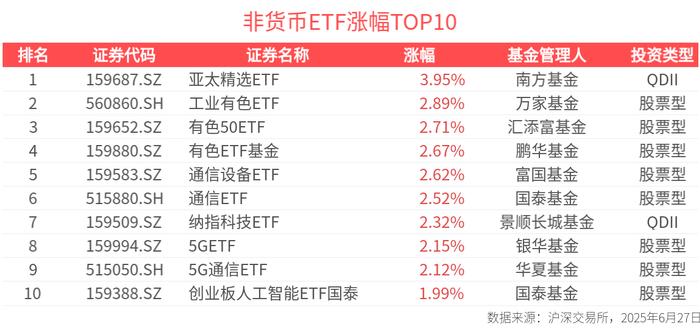
ETF英雄汇:亚太精选ETF(159687.SZ)领涨、标普消费ETF(159529.SZ)溢价明显-20250627
Xin Lang Cai Jing· 2025-06-27 10:12
Market Overview - As of June 27, 2025, A-shares showed mixed performance with the Shanghai Composite Index down by 0.70% at 3424.23 points, while the Shenzhen Component Index rose by 0.34% to 10378.55 points, and the ChiNext Index increased by 0.47% to 2124.34 points [1] - The total trading volume across both markets reached 1.54 trillion yuan, with northbound capital trading balanced for the day [1] Sector Performance - Industrial metals, other electronics, and communication equipment were the top gainers, with increases of 3.49%, 3.10%, and 2.56% respectively [1] - Conversely, rural commercial banks, large state-owned banks, and city commercial banks were the biggest losers, declining by 3.40%, 3.06%, and 2.90% respectively [1] ETF Performance - A total of 571 non-currency ETFs rose, accounting for 49% of the market [1] - The China Securities Communication Equipment Theme Index increased by 2.36%, while the Communication Equipment ETF rose by 2.62% [1] - The China Securities Industrial Nonferrous Metals Theme Index saw a rise of 2.22%, with the Industrial Nonferrous ETF increasing by 2.89% [1] Specific ETF Details - The Asia Pacific Select ETF (159687.SZ) has a latest share size of 325 million, closely tracking the FTSE Asia Pacific Low Carbon Select Index, which emphasizes low carbon companies [4] - The Industrial Nonferrous ETF (560860.SH) has a share size of 455 million and tracks the China Securities Industrial Nonferrous Metals Theme Index, with a current P/E ratio of 14.62, below the historical average [4] - The Nonferrous 50 ETF (159652.SZ) has a share size of 256 million and tracks the China Securities Sub-Industry Nonferrous Metals Theme Index, with a current P/E ratio of 17.83, also below the historical average [5] Declining ETFs - A total of 520 non-currency ETFs declined, representing 45% of the market [5] - The China Securities 800 Bank Index and the China Securities Bank Index were among the largest decliners, down by 2.95% and 2.94% respectively [5] Premium Rates - The S&P 500 Consumer Select Index had a premium rate of 25.79%, while the S&P 500 Index had a premium of 12.87% [8] - The top three ETFs by premium rate included the S&P Consumer ETF (25.79%), S&P 500 ETF (12.87%), and Saudi ETF (4.77%) [9]
【财经分析】多重变量交织下 锡价预计将震荡上行
Zhong Guo Jin Rong Xin Xi Wang· 2025-05-11 11:24
Group 1 - The core viewpoint of the articles highlights a significant increase in net profits for tin-listed companies due to rising tin prices driven by supply-demand changes, particularly from disruptions in key mining regions [1][3][4] - In Q1, major tin companies reported substantial revenue growth, with Tin Industry Co. achieving a revenue of 9.729 billion yuan, up 15.82%, and a net profit of 499 million yuan, up 53.08% [1] - Other companies like Huaxi Nonferrous and Xingye Silver also reported impressive growth, with Huaxi Nonferrous's revenue reaching 1.245 billion yuan, up 20.16%, and Xingye Silver's revenue at 1.149 billion yuan, up 50.37% [2][1] Group 2 - The supply-side challenges are deepening, with significant disruptions from the Bisie tin mine in the Democratic Republic of Congo and earthquakes in Myanmar, leading to an expanded supply-demand gap and pushing tin prices close to 300,000 yuan per ton [3][6] - Policy changes, such as Indonesia's adjustment of tin export tax rates, have further exacerbated supply concerns, increasing export costs and impacting domestic smelting operations [3] - Domestic smelting plants are facing raw material shortages, resulting in historically low processing fees and a slight decline in overall operating rates [3] Group 3 - On the demand side, structural upgrades are supporting long-term growth, with sectors like semiconductors, AI computing, and new energy driving increased tin demand [4] - The semiconductor industry's recovery is a key driver, with global sales expected to grow over 15% year-on-year in Q1 2025, significantly impacting tin consumption [4] - New energy vehicles and AI infrastructure are creating new demand growth areas, although high tin prices may lead to cautious purchasing behavior among downstream companies [5][4] Group 4 - The market is experiencing high volatility, with concerns over terminal demand due to tariff policies causing tin prices to drop to around 260,000 yuan per ton after a peak [6] - Predictions indicate that Q2 will be the tightest quarter for the global tin market, with ongoing supply challenges from key mining regions [6] - The interaction of macro policies, geopolitical factors, and industrial demand is critical, as the global tin market is at a pivotal point where any significant variable could lead to drastic price reactions [6]
镍周报:关注矿端与政策扰动风险,镍价震荡-20250428
Tong Guan Jin Yuan Qi Huo· 2025-04-28 09:44
Report Industry Investment Rating No relevant content found. Core Viewpoints of the Report - The macro - level shows that Trump signaled tariff adjustment, the Sino - US tariff dispute may ease, and the Fed may cut interest rates in June after getting more economic data. The market risk preference has cooled [5]. - Fundamentally, although Indonesia lowered the nickel ore domestic trade benchmark price in April (Phase II), the FOB price of Indonesian laterite nickel ore is still strong, and the price of Philippine nickel ore has risen significantly. Domestic nickel ore port inventories are at a low level. The inventory of 300 - series stainless steel shows signs of destocking but is still at a high level, suppressing the continuous decline of ferronickel prices. The nickel sulfate market is mediocre. After the nickel price stabilizes, the domestic - foreign price difference is corrected, and the export window re - opens, supporting high domestic production. Market transactions are dull, waiting for the implementation of Indonesian policies [5]. - In the later stage, there are disturbance risks in both policy and resource aspects. It is advisable to be cautious and wait and see in the short term. The new Indonesian tax regulations come into effect on Saturday, and the negotiated tax rate may differ from expectations. In the industry, as the auto sales enter the off - season, there is no incremental expectation in the power market, and the high stainless - steel inventory will continue to pressure the ferronickel price. Supply remains high with no recent disturbances, and there is no current supply - demand contradiction. However, with overseas nickel ore shortages, domestic nickel ore port inventories are at an absolute low, and the overseas shortage may gradually affect the domestic market. While being vigilant about policy disturbances, pay attention to the risks at the mine end [5][13]. Summary by Related Catalogs 1. Last Week's Market Important Data - SHFE nickel price on April 25, 2025, was 125,800 yuan/ton, up 1,660 yuan/ton from April 16 [6]. - LME nickel price on April 25, 2025, was 15,545 dollars/ton, down 138 dollars/ton from April 16 [6]. - LME inventory on April 25, 2025, was 203,850 tons, down 678 tons from April 16 [6]. - SHFE inventory on April 25, 2025, was 24,800 tons, down 520 tons from April 16 [6]. - Jinchuan nickel premium on April 25, 2025, was 2,150 yuan/ton, down 600 yuan/ton from April 16 [6]. - Russian nickel premium remained unchanged at 250 yuan/ton from April 16 to April 25 [6]. - The average price of high - nickel pig iron on April 25, 2025, was 990 yuan/nickel point, down 20 yuan/nickel point from April 16 [6]. - Stainless - steel inventory on April 25, 2025, was 926,000 tons, down 17,400 tons from April 16 [6]. 2. Market Review Nickel Ore - The FOB price of Philippine 1.5% laterite nickel ore rose from 49.25 dollars/wet ton to 51 dollars/wet ton, and the FOB price of Indonesian 1.5% laterite nickel ore rose from 36.25 dollars/wet ton to 38 dollars/wet ton (April 18). Although Indonesia recently lowered the April (Phase II) domestic trade benchmark price, the shortage situation continues, and the prices of both Indonesian and Philippine nickel ores have increased [7]. - Domestic nickel ore port inventories have reached a low level in recent years. Despite the continuous increase in domestic nickel ore arrivals this year, the demand for nickel ore is strong due to the record - high domestic refined nickel production [7]. Ferronickel - The average arrival - port duty - paid price of 10 - 12% high - nickel pig iron dropped from 987 yuan/nickel point to 973 yuan/nickel point. In March, China's ferronickel production was 25,400 metal tons, a month - on - month decrease of 2.25%. In March, the total domestic ferronickel imports were about 1.0133 million tons, a year - on - year increase of 60%, and the import scale exceeded one million tons for the first time. Indonesia's ferronickel production in April is expected to be 141,000 nickel tons, a year - on - year increase of 15.3% and a month - on - month decrease of 0.44%, with the production growth rate significantly slowing down [8]. - In April, the total production of China's 300 - series stainless steel was about 1.92 million tons, an increase of 26 tons compared with the same period last year. As of April 24, the domestic stainless - steel inventory was 579,600 tons, a month - on - month destocking of 15,900 tons. Overall, the inventory accumulation of stainless steel has slowed down, but the destocking trend is not obvious, and the inventory remains at a high level. Currently, domestic ferronickel still faces strong cost pressure and high import dependence, with the import scale reaching a new high. However, the current nickel ore supply in Indonesia is tight, and the growth of ferronickel production has significantly slowed down [8]. Nickel Sulfate - The price of battery - grade nickel sulfate rose from 28,050 yuan/ton to 28,080 yuan/ton, and the price of electroplating - grade nickel sulfate rose from 29,750 yuan/ton to 30,750 yuan/ton. In April, the expected production of nickel sulfate is about 27,900 tons, a month - on - month increase of 7.19%. In April, the production of ternary materials rebounded month - on - month, with a total of about 62,100 tons, a month - on - month increase of 7.22%. Overall, the new - energy power market performs mediocrely, the mainstream cathode is still lithium - iron phosphate, and the market share of ternary materials is continuously compressed. With the future entry of CATL's sodium - ion batteries into the market, the market share of ternary batteries may be further squeezed, and the long - term demand for nickel sulfate is expected to decline [9]. Macro - level - Trump signaled tariff negotiations and said that the tariff sanctions on China would be significantly reduced, but as of the report release, Sino - US tariff negotiations had not started. The US economic survey report shows that there is no obvious change in the US domestic economy, but it repeatedly emphasizes the uncertainty of the impact of tariff policies on the economy. Fed officials said that there are signs of cooling in the US labor market, and the Fed may start to cut interest rates in June after getting more data support. After the news was released, non - ferrous metals, crude oil, and gold rebounded significantly [5][9][10]. Fundamentals - Supply side: In April, domestic production capacity was stable, and production reached a new high. The expected production of refined nickel in April was 34,280 tons, an increase of about 2,120 tons from the previous month; the sample production capacity was 53,299 tons, the same as the previous period; the expected operating rate in April was 64.32%, an increase of about 0.12 percentage points from the previous month. In March, the domestic electrolytic nickel export scale was about 145,000 tons, a year - on - year increase of 93.53%. As of April 23, the export profit of Chinese nickel under the SMM caliber was 218.08 dollars/ton. Overall, although the month - on - month export of domestic electrolytic nickel has shrunk, the year - on - year increase is significant, and the absolute volume remains at a high level. With the stable nickel price, the domestic - foreign price difference is corrected, and the export window re - opens, which will still support high domestic electrolytic nickel supply [10]. - Consumption side: From April 1 - 20, the retail sales of new - energy passenger vehicles nationwide were 478,000 units, a year - on - year increase of 20% compared with the same period in April last year and a month - on - month decrease of 11%. The retail penetration rate was 53.3%. Since the beginning of this year, the cumulative retail sales have been 2.898 million units, a year - on - year increase of 33%. In early April, the growth rate of new - energy vehicle sales slowed down significantly, dragging down the annual consumption growth rate. According to the CPCA, the production - sales ratio of new - energy vehicles is at a low level, and the post - holiday rebound is weaker than in previous years. The weak demand momentum leads to a mismatch between vehicle manufacturers' production plans and sales expectations, and the inventory pressure on the whole vehicle remains. Short - term consumption may depend on the results of the auto show in the second half of the month. Currently, China and the EU have started negotiations on electric - vehicle prices, and a minimum - pricing plan will replace the tariff plan. However, regardless of the pricing result, the competitiveness of domestic brands in the European market will gradually weaken, and the external demand for exports is not optimistic. In the traditional field, as of April 20, the cumulative sales of commercial housing in 30 large and medium - sized cities were 285,600 units, a year - on - year decrease of 1.87%; the cumulative sales area was 29.6657 million square meters, a year - on - year increase of 4.16%. Overall, the domestic commodity sales have weakened again, and the year - on - year negative growth shows signs of expanding, indicating that the previous replacement demand may be coming to an end. With the lack of financial attributes, the rigid - demand consumption of housing is limited. However, there is still a window for the easing of Sino - US trade, and electrical appliance orders are expected to gradually recover in the near future, but the incremental expectation is limited, and it is difficult to change the bearish fundamentals [11]. Inventory - The current total social inventory of pure nickel in six locations is 44,661 tons, an increase of 701 tons from the previous period; the SHFE inventory is 24,800 tons, a month - on - month decrease of 520 tons; the LME nickel inventory is 203,850 tons, a month - on - month decrease of 678 tons; the total inventory of the world's two major exchanges is 228,650 tons, a month - on - month decrease of 1,198 tons [12]. 3. Industry Highlights - LG's withdrawal may delay Indonesia's goal of becoming an electric - vehicle battery center. The vice - chairman of the Indonesian Energy, Mineral, and Coal Suppliers Association said that LG's withdrawal from the "Titan Project" may delay Indonesia's goal of becoming a center for electric - vehicle (EV) batteries [14]. - The construction of Jinchuan's nickel - cobalt nickel smelter project has accelerated. In 2025, Jinchuan's nickel - cobalt nickel smelter launched a "key - project mode" focusing on technological innovation, equipment upgrading, and green transformation. The number of projects increased by 145% year - on - year, and the investment increased by 41.5% to comprehensively enhance core competitiveness [14]. - Hanrui Cobalt has postponed the commissioning of its nickel smelter in Indonesia to 2026. Nanjing Hanrui Cobalt Co., Ltd. has postponed the commissioning of its nickel - smelting project in Indonesia to March 31, 2026, citing delays in obtaining administrative permits at the project site and complex geological conditions [14]. - Zhefu Holdings' nickel sulfate production line has been put into operation. As of April 16, Zhefu Holdings stated on the investor interaction platform that its nickel sulfate production line has been put into operation, with a nickel equivalent production of about 6,400 tons in 2024. The refined cobalt sulfate and lithium carbonate projects have basically completed construction and are ready for commissioning [14].