
家电

Search documents
家电行业有望实现温和复苏,家电ETF(159996)盘中涨超1%,连续4日资金净流入超1.3亿元
Mei Ri Jing Ji Xin Wen· 2026-02-10 13:47
Group 1 - The home appliance industry is expected to achieve a mild recovery, with the home appliance ETF (159996) rising over 1% and experiencing a net inflow of over 130 million yuan for four consecutive days [1] - According to Zhong Chengxin International, since 2025, the overall operation of the home appliance industry has stabilized, although some segments are under pressure, with air conditioning and cleaning appliances showing notable performance while color TVs face challenges [1] - The industry structure is characterized by high concentration in black and white appliances, a gradient differentiation in kitchen appliances, and relative dispersion in small appliances, with stable competition but intensified competition due to the shift from export to domestic sales [1] Group 2 - The home appliance ETF (159996) tracks the home appliance index (930697), which selects listed companies engaged in the manufacturing and sales of home appliances from the Shanghai and Shenzhen markets, covering white goods, black goods, and kitchen small appliances [1] - The constituent stocks of the index typically have a high market share and brand influence, with an overall style leaning towards consumer-oriented investments, suitable for investors focusing on stable industry growth [1] - Looking ahead to 2026, the home appliance industry is anticipated to achieve a mild recovery driven by policy continuity and structural upgrades [1]
家用电器行业投资策略周报:索尼FY2025Q3季报梳理:06W2026周报-20260210
CAITONG SECURITIES· 2026-02-10 12:40
Core Insights - The report focuses on Sony's FY2025 Q3 earnings, highlighting a slight increase in sales and a significant 22% year-on-year growth in operating profit, driven by its gaming, music, and image sensor segments, all achieving record performance for the third quarter [4][8] - The gaming segment's profit growth is attributed to favorable exchange rates, strong performance in network services, and game software sales, with a strategic shift towards monetizing existing users and new game releases planned for future growth [4][9] - The music segment saw robust growth in sales and operating profit, primarily from streaming revenues, live performances, and popular works from SMG artists, with notable successes in global music charts [4][13] - The film segment experienced a decline in performance, prompting Sony to sign a groundbreaking global exclusive premiere agreement with Netflix to stabilize long-term revenue [4][18] - The electronics segment faced a decline in sales and operating profit, mainly due to weak performance in the Chinese market, but global demand for interchangeable lens cameras remains strong [4][20] - The image sensor segment achieved record sales and operating profit, benefiting from a recovery in the smartphone market and an increase in the proportion of high-end sensors [4][24] - Sony raised its full-year forecasts for FY2025, increasing sales, operating profit, and cash flow expectations, while also announcing a significant increase in its stock buyback program to enhance shareholder returns [4][26][27] Segment Summaries Gaming and Network Services (G&NS) - G&NS reported sales of 1,613.6 billion yen, a 4% year-on-year decline, but operating profit reached 140.8 billion yen, a 19% increase, driven by favorable exchange rates and growth in network services and first-party game software sales [9][10] - PlayStation's monthly active users reached 132 million, a 2% increase year-on-year, with record software revenue driven by major third-party IPs and new blockbuster games [9][10] Music Segment - The music segment achieved sales of 542.4 billion yen, a 13% year-on-year increase, with operating profit of 106.4 billion yen, a 9% increase, driven by growth in streaming revenues and successful releases from SMG artists [13][14] - Notable successes included Rosalía's album topping global charts and multiple Grammy nominations for SMG artists [13] Film Segment - The film segment reported sales of 353.3 billion yen, an 11% year-on-year decline, with operating profit of approximately 30.9 billion yen, a 9% decrease, primarily due to high comparative figures from the previous year [18][19] - A new agreement with Netflix aims to provide a stable revenue base for future film releases [18] Electronics Segment - The electronics segment saw sales and operating profit decline, with significant pressure from the Chinese market, but strong global demand for interchangeable lens cameras was noted [20][22] - A joint venture with TCL aims to enhance competitiveness in the home entertainment sector [22] Image and Sensor Solutions (I&SS) - I&SS achieved sales of 604.3 billion yen, a 21% year-on-year increase, with operating profit of 132 billion yen, a 35% increase, driven by mobile image sensor sales and higher unit prices [24][25] Full-Year Outlook - Sony raised its FY2025 sales forecast to approximately 12.3 trillion yen, an increase of 3%, and operating profit to 1.54 trillion yen, an 8% increase [26][27]

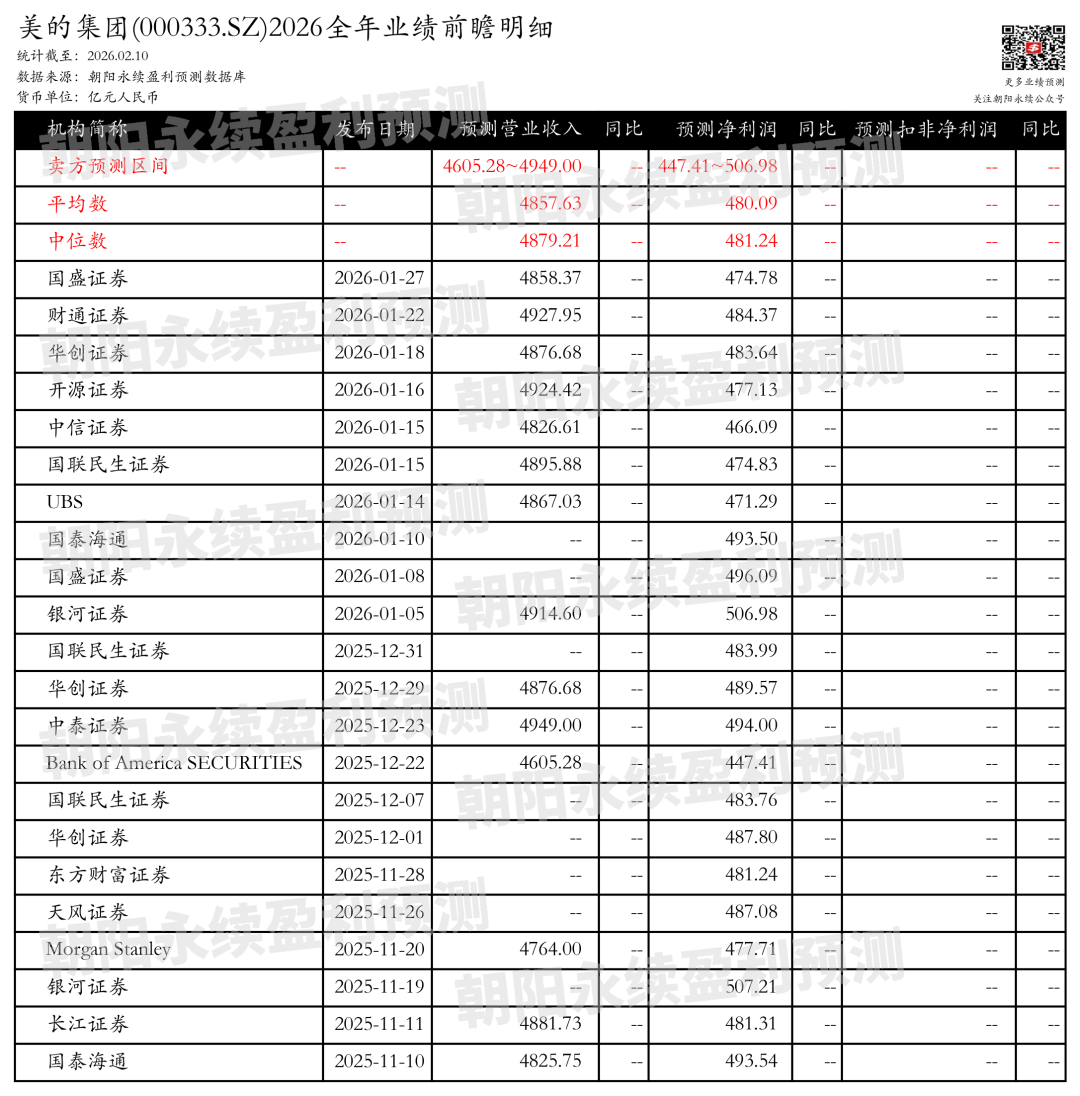
美的集团:工业机器人市场集中度高,预测全年营业收入4605.28~4949.00亿元
Xin Lang Cai Jing· 2026-02-10 12:40
Group 1 - The core expectation for Midea Group's annual performance includes a forecasted revenue range of 460.53 to 494.90 billion yuan and a net profit forecast of 44.74 to 50.70 billion yuan [1][7] - The average revenue forecast from various institutions is approximately 485.76 billion yuan, with a median of 487.92 billion yuan, while the average net profit forecast is around 48.01 billion yuan [2][8] - The company is expected to disclose its financial data soon, which will be crucial for assessing whether it can exceed these forecasts [1][7] Group 2 - Midea Group has successfully acquired KUKA, establishing a comprehensive industrial robotics business and creating an automated industry system that integrates self-research, international mergers, and ecological collaboration [3][9] - KUKA is recognized as a leading global provider of intelligent automation solutions, with its product system centered on industrial robots, serving multiple industries including new energy vehicles, batteries, e-commerce, and healthcare [4][10] - Midea Group's robotics business ranks third globally, holding an 8.9% market share, and is second in sales and revenue within the heavy-duty industrial robotics segment [5][9] Group 3 - The company focuses on research and innovation, gradually achieving self-research and production of components, while expanding its business in China and optimizing its customer structure [6][10] - Midea Group has transformed from a home appliance manufacturer to a global technology group since its establishment in 1968, with diversified operations in smart home and industrial solutions [6][10] - The company emphasizes shareholder returns, increasing its dividend payout ratio and implementing buyback plans to bind its core team and reward shareholders [6][10]


深圳今年如何“花钱”?财政将支持实施提振消费专项行动
Nan Fang Du Shi Bao· 2026-02-10 12:00
Core Insights - Shenzhen's budget report for 2025 and draft for 2026 highlights a strong financial position with a general public budget revenue of 11,302 billion yuan in 2025, marking five consecutive years above 10,000 billion yuan [1] - The report emphasizes a focus on enhancing public welfare and economic development through strategic fiscal policies and spending [6] Revenue Structure - Shenzhen's local revenue reached 4,163.8 billion yuan in 2025, reflecting a growth of 6.4%, with tax revenue contributing 3,510.6 billion yuan, a 7.5% increase, and non-tax revenue at 653.1 billion yuan, growing by 0.6% [1] - Tax revenue accounts for 84.3% of the local revenue, positioning Shenzhen's revenue structure among the best in the country [1] Expenditure Overview - The total general public budget expenditure for 2025 is set at 4,502.5 billion yuan, with nine categories of public welfare spending amounting to 3,048.8 billion yuan, representing 67.7% of total fiscal expenditure [3] - Key areas of spending include education, healthcare, and social welfare, with initiatives for free preschool education and enhanced healthcare funding [3][6] Debt Management - Shenzhen's local government debt limit for 2025 is set at 1,063 billion yuan, with all issued bonds comprising 68 billion yuan in general bonds and 995 billion yuan in special bonds [4] - The focus on special bonds aims to support infrastructure, social welfare, and investment expansion [4] Future Fiscal Policies - For 2026, Shenzhen plans to maintain a proactive fiscal policy, with public welfare spending expected to remain around 65% of total fiscal expenditure [6] - The city aims to stimulate consumption through fiscal subsidies and support for various sectors, including automotive and electronics [8] - There is a commitment to fostering a modern industrial system and enhancing the business environment for private enterprises [8]

开源量化评论(119):优选金股30组合的年度回顾及最新持仓
KAIYUAN SECURITIES· 2026-02-10 11:42
- Model Name: 优选金股 30 组合 - Model Construction Idea: The 优选金股 30 组合 aims to track the latest market trends and dynamically capture high-elasticity stocks by relying on analysts' new recommendations[3][4] - Model Construction Process: 1. Divide all gold stocks into new and repeated gold stocks based on whether they are newly recommended or repeated from the previous month[4] 2. Select the top 30 stocks with the highest performance expectations among the new gold stocks each month[20] 3. Weight the selected stocks based on the number of recommendations by analysts[20] - Model Evaluation: The model has consistently outperformed the 中证 500 index for nine consecutive years, with an annualized return of 23.1% and an annualized excess return of 21% since 2017[2][12] - Model Backtest Results: - 2017: 优选金股 30 return 33.5%, 中证 500 return 0.6%, excess return 32.9%[15] - 2018: 优选金股 30 return -13.0%, 中证 500 return -33.3%, excess return 20.3%[15] - 2019: 优选金股 30 return 53.3%, 中证 500 return 27.1%, excess return 26.2%[15] - 2020: 优选金股 30 return 87.6%, 中证 500 return 20.5%, excess return 67.1%[15] - 2021: 优选金股 30 return 28.7%, 中证 500 return 15.5%, excess return 13.2%[18] - 2022: 优选金股 30 return -19.8%, 中证 500 return -20.7%, excess return 0.8%[18] - 2023: 优选金股 30 return 11.2%, 中证 500 return -7.3%, excess return 18.5%[18] - 2024: 优选金股 30 return 15.4%, 中证 500 return 5.3%, excess return 10.1%[18] - 2025: 优选金股 30 return 52.3%, 中证 500 return 30.4%, excess return 21.9%[18] - Factor Name: 业绩超预期指标 (SUE) - Factor Construction Idea: The SUE factor measures the degree to which a company's actual financial performance exceeds analysts' expectations, which is generally associated with better stock returns[26][27] - Factor Construction Process: 1. Convert cumulative analyst forecast data into single-quarter values[27] 2. Compare single-quarter forecast values with actual values using the formula: $$S U E={\frac{R_{t}-E_{t}}{\sigma(R_{t}-E_{t})}}$$ where $R_{t}$ is the actual value, $E_{t}$ is the forecast value, and $\sigma(R_{t}-E_{t})$ is the standard deviation of the difference between actual and forecast values[26] 3. Integrate earnings forecasts, earnings bulletins, and periodic reports, and forward-fill factor values during financial report vacuum periods[27] - Factor Evaluation: The SUE factor shows strong selection effects in new gold stocks, indicating that stocks with higher performance expectations tend to perform better[27] - Factor Backtest Results: - New Gold Stocks: Annualized return 13.6%, annualized volatility 24.7%, return-volatility ratio 0.55, maximum drawdown 38.5%[26] - Repeated Gold Stocks: Annualized return 8.4%, annualized volatility 23.9%, return-volatility ratio 0.35, maximum drawdown 45.0%[26]
场景化成消费核心导向 京东家电家居“巅峰24小时”IP联合品牌高管共探增长新机遇
Sou Hu Wang· 2026-02-10 10:24
Core Insights - The integration of AI technology into daily life is shifting consumer expectations of "home" from mere functional spaces to emotional and healing "lifestyle solution spaces" [1] - The competition logic in the home appliance and furniture industry is evolving from a focus on product performance to a comprehensive competition involving experiential scenarios, emotional connections, and holistic service capabilities [1] Group 1: Consumer Trends - The core trend in home consumption is evolving towards creating "meta scenarios," where the demand for "rituals" shifts from social display to self-care, making "home" a sanctuary for emotional connections [2] - Brands are increasingly collaborating to align with this trend, as seen in Midea's thematic participation in the "Peak 24 Hours" event, which aimed to elevate the product experience into a healing space [2] - The personalization of smart appliances is emerging as a new consumer trend, with brands like Casarte and AUX creating products tailored to specific family scenarios [2] Group 2: Service and Marketing Innovations - Service capability is becoming a new competitive advantage for brands, with companies like Hisense and TCL focusing on integrating consumer needs with technology [3] - Marketing strategies have shifted from traditional advertising to interactive, emotional, and scenario-based communication, exemplified by JD and TCL's "Champion China Tour" event [3] - The collaboration between JD and brands like Lin's Home focuses on creating immersive experiences that blend online and offline interactions, enhancing brand effectiveness [3] Group 3: Future Industry Outlook - Industry leaders agree that the home appliance and furniture sector will evolve towards greater intelligence, personalization, and a focus on holistic value [4] - The future of manufacturing is centered on creating better consumer experiences, as emphasized by Hisense's commitment to enhancing life quality [4] - JD's "Peak 24 Hours" IP is redefining the concept of "home" as a comprehensive carrier of emotions, life renewal, and self-realization, positioning itself as an enabler and co-builder in the industry [4]

北京市家电数码“以旧换新”补贴升级
Sou Hu Cai Jing· 2026-02-10 08:50
Core Viewpoint - The implementation of the "Beijing 2026 Home Appliance Trade-in and Digital Product Purchase Subsidy Implementation Details" aims to enhance the precision and efficiency of subsidy fund allocation, reflecting a shift from "heavy investment" to "performance-oriented" governance in fiscal fund usage [2][4][6]. Group 1: Subsidy Details - The subsidy applies to six categories of home appliances and four categories of digital and smart products, with a subsidy rate of 15% of the final sales price after discounts, capped at 1,500 yuan for home appliances and 500 yuan for digital products [3][4]. - Consumers must complete real-name authentication via the "Jing Tong" mobile app to claim subsidies, with specific limits on the number of qualifications that can be claimed and their validity periods [3][4]. Group 2: Policy Implementation and Management - The policy emphasizes a structured approach to subsidy qualification, requiring consistency among the applicant, payer, and recipient, and mandates that products must be unsealed and activated for verification [4][6]. - The new policy framework aims to prevent misuse of qualifications and ensure that subsidy funds reach genuine consumers, addressing previous issues of fund wastage and regulatory challenges [4][6]. Group 3: Broader Policy Context - The "Two New" policy has entered a quality enhancement phase, with local governments accelerating the implementation of related measures since its announcement [5][6]. - The central and local governments are collaborating to ensure the effective rollout of the policy, aligning with national goals to expand domestic demand and upgrade consumption [5][6].

换新车、购新机,山东春节补贴加码,以旧换新最高补2万元
Qi Lu Wan Bao· 2026-02-10 06:12
Core Viewpoint - The Shandong provincial government is implementing a consumption promotion policy during the 2026 Spring Festival, focusing on trade-in programs for various consumer goods to stimulate the market and benefit residents [1][3]. Group 1: Policy Overview - The 2026 policy emphasizes "precise coverage, standard optimization, and simplified processes," targeting three main categories: automobiles, home appliances, and digital/intelligent products [3]. - The trade-in program includes subsidies for scrapping and replacing old cars, exchanging home appliances (covering six types including refrigerators), and purchasing new digital and intelligent products, with smart glasses being newly included [3]. Group 2: Subsidy Standards - For scrapping old vehicles to purchase new energy passenger cars, the subsidy is 12% of the vehicle price, with a maximum of 20,000 yuan; for replacing vehicles, the subsidy is 8% of the sales price, capped at 15,000 yuan [3]. - Purchasing first-level energy-efficient home appliances will receive a 15% subsidy based on the sales price, with a maximum of 1,500 yuan per item [3]. - Digital and intelligent products priced under 6,000 yuan will receive a 15% subsidy, with a maximum of 500 yuan per item [3]. Group 3: Application Process and Supply Assurance - Consumers can apply for qualifications and subsidies through the "Love Shandong" government service platform or through provincial and municipal cooperation platforms [3]. - To ensure supply during the Spring Festival, the province will implement "no closure during the Spring Festival" and "unlimited supply," with cities increasing investments in offline retail to ensure sufficient trade-in qualifications for home appliances and digital products [3]. - Consumers purchasing new cars and obtaining invoices will qualify for the corresponding subsidies, while enterprises are encouraged to create smart terminal experience zones and offer additional discounts to in-store experience consumers [3].
TCL电子午前涨超5%发盈喜及索尼合作催化股价 全球化战略持续深化
Xin Lang Cai Jing· 2026-02-10 05:21
Core Viewpoint - TCL Electronics has shown significant growth in its stock price and is expected to report a substantial increase in adjusted net profit for the year, exceeding market expectations. The company has also entered a strategic partnership with Sony to establish a joint venture, enhancing its market position in the high-end segment [1]. Group 1: Financial Performance - TCL Electronics' stock price increased by over 5%, reaching 12.92 HKD, with a year-to-date gain of nearly 24% [1]. - The company anticipates an adjusted net profit of approximately 23.3 billion to 25.7 billion HKD for the year, representing a year-on-year growth of 45% to 60%, significantly surpassing market expectations [1]. Group 2: Strategic Partnerships - TCL has reached a strategic cooperation intention with Sony to establish a joint venture that will handle Sony's home entertainment, technology, and service businesses, covering the entire process of development, manufacturing, sales, and customer service for products like televisions and home audio systems [1]. Group 3: Market Position and Growth - According to Changjiang Securities, TCL's global market share has rapidly increased, with its television global shipment market share rising from 10.7% in 2020 to 14.5% in the first three quarters of 2025, maintaining a position among the top three globally in terms of shipment volume [1]. - The joint venture with Sony is expected to help TCL leverage the "Sony" and "BRAVIA" brand combinations to penetrate the global high-end market, thereby enhancing its brand value and pricing power [1]. - TCL can utilize Sony's established global high-end channels and consumer recognition to improve its brand image in key markets such as Europe and North America [1].
港股异动 | TCL电子(01070)午前涨超5% 盈喜及索尼合作催化股价 全球化战略持续深化
智通财经网· 2026-02-10 04:01
Core Viewpoint - TCL Electronics has shown significant stock performance, with a year-to-date increase of nearly 24%, and a recent rise of 5.12% to HKD 12.93, driven by strong earnings forecasts and strategic partnerships [1] Financial Performance - TCL Electronics has projected an adjusted net profit for the year between HKD 23.3 billion and HKD 25.7 billion, representing a year-on-year growth of 45% to 60%, significantly exceeding market expectations [1] Strategic Partnerships - The company has reached a strategic cooperation intention with Sony to establish a joint venture that will handle Sony's home entertainment, technology, and service businesses, covering the entire process of development, manufacturing, sales, and customer service for products like televisions and home audio systems [1] Market Position - According to Longjiang Securities, TCL's global market share has rapidly increased, with its global TV shipment market share rising from 10.7% in 2020 to 14.5% in the first three quarters of 2025, maintaining a position among the top three globally in terms of shipment volume [1] Brand Enhancement - Through the joint venture, TCL is expected to leverage the "Sony" and "BRAVIA" brand combinations to penetrate the global high-end market, aiming to reshape its brand value and pricing power [1] Market Strategy - TCL can utilize Sony's established global high-end channels and consumer recognition to enhance its brand image in key markets such as Europe and North America [1]